A Detailed Review of "The Essential Oils" by Ernest Guenther: The Perfumer’s Bible
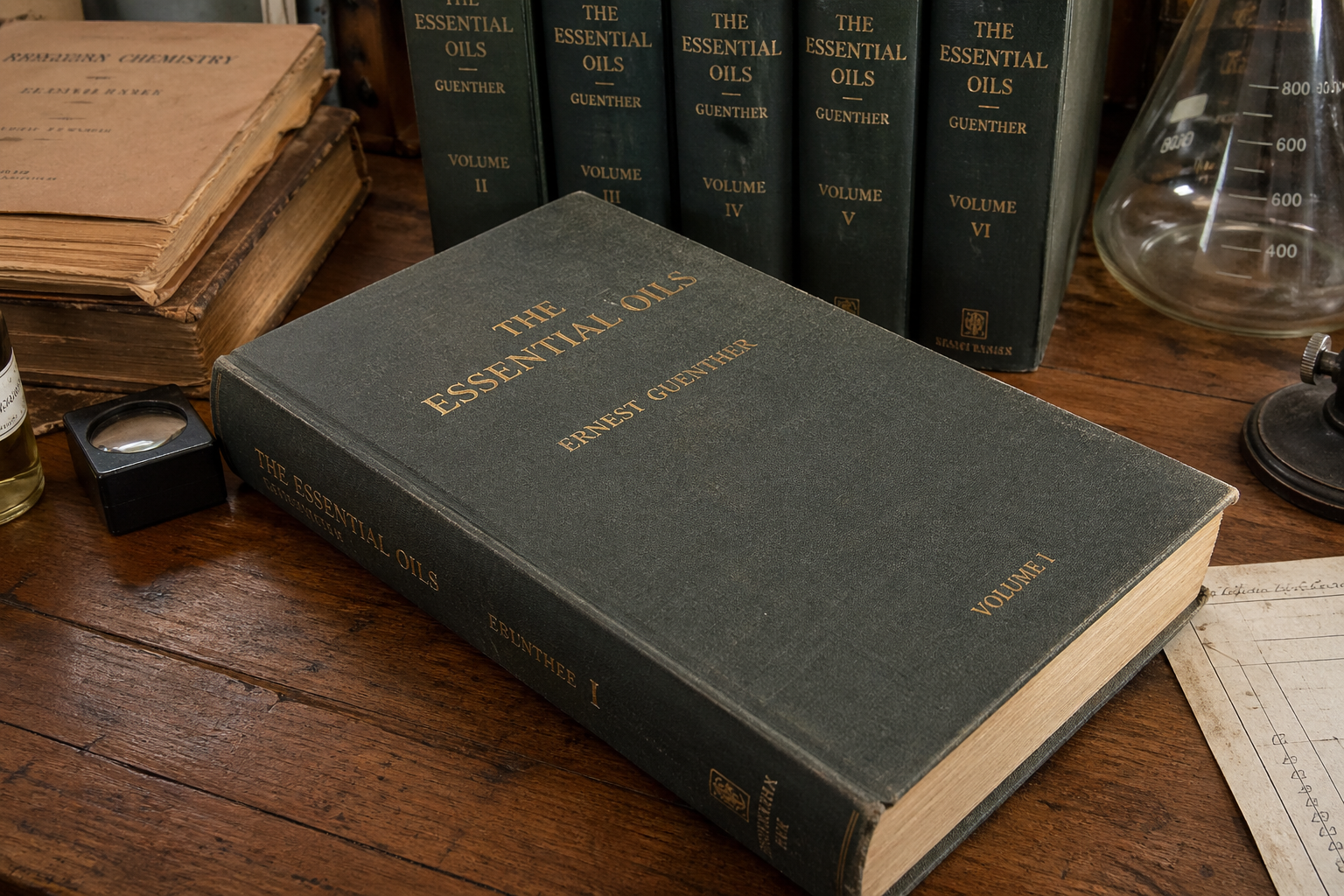
The Essential Oils by Ernest Guenther is one of a dozen books the Society of Flavor Chemists recommends that every certified flavorist should use.
For anyone serious about aromatherapy, perfumery, or industrial chemistry, the name Ernest Guenther is synonymous with authority. His magnum opus, The Essential Oils, is not merely a book; it is a historic monument in the scientific literature of volatile oils. Often compared to Gibbon’s Decline and Fall for its sheer scale, this six-volume set represents a "maximum opus" that bridged the gap between ancient extraction methods and modern chemical analysis.
Having traversed the collections of archives like the NSTL and the Princeton University Library, this review synthesizes why this series remains the gold standard, decades after its initial publication by D. Van Nostrand Co. in the mid-20th century.
Overview and Historical Context
Dr. Ernest Guenther (1895–), a vice-president of Fritzsche Brothers, Inc., was not a desk-bound academic. As detailed by the Society of Cosmetic Chemists, Guenther traveled to remote corners of the world—from the ylang-ylang fields of the Madagascar islet of Nossi-Be to the pine forests of the American South—to document production firsthand.
Published between 1948 and 1952, this work arrived at a pivotal moment. World War II had disrupted traditional supply routes (specifically from Grasse, France), and Guenther’s work helped establish a self-sufficient essential oil industry in the Western Hemisphere. The book captures this transition: it documents the "romantic past" of galleons and buccaneers while introducing the rationalized production techniques of the modern era.
The Structure of the Work
The series is meticulously organized across six volumes, making it easy to navigate for specific research:
- Volume 1: History, Origin in Plants, Production, Analysis. This lays the groundwork, including a fascinating history by George Urdang on the evolution of distillation from ancient Persia to medieval Europe.
- Volume 2: Constituents of Essential Oils. Dive deep into the terpenes, sesquiterpenes, and chemistry.
- Volumes 3–6: Individual Essential Oils of the Plant Families. These volumes cover everything from Gramineae to Rosaceae, providing monographs on specific oils like Thuja plicata, hops, and sandalwood.
Why This Book Stands Out (Key Strengths)
1. The Combination of Field Work and Lab Science
Most textbooks rely on second-hand data. Guenther’s work is unique because he personally supervised production at the Fritzsche factory in Seillans, France. He details non-distillation methods (like enfleurage and solvent extraction) alongside steam distillation. The discussions on the production of concretes and resinoids provide technical data you simply cannot find on modern blogs, including specific yields and temperature controls.
2. Depth of Chemical Analysis
While Volume 1 is approachable for beginners, Volume 2 and the later monographs are surprisingly deep. For the organic chemist, Guenther includes structural formulas proposed and revised for complex compounds like cedrene and zingiberene.
A specific highlight is the analytical methodology for detecting adulteration. In an era before mass spectrometers were ubiquitous, Guenther detailed the "thiosulphate factor" for ascaridole determination and the halogen test for synthetic benzaldehyde. As noted in a Nature review, this attention to analytical chemistry makes the book invaluable for quality control.
3. The "Why" Behind the Oils
Guenther doesn't just tell you how to distill; he explores why plants produce oils. He collaborates with bio-organic chemists like Dr. Haagen-Smit to discuss the plant physiology and the chain-systems of synthesis. One reviewer humorously noted that while the book explains almost everything, it leaves the theological question of "why God created them" slightly open—a testament to the exhaustive detail provided elsewhere.
SEO-Friendly "Pros" and "Cons"
Pros:
- Authoritative Source: Cited by peer-reviewed journals like Nature and Analytical Chemistry .
- Comprehensive Scope: Covers history, botany, distillation (binary diagrams, pressure differentials), chemistry, and global commerce.
- Practical Data: Includes tables for boiling points of isolates at reduced pressure and conversion charts.
- Legacy Content: Endorsed by Fritzsche Brothers and Krieger Publishing, ensuring accuracy.
Cons:
- Dated Material: Published in 1952. Modern analytical techniques (like GC-MS) have evolved, though the foundational chemistry remains sound.
- Density of Text: This is not a casual coffee-table book. It is technical prose, described as having "Roman majesty." Expect over a million words.
- Availability: Out of print in its original run. You are likely looking at reprints from Jepson Press or Krieger Publishing Company.
Final Verdict (Target: Perfumers, Chemists, Historians)
If you are looking for a "cure for anxiety" essential oil blend, this is not the book for you. If you are a perfumer, flavorist, botanist, or industrial chemist wanting to understand the true history and science of oils like sandalwood (Mysore) or copaiba (Brazil), this is essential reading.
Ernest Guenther erected a monument "more enduring than bronze." The data may be old, but the wisdom and methodology contained in The Essential Oils are timeless. It is a worthy addition to any serious academic library or industry professional’s reference collection.
Rating: ★★★★★ (5/5 - For the Professional/Researcher)
###