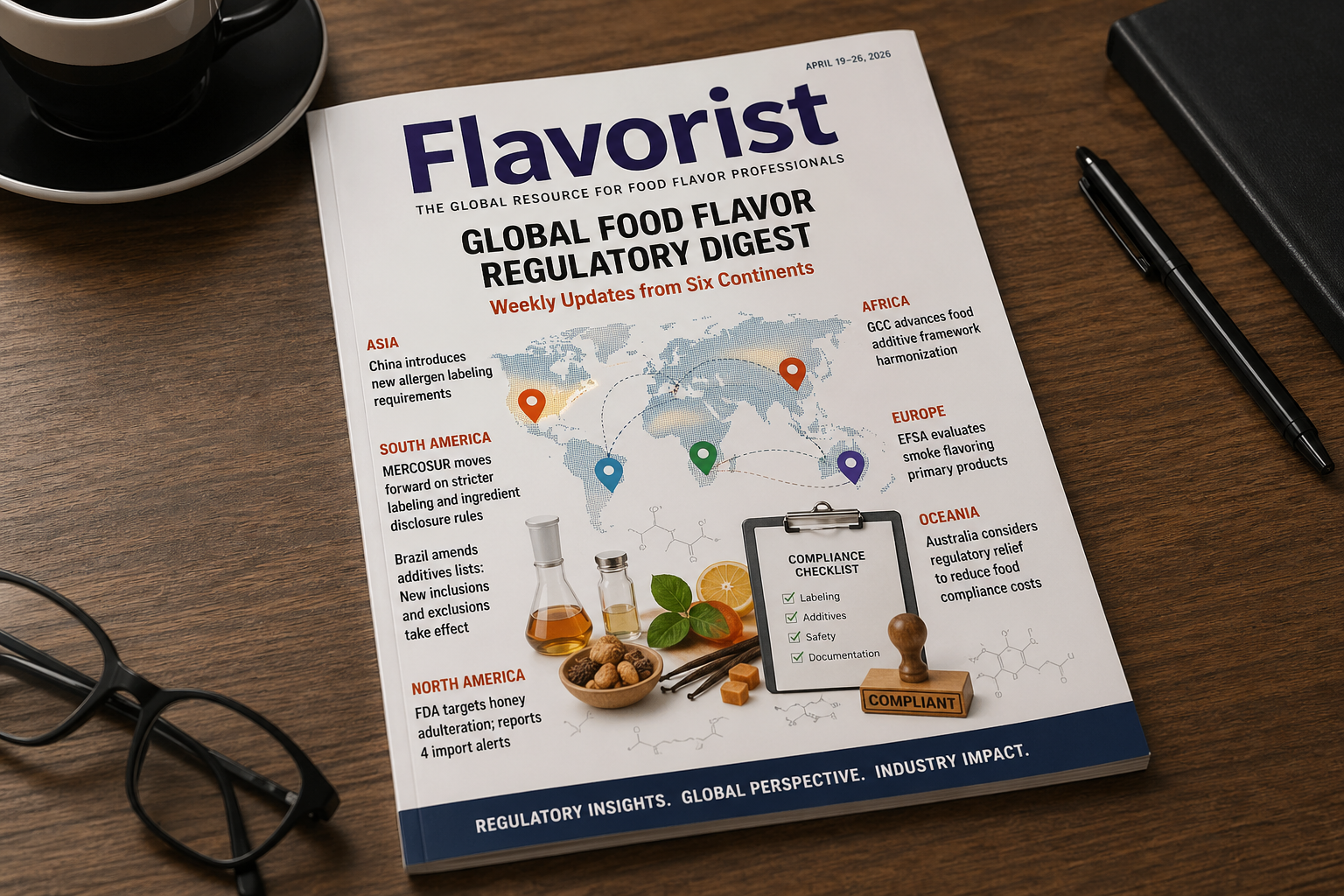
Global Food & Flavor Industry Regulatory Digest: Weekly Updates from North America, South America, Asia, Africa, Europe, and Oceania (April 19–26, 2026)
North America
🇲🇽 Mexico: Major Amendment to the General Health Law
A broad amendment to Mexico's General Health Law (GHL), published on January 15, 2026, is now a key part of the current legal landscape. This reform formally incorporates "digital health" into the framework, covering telehealth, mobile health, and electronic records. For the food and beverage industry, this signifies a continued evolution in Mexico's regulatory approach following years of administrative changes and significant litigation against the health regulator COFEPRIS.
- Relevant Keyword: Mexico General Health Law Amendment
🇺🇸 U.S. Federal: Industry Pushback on GRAS "Loophole" Fix
The food and dietary supplement industry is actively pushing back against a proposal from the Trump administration and HHS Secretary Robert F. Kennedy Jr. that would eliminate the "Generally Recognized as Safe" (GRAS) pathway. This system currently allows companies to self-affirm the safety of new ingredients without mandatory FDA pre-market review. Industry groups argue the change would exceed the FDA's legal authority and create market chaos, while consumer advocates support closing what they call a safety "loophole".
- Relevant Keyword: FDA GRAS notification proposal
🇺🇸 U.S. State: Texas Food Labeling Law Lawsuit Update
On December 5, 2025, a coalition of food and beverage manufacturers filed a lawsuit challenging a new Texas law that requires warning labels on products containing 44 specific artificial colors, chemicals, and additives. The industry argues the state law is preempted by federal FDA labeling requirements, violates the First Amendment, and is unconstitutionally vague. The law is currently set to apply to products manufactured on or after January 1, 2027.
- Relevant Keyword: Texas food warning label lawsuit
🇲🇽 Mexico: COFEPRIS Regulatory Backlog and Communication
New guidance on Mexico's life sciences landscape notes that the COFEPRIS administration in 2025-2026 has reinstated communication with the regulated industry to tackle a severe administrative backlog. While a significant number of pending applications have been resolved, resolution times for some products remain uncertain. A new administration under Dr. Victor Hugo Borja took over in Here is a summary of the key legal and regulatory news for the food and flavor industry in South America from the past week (approximately April 19–26, 2026).
- Relevant Keyword: Mexico COFEPRIS regulatory backlog
South America
Here is a summary of the key legal and regulatory news for the food and flavor industry in South America from the past week (approximately April 19–26, 2026), based on available information.
🇧🇷 Brazil
1. Anvisa Updates Technical Standards for Food Additives
Brazil's National Health Surveillance Agency (Anvisa) published Normative Instruction No. 432/2026, updating the list of permitted food additives and their usage conditions. Key changes include the removal of potassium tartrates from liquid sweeteners and tocopherols from soy-based beverages, alongside new authorizations for lecithin in UHT dairy drinks and glycolipids as preservatives in juices and alcoholic beverages .
- Relevant Keyword: Brazil Anvisa additives update 2026
2. Bill Proposes Ban on Fake Images on Food Labels
A new bill (PL 956/2026) in Brazil aims to prohibit the use of images or illustrations of ingredients that are not actually present in a food product's composition. For the flavor industry, it states that the presence of synthetic flavors does not authorize the use of the original ingredient's image. If approved, violating products would be considered misleading advertising .
- Relevant Keyword: Brazil fake food images bill
3. Bill Requires Specific Identification of Artificial Flavors
Another legislative proposal (PL 852/2026) is advancing to require food labels to specifically identify artificial flavoring additives by their INS number or chemical name, rather than just the generic term "artificial flavor." The bill also establishes a graduated penalty system for labeling infractions, with fines up to R$5 million .
- Relevant Keyword: Brazil artificial flavor labeling bill
🇨🇴 Colombia
4. INVIMA Issues Health Alert for Fraudulent "Organic Green Coffee"
Colombia's food and drug watchdog INVIMA issued a health alert on April 15, 2026, regarding a product called "Organic Green Coffee." The product is being sold with false sanitary registrations and is promoted with unapproved health claims (e.g., lowering cholesterol). The agency has classified its sale as a public health risk .
- Relevant Keyword: Colombia INVIMA coffee fraud alert
5. INVIMA Warns Against Three Cheese Brands with Expired Registrations
INVIMA issued a sanitary alert (No. 89-2026) against three cheese brands—Lácteos Los Ñatos, Lácteos Reyes / Prolácteos del Puerto, and Don Juan - El Tebol—for being sold with expired sanitary registrations. These products are now considered "fraudulent" under Colombian law, and the agency has ordered their immediate removal from the market .
- Relevant Keyword: Colombia expired cheese registration INVIMA
🔍 Summary for Other South American Countries
The search did not find specific new regulatory announcements from Argentina's ANMAT or Chile's Ministry of Health in the last 7 days. The most recent news from ANMAT refers to product prohibitions from late 2025, while a major Chilean proposal to regulate ultra-processed food labeling was approved by a Senate committee in January 2026 .
Asia
🇮🇩 Indonesia: Mandatory "Nutri Level" Front-of-Pack Labeling
Indonesia's Ministry of Health has issued a regulation requiring the "Nutri Level" front-of-pack nutrition label on ready-to-consume foods and drinks, particularly sweetened beverages. The regulation was published on April 14, 2026. The system uses four color-coded categories (A in green to D in red) indicating levels of sugar, salt, and fat. Large-scale businesses must display the label on packaging, advertisements, and menus, though micro and small enterprises are exempt in the initial phase.
- Relevant Keyword: Indonesia Nutri Level labeling rule
🇨🇳 China: Hosts 56th Codex Committee on Food Additives (CCFA) Meeting
The 56th session of the Codex Committee on Food Additives (CCFA) was held in Chongqing, China, from April 13–17, 2026—within the relevant timeframe for this update. Over 50 countries participated in discussions on the General Standard for Food Additives (GSFA), the International Numbering System (INS) for food additives, and priority lists for additive evaluation. Notably, China introduced a proposal to revise working procedures for GSFA food additive provisions related to product standards, based on China's experience with Quick Frozen Dumplings and Yeast Standards.
- Relevant Keyword: 56th CCFA meeting Chongqing
🇯🇵 Japan: Food Labeling Standards Amended (Cashew Nuts Added as Allergen)
Japan's Cabinet Office Ordinance No. 34 of 2026, effective April 1, 2026, amends the Food Labeling Standards. The key change is the reclassification of cashew nuts from "foods equivalent to specified raw materials" to "specified raw materials" (major allergens). Transition periods apply: processed foods manufactured, processed, or imported by March 31, 2028, may follow previous labeling rules. Additional changes include revisions or deletions of individual labeling rules for over 20 product categories, including tomato processed foods, pickled vegetables, dried noodles, ham, sausages, dressings, vinegar, and fruit beverages.
- Relevant Keyword: Japan food labeling amendment cashew allergen
🇰🇷 South Korea: Draft Amendment to Imported Food Safety Act Enforcement Rules
On April 21, 2026, South Korea's Ministry of Food and Drug Safety (MFDS) issued a draft amendment to the Enforcement Rules of the Imported Food Safety Management Special Act (WTO/SPS Notification G/SPS/N/KOR/845). The key change introduces risk-based re-inspection for non-compliant imported foods—laboratory testing frequency will be set flexibly (up to 20 times) based on risk level, replacing the previous uniform frequency. The amendment also simplifies hygiene training requirements and modifies registration procedures for excellent importers.
- Relevant Keyword: South Korea imported food safety amendment
🇭🇰 Hong Kong: Prepackaged Konjac Jelly Labeling Rules Now in Effect
As of April 1, 2026, Hong Kong's amended Food and Drugs (Composition and Labelling) Regulation is fully in effect. Mini-cup konjac jelly products measuring 45mm or less in height or width are banned from sale. Other prepackaged konjac jellies must carry a warning label in both Chinese and English ("Caution: Do not swallow whole. Elderly and children must consume under supervision.") on the most outer layer of the sales package, printed with high contrast and underlining. Violations carry a maximum fine of HK$50,000 and six months' imprisonment.
- Relevant Keyword: Hong Kong konjac jelly labeling ban
🇮🇳 India: FSSAI Enforcement Actions
Food safety enforcement remains active. On April 23, 2026, a joint task force including FSSAI's Northern Regional Office raided an illegal distribution hub in Delhi's Najafgarh. Officials seized approximately 45 kg of expired gainers and whey protein, with another 85 kg of protein and creatine products under scrutiny for safety checks. The unit was operating without a valid food license under the Food Safety and Standards Act, 2006. Additionally, on April 26, 2026, FSSAI's UP unit closed an illegal momos and chutney unit in Kanpur, destroying 20 kg of unwholesome momos and 20 litres of artificially colored chutney.
- Relevant Keyword: India FSSAI protein supplement seizure
- Relevant Keyword: Kanpur momos chutney food safety raid
🌏 Regional: ASEAN-Canada Food Safety Cooperation
Indonesia's Quarantine Agency (Barantin) and Canada are strengthening ASEAN food safety systems through the CanSafe Project, a laboratory capacity-building initiative. A Food Safety Laboratory Management Workshop ran through April 23, 2026, involving the Canadian Food Inspection Agency and ASEAN member states. The initiative focuses on standardized testing systems to address food contamination and antimicrobial resistance, operating under the ASEAN-Canada Comprehensive Economic Partnership Agreement (CEPA) on Sanitary and Phytosanitary (SPS) measures.
- Relevant Keyword: ASEAN Canada food safety CanSafe project
🔍 Note on Other Asian Countries
The search did not find specific new regulatory announcements from Singapore (beyond the previously implemented Nutri-Grade system referenced in Indonesia's announcement), Thailand, Vietnam, or Malaysia within the April 20–26, 2026 timeframe.
Africa
Here is a summary of the key legal and regulatory news for the food and flavor industry in Africa from the past week (approximately April 19–26, 2026).
🌍 Multi-Country (East Africa)
1. East African Community Draft Standard for Mayonnaise
The Kenya Bureau of Standards (KEBS) , on behalf of the East African Community, has notified a new draft standard for mayonnaise (DEAS 1320:2026). The document specifies requirements for full-fat, low-fat, and light mayonnaise. This directly impacts the flavor industry as it sets standards for emulsified products reliant on specific taste profiles.
- Relevant Keyword: East African Community mayonnaise standard
- Note: Interested parties can submit comments to KEBS through their WTO National Enquiry Point.
🇲🇬 Madagascar
2. Safeguard Investigation on Fruit Juice & Flavored Beverages
On April 15, 2026, the Madagascan authority ANMCC initiated a safeguard investigation regarding imports of fruit juices and non-alcoholic fruit-flavored beverages. The investigation aims to determine if a surge in these imports has caused serious injury to local producers. The deadline for interested parties to submit comments and request questionnaires is May 15, 2026.
- Relevant Keyword: Madagascar juice safeguard investigation
🇿🇦 South Africa
3. New Mycotoxin Limits Regulation
South Africa published new "Foodstuffs: Mycotoxin Maximum Levels" regulations (R. 7091), which will replace the old R1145/2004 regulations. The new rules significantly expand the number of mycotoxin limits (from 9 to 33) and align closely with Codex Alimentarius standards. For the spice and flavor industry, this includes new strict limits for ochratoxin A in spices (e.g., dried chili, nutmeg). The regulation comes into effect in February 2028.
- Relevant Keyword: South Africa mycotoxin limits
4. Emergency Vinegar Labeling Amendments
New amendments to the Vinegar Regulations (GNR. 7218) are now in effect. Key changes include banning "quality-implying" words like "natural," "pure," or "premium" from labels unless they are part of a trademark. Additionally, flavored vinegars must now state the addition clearly (e.g., "Vinegar with Garlic"). The amendment also standardizes how acidity percentages must be displayed.
- Relevant Keyword: South Africa vinegar labeling rules
🇪🇬 Egypt
5. Enforcement of Prepackaged Food Labeling Rules
The Egyptian National Food Safety Authority (NFSA) continues to strictly enforce the updated Prepackaged Food Labeling Standard (No. 1546/2024) . The rules mandate specific warning statements and prohibit misleading images. Recent enforcement actions included the seizure of 71 tons of spoiled fish ahead of the Sham El-Nessim festival, highlighting the government's current focus on rigorous market inspections.
- Relevant Keyword: Egypt food label complian
Europe
🇪🇺 EU: Lidocaine MRL Amendment (Veterinary Drug Residues)
On April 23, 2026, the European Commission adopted Implementing Regulation (EU) 2026/892, amending the classification of the local anesthetic lidocaine regarding maximum residue limits (MRLs) in food of animal origin. The key change for porcine (pigs): a "No MRL required" classification is now permitted for specific uses—cutaneous/epilesional use in piglets up to 7 days old, and injection into the scrotum, testicles, and spermatic cord in piglets up to 7 days old. For bovine and Equidae, existing MRLs remain in force.
- Relevant Keyword: EU lidocaine MRL regulation 2026/892
🇪🇺 EU: Breakfast Directive Compliance Deadline (June 14, 2026)
With the revised EU Breakfast Directive applying from June 14, 2026, food manufacturers have less than three months to comply. Key changes for the food and flavor industry include:
- Honey origin labeling: Blends must list all countries of origin in decreasing order by weight with percentages; a 5% tolerance is allowed per origin. Packages under 30g may use ISO country codes.
- Higher fruit content for jams: Standard jams increase from 350g to 450g fruit per kg; extra jams from 450g to 500g/kg.
- New reduced-sugar juice categories: Must contain at least 30% less naturally occurring sugar; sweeteners are prohibited for compensation. Products labeled before the deadline may be sold until stocks run out.
- Relevant Keyword: EU Breakfast Directive compliance deadline
🇪🇺 EU: Iceland-EU Geographical Indications Agreement Amendment
On April 15, 2026, the European Commission adopted Decision (EU) 2026/2281 approving amendments to Annexes I and II of the EU-Iceland agreement on geographical indication (GI) protection for agricultural products and foodstuffs. The amendments replace the legislative references in Part A of Annex I with the new Regulation (EU) 2024/1143 on GIs for wine, spirit drinks, and agricultural products. Annex II is updated with the complete list of EU agricultural product GIs to be protected in Iceland, covering dozens of products from Austria (e.g., Tiroler Speck), Belgium (e.g., Jambon d'Ardenne), Bulgaria (e.g., Bulgarsko kiselo mlyako), and other Member States.
- Relevant Keyword: EU-Iceland GI agreement amendment 2026
🇳🇱 Netherlands: NVWA Allergen Policy Q&A Published
The Netherlands Food and Consumer Product Safety Authority (NVWA) has published a comprehensive Q&A document clarifying the Dutch allergen policy, developed in collaboration with industry associations (FNLI, CBL) and patient organizations. Key points for the food industry:
- From January 1, 2026, all labels must comply with the new rules (based on production date).
- Only two Precautionary Allergen Labeling (PAL) phrases are permitted: "May contain [allergen]" or "Not suitable for [allergen/condition]."
- Reference doses (ED05) are the basis for determining action limits—different for each allergen. For gluten-free products, the 20 ppm limit remains the strictest applicable standard.
- A PAL without substantiation or in the absence of a demonstrable risk is not permitted. Enforcement will involve assessment of production processes.
- Relevant Keyword: Netherlands NVWA allergen policy Q&A
🇪🇺 EU: General Food Law Traceability Requirements
The European Commission has announced new implementing rules under Article 18 of the General Food Law, requiring every business in the food and drink trade to keep detailed records of all food and food ingredients from farm to fork. Key requirements:
- Records must be kept for five years, except for perishable products (e.g., fresh meat), which require six months of record-keeping.
- Applies to all operators, including small businesses (e.g., private catering from home kitchens, restaurants purchasing wild game).
- The goal is standardized traceability across the EU, enabling authorities to track food almost instantly during food safety crises (outbreaks, contamination).
- Relevant Keyword: EU General Food Law traceability rules
🔍 Earlier April 2026 Developments (for context)
While slightly outside the April 20-26 window, the following were published earlier in April and remain highly relevant:
- Novel Foods Delegation Report (Feb 4, 2026, published April 2026) : The European Commission submitted its report on delegated powers under the Novel Foods Regulation (EU) 2015/2283, including updates on the definition of "engineered nanomaterials." The European Parliament objected to the Commission's proposed delegated act in April 2024, arguing it exceeded delegated powers .
- EFSA Flavouring Group Evaluations: In January 2026, EFSA's FAF Panel published FGE.09Rev4 (21 substances—20 with no safety concerns at estimated intakes, one requiring additional toxicity data) and FGE.87Rev3 (19 bicyclic secondary alcohols, ketones, and esters, with some requiring refined exposure assessments) .
🇬🇧 United Kingdom (Non-EU)
The search did not find specific new regulatory announcements from the UK's Food Standards Agency (FSA) or DEFRA within the April 20-26, 2026 timeframe. The Windsor Framework continues to govern Northern Ireland's food rules, but no new notices were issued last week.
Oceania
Several key legal and regulatory updates were found for the food and flavor industry in Oceania from the past week (approximately April 19–26, 2026). The news is heavily centered on Australia and New Zealand, with major developments involving FSANZ decisions, mandatory allergen labeling changes, and official adoption of food standards amendments.
🇦🇺🇳🇿 Australia & New Zealand
1. FSANZ Approves New Caffeine Permissions (Proposal P1056)
On April 1, 2026, Food Standards Australia New Zealand (FSANZ) approved Proposal P1056, amending permissions for using isolated caffeine in food products . The changes will become mandatory after approval by the Food Ministers' Meeting. Key provisions include:
- Sports foods will be expressly permitted to contain caffeine from any source (including isolated) with limits of 200 mg per day and concentration limits of <5% for powders and <1% for liquids.
- General foods remain prohibited from containing isolated caffeine or plant extracts like guarana.
- New mandatory warning/advisory statements will apply to products containing caffeine .
- Relevant Keyword: FSANZ caffeine approval P1056
2. FSANZ Abandons "Added Sugars" Labeling Proposal
On March 31, 2026, FSANZ officially abandoned Proposal P1058, which sought to require mandatory "added sugars" labeling in the nutrition information panel . FSANZ concluded that the change would provide no clear public health benefit, could mislead or confuse consumers, and would impose substantial costs on industry and government enforcement agencies .
- Relevant Keyword: FSANZ added sugars proposal abandoned
3. New Zealand Officially Adopts Joint Food Standards Amendments
On March 23, 2026, New Zealand's Minister for Food Safety adopted Amendments 245, 246, 247, and 248 to the joint Australia New Zealand Food Standards Code . The amendments came into effect on March 26, 2026, as published in the New Zealand Gazette on April 10, 2026. These amendments incorporate various FSANZ decisions into New Zealand law.
- Relevant Keyword: New Zealand food standards amendments adopted
4. FSANZ Updates Approval for 2'-FL in Infant Formula
On March 24, 2026, FSANZ approved Application A1334 by Cataya Bio (Shanghai) Company Limited to permit the voluntary addition of a new genetically modified source of 2'-fucosyllactose in infant formula products . The Food Ministers' Meeting has 60 days to request a review.
- Relevant Keyword: FSANZ 2'-FL infant formula approval
5. FSANZ Commences Assessment of GM Corn Line COR121
On March 26, 2026, FSANZ commenced assessment of Application A1349 by Corteva Agriscience Australia Pty Ltd to seek approval for food derived from corn line COR121, genetically modified for protection from lepidopteran insect pests . FSANZ will announce an opportunity for public comment at a later date.
- Relevant Keyword: FSANZ GM corn COR121 assessment
6. FSANZ Assesses New Processing Aid (Protein-Glutamine Glutaminase)
On March 5, 2026, FSANZ commenced assessment of Application A1347 by Chr. Hansen Pty Ltd to permit protein-glutamine glutaminase from Bacillus licheniformis for use as a processing aid for various applications .
- Relevant Keyword: FSANZ protein-glutamine glutaminase application
🇦🇺🇳🇿 Australia & New Zealand – Regulatory Compliance Reminders
7. PEAL Allergen Labeling Grace Period Has Expired
The transition period for the Plain English Allergen Labelling (PEAL) requirements officially ended on February 25, 2026 . All products on retail shelves must now be fully compliant with Standard 1.2.3. Key requirements under PEAL:
- Mandatory "Required Names" from Schedule 9 must be used (e.g., specific tree nut names like "Almond" instead of generic "Tree nuts")
- Dual bolding rule – allergens must be bolded in both the ingredient list and the "Contains" summary statement
- Wheat/gluten distinction – products containing wheat flour must state "Contains wheat, gluten"
- Relevant Keyword: PEAL allergen labeling compliance
8. New Zealand Import Requirements (Notice No. MPI 1820)
New Zealand's Ministry for Primary Industries updated requirements for registered food importers and imported food for sale under Notice No. MPI 1820 . Key requirements for specific products include:
- Histamine-susceptible fish – testing required (histamine ≤200 mg/kg)
- Peanuts and pistachios – testing for total aflatoxins (≤0.015 mg/kg)
- Ready-to-eat crustaceans – testing required
- Scallops – documented evidence that viscera and roe are completely removed
- Relevant Keyword: New Zealand food import requirements