Alcohols in Flavor Chemistry: What Every Flavorist Needs to Know
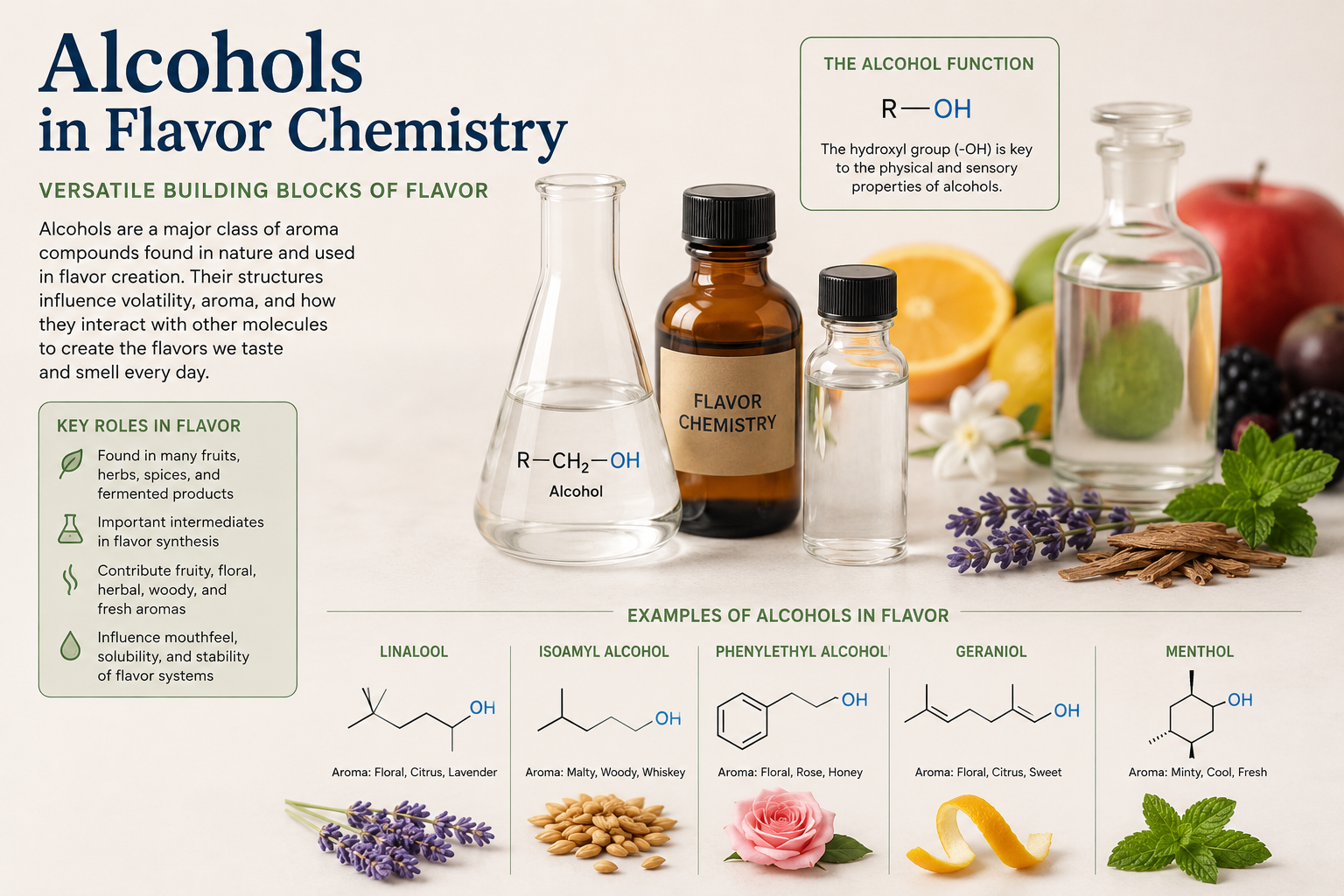
1. General Structure, Functionality, Reactivity & Stability
Structure: Alcohols carry a hydroxyl (–OH) group bonded to an sp³ carbon. They're classified as primary (1°), secondary (2°), or tertiary (3°) depending on how many carbons attach to that carbinol carbon — this matters because it determines what oxidation can produce.
Functionality: The –OH group is moderately polar and hydrogen-bonds with itself and with water, which is why alcohols sit between hydrocarbons (nonpolar) and acids (very polar) in solubility and volatility behavior.
Reactivity:
- Oxidation — the big one for flavor: primary alcohols → aldehydes → carboxylic acids; secondary alcohols → ketones (no further oxidation under mild conditions)
- Esterification — alcohols + acids → esters (this is hugely important; many "fruity" flavor notes are esters formed from these very alcohols)
- Dehydration — can lose water to form alkenes under acid/heat
- Etherification — alcohol + alcohol → ethers
Stability: Alcohols are generally the most stable, "shelf-friendly" of the oxygenated flavor classes — far more stable than the aldehydes they oxidize into. Aldehydes readily autoxidize, polymerize, and form off-notes; alcohols tolerate storage, heat, and light much better, which is part of why they're common base/backbone components in flavor compounding. Unsaturated alcohols are the exception — see section 5.
2. IUPAC vs. Common Names
| IUPAC Name | Common Name | Class | Typical Note |
|---|---|---|---|
| Methanol | Methyl alcohol | Aliphatic | Sharp, solvent |
| Ethanol | Ethyl alcohol | Aliphatic | Sharp, neutral |
| 1-Hexanol | Hexyl alcohol | Aliphatic | Green, grassy |
| 1-Octanol | Octyl/caprylic alcohol | Aliphatic | Waxy, citrus-green |
| (Z)-3-Hexen-1-ol | cis-3-Hexenol, "leaf alcohol" | Aliphatic (unsaturated) | Fresh-cut grass |
| 3,7-Dimethyl-2,6-octadien-1-ol | Geraniol | Terpene | Rose, geranium |
| 3,7-Dimethyl-1,6-octadien-3-ol | Linalool | Terpene | Floral, lavender |
| 3,7-Dimethyloct-6-en-1-ol | Citronellol | Terpene | Rose, citrus |
| 5-Methyl-2-(propan-2-yl)cyclohexan-1-ol | Menthol | Terpene (cyclic) | Cooling, minty |
| Phenylmethanol | Benzyl alcohol | Aromatic | Faint floral, fruity |
| 2-Phenylethanol | Phenethyl alcohol | Aromatic | Rose, honey |
| Furan-2-ylmethanol | Furfuryl alcohol | Heterocyclic | Bready, caramel-like |
3. Structural & Functional Grouping
- Aliphatic — open-chain, straight or branched, saturated or unsaturated (ethanol, hexanol, cis-3-hexenol, octanol). The largest and most varied group in flavor work.
- Terpene alcohols — built from isoprene (C5) units, usually C10 monoterpenoids; often cyclic or have multiple double bonds (geraniol, linalool, citronellol, menthol, α-terpineol). Tend to carry floral, herbal, or "natural essential oil" character.
- Aromatic — contain a benzene ring (benzyl alcohol, phenethyl alcohol, cinnamic alcohol). Generally softer, sweeter, more diffusive floral/balsamic notes than aliphatics.
- Heterocyclic — ring structure containing a heteroatom (O, N, or S), e.g., furfuryl alcohol, tetrahydrofurfuryl alcohol. Common in roasted, baked, and caramelized flavor profiles, often derived from sugar degradation (Maillard-adjacent chemistry).
4. Chain Length Progression — Aliphatic Alcohols
| Chain Length | Examples | Aroma Character | Physical Trend |
|---|---|---|---|
| C1–C3 | Methanol, ethanol, propanol | Sharp, pungent, solvent-like | Highly volatile, fully water-miscible |
| C4–C5 | Butanol, amyl alcohol | Fusel, "winey," mildly fruity | Volatility dropping, solubility decreasing |
| C6 | Hexanol | Green, grassy, slightly fatty | Moderate volatility |
| C7–C9 | Heptanol, octanol, nonanol | Waxy, fatty, citrus-green | Lower volatility, increasingly lipophilic |
| C10+ | Decanol and beyond | Waxy, soapy, fatty | Low volatility, oily, poor water solubility |
The general rule: as chain length increases, boiling point rises and water solubility falls (more lipophilic), while the odor character drifts from sharp/solvent-like → green/fresh → waxy/fatty/soapy. Mid-chain alcohols (C6–C9) tend to be the most flavor-relevant because they balance enough volatility to be perceived with enough character to be distinctive.
5. Oxidation Sequence — Organoleptic Shift
Primary alcohol → aldehyde → carboxylic acid is the classic flavor-chemistry oxidation ladder, and the organoleptic profile shifts dramatically at each step:
Example: Hexanol → Hexanal → Hexanoic acid
- Hexanol (alcohol): green, grassy, fairly mild, relatively high odor threshold
- Hexanal (aldehyde): much sharper and more intensely "green/cut-grass," lower odor threshold (more potent per molecule) — aldehydes are typically the most potent, character-defining intermediates
- Hexanoic acid (acid): character flips entirely — sweaty, cheesy, goaty, rancid-fatty notes
Example: Ethanol → Acetaldehyde → Acetic acid
- Ethanol: neutral, mild
- Acetaldehyde: sharp, fruity, green-apple-like, pungent
- Acetic acid: sour, vinegary
Pattern to remember: alcohols = mild/soft/green; aldehydes = the potency spike, often the most "characteristic" note of the series with the lowest threshold; acids = a character break toward sour, cheesy, sweaty, or rancid notes, with thresholds that vary a lot by chain length (short-chain acids are intensely pungent; longer-chain acids skew waxy/cheesy).
6. Saturated vs. Unsaturated — Same Chain Length
1-Hexanol vs. cis-3-Hexenol (both C6):
| 1-Hexanol (saturated) | cis-3-Hexenol (unsaturated) | |
|---|---|---|
| Aroma | Green, grassy, mild, slightly fatty | Intense, fresh-cut grass / "just-mowed lawn," very green |
| Odor threshold | Higher (less potent) | Much lower (far more potent) |
| Stability | Stable, good shelf life | Less stable — double bond is prone to autoxidation, isomerization, and degradation under heat/light/oxygen |
| Reactivity | Mainly esterification/oxidation under deliberate conditions | Reactive double bond — readily oxidizes or isomerizes (e.g., toward trans-2-hexenal) |
Why the difference: the cis double bond puts a "kink" in the chain, changing molecular shape and how it fits olfactory receptors — this is a big part of why unsaturated compounds are often dramatically more potent and "fresher/greener" smelling than their saturated counterparts. Geometry matters too: cis vs. trans isomers of the same constitution can smell quite different (cis-3-hexenol's grassy "leaf alcohol" character vs. the different profile of its trans-2 counterpart). The tradeoff is stability — that same reactive double bond that gives the vivid green character also makes the molecule more prone to oxidative breakdown, so unsaturated flavor alcohols generally need more careful handling/storage than their saturated analogs.
###