Asia Food & Flavor Regulatory Digest: July 13–31, 2026
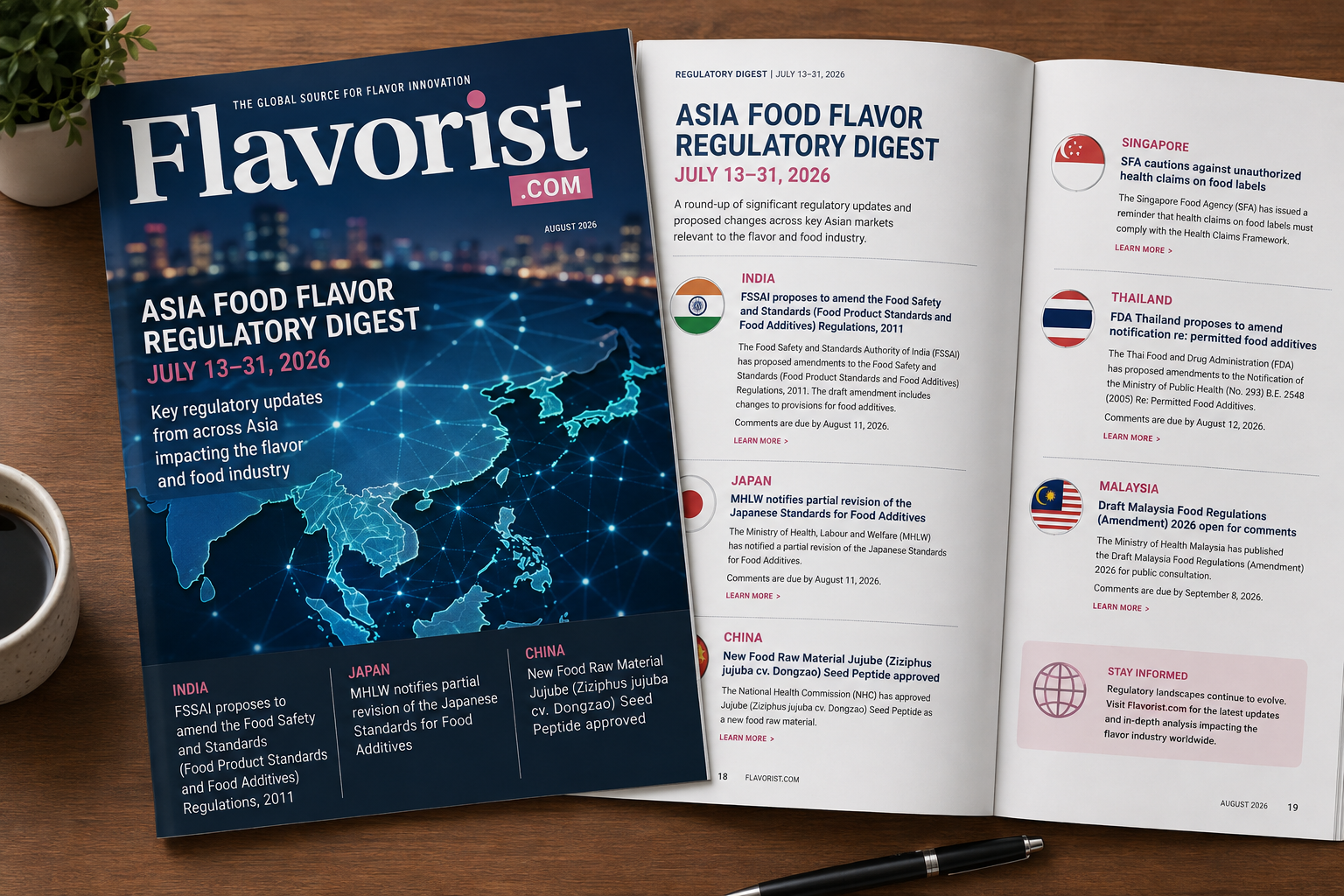
Here is the comprehensive compilation of law and regulatory news for the food and flavor industry across Asia that was released during July 13 – July 31, 2026, with summaries and hyperlinked sources.
1. China — CFSA Opens Consultation on Four New Food Raw Materials
Released: July 13, 2026
Status: Draft / public consultation; comments close August 12, 2026
Instrument: CFSA public notice
China’s National Center for Food Safety Risk Assessment (CFSA) issued four new food raw materials for public comment: (1) Cofea arabica bean total chlorogenic acid, (2) milk osteopontin, (3) L-alpha-glycerylphosphorylcholine (from phospholipid), and (4) procyanidins (from maritime pine bark or peanut seed coat). Each substance comes with defined production processes, recommended daily intake limits, specified food categories and maximum use levels, and mandatory label warnings for infants, pregnant women, and lactating women. For the flavor and food industry, these new raw materials create opportunities for functional food and beverage formulations—particularly in dairy, beverages, confectionery, and bakery segments—but require careful attention to population restrictions and labeling obligations.
Sources:
2. South Korea — MFDS Revises Food Additive Code
Released: July 13, 2026
Status: Final partial amendment; effective January 1, 2028
Instrument: MFDS Food Additive Code amendment
South Korea’s Ministry of Food and Drug Safety (MFDS) released a partial amendment to the Food Additive Code that expands the permitted scope of several nutrient fortifiers, clarifies usage standards for sweeteners, aligns phosphate classifications with international standards, and rationalizes other standards to support industry developments. For flavor manufacturers and food formulators, the sweetener and phosphate clarifications are particularly relevant, as they affect beverage, dairy, and processed food formulations. The 18-month transition period allows time for reformulation and label updates.
Sources:
- ChemLinked — South Korea Revises Food Additive Code
- Foodmate — South Korea Revises Standards and Specifications for Food Additives
3. China — CFSA Opens Three Food Additives for Public Feedback
Released: July 15, 2026
Status: Draft / public consultation; comments close August 14, 2026
Instrument: CFSA public notice
CFSA opened three food additives for public comment: one nutritional fortification substance with an expanded usage scope (Lacto-N-neotetraose, or LNnT, expanded to modified milk, flavored fermented milk, baked foods, and beverages) and two food additives with added quality specification requirements (neohesperidin dihydrochalcone produced by fermentation for use as a food flavoring, and 3′-sialyllactose sodium salt as a nutrient fortifier). For the flavor industry, the neohesperidin dihydrochalcone specification is significant as it establishes a new high-intensity sweetener/flavor modulator pathway via fermentation technology, with a maximum use level of 5 mg/kg in foods.
Sources:
- ChemLinked — Updated China Food Additives Updates
- ChinaFoodDB — CFSA Collects Public Comments on Three New Food Additives
4. Thailand — Thai FDA Proposes Revised Food Additive Regulations
Released: July 16, 2026
Status: Draft Ministry of Public Health notification; comments close September 30, 2026
Instrument: Draft amendment to Notification on Prescribing the Principle, Conditions, Methods and Proportion of Food Additives
Thailand’s Food and Drug Administration released a public consultation draft to revise the conditions for food additive use. The proposal would add several new food additives, expand the permitted uses of existing additives across multiple food categories, withdraw some current permissions, and revise maximum limits for selected substances to align with the latest international Codex Alimentarius guidelines. For flavor and food manufacturers, this affects formulation choices, supplier specifications, and compliance documentation for products sold in Thailand. Companies should review the draft annexes to determine whether their current additive portfolios remain compliant.
Sources:
- ChemLinked — Thailand Consults on Revised Food Additive Regulations
- Global Foodmate — Thailand Proposes Amendments to Regulations on Permitted Food Additives
5. Thailand — Grace Period Ends for Prepackaged Food Labeling Notification No. 450
Released/Enforced: July 19, 2026
Status: Final enforcement of existing regulation
Instrument: MOPH Notification No. 450 B.E. 2567 (2024)
The two-year transition period for Thailand’s updated prepackaged food labeling rule expired on July 19, 2026. From this date, any prepackaged food manufactured in or imported into Thailand must carry a Notification-450-compliant label. The rule adds shellfish (molluscs) and squid as mandatory declarable allergens alongside the previously required crustacea. The “best before” definition is also realigned with Codex Alimentarius. For food and flavor companies, this means any remaining stock with old-format labels became non-compliant on July 19, regardless of production date, and allergen matrices must now include molluscs and squid as distinct categories for the Thai market.
Sources:
- Cleo Labs — Thailand Prepackaged Food Labeling Deadline
- ChemLinked — Thailand Amends Prepackaged Food Labeling
6. India — FSSAI Revises Coffee-Chicory Labeling Requirements
Released: July 21, 2026
Status: Final direction; effective July 1, 2027
Instrument: FSSAI Direction F. No. 14(12)2020/RIRC/RCD/FSSA1
India’s Food Safety and Standards Authority of India (FSSAI) issued a direction revising the front-of-pack labeling for coffee-chicory mixtures. The previous box declaration requirement is kept in abeyance and replaced with a simplified front-of-pack statement showing the percentage of coffee and chicory. The declaration must appear in a minimum 1 mm font size (2 mm for packages with a Principal Display Panel larger than 100 cm²). The revised requirements apply to both roasted/ground and instant coffee-chicory mixtures, giving industry a one-year transition period. This affects labeling artwork, packaging specifications, and regulatory documentation for exporters to India.
Sources:
- CliniExperts — FSSAI Coffee-Chicory Labeling Update
- TraceOne — Asia-Pacific Food Regulation Updates
- FSSAI Official Direction (PDF)
7. South Korea — MFDS Proposes New Rules for Customized Health Functional Foods
Released: July 21, 2026
Status: Draft partial amendment; comments close August 31, 2026
Instrument: MFDS Notice 2026-338
South Korea’s Ministry of Food and Drug Safety (MFDS) proposed a partial amendment to the Enforcement Rule of the Health Functional Food Act. The draft introduces updated labeling requirements and expanded consumer information disclosure obligations for “customized health functional foods.” This affects personalized nutrition products and has downstream implications for flavor formulation, as customized nutrient profiles often require taste masking, stability adjustments, and modified flavor systems. Stakeholders may submit comments through August 31, 2026.
Source:
8. China — CFSA Consults on New Varieties of Food-Related Products
Released: July 21, 2026
Status: Draft / public consultation; comments close August 19, 2026
Instrument: CFSA notice on food-related products under GB 4806.7-2023
CFSA issued a notice announcing that two substances—C.I. Pigment Black 7 and the reaction product of N,N′-di(octadecanoyl)ethylenediamine, homopolymer of azacyclotridecan-2-one and 1-isocyanatooctadecane—have passed technical review for expanded application scope under the National Food Safety Standard for Plastic Materials and Products for Food Contact (GB 4806.7-2023). While this is a food-contact-material measure, it is relevant to the flavor and food industry because packaging compliance affects shelf-life, flavor stability, and migration limits for plastic containers used for flavored beverages and foods.
Source:
9. Vietnam — Draft Revision of Food Safety Law Published for Public Comment
Released: July 28, 2026
Status: Draft law revision; no closing date stated
Instrument: Draft revision of the Food Safety Law 2010
Vietnam published a draft revision of its Food Safety Law for public comment. The overhaul introduces new regulatory concepts including food quality, food ingredients, health supplements, foods for special dietary uses, supplemented food, micronutrient fortified foods, and nutritional products for children under 36 months. It also updates labeling requirements, including nutritional warnings, and reorganizes ministerial responsibilities (notably renaming the Ministry of Agriculture and Rural Development to the Ministry of Agriculture and Environment). For the food and flavor industry, the expanded definitions and new product categories will create both opportunities and compliance obligations, particularly for functional foods, fortified products, and imported ingredients.
Sources:
- UseForesight — Vietnam Food Safety Law Revision
- ChemLinked — Vietnam Proposes Food Safety Law Overhaul
This review focused on measures first released to the public (as laws, regulations, draft notifications, official directions, or public consultations) between July 13 and July 31, 2026. Several important developments reported in early July (e.g., Indonesia’s BPOM Regulation No. 10/2026 on Nutri-Level labeling, finalized June 9; Indonesia’s BPOM Regulation No. 11/2026 on food packaging, promulgated June 23; and Thailand’s draft flavoring substances overhaul, released July 9) fall outside the specified date window and were therefore excluded. All hyperlinks above point to official or reputable regulatory intelligence sources; primary documents in local languages should be verified before making compliance decisions.