California AB 2244 and the New “Non-Ultraprocessed” Standard: What It Could Mean for Flavors and Food Formulation
Tuesday September 22, 2026 – California is moving closer to establishing one of the most consequential new labeling frameworks in the rapidly evolving debate over ultra-processed foods (UPFs).
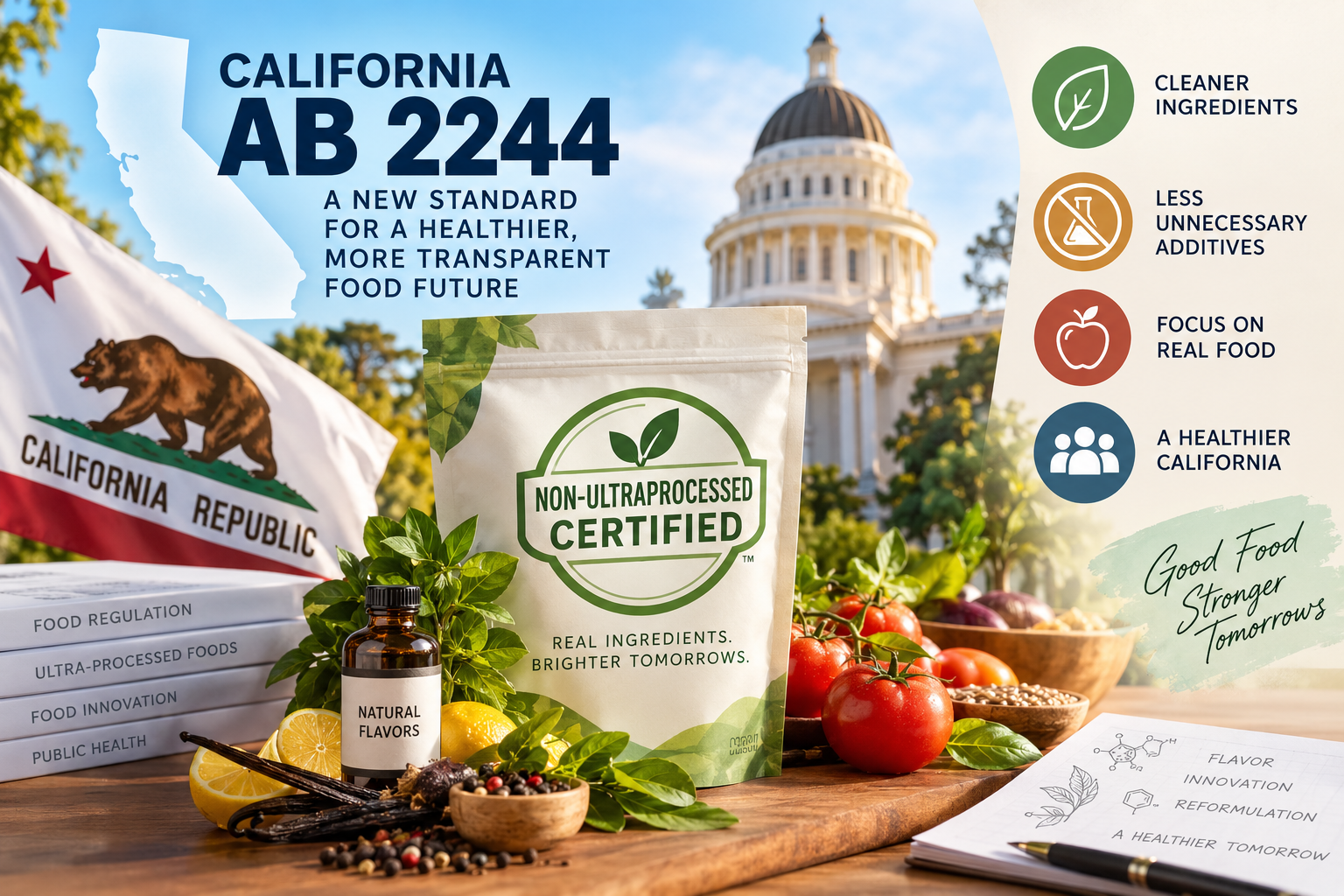
Assembly Bill 2244, introduced by Assemblymember Jesse Gabriel, would establish a voluntary “Non-Ultraprocessed Certified” standard for qualifying food and beverage products. For the flavor industry, the proposal deserves particular attention because California’s emerging definition of ultra-processed food specifically considers certain flavoring agents, flavor adjuvants and flavor enhancers—while treating some natural flavors and seasonings differently.
The implications extend beyond a new logo on food packaging. If implemented, the certification could influence ingredient selection, product reformulation, supplier documentation and the way food manufacturers position products to consumers increasingly concerned about processing and additives.
What Is California AB 2244?
AB 2244 would establish a state-backed certification program allowing eligible foods to carry a “Non-Ultraprocessed Certified” or “Non-UPF Certified” seal.
The program is designed as a voluntary certification rather than a blanket prohibition on processed foods. Under the enrolled legislation, the California Department of Public Health would be required to accredit certification agents no later than June 1, 2029. Those agents would determine whether individual products meet the state's certification requirements.
A certified product could display a standardized seal created by the state. The seal could appear on the principal display panel, information panel or elsewhere on the package as long as it does not obscure required labeling information.
Certification would also not necessarily be permanent. Products would need to be recertified at least once every three years, while a manufacturer that reformulates a certified product would have to obtain certification for the new formulation before continuing to use the seal.
As of September 22, 2026, the bill has cleared the California Legislature and has been presented to Governor Gavin Newsom. The enrolled bill was presented to the governor on September 8, meaning the proposal is at the final stage of California's legislative process but should not yet be described as an enacted certification program.
AB 2244 Builds on California's Existing Ultra-Processed Food Law
AB 2244 does not emerge in isolation.
In October 2025, California enacted AB 1264, establishing a statutory framework for identifying ultra-processed foods and ultimately restricting certain UPFs in public schools. The law directs the state to develop regulations defining categories including “ultraprocessed foods of concern” and “restricted school foods.”
AB 2244 effectively takes that emerging regulatory framework beyond the school cafeteria and into the consumer marketplace by creating a positive certification that qualifying products could voluntarily display.
That distinction is significant.
Instead of simply telling manufacturers which foods may face restrictions in certain settings, a certification program could give manufacturers a commercial incentive to formulate products specifically to qualify as non-UPF.
Why Flavors Are at the Center of the Discussion
For flavor houses, ingredient suppliers and product developers, one of the most important elements of the California framework is its treatment of ingredients that perform particular technical functions.
Perfumer & Flavorist notes that flavoring agents, flavor adjuvants and flavor enhancers can contribute to a product falling within California's definition of an ultra-processed food when combined with other specified nutritional or compositional characteristics.
Those characteristics can include thresholds involving saturated fat, sodium and added sugar, as well as certain sweeteners and other specified substances.
But there is an important nuance:
The mere presence of a flavor ingredient does not automatically make a product an ultra-processed food under the California framework.
That distinction matters because the public debate over UPFs sometimes creates the impression that any food containing flavors, emulsifiers or other functional ingredients is automatically classified as ultra-processed. California's statutory approach is more complicated than that.
Natural Flavors Receive Different Treatment
Another particularly important issue for flavor manufacturers is the distinction between different categories of flavor ingredients.
According to the Perfumer & Flavorist analysis, California's framework excludes certain spices, natural seasonings and natural flavorings covered by the referenced federal regulatory definition from the relevant flavor category.
This means the regulatory consequences of using a flavor ingredient could depend partly on how that ingredient is legally classified.
For flavor suppliers, therefore, the issue may increasingly extend beyond sensory performance.
Documentation, regulatory classification and the precise identity of a flavor system could become more commercially important when customers are developing products intended to qualify for a non-UPF claim.
AB 2244 Is Not a Ban on Flavors
One of the most important points in understanding the proposal is what it does not do.
AB 2244 does not broadly ban flavoring agents, flavor enhancers or processed foods.
Instead, it creates criteria that products would have to satisfy if manufacturers voluntarily want to use the state's Non-Ultraprocessed Certified designation.
For the flavor industry, that changes the issue from straightforward regulatory compliance to something closer to formulation strategy and market positioning.
A flavor ingredient might remain perfectly legal for use in food while nevertheless making it more difficult—or potentially impossible—for a particular formulation to qualify for a desired certification.
That distinction could become increasingly important for R&D teams.
The Bigger Problem: There Is Still No Universally Accepted Definition of “Ultra-Processed”
California's initiative arrives amid a much larger scientific and regulatory debate over what the term ultra-processed food should actually mean.
Much of today's UPF research uses the NOVA classification system, which categorizes foods largely according to the nature, purpose and extent of processing and formulation rather than simply examining calories, fat, sugar or sodium.
This approach has helped researchers investigate dietary patterns, but it can also produce classifications that are counterintuitive to consumers.
As Perfumer & Flavorist points out, foods such as fortified breads, some plant-based milk alternatives and mass-produced yogurts can potentially fall into broad UPF categories alongside products such as soda, candy and processed meats.
That raises a fundamental policy question:
Is the health concern the processing itself, particular additives, a product's nutritional composition, its physical structure, how quickly it can be eaten, its palatability—or some combination of these factors?
Scientists are still working through that question.
What Does the Science Say About Ultra-Processed Foods?
There is meaningful evidence connecting diets high in ultra-processed foods with adverse health outcomes, but identifying exactly what drives those associations remains an active area of research.
One of the most influential experiments came from the U.S. National Institutes of Health. In a tightly controlled randomized trial involving 20 adults, researchers provided participants with either ultra-processed or minimally processed diets for two weeks before switching them to the other diet.
The diets were designed to be comparable in presented calories and several major nutrients. Nevertheless, participants consumed approximately 500 more calories per day while eating the ultra-processed diet and gained about 0.9 kilograms, or two pounds, during that phase. They lost approximately the same amount during the minimally processed phase.
The study provided unusually strong experimental evidence that characteristics of an ultra-processed dietary pattern can affect food intake. However, it did not establish that every food classified as ultra-processed is equally harmful, nor did it establish that one particular category of additive—such as flavors—is responsible for the effect.
That distinction is crucial for regulators and ingredient companies.
The Federal Government Is Also Working on a UPF Definition
California is not developing its policies in a regulatory vacuum.
The U.S. Food and Drug Administration and Department of Agriculture have also been working toward a uniform federal definition of ultra-processed foods. The FDA has acknowledged that significant questions remain about how and why high UPF consumption may affect health.
That federal activity makes California's approach particularly noteworthy.
For decades, food regulation has generally focused on specific ingredients, contaminants, nutrient disclosures or defined health and safety risks. The emerging UPF debate introduces a broader concept: regulating or labeling foods partly according to the way they are formulated and the technical functions of ingredients.
That could represent a significant evolution in food policy.
What AB 2244 Could Mean for Flavor Companies
For flavor manufacturers and suppliers, AB 2244 suggests several practical changes may be coming.
First, regulatory classification could become a stronger selling point. Customers may increasingly want to know whether a flavor system contains ingredients that could affect their eligibility for non-UPF certifications or claims.
Second, suppliers could see greater demand for natural flavor systems, recognizable ingredients and formulations designed around specific regulatory definitions.
Third, food manufacturers may begin asking flavor houses to help them reformulate existing products while preserving sensory characteristics.
That can be technically difficult. Reducing sugar, sodium or fat can change sweetness, aroma release, mouthfeel and overall flavor perception. Removing or replacing functional ingredients may create additional stability or shelf-life challenges.
Flavor technology could therefore become more—not less—important as manufacturers pursue simpler formulations.
Certification Could Turn “Non-UPF” Into a New Product Positioning Category
Perhaps the most significant long-term consequence of AB 2244 is commercial rather than purely regulatory.
Consumers already encounter package claims such as organic, non-GMO, gluten-free, no artificial flavors and no added sugar. A government-backed Non-Ultraprocessed Certified seal could potentially create another recognizable purchasing signal.
If consumer interest develops around the designation, manufacturers may begin designing products specifically to qualify for it.
That would create a new formulation question for R&D teams:
Can a product deliver the same taste, texture, stability, affordability and shelf life while satisfying non-UPF certification requirements?
For flavor suppliers, answering that question could become a new area of innovation.
California Is Becoming a Testing Ground for Food-Ingredient Regulation
AB 2244 also fits within a broader pattern of California food policy.
The state has enacted measures addressing particular food additives and synthetic dyes, strengthened school nutrition standards and, through AB 1264, established a framework for restricting certain ultra-processed foods in schools. California has also invested heavily in universal school meals and farm-to-school programs.
That matters nationally because large food companies rarely formulate products solely for one state if maintaining separate inventories becomes expensive or operationally difficult.
As a result, California requirements can sometimes influence formulation decisions beyond California itself—even when a law technically applies only within the state.
Whether AB 2244 would have that kind of wider influence remains to be seen, particularly because the certification would be voluntary.
What Food and Flavor Companies Should Watch Next
The immediate issue is the final disposition of AB 2244. Beyond that, companies should closely follow California's implementation of AB 1264 because the definitions and regulatory determinations emerging from that process are closely connected to the certification framework envisioned by AB 2244.
The enrolled AB 2244 directs California to accredit certification agents by June 1, 2029, and establishes requirements around certification, recertification, reformulated products and public registration information.
For manufacturers and flavor suppliers, this means the next several years could involve substantially more attention to ingredient classification, documentation and formulation architecture.
The Bottom Line
California's AB 2244 is important because it moves the ultra-processed food debate from an academic classification system toward something consumers could potentially see directly on food packaging.
For the flavor industry, however, the legislation is more nuanced than a simple restriction on flavors.
Flavoring agents and flavor enhancers can be relevant to whether a product falls within California's UPF framework, but the presence of a flavor alone does not necessarily make a food ultra-processed. Natural flavors and seasonings can also receive different treatment depending on their regulatory classification.
The larger trend is therefore likely to be reformulation and ingredient scrutiny rather than the disappearance of flavor technology.
If non-UPF positioning gains traction, flavor companies may find themselves at the center of the challenge: helping manufacturers produce foods with shorter or differently structured ingredient lists while still delivering the taste, texture, stability and consumer experience people expect.
AB 2244 may ultimately prove to be more than another California labeling initiative. It could be an early indication of how the food industry's rapidly expanding debate over ultra-processed foods will translate into product development, ingredient selection and consumer-facing claims.
###