Flavorist’s Technical Application Guide to Application of Phenyl Ethyl Alcohol (2-Phenylethanol) in Rose, Strawberry, Raspberry, Lychee, Honey and Tea Flavors
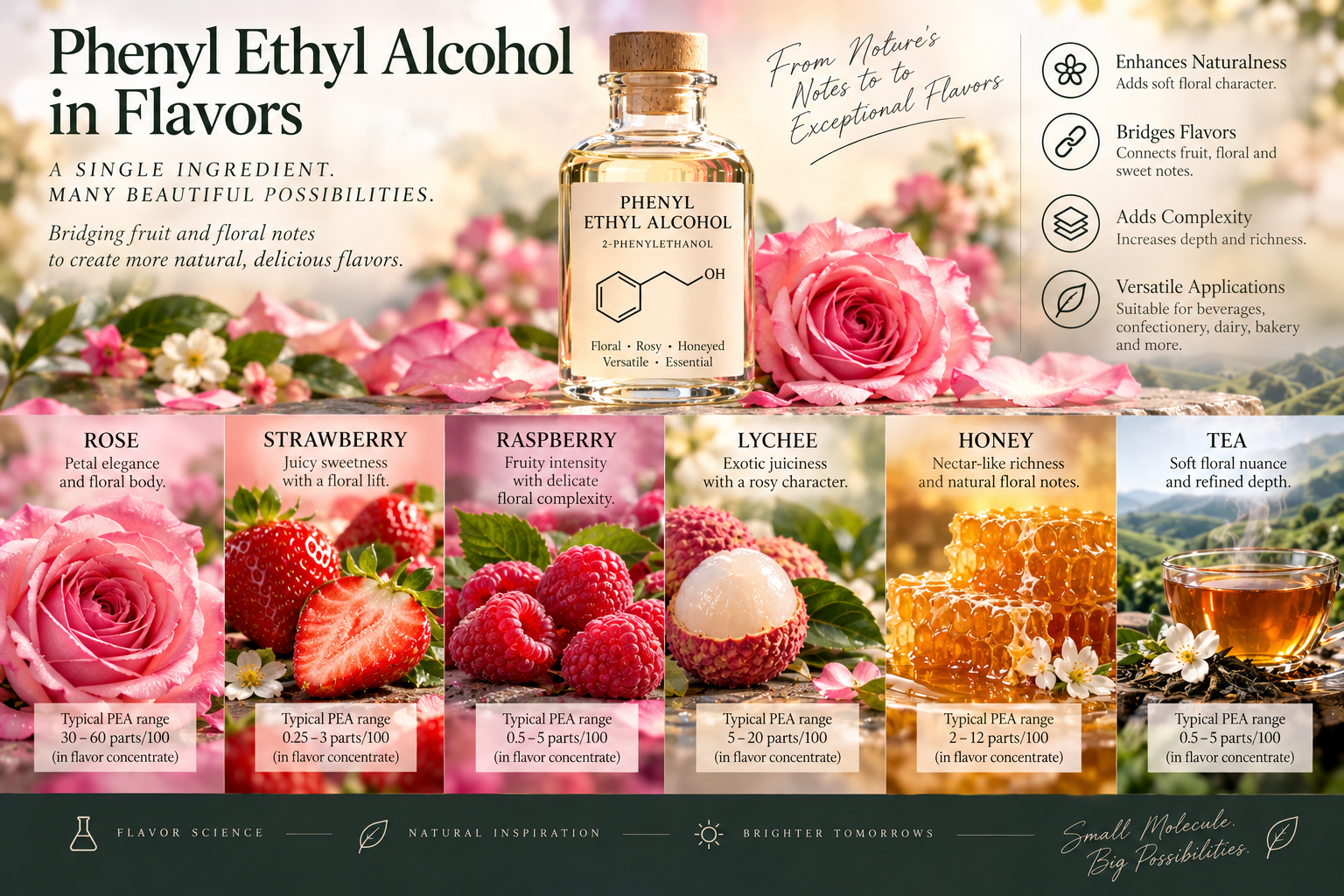
Below is a technical summary framed for bench flavor development. The formulas are illustrative starting accords, not optimized commercial formulas. “Parts” are weight parts within the aromatic concentrate; where very potent materials are shown as dilutions, the stated dilution—not neat material—is what is weighed. Final use levels need sensory, stability, toxicological/specification, and jurisdiction-specific regulatory review.
Flavorist’s Technical Application Guide
Phenyl Ethyl Alcohol (2-Phenylethanol) in Rose, Strawberry, Raspberry, Lychee, Honey and Tea Flavors
1. Purpose and Formulation Approach
Phenyl ethyl alcohol (PEA; 2-phenylethanol) is a soft rose-petal, floral, slightly honeyed aromatic alcohol. In flavor creation, its greatest value is usually not as a stand-alone character ingredient but as a floral body material, bridge and modifier.
PEA can connect volatile fruity top notes to heavier floral, honeyed and fermentation-derived notes. It is especially useful when a flavor needs floral naturalness without an aggressively perfumery character.
The formulas below are intended as bench starting points. They deliberately use relatively simple palettes so that the contribution of PEA can be understood and adjusted.
Unless otherwise stated:
- quantities are parts by weight;
- formulas total approximately 100 parts;
- ethanol, propylene glycol (PG), triacetin or another suitable food-grade carrier may be selected according to application and regulatory requirements;
- “10%” means a 10% w/w working solution;
- “1%” means a 1% w/w working solution;
- finished-product dosage ranges are screening ranges rather than regulatory use limits.
2. Working with PEA
Sensory progression
At relatively low contribution:
fruit/floral lift → natural floral background → rose petal → recognizable rose → perfumery/soapy
The ideal point in most non-rose flavors occurs before the consumer consciously recognizes “rose.”
Recommended bench-screening method
Instead of attempting to determine the optimum from the flavor concentrate, prepare a PEA ladder.
For example, take the same base flavor and prepare:
- Control — no added PEA
- Low — approximately 50% of the proposed PEA level
- Target — proposed level
- High — approximately 150–200% of proposed level
Dose all four versions into the finished application at the intended flavor dosage.
Evaluate:
aroma → first taste → mid-palate → finish → aftertaste
Record floral intensity, fruit identity, juiciness, naturalness, sweetness perception and any perfumery/soapy character.
3. Rose Flavor
Design objective
A recognizable rose profile requires more than PEA. PEA provides the petal/body, while other floral materials provide diffusion, freshness and botanical identity.
Illustrative Rose Accord
| Ingredient | Parts | Primary function |
|---|---|---|
| Phenyl ethyl alcohol | 45.0 | Rose-petal body; floral volume |
| Geraniol | 12.0 | Fresh rosy character |
| Citronellol | 10.0 | Soft citrus-rose character |
| Nerol | 4.0 | Fresh, slightly green rose nuance |
| Linalool | 5.0 | Floral lift and diffusion |
| Citronellal | 1.0 | Bright green-citrus lift |
| β-Damascenone 1% | 0.5 | Powerful natural rose/fruity depth |
| Eugenol 10% | 0.5 | Warm spicy botanical complexity |
| Carrier | 22.0 | Dilution and handling |
| Total | 100.0 |
PEA trial range
Within this type of rose accord, screen roughly 30–60 parts PEA per 100 parts aromatic concentrate.
Reducing PEA makes the accord lighter and potentially sharper. Increasing it creates greater petal volume but eventually produces a heavy cosmetic/perfumery effect.
Finished-product screening
As an initial bench experiment, evaluate approximately 10–100 ppm of the flavor concentrate in beverages, followed by application-specific optimization. Confectionery may require substantially different flavor dosage.
The appropriate level depends heavily on the strength of the concentrate and therefore cannot be inferred from the PEA concentration alone.
Log in to view all other applications of phenyl ethyl alcohol