Citrus Folding: Concept to Application
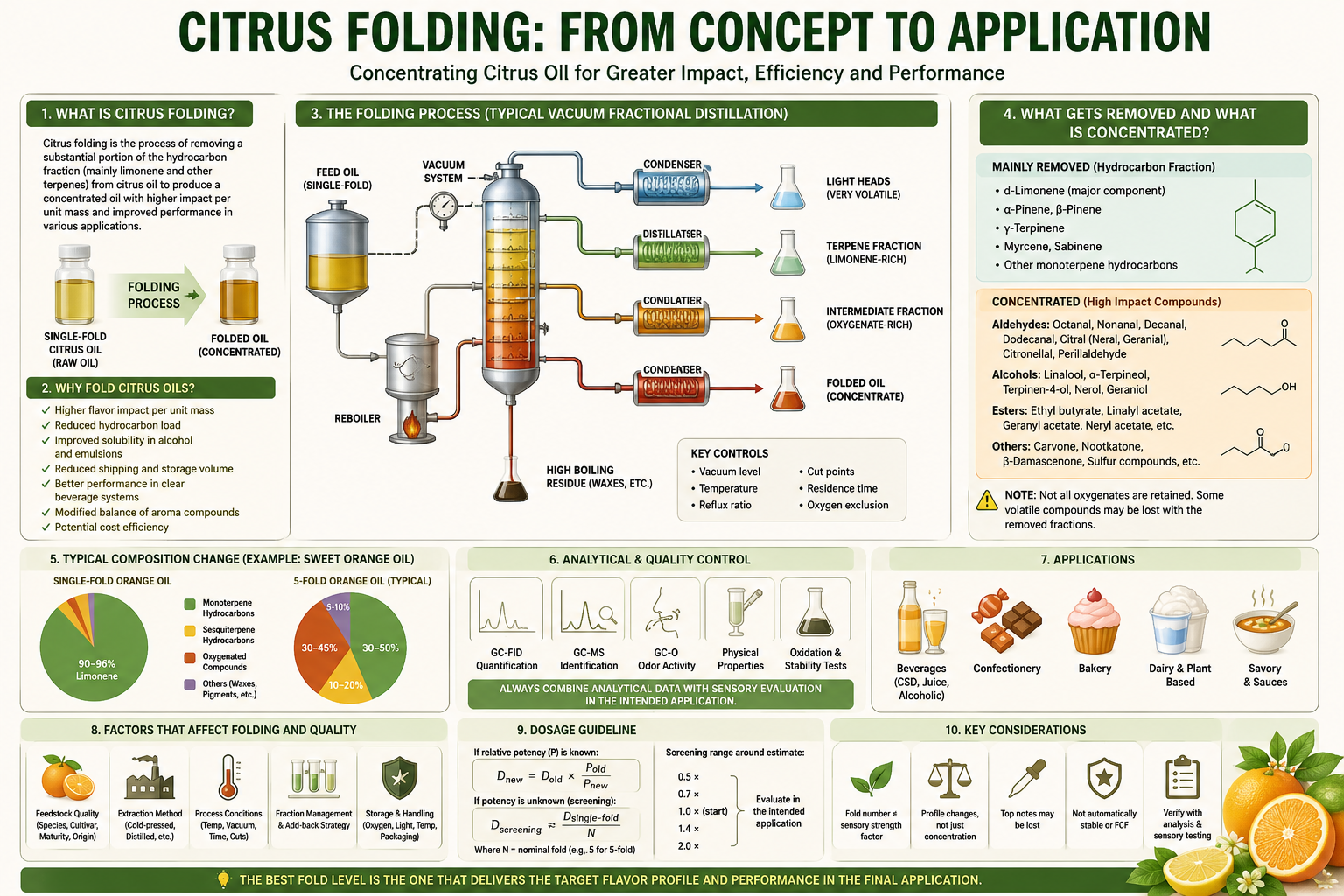
1. What folding is
Folding is concentration of the oxygenated (flavor-active) fraction by removing terpene hydrocarbons — partial or complete deterpenation. Peel oil is over 90% d-limonene, a water-insoluble hydrocarbon that does not contribute significantly to flavour, though it can act as a carrier for other molecules. Folding reduces that hydrocarbon content to increase the proportion of desired flavouring substances such as aldehydes and esters.
"Fold" is a concentration ratio by weight, not a marker multiplier. A five-fold concentrate is concentrated to 1/5 of its original weight. This is the single most misunderstood point in the whole subject, and everything in §5 follows from it.
2. Why you fold
- Aqueous/hydroalcoholic solubility — the biggest driver for beverage work.
- Oxidative stability — terpene hydrocarbons must be removed to obtain a stable final product: they don't contribute much to flavor or fragrance, and they're unstable when exposed to heat or light. Limonene autoxidizes to carvone, carveol, and limonene oxide — the "turpentine/old peel" off-note.
- Flavor value density — dose less, ship less.
- Process survival — baking, hard-candy cook temps, extrusion.
3. The raw material landscape (read this before you spec anything)
Folding is one branch of a larger tree, and you can't reason about it in isolation:
- Peel oils are collected by cold-expression from the peel. Essence (aroma) oils are collected in the concentration step following juicing. Both, recovered without further concentration, are single fold (1X).
- Cold-pressed oils generally show higher aldehyde/ester ratios than essence oils; the higher ester content of essence oils accounts for their more juice-like aroma. Essence oil is your juicy/fresh building block — and the standard remedy for what folding destroys.
- Orange, lemon, lime and grapefruit "terpenes" are flavoring materials derived from the distillate of the folding process — the coproduct is itself a saleable, FEMA-listed ingredient, not waste.
- Collecting citrus oils by distillation of peels/juices is generally not practiced, since distillation produces lower-quality oils. The exception is lime — both distilled and cold-expressed lime oils are in commerce, and distilled lime's sharp flavor is desirable for some products.
4. Composition primer
| Oil | Bulk terpenes | Character-defining fraction |
|---|---|---|
| Orange | ~95% d-limonene | Decanal, octanal, citral, valencene; sinensals at trace |
| Lemon | ~95% terpene hydrocarbons | ~3% citral (geranial + neral) |
| Lime | limonene | Cold-pressed vs distilled differ radically — see §8 |
| Grapefruit | limonene | Grapefruit mercaptan is important to the flavor profile; nootkatone |
| Bergamot | limonene, linalyl acetate | Linalyl acetate/linalool; bergapten (phototoxic) |
5, Fold ≠ marker gain
Marker content always rises less than the nominal fold, because oxygenates co-distill and are lost. Distillation cannot fully separate the two groups of compounds — a small residue of oxygenated molecules is always found in the distillate, lowering the aldehyde content of the pot residue, i.e. the folded oil.
The Florida concentrate data quantifies it:
| Cold-pressed Valencia | "25-fold" concentrate | |
|---|---|---|
| Total aldehydes | 1.6% | 8.4% — only ~5× |
| d-Limonene | 95% | 57% |
| Decanal | 0.28% | 2.15% |
The proof is in the color: concentrating to 25-fold raised color value 20-fold while oxygenated flavor compounds increased only about ten times. Carotenoids are non-volatile, so color tracks the true volume reduction — meaning roughly half the oxygenates left with the distillate.
At the low end, same story: a 5-fold orange specs 4.0–5.0% total aldehydes as decanal, against ~1.2–1.6% single-fold — about 3×, not 5×.
→ Buy on the spec sheet's aldehyde/citral %. Never on the fold number.
6. The other consequence: top-note stripping
Octanal boils at 163.4°C — well below limonene's ~176–177°C. So the C8 aldehyde comes off early in the cut, along with the terpenes you meant to remove. High-fold oils are proportionally heavier in decanal/citral/valencene but stripped of fresh, juicy lift; they read deeper, rounder, sometimes cooked.
The fix is layering, not more fold. Terpeneless oils, being highly concentrated with good stability and superior water solubility, find wide application as modifiers with single-folded oils, blended oils and citrus flavour fractions. Build: cold-pressed peel oil or essence oil for the fresh top → folded/terpeneless for character, strength, and stability → isolates for the signature molecule.
7. Methods
Terpene hydrocarbons may conventionally be reduced by vacuum distillation, solvent extraction, or adsorption chromatography.
- Vacuum fractional distillation — the workhorse. Widely used to produce 5- to 10-fold oils. Reduced pressure lowers effective boiling points to protect heat-labile compounds; limonene comes over first, the folded oil is the pot residue.
- Liquid–liquid extraction — partition against aqueous ethanol; oxygenates favor the polar phase. No heat, better top-note retention.
- Supercritical CO₂ / short-path distillation — gentlest, for delicate profiles.
- Adsorption chromatography — more niche.
Terpeneless is a separate category, not a point on the fold scale. Monoterpene hydrocarbons are reduced until the oil contains only minimal amounts. Terpeneless lemon runs 40–50% citral and is reckoned equivalent in flavour to about 10–15 times its volume of lemon oil.
8. Fold levels and applications
Commercial folding degrees: 2× to 5× for mandarin and lime; 2× to 10× for lemon and grapefruit; 2× to 20× for orange. A single-fold oil can be concentrated to any degree — from a slightly concentrated 2X, to 5–10X, to a highly concentrated terpeneless oil, each with distinguishing flavor character.
- 1× (peel or essence): brightest, cheapest, least stable. Fresh applications, short shelf life, non-aqueous.
- ~5×: the general beverage workhorse.
- 10×: concentrated beverage systems, better stability.
- 20× / terpeneless: maximum stability and solubility — hard candy, bake-stable systems, clear beverages. Dose low, rebuild the top.
Distilled lime deserves its own note. Almost all citral is decomposed by the distillation process, and high amounts of terpineols remain; together with terpinolene, cineols, p-cymene, fenchol and borneol, these give distilled lime its distinct sweet limey aroma. Cola and candy briefs want it; a fresh margarita brief does not. Neither is better — they're different tools.
9. QC and analytics
- GC-FID / GC-MS — full profile and quantification; your primary tool.
- Total aldehydes as % decanal — the USP procedure (hydroxylamine hydrochloride titration); still the commercial spec basis for orange.
- Chiral GC — d/l ratios for authenticity. Main adulterations to catch: cutting with cheap d-limonene or orange terpenes, synthetic citral in lemon, solvent stretching.
- Physical constants — RI, optical rotation, specific gravity.
- UV/HPLC for furocoumarins — mandatory for bergamot.
10. Stability and formulation
- Even folded oils usually need emulsification or a solubilizer for clear beverages; terpeneless grades are most forgiving.
- Citral in low-pH systems is a folding-independent problem and the classic lemon-lime instability. Geranial isomerizes to neral, forming p-menthadien-8-ol and p-menthadien-4-ol; these oxidize to p-cymene-8-ol, which dehydrates to α-p-dimethylstyrene, p-cymene and p-cresol. p-Cresol and p-methylacetophenone are the most potent degradation products. Sensory: p-cymene (gasolinic, smoky), p-cresol (smoky charcoal), p-methylacetophenone (cherry, powdery). Sodas and lemonades sit at pH 2.5–4.0 — precisely the danger zone. Degradation accelerates with oxygen, light, and heat.
- Protect residual terpenes with tocopherols or ascorbyl palmitate. Store cold, dark, full containers, N₂ blanket, minimal headspace.
11. Regulatory and safety
- Citrus EOs are generally recognized as safe (GRAS). The FEMA GRAS re-review of citrus NFCs is the current authority.
- Non-volatiles concentrate in the folded oil. Because the folded oil is the pot residue, waxes, carotenoids, coumarins and furocoumarins concentrate there — the 20-fold color jump is the visible proof. For distillative folding, assume bergapten concentrates; don't assume folding removes it. Bergamot and lemon oils for fragrance use are rectified specifically to remove bergaptene — that's a separate step, and FCF status must be specified, not inferred from fold.
- Watch citral for sensitization potential at higher use levels; check current IFRA guidance for fragrance-side work.
Two notes on how to use this. First, if you take one thing: fold names the volume reduction, the spec sheet names the flavor. Second, when you search this topic, a lot of recently-published content asserts the marker-multiplication definition — the peer-reviewed and primary-industry sources contradict it, so check which well you're drawing from.
###