Cyclization Reactions in Flavor Chemistry: A Detailed Training Guide for Flavorists
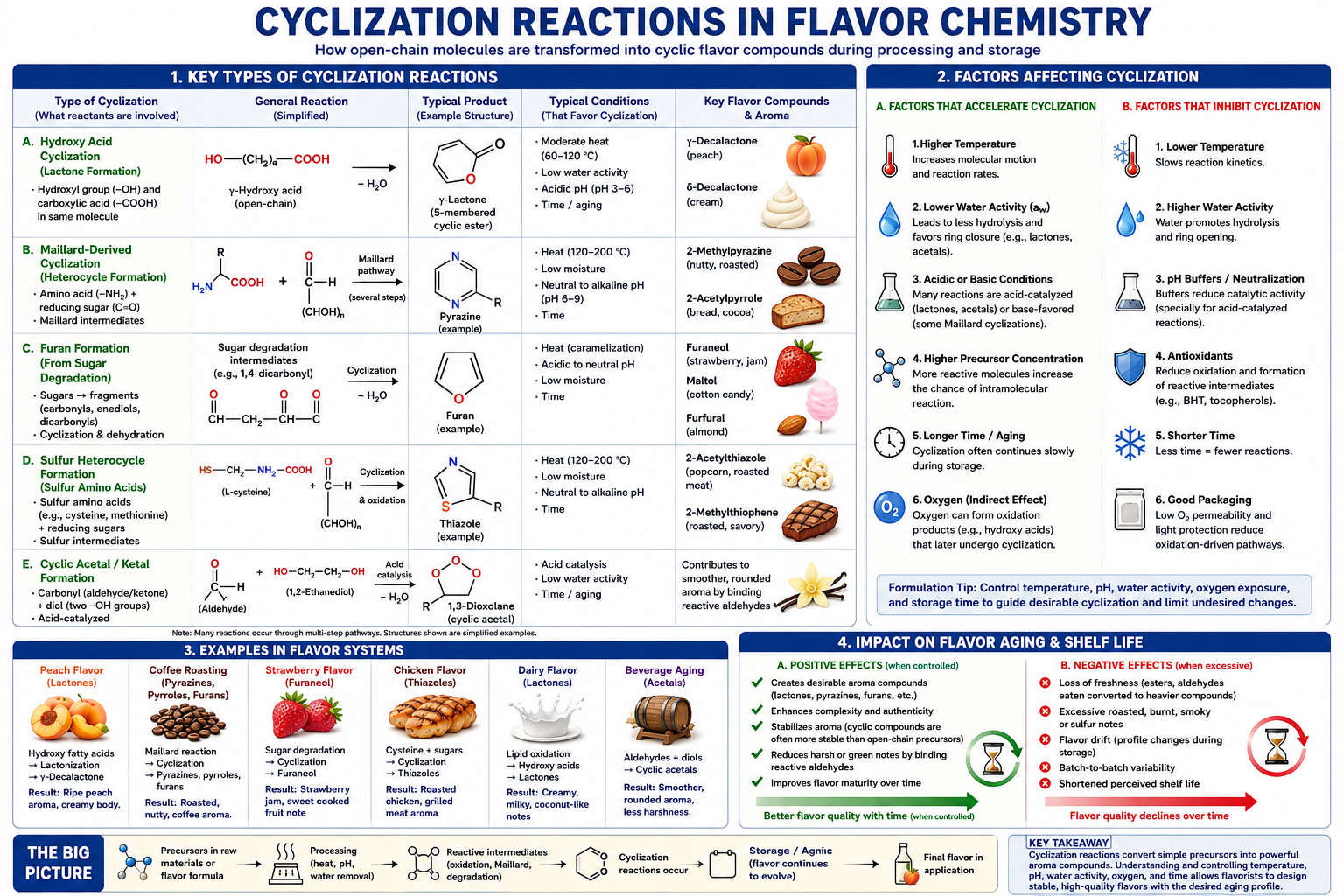
Cyclization is among the dozens of chemical reactions and physical processes related to flavors that the Society of Flavor Chemists requires certified flavorists to understand and consider when formulating flavors.
Introduction
Cyclization is one of the most important yet often underappreciated reaction classes in flavor chemistry. Many of the compounds responsible for the characteristic aromas of fruits, dairy products, roasted coffee, cocoa, baked goods, grilled meats, alcoholic beverages, and aged flavors are cyclic molecules formed through cyclization reactions.
A cyclization reaction occurs when different functional groups within the same molecule react with one another, converting an open-chain structure into a ring structure.
Think of an open-chain molecule as a piece of string. If the two ends of the string come together and connect, a loop or ring is formed. The same concept applies in chemistry.
For flavorists, cyclization is important because:
- Many highly odor-active flavor molecules are cyclic.
- Cyclization often occurs during processing, storage, and flavor aging.
- Cyclization can improve flavor quality by generating desirable aroma compounds.
- Cyclization can also degrade freshness and create off-notes if not controlled.
Understanding cyclization helps flavorists predict how a flavor will evolve over time and how processing conditions may affect flavor quality.
1. Chemical Groups Involved and Conditions Required
Cyclization is not a single reaction but rather a broad category of reactions. Several different types occur in flavor systems.
A. Hydroxy Acid Cyclization (Lactone Formation)
This is one of the most important cyclization pathways in fruit and dairy flavors.
Chemical Groups Involved
The molecule contains:
- A hydroxyl group (-OH)
- A carboxylic acid group (-COOH)
located within the same molecule.
Example:
HO-(CH₂)₄-COOH
The hydroxyl group acts like a nucleophile and attacks the carbonyl carbon of the carboxylic acid.
The molecule essentially "folds onto itself."
The result is:
- Ring closure
- Water elimination
- Formation of a lactone
Why Does This Happen?
Five-membered and six-membered rings are energetically stable.
Nature tends to favor stable structures.
The most common flavor lactones are:
γ-Lactones (5-membered rings)
Examples:
- γ-Decalactone
- γ-Undecalactone
- γ-Dodecalactone
δ-Lactones (6-membered rings)
Examples:
- δ-Decalactone
- δ-Dodecalactone
Sensory Characteristics
Lactones contribute:
| Lactone | Aroma |
|---|---|
| γ-Decalactone | Peach |
| γ-Undecalactone | Apricot |
| γ-Nonalactone | Coconut |
| δ-Decalactone | Cream |
| Massoia Lactone | Coconut cream |
Many fruit flavors rely heavily on lactones.
Conditions Favoring Lactonization
Moderate Heating
Heat increases molecular motion.
The hydroxyl group can more easily encounter the carboxyl group.
Examples:
- Dairy processing
- Fruit concentration
- Spray drying
Low Water Activity
Water drives the reverse reaction.
Less water means:
More lactone formation.
This explains why powdered flavors often contain more lactones than beverages.
Acidic pH
Acids accelerate:
- Proton transfer
- Ring closure
- Water elimination
Many fruit systems naturally favor lactonization.
B. Cyclization During Maillard Reactions
This is the major source of roasted flavors.
Starting Materials
Amino Acids
Examples:
- Glycine
- Alanine
- Methionine
- Cysteine
Reducing Sugars
Examples:
- Glucose
- Fructose
- Ribose
What Happens?
The amino acid reacts with the sugar.
The resulting intermediates undergo:
- Rearrangement
- Fragmentation
- Cyclization
Numerous heterocyclic molecules are formed.
Major Ring Systems Produced
Pyrazines
Provide:
- Nutty
- Roasted
- Peanut
- Popcorn notes
Examples:
- 2-Methylpyrazine
- 2,5-Dimethylpyrazine
Pyrroles
Provide:
- Bread crust
- Cocoa
- Toasted aromas
Imidazoles
Provide:
- Savory
- Meaty
- Roasted nuances
Oxazoles
Provide:
- Toasted
- Brown
- Nut-like notes
Thiazoles
Provide:
- Grilled meat
- Roast beef
- Chicken flavor
These are especially important in savory flavor creation.
Why Cyclization Occurs
The reactive intermediates generated by Maillard chemistry are often unstable.
By forming rings, they become:
- More stable
- More aromatic
- More odor-active
Cyclization therefore acts as a pathway to create flavor-active compounds.
C. Furan Formation
Furans are among the most important compounds in cooked flavors.
Functional Groups Involved
Typically:
- Carbonyl groups
- Hydroxyl groups
- Unsaturated intermediates
generated from sugar degradation.
Formation Mechanism
Sugars break apart during heating.
Fragments recombine and cyclize.
This creates:
Furans
Examples:
- Furan
- 2-Methylfuran
- 2-Furfural
Furanones
Examples:
- Furaneol
- Maltol
Aroma Contributions
| Compound | Aroma |
|---|---|
| Furaneol | Strawberry jam |
| Maltol | Cotton candy |
| Furfural | Almond |
| 2-Acetylfuran | Caramel |
These compounds are extremely important in fruit, caramel, coffee, and bakery flavors.
D. Sulfur Heterocycle Formation
One of the most powerful cyclization pathways.
Starting Materials
Sulfur amino acids:
- Cysteine
- Methionine
combined with sugars.
Products
Thiazoles
Thiophenes
Thiazolines
Why Important?
Many sulfur heterocycles have odor thresholds measured in parts-per-billion.
Tiny amounts can completely change a flavor profile.
Examples:
- Grilled chicken
- Roast beef
- Fried onions
- Cooked meat
E. Cyclic Acetal and Ketal Formation
Important during flavor aging.
Functional Groups
Aldehydes
Examples:
- Citral
- Hexanal
- Benzaldehyde
Alcohols or Diols
Examples:
- Propylene glycol
- Glycerol
Result
Formation of cyclic acetals.
These structures are often more stable than the original aldehydes.
Flavor Impact
Can reduce:
- Harshness
- Solvent notes
- Sharp green notes
Can create:
- Roundness
- Smoothness
- Maturity
2. Factors Accelerating or Inhibiting Cyclization
Understanding these factors allows flavorists to predict flavor changes during manufacturing and storage.
Factor 1: Temperature
Most cyclization reactions accelerate exponentially with temperature.
A useful rule:
Many reaction rates approximately double for every 10°C increase.
Examples:
| Temperature | Relative Rate |
|---|---|
| 25°C | 1× |
| 35°C | 2× |
| 45°C | 4× |
| 55°C | 8× |
Formulation Consideration
Ask:
Will the flavor encounter:
- Pasteurization?
- UHT processing?
- Baking?
- Extrusion?
- Spray drying?
Cyclization may continue long after manufacturing.
Factor 2: Water Activity
Water can either:
- Facilitate molecular mobility
- Reverse cyclization reactions
depending on the system.
Low Water Activity
Generally favors:
- Lactones
- Acetals
- Pyrazines
High Water Activity
Generally favors:
- Ring opening
- Hydrolysis
Factor 3: pH
Many cyclization reactions are acid-catalyzed.
Low pH
Accelerates:
- Lactonization
- Acetal formation
- Terpene cyclization
High pH
Accelerates:
- Maillard cyclization
- Pyrazine formation
- Certain sulfur heterocycles
Factor 4: Time
Cyclization does not stop after manufacturing.
Many flavorists have experienced this phenomenon:
Freshly made flavor:
"Thin"
Two weeks later:
"Much better"
Several months later:
"Over-aged"
Cyclization is often responsible.
Factor 5: Oxygen
Oxygen often generates precursor molecules that subsequently cyclize.
Example:
Lipid oxidation
↓
Hydroxy acids
↓
Lactones
Packaging Consideration
Packaging oxygen transmission rate (OTR) becomes critical.
Higher oxygen exposure often means:
More flavor evolution.
3. Practical Examples Flavorists Encounter
Example 1: Peach Flavor
Freshly manufactured flavor:
- Fruity esters dominate.
During storage:
Hydroxy fatty acids slowly cyclize.
Formation of:
γ-Decalactone
Result:
- More authentic peach note.
- Fuller body.
- Better persistence.
Example 2: Dairy Flavor
Milk fat oxidation creates hydroxy acid precursors.
Cyclization forms:
- δ-Decalactone
- γ-Nonalactone
Result:
- Creamy
- Buttery
- Coconut-like nuances
Example 3: Coffee Flavor
During roasting:
Sugars + amino acids
↓
Cyclization
↓
Pyrazines
Pyrroles
Furans
Result:
- Coffee aroma
- Toasted character
- Nutty notes
Without cyclization, coffee would smell little like coffee.
Example 4: Chicken Flavor
Cysteine + Ribose
↓
Sulfur intermediates
↓
Cyclization
↓
Thiazoles
Thiophenes
Result:
- Roasted chicken
- Grilled meat
- Savory impact
Example 5: Strawberry Flavor
Sugar degradation
↓
Cyclization
↓
Furaneol
Result:
- Strawberry jam
- Cooked fruit
- Cotton candy notes
4. Impact on Flavor Aging and Shelf Life
Cyclization is one of the most important drivers of flavor aging.
Positive Effects
Flavor Maturation
Some flavors require aging.
Examples:
- Vanilla
- Dairy
- Brown flavors
- Alcoholic beverage flavors
Controlled cyclization produces:
- Better balance
- Greater complexity
- Enhanced realism
Aroma Stabilization
Many cyclic compounds are more chemically stable.
Examples:
- Lactones
- Pyrazines
- Furans
Once formed, they often survive storage better than their precursors.
Reduced Harshness
Reactive aldehydes may be converted into cyclic structures.
Result:
- Smoother flavor
- Less green character
- Reduced chemical notes
Negative Effects
Loss of Freshness
Fresh flavors depend on:
- Aldehydes
- Esters
- Alcohols
Cyclization can consume these compounds.
Result:
Fresh apple flavor
↓
Cooked apple flavor
Fresh strawberry
↓
Jammy strawberry
Fresh citrus
↓
Marmalade-like citrus
Excessive Roasted Notes
Continued cyclization can produce excessive:
- Pyrazines
- Pyrroles
- Sulfur heterocycles
Result:
Burnt character.
Flavor Drift
The flavor profile gradually changes over time.
What was approved at production may no longer match the profile after six months.
Batch-to-Batch Variability
Small differences in:
- pH
- Water activity
- Storage temperature
- Oxygen exposure
can dramatically alter cyclization rates.
This explains why identical formulations sometimes age differently.
Key Lessons for Flavorist Trainees
When evaluating a flavor, do not focus only on the molecules present today. Think about the molecules that may form tomorrow through cyclization. Many desirable flavor compounds—including lactones, pyrazines, furans, pyrroles, thiazoles, and cyclic acetals—are created through cyclization reactions during processing and storage. These reactions are strongly influenced by temperature, pH, water activity, oxygen exposure, and time. A skilled flavorist understands not only how a flavor tastes when it is produced, but how cyclization will reshape that flavor after weeks, months, or even years of storage. This ability to anticipate flavor evolution is one of the defining skills that separates an experienced flavor chemist from a beginner formulator.