Defining and Controlling Earthy Notes in Food Flavor
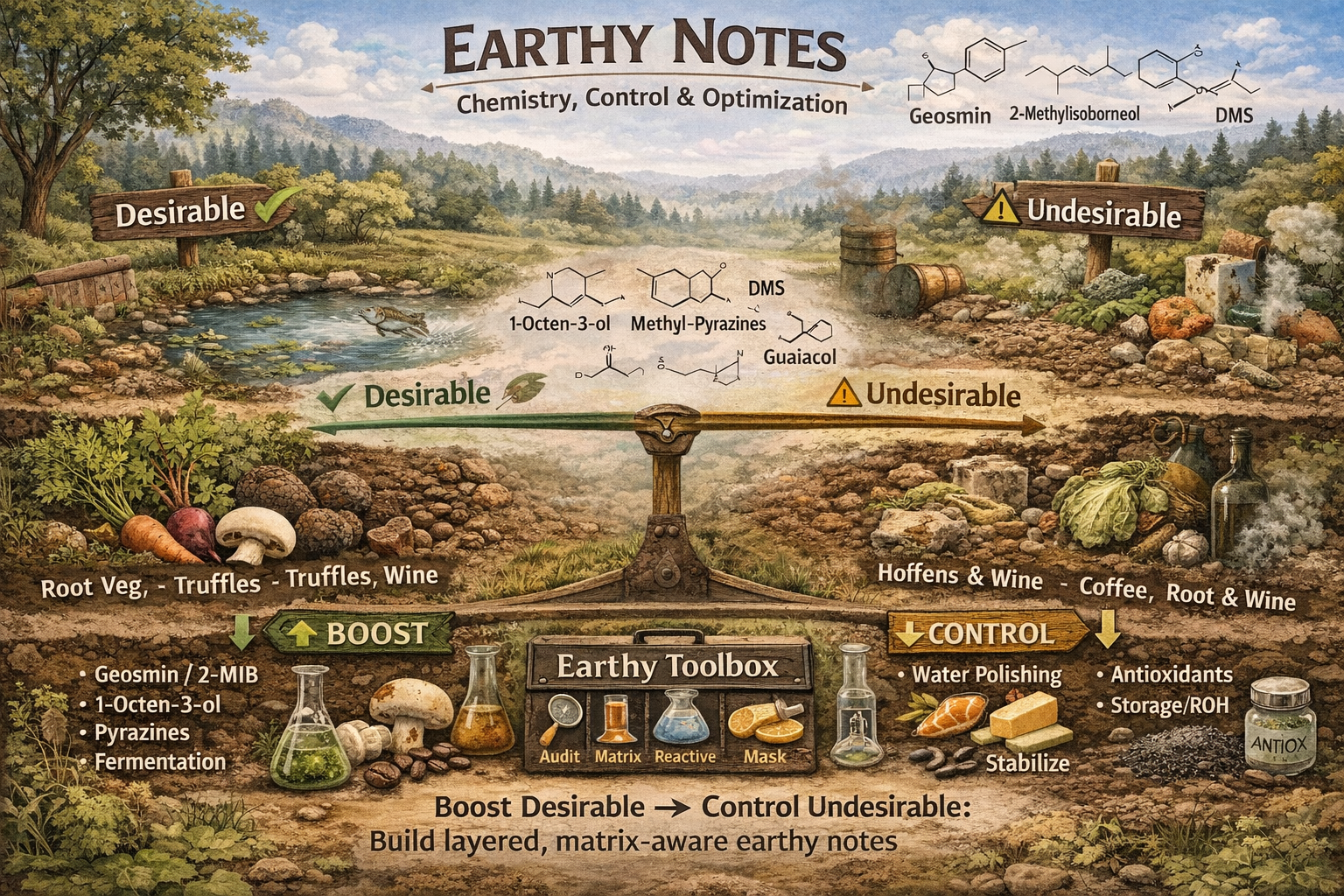
Earthy Note in the Context of SFC’s 25 Core Flavor Notes
The Society of Flavor Chemists (SFC) mandates that all Certified Flavor Chemists master a lexicon of 25 primary flavor notes—earthy among them—as part of a standardized sensory vocabulary. This shared language ensures precision when formulating, replicating, or troubleshooting complex food flavors across the industry.
Within this lexicon, the earthy note is defined as the characteristic aroma of damp soil, wet clay, fresh mushrooms, raw beets, or geosmin-tainted water. It is distinct from related notes like musty (mold-driven), woody (lignin-derived), or peaty (smoke-associated). Flavor chemists must be able to identify earthy notes at very low thresholds—geosmin, for example, is perceptible to most humans at concentrations as low as 5–10 parts per trillion.
In practical application, earthy notes serve dual roles. Desirable earthiness anchors savory flavors (truffle oil, beet concentrates, fermented teas like pu-erh) and adds complexity to plant-based meats. Conversely, undesirable earthiness can ruin delicate products like dairy beverages, white fish, or spring water, requiring masking or removal.
Certified chemists use the SFC framework to systematically adjust earthy notes via:
- Boosting: Adding pyrazines, geosmin, or caryophyllene oxide at ppm levels.
- Dampening: Employing vanillin, diacetyl, or citrus terpenes as suppressants.
- Matrix engineering: Modulating fat, starch, or protein content to control release kinetics.
Mastery of this note—like all 25—is essential for proper use of ingredients, product consistency, and competitive formulation in the global flavor industry.
An earthy note is one of the most distinctive and polarizing flavor attributes—ranging from pleasant “forest floor / root vegetable / mushroom” to undesirable “musty / moldy.” It is chemically diverse, spanning terpenoids, heterocycles, and microbial metabolites with extremely low odor thresholds.