Noteworthy: Compounds and building blocks for brown notes
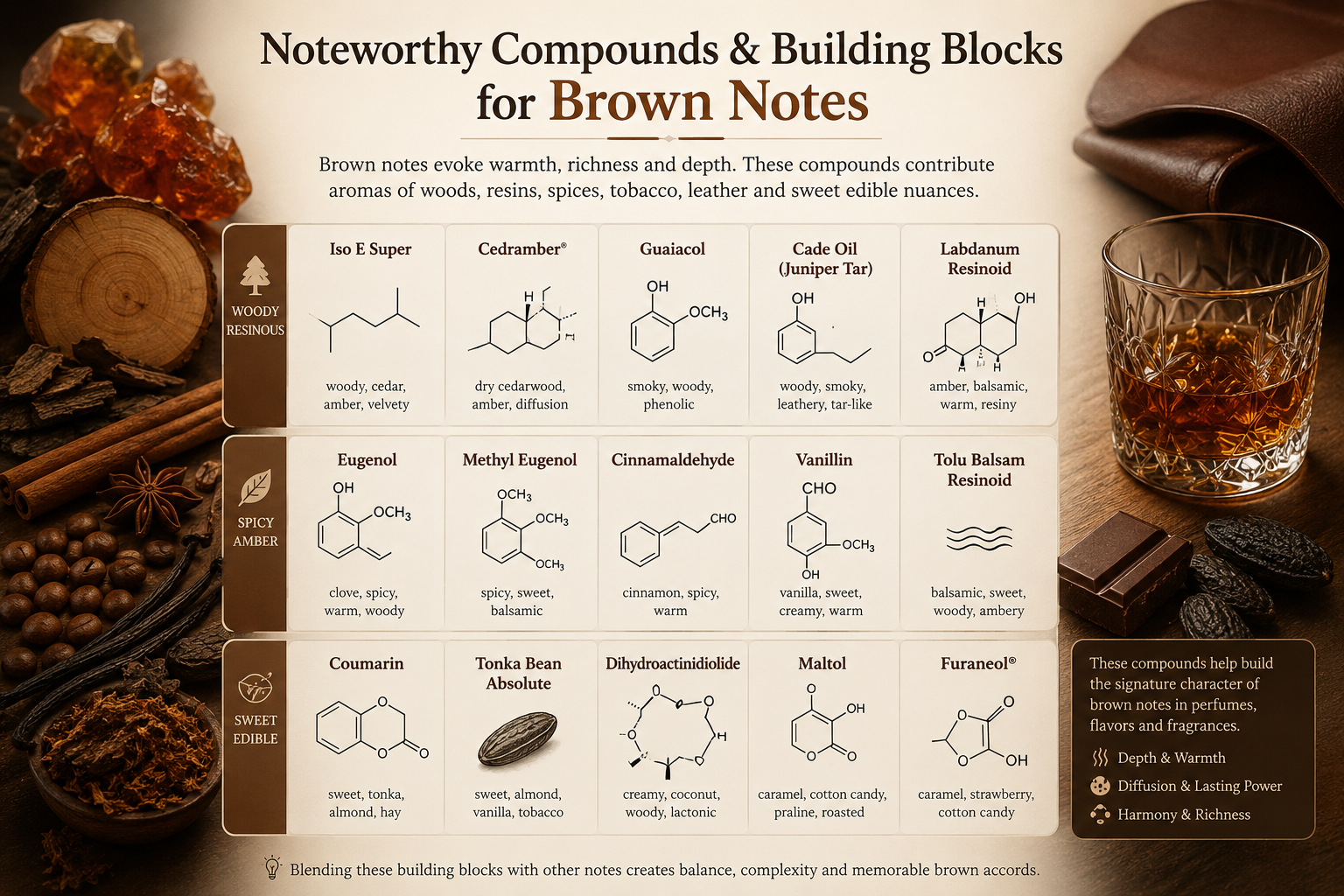
Brownness is a fundamental flavor note that every flavorist needs to understand. The Society of Flavor Chemists requires certified flavorists to know which chemical compounds contribute to a brown note. During the qualification exam, test takers may be asked to describe the compounds that make a flavor browner.
In flavor creation, "brown" flavor character refers to the sensory impression associated with heating, roasting, baking, caramelization, Maillard reactions, toasted sugars, cooked proteins, coffee, cocoa, nuts, crusts, and dark cooked foods.
Brown notes are among the most important dimensions in flavor formulation because they provide warmth, depth, authenticity, cooked character, richness, and maturity.
Major Compound Families That Create Brown Notes
1. Pyrazines
Pyrazines are often considered the backbone of brown flavors.
They contribute:
- Roasted
- Toasted
- Nutty
- Baked
- Coffee-like
- Cocoa-like
Examples:
| Compound | Character |
|---|---|
| 2-Methylpyrazine | Roasted peanut |
| 2,5-Dimethylpyrazine | Toasted cereal |
| 2,3-Dimethylpyrazine | Baked crust |
| Trimethylpyrazine | Cocoa, roasted nuts |
| Tetramethylpyrazine | Deep roasted |
| 2-Ethyl-3,5-dimethylpyrazine | Dark roast coffee |
| 2-Ethyl-3-methylpyrazine | Peanut butter |
| 2-Isobutyl-3-methoxypyrazine | Roasted green vegetable |
Typical effect:
- Creates immediate "brownness"
- Builds baked and roasted authenticity
2. Furans
Produced during caramelization and Maillard reactions.
Provide:
- Caramel
- Brown sugar
- Cotton candy
- Cooked sweetness
Examples:
| Compound | Character |
|---|---|
| Furaneol | Strawberry jam, caramel |
| Homofuraneol | Burnt sugar |
| Furfural | Bread crust |
| 5-Methylfurfural | Dark caramel |
| 2-Acetylfuran | Roasted sweetness |
| Furfuryl alcohol | Coffee |
Furans often create the "sweet brown" portion of a flavor.
3. Sulfur-Containing Maillard Compounds
These compounds create realistic cooked food character.
Examples:
| Compound | Character |
|---|---|
| Methional | Cooked potato |
| Dimethyl trisulfide | Cooked meat |
| 2-Furfurylthiol | Fresh coffee |
| 2-Methyl-3-furanthiol | Roast meat |
| Bis(2-methyl-3-furyl) disulfide | Grilled meat |
| Thiophenes | Roasted |
These materials make brown flavors feel authentic rather than merely sweet.
4. Strecker Aldehydes
Generated during amino acid degradation.
Examples:
| Compound | Character |
|---|---|
| Phenylacetaldehyde | Honey-brown |
| Methional | Cooked potato |
| 3-Methylbutanal | Malt |
| 2-Methylbutanal | Toasted grain |
These add:
- Malt
- Toast
- Bakery
- Warmth
5. Maltol-Type Materials
Important for bakery and confection flavors.
Examples:
| Compound | Character |
|---|---|
| Maltol | Cotton candy |
| Ethyl Maltol | Caramel candy |
| Isomaltol | Burnt sugar |
| Cyclotene | Maple syrup |
Provide:
- Sweet brownness
- Caramelization
- Bakery warmth
6. Lactones
Provide creamy brown character.
Examples:
| Compound | Character |
|---|---|
| γ-Nonalactone | Coconut cream |
| γ-Decalactone | Peach cream |
| δ-Decalactone | Dairy richness |
| Massoia lactone | Coconut caramel |
These soften harsh roast notes.
7. Phenolic Brown Notes
Found in coffee, cocoa, whisky, smoke, and dark roasted products.
Examples:
| Compound | Character |
|---|---|
| Guaiacol | Smoke |
| 4-Methylguaiacol | Roasted coffee |
| Eugenol | Spice |
| Syringol | Smoke sweetness |
| Vanillin | Brown sweetness |
Provide:
- Dark roast
- Smoke
- Cocoa depth
8. Cyclopentenolones
Extremely powerful brown-note contributors.
Examples:
| Compound | Character |
|---|---|
| Cyclotene | Maple |
| Maple furanone | Brown sugar |
| Sotolon | Aged maple |
These create:
- Syrup
- Brown sugar
- Maple
- Long-lasting brown body
Brownness by Food Type
Bread Crust
Key materials:
- 2,5-Dimethylpyrazine
- Furfural
- 3-Methylbutanal
- Maltol
- Acetylpyrazine
Cookie
Key materials:
- Acetylpyrazine
- Maltol
- Vanillin
- Furaneol
- Cyclotene
Chocolate
Key materials:
- Trimethylpyrazine
- Tetramethylpyrazine
- 2-Ethyl-3,5-dimethylpyrazine
- Vanillin
- Phenylacetaldehyde
Coffee
Key materials:
- Furfuryl mercaptan
- Guaiacol
- Pyrazines
- Furfuryl alcohol
- 2-Acetylfuran
Caramel
Key materials:
- Maltol
- Ethyl Maltol
- Furaneol
- Cyclotene
- Sotolon
Roasted Nut
Key materials:
- 2-Methylpyrazine
- 2,3-Dimethylpyrazine
- 2,5-Dimethylpyrazine
- Trimethylpyrazine
Materials That Boost Perceived Brownness
Even though they are not inherently brown, they amplify brown perception:
| Material | Effect |
|---|---|
| Vanillin | Sweet brown |
| Ethyl Vanillin | Rich brown |
| Maple Lactone | Syrupy brown |
| Acetoin | Cooked dairy |
| Diacetyl | Butter |
| Butyric acid (trace) | Cooked richness |
| Phenylacetic acid | Honey brown |
| Honey flavors | Brown sweetness |
Materials That Suppress Brown Notes
| Material | Effect |
|---|---|
| Citral | Fresh citrus |
| Hexanal | Green |
| cis-3-Hexenol | Fresh-cut grass |
| Linalool | Floral |
| Menthol | Cooling |
| Eucalyptol | Fresh |
| Aldehyde C-10 | Waxy citrus |
| Aldehyde C-12 MNA | Clean freshness |
These shift a flavor toward fresh, green, or bright and away from brown.
A Practical "Brown Flavor Block"
A highly versatile commercial brown-note block might contain:
| Component | Relative Parts |
|---|---|
| Acetylpyrazine | 15 |
| 2,5-Dimethylpyrazine | 12 |
| Trimethylpyrazine | 8 |
| Maltol | 20 |
| Ethyl Maltol | 10 |
| Furfural | 8 |
| 5-Methylfurfural | 5 |
| Cyclotene | 10 |
| Vanillin | 8 |
| Phenylacetaldehyde | 4 |
This type of block can be added at low levels to:
- Chocolate flavors
- Coffee flavors
- Bakery flavors
- Caramel flavors
- Brown sugar flavors
- Nut flavors
- Cola flavors
- Whiskey flavors
- Meat reaction flavors
to increase perceived brownness, roast, warmth, and cooked authenticity without drastically changing the primary character.
Brown Flavor Construction System
50 Plug-and-Play Brown Flavor Blocks for Commercial Flavor Development
This system is designed as a modular toolkit. Each block can be used individually or layered with others to construct virtually any brown flavor profile, from lightly toasted bread to dark roasted coffee and chocolate.
SECTION 1 — BREAD & BAKERY BLOCKS
Block 1: Fresh Bread Crust
Character:
- Warm
- Golden brown
- Fresh baked
Key Materials:
| Material | Relative Parts |
|---|---|
| Acetylpyrazine | 25 |
| 2,5-Dimethylpyrazine | 15 |
| Furfural | 15 |
| Maltol | 15 |
| 3-Methylbutanal | 10 |
| Vanillin | 10 |
| Cyclotene | 5 |
| Acetoin | 5 |
Applications:
- Bread
- Rolls
- Crackers
Block 2: Toasted Bread
Character:
- Darker toast
- Crispy crust
Key Materials:
| Material | Parts |
|---|---|
| Acetylpyrazine | 30 |
| Trimethylpyrazine | 20 |
| Furfural | 15 |
| 2-Acetylpyrrole | 10 |
| Cyclotene | 10 |
| Maltol | 10 |
| Guaiacol | 5 |
Block 3: Brioche Brown Note
Character:
- Eggy
- Buttery
- Golden crust
Key Materials:
- Acetoin
- Diacetyl
- Maltol
- Acetylpyrazine
- Furaneol
- Vanillin
Block 4: Croissant Crust
Character:
- Rich bakery
- Butter-brown
Key Materials:
- Diacetyl
- Acetoin
- Acetylpyrazine
- Cyclotene
- Furfural
Block 5: Pretzel Brown
Character:
- Alkaline crust
- Dark baked
Key Materials:
- Acetylpyrazine
- Tetramethylpyrazine
- 2-Acetylpyrrole
- Furfural
- Guaiacol
SECTION 2 — COOKIE & BISCUIT BLOCKS
Block 6: Sugar Cookie
Character:
- Lightly baked
- Sweet brown
Key Materials:
- Maltol
- Ethyl Maltol
- Vanillin
- Acetylpyrazine
- Furaneol
Block 7: Butter Cookie
Character:
- Rich
- Creamy brown
Key Materials:
- Diacetyl
- Acetoin
- Vanillin
- Maltol
- Acetylpyrazine
Block 8: Graham Cracker
Character:
- Honey-brown
- Toasted wheat
Key Materials:
- Phenylacetaldehyde
- Maltol
- Acetylpyrazine
- Furfural
- Cyclotene
Block 9: Biscuit Crust
Character:
- Dry baked
- Cereal
Key Materials:
- 2,5-Dimethylpyrazine
- Furfural
- Maltol
- Cyclotene
Block 10: Wafer Brown
Character:
- Light toasted
Key Materials:
- Acetylpyrazine
- Maltol
- Vanillin
SECTION 3 — BROWNIE & CAKE BLOCKS
Block 11: Brownie Core
Character:
- Dense chocolate brown
Key Materials:
- Trimethylpyrazine
- Tetramethylpyrazine
- Maltol
- Vanillin
- Cyclotene
Block 12: Cake Crust
Character:
- Sweet baked
Key Materials:
- Acetylpyrazine
- Ethyl Maltol
- Vanillin
- Furaneol
Block 13: Yellow Cake Brown
Character:
- Buttery baked
Key Materials:
- Acetoin
- Diacetyl
- Maltol
- Vanillin
Block 14: Devil's Food Cake
Character:
- Dark cocoa brown
Key Materials:
- Tetramethylpyrazine
- Cocoa pyrazines
- Cyclotene
- Vanillin
Block 15: Cupcake Brown
Character:
- Sweet bakery
Key Materials:
- Maltol
- Ethyl Maltol
- Vanillin
- Acetylpyrazine
SECTION 4 — COFFEE BLOCKS
Block 16: Light Roast Coffee
Key Materials:
- Furfuryl Alcohol
- Furfural
- Trimethylpyrazine
- Guaiacol
Block 17: Medium Roast Coffee
Key Materials:
- Furfuryl Mercaptan
- Guaiacol
- Pyrazines
- 2-Acetylfuran
Block 18: Dark Roast Coffee
Key Materials:
- 2-Furfurylthiol
- 4-Methylguaiacol
- Tetramethylpyrazine
Block 19: Espresso
Key Materials:
- Furfurylthiol
- Guaiacol
- Trimethylpyrazine
- Sulfur roast notes
Block 20: Burnt Coffee Edge
Key Materials:
- Phenol
- Guaiacol
- Syringol
- Pyrazines
SECTION 5 — COCOA & CHOCOLATE BLOCKS
Block 21: Milk Chocolate Brown
Key Materials:
- Trimethylpyrazine
- Vanillin
- Maltol
- Acetoin
Block 22: Dark Chocolate
Key Materials:
- Tetramethylpyrazine
- Phenylacetaldehyde
- Vanillin
Block 23: Cocoa Powder
Key Materials:
- Cocoa pyrazines
- Cyclotene
- Furfural
Block 24: Dutch Cocoa
Key Materials:
- Tetramethylpyrazine
- Guaiacol
- Cyclotene
Block 25: Chocolate Brownie
Key Materials:
- Chocolate block
- Bakery block
- Caramel block
SECTION 6 — CARAMEL BLOCKS
Block 26: Light Caramel
Key Materials:
- Maltol
- Furaneol
- Vanillin
Block 27: Medium Caramel
Key Materials:
- Ethyl Maltol
- Cyclotene
- Furfural
Block 28: Dark Caramel
Key Materials:
- Cyclotene
- Sotolon
- 5-Methylfurfural
Block 29: Burnt Sugar
Key Materials:
- Isomaltol
- Cyclotene
- Furfural
Block 30: Toffee
Key Materials:
- Diacetyl
- Maltol
- Cyclotene
- Vanillin
SECTION 7 — ROASTED NUT BLOCKS
Block 31: Peanut Roast
Key Materials:
- 2-Methylpyrazine
- 2,5-Dimethylpyrazine
Block 32: Almond Roast
Key Materials:
- Benzaldehyde
- Pyrazines
Block 33: Hazelnut Roast
Key Materials:
- Filbertone
- Pyrazines
Block 34: Pecan Roast
Key Materials:
- Furans
- Pyrazines
Block 35: Walnut Roast
Key Materials:
- Phenolics
- Pyrazines
SECTION 8 — DARK SUGAR BLOCKS
Block 36: Brown Sugar
Key Materials:
- Maltol
- Cyclotene
- Vanillin
Block 37: Molasses
Key Materials:
- Sotolon
- Cyclotene
- Phenolics
Block 38: Maple Syrup
Key Materials:
- Sotolon
- Cyclotene
Block 39: Treacle
Key Materials:
- Burnt sugar compounds
- Molasses notes
Block 40: Muscovado
Key Materials:
- Molasses block
- Caramel block
SECTION 9 — TOASTED GRAIN BLOCKS
Block 41: Toasted Wheat
Key Materials:
- Acetylpyrazine
- Furfural
Block 42: Malted Barley
Key Materials:
- Maltol
- 3-Methylbutanal
Block 43: Toasted Oat
Key Materials:
- Maltol
- Pyrazines
Block 44: Corn Toast
Key Materials:
- Dimethylpyrazines
- Furfural
Block 45: Granola
Key Materials:
- Honey notes
- Maltol
- Toasted grain notes
SECTION 10 — DEEP BROWN SPECIALTY BLOCKS
Block 46: Whiskey Barrel
Key Materials:
- Vanillin
- Guaiacol
- Oak lactones
Block 47: Smoked Brown
Key Materials:
- Guaiacol
- Syringol
- Cresols
Block 48: Maple Bacon Brown
Key Materials:
- Sotolon
- Pyrazines
- Smoke phenolics
Block 49: Roasted Marshmallow
Key Materials:
- Maltol
- Vanillin
- Furaneol
- Cyclotene
Block 50: Universal Brown Booster
A versatile additive block for increasing brown character in almost any flavor.
| Material | Parts |
|---|---|
| Acetylpyrazine | 20 |
| Trimethylpyrazine | 10 |
| Maltol | 20 |
| Ethyl Maltol | 15 |
| Cyclotene | 10 |
| Furfural | 10 |
| Vanillin | 10 |
| Phenylacetaldehyde | 5 |
Typical usage:
- 0.05–2% of finished flavor concentrate.
Effects:
- Increases roast
- Enhances baked character
- Adds warmth
- Improves caramelization perception
- Deepens cocoa and coffee profiles
- Boosts brown sugar authenticity