Essential Oils: What Flavorists Need to Know
1. What essential oils are
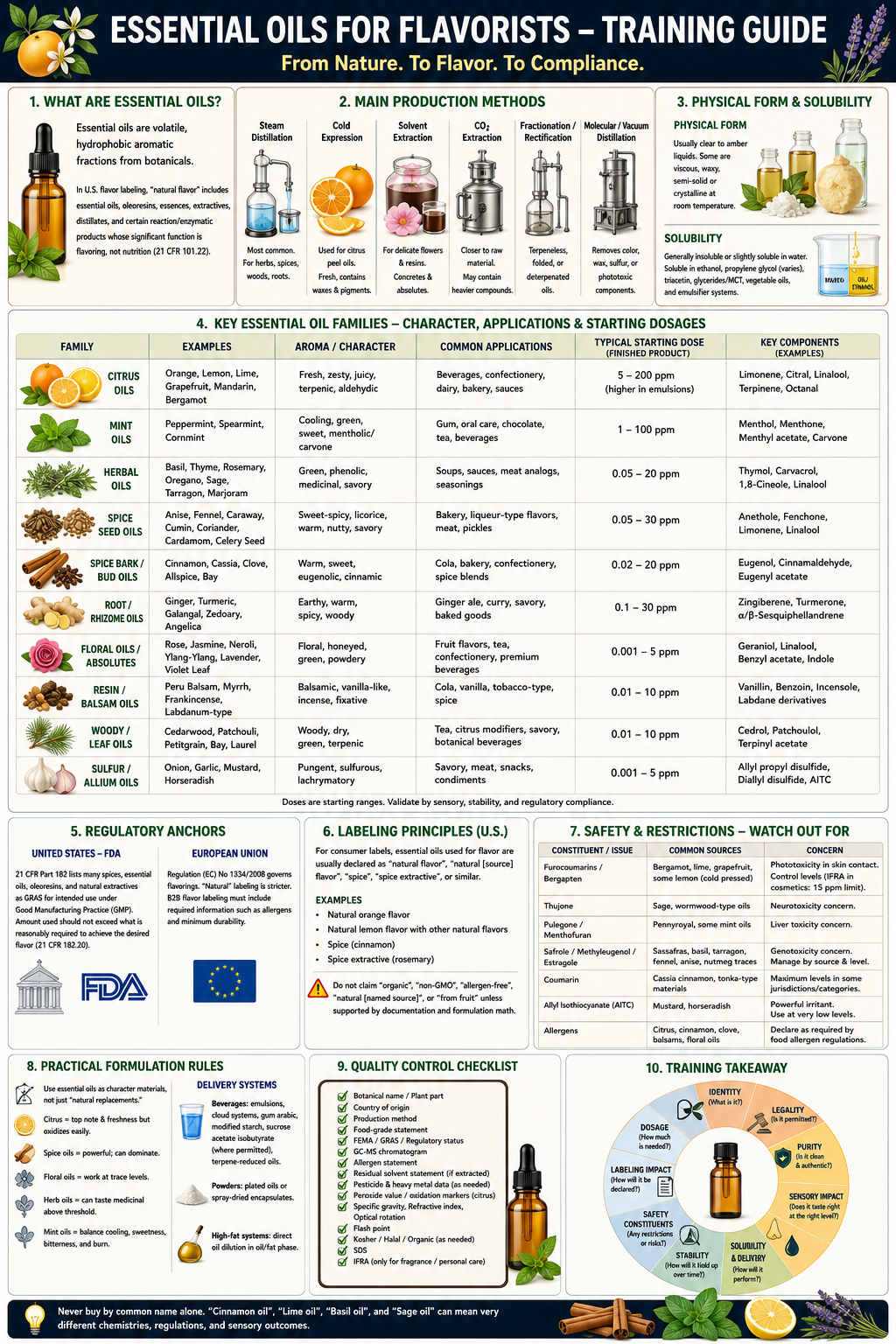
Essential oils are volatile, hydrophobic aromatic fractions from botanicals. In U.S. flavor labeling, “natural flavor” includes essential oils, oleoresins, essences, extractives, distillates, and certain reaction/enzymatic products whose significant function is flavoring, not nutrition. (Legal Information Institute)
Physical form: usually clear to amber mobile liquids; some are viscous, waxy, semi-solid, or crystalline at room temperature, for example rose otto, anise, fennel, menthol-rich mint fractions, or patchouli-type oils.
Solubility: generally insoluble or only slightly soluble in water; soluble in ethanol, propylene glycol to varying degrees, triacetin, glycerides/MCT, vegetable oils, and emulsifier systems. Citrus terpenes are especially oil-soluble and poor in aqueous systems unless emulsified.
2. Main production methods
| Method | Used for | Flavorist notes |
|---|---|---|
| Steam distillation | Mint, herbs, spices, woods, roots | Most common. Can create cooked, terpenic, phenolic, or sulfur changes. |
| Cold expression | Citrus peel oils | Freshest citrus impact; contains waxes, pigments, nonvolatiles, and sometimes furocoumarins. |
| Solvent extraction | Absolutes, concretes, resinoids | Used for delicate flowers/resins. Must meet food-grade solvent/residue rules. |
| CO₂ extraction | Spices, herbs, hops, citrus | Often closer to raw material; may contain heavier waxy/resinous compounds. |
| Fractionation / rectification | Terpeneless, folded, deterpenated oils | Improves solubility, stability, strength, or removes harsh terpenes. |
| Molecular distillation / vacuum distillation | Citrus, spice, herb oils | Used to reduce phototoxic components, sulfur, color, wax, or heavy notes. |
3. Organoleptic families, applications, and starting dosages
Use dosages as finished-product starting ranges, then validate by sensory, stability, and regulation. Typical practical use is often 0.1–50 ppm, but some materials are used below 0.1 ppm and some citrus/mint oils much higher.
| Family | Examples | Character | Applications | Typical starting dose |
|---|---|---|---|---|
| Citrus peel oils | Orange, lemon, lime, grapefruit, mandarin, bergamot | Fresh, zesty, juicy, terpenic, aldehydic | Beverages, confectionery, dairy, bakery, sauces | 5–200 ppm; emulsions may use higher oil phase load |
| Mint oils | Peppermint, spearmint, cornmint | Cooling, green, sweet, carvone/mentholic | Gum, oral care, chocolate, tea, beverages | 1–100 ppm |
| Herbal oils | Basil, thyme, rosemary, oregano, sage, tarragon, marjoram | Green, phenolic, medicinal, savory | Soups, sauces, meat analogs, seasonings | 0.05–20 ppm |
| Spice seed oils | Anise, fennel, caraway, cumin, coriander, cardamom, celery seed | Sweet-spicy, licorice, warm, nutty, savory | Bakery, liqueur-type flavors, meat, pickles | 0.05–30 ppm |
| Spice bark/bud oils | Cinnamon, cassia, clove, allspice, bay | Warm, sweet, eugenolic, cinnamic | Cola, bakery, confectionery, spice blends | 0.02–20 ppm |
| Root/rhizome oils | Ginger, turmeric, galangal, zedoary, angelica | Earthy, warm, spicy, woody | Ginger ale, curry, savory, baked goods | 0.1–30 ppm |
| Floral oils/absolutes | Rose, jasmine, neroli, ylang-ylang, lavender, violet leaf | Floral, honeyed, green, powdery | Fruit flavors, tea, confectionery, premium beverages | 0.001–5 ppm |
| Resin/balsam oils | Peru balsam, myrrh, frankincense, labdanum-type | Balsamic, vanilla-like, incense, fixative | Cola, vanilla, tobacco-type, spice | 0.01–10 ppm |
| Woody/leaf oils | Cedarwood, patchouli, petitgrain, bay, laurel | Woody, dry, green, terpenic | Tea, citrus modifiers, savory, botanical beverages | 0.01–10 ppm |
| Sulfur/allium oils | Onion, garlic, mustard, horseradish | Pungent, sulfurous, lachrymatory | Savory, meat, snacks, condiments | 0.001–5 ppm |
4. U.S. food-flavor regulatory anchor
FDA’s 21 CFR Part 182 lists many spices, essential oils, oleoresins, and natural extractives as GRAS for intended use under good manufacturing practice. GMP means the amount should not exceed what is reasonably required, the substance must be food grade, and it must be handled as a food ingredient. (eCFR)
FDA 21 CFR §182.20 specifically lists many essential oils/extractives, including citrus peel oils, bergamot, lemon, lime, orange, grapefruit, peppermint, spearmint, cinnamon bark/leaf, cassia, clove-related spice oils, cardamom, coriander, cumin, ginger, nutmeg, rosemary, sage, thyme, basil, bay, fennel, anise, tarragon, lavender, rose, jasmine, ylang-ylang, neroli, petitgrain, onion, mustard, and others. (eCFR)
5. EU regulatory anchor
In the EU, flavorings are governed mainly by Regulation (EC) No 1334/2008. “Natural” labeling is stricter than casual marketing language: natural flavoring substance labeling requires the flavoring part to be natural, and B2B flavor labeling must include required information such as allergens and minimum durability. (effa.eu)
6. Labeling principles flavorists must know
For U.S. consumer labels, essential oils used for flavor are usually declared as “natural flavor,” “natural [source] flavor,” “spice,” “spice extractive,” or similar, depending on composition, source, and product positioning. If the flavor is entirely natural, it may be labeled as natural flavor; if it contains both natural and artificial flavoring components, the declaration changes accordingly. (Legal Information Institute)
Do not promise “organic,” “non-GMO,” “allergen-free,” “natural [named source],” or “from fruit” unless supplier documentation and formulation math support it.
7. Safety and restriction watch-outs
Flavorists must screen essential oils for naturally occurring restricted or risk-relevant constituents:
| Constituent / issue | Common sources | Concern |
|---|---|---|
| Furocoumarins / bergapten | Cold-pressed bergamot, lime, grapefruit, some lemon | Phototoxicity in cosmetic/fragrance use; food use still needs specification control. IFRA notes a 15 ppm bergapten limit for UV-exposed leave-on products. (d3t14p1xronwr0.cloudfront.net) |
| Thujone | Sage, wormwood-type oils | Neurotoxicity concern; check local limits. |
| Pulegone / menthofuran | Pennyroyal, some mint oils | Liver toxicity concern; avoid non-food-grade pennyroyal. |
| Safrole / methyleugenol / estragole | Sassafras-type, basil, tarragon, fennel, anise, nutmeg traces | Genotoxicity concern; manage by source, level, and regulation. |
| Coumarin | Cassia cinnamon, tonka-type materials | Maximum levels in some jurisdictions/categories. |
| Allyl isothiocyanate | Mustard, horseradish | Powerful irritant; use very low and verify limits. |
| Allergens | Citrus, cinnamon, clove, balsams, floral oils | Food allergen rules differ from fragrance allergen rules; document and label as required. |
8. Practical formulation rules
Use essential oils as character materials, not just “natural replacements.” Citrus gives top note and freshness but oxidizes easily. Spice oils are powerful and can dominate. Floral oils work at trace levels. Herb oils can taste medicinal above threshold. Mint oils require balance between menthol cooling, sweetness, bitterness, and burn.
For beverages, use emulsions, cloud systems, gum arabic, modified starch, sucrose acetate isobutyrate where permitted, or terpene-reduced oils. For powders, use plated oils or spray-dried encapsulates. For high-fat systems, direct oil dilution is usually easiest.
9. Quality-control checklist
Every oil lot should have: botanical name, plant part, country of origin, production method, food-grade statement, FEMA/GRAS or regulatory status where applicable, GC-MS profile, allergen statement, residual solvent statement if extracted, pesticide/heavy metal data when needed, peroxide value or oxidation markers for citrus, specific gravity, refractive index, optical rotation, flash point, kosher/halal/organic as needed, SDS, and IFRA only when used in fragrance/personal-care applications.
10. Training takeaway
A flavorist should evaluate every essential oil by identity, legality, purity, sensory impact, solubility, stability, safety constituents, labeling impact, and dosage. Never buy by common name alone: “cinnamon oil,” “lime oil,” “basil oil,” and “sage oil” can mean very different chemistries, regulations, and sensory outcomes.
###