Europe Food & Flavor Regulatory Update: Key legal and regulatory developments released August 1–14, 2026
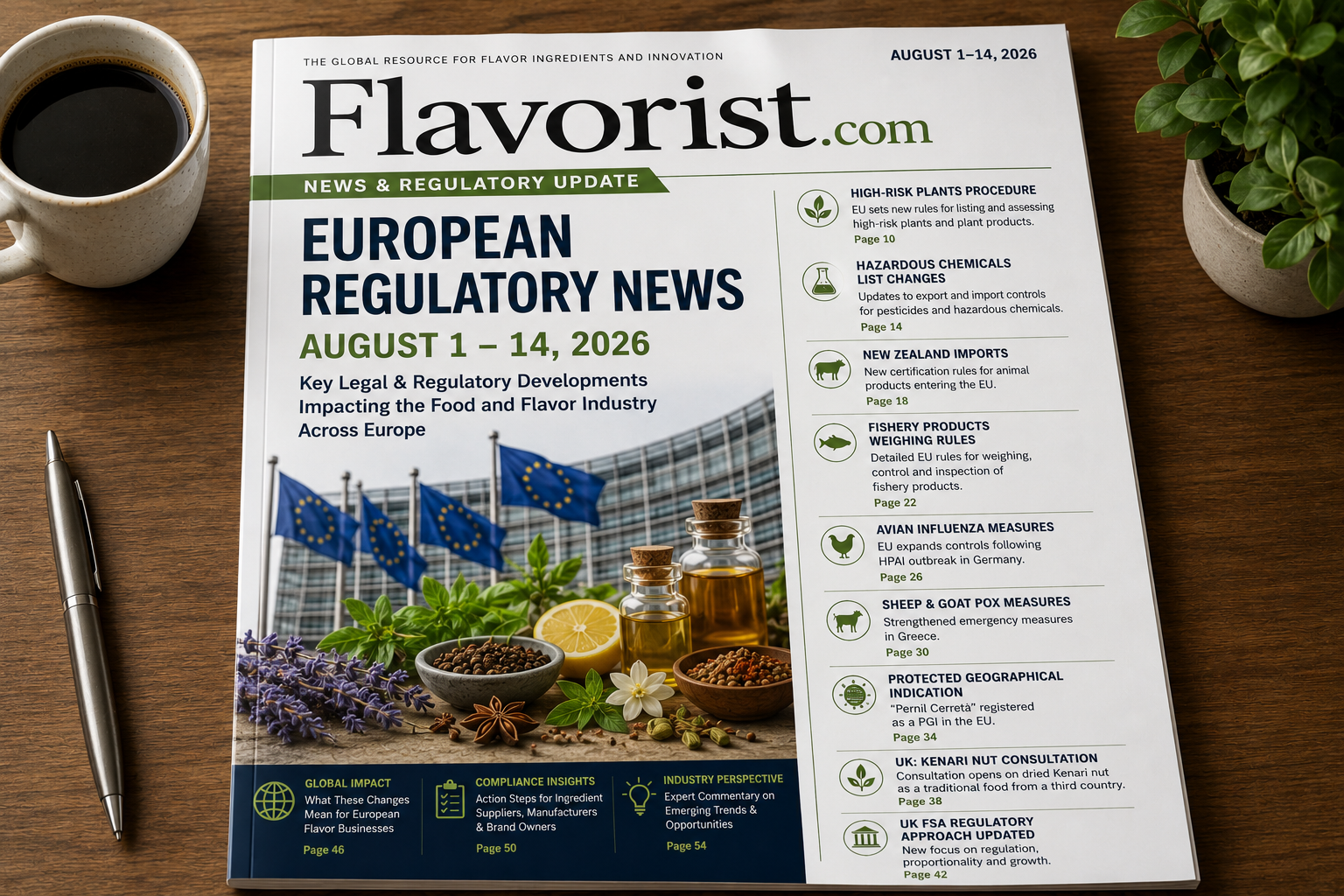
Friday August 14, 2026 – Below are derived from a review of the principal EU and UK regulatory channels for August 1–14, 2026, particularly EUR-Lex/Official Journal, European Commission DG SANTE, FSA and Food Standards Scotland. prioritized are measures that could affect food ingredients, flavors, botanicals, agricultural raw materials, seafood, meat, imports, pesticides, novel foods, labeling, protected products, and food-safety compliance.
All releases identified include nine developments with meaningful food-industry relevance during the period. Several are directly binding EU measures; others are consultations, regulatory guidance, or enforcement actions that companies should monitor.
1. EU creates new procedure for assessing “high-risk” imported plants and plant products
European Union | Published August 14, 2026 | Delegated Regulation | High relevance to botanical ingredient supply chains
The European Commission published Delegated Regulation (EU) 2026/1195, establishing procedures for listing and assessing high-risk plants, plant products and other objects under the EU Plant Health Regulation. The measure determines how products can be provisionally categorized as high risk and subsequently evaluated before import restrictions are maintained, modified or removed. It was published in the Official Journal on August 14. (Eur-Lex)
For the flavor industry, the significance lies mainly upstream. Numerous flavors and extracts originate from imported herbs, spices, fruits, roots, leaves, seeds and other botanical materials. Changes to plant-health risk status can affect the ability to import those raw materials, documentation requirements and border-clearance timelines.
Industry impact: European flavor houses and botanical extract manufacturers should ensure procurement teams monitor plant-health classifications alongside ordinary food-safety requirements. A botanical may be legally acceptable as a food ingredient yet still face restrictions because of plant-pest risks.
Source: [EUR-Lex — Commission Delegated Regulation (EU) 2026/1195] (Eur-Lex)
2. EU changes hazardous-chemical listings covering pesticides
European Union | Published August 12, 2026 | Delegated Regulation | Medium–High relevance
The Commission published Delegated Regulation (EU) 2026/1278, amending and correcting Regulation (EU) No 649/2012 concerning the export and import of hazardous chemicals, including pesticides. The regulation updates the chemicals subject to controls under the EU's implementation of the Rotterdam Convention/Prior Informed Consent framework. (Eur-Lex)
This is not a food-additive regulation and does not itself establish pesticide maximum residue levels. However, it matters to the food and flavor sector because agricultural raw materials—spices, herbs, citrus, fruits, vegetables and botanicals—depend heavily on pesticide availability and international chemical supply chains. Tighter export/import controls can change which crop-protection chemicals are economically or legally accessible to growers in supplying countries.
Industry impact: Ingredient companies should coordinate pesticide-residue monitoring with agricultural suppliers rather than relying solely on finished-material certificates of analysis. Changes in pesticide availability can shift grower practices and potentially alter residue profiles in imported botanicals.
Source: [EUR-Lex — Commission Delegated Regulation (EU) 2026/1278] (Eur-Lex)
3. EU introduces new certification framework for food-producing animals and animal products imported from New Zealand
European Union | Published August 12, 2026 | Implementing Decision | High relevance to animal-derived foods and ingredients
Commission Implementing Decision (EU) 2026/1936 creates new certification rules and a model health certificate covering imports from New Zealand of live animals and animal products considered equivalent to EU standards. It replaces the previous 2015 certification decision and entered into force August 13. (Eur-Lex)
The framework covers animal and public-health attestations, official certification and electronic transmission through systems including TRACES. It also incorporates assurances concerning antimicrobial medicinal products and allows certain combined health certifications. Transitional arrangements govern the use of existing certificates. (Eur-Lex)
Industry impact: The measure matters to companies importing New Zealand meat, dairy and other animal-derived food materials, including ingredients incorporated into prepared foods, savory systems and nutritional formulations. European importers should review certificates with suppliers, customs brokers and veterinary-compliance teams to prevent border delays when the updated requirements become applicable.
Source: [EUR-Lex — Commission Implementing Decision (EU) 2026/1936] (Eur-Lex)
4. EU establishes detailed new weighing and control rules for fishery products
European Union | Published August 11, 2026 | Implementing Regulation | High relevance to seafood processors
The Commission published Implementing Regulation (EU) 2026/1932, establishing detailed rules covering the weighing, control and inspection of fishery products, including minimum standards for weighing systems, sampling plans and control programmes. The regulation applies from January 11, 2027. (Eur-Lex)
Required records include the weighing system used, vessel information, timing and location of weighing, quantities and species identified using FAO codes. Member States may permit certain alternative arrangements, but equivalent or better accuracy must be demonstrated. (Eur-Lex)
Industry impact: Seafood processors, importers and manufacturers using seafood-derived ingredients should expect greater emphasis on accurate quantity determination and traceability at landing and processing points. The measure is particularly relevant to fish processors supplying stocks, extracts, seafood seasonings and other value-added ingredients because source documentation can flow through to downstream traceability and mass-balance systems.
Source: [EUR-Lex — Commission Implementing Regulation (EU) 2026/1932] (Eur-Lex)
5. EU expands emergency controls following highly pathogenic avian influenza in Germany
European Union | Published August 11, 2026 | Implementing Decision | Medium–High supply-chain relevance
The Commission adopted Implementing Decision (EU) 2026/1944 following a new highly pathogenic avian influenza (HPAI) outbreak in Germany. Germany notified an outbreak at a poultry establishment in Lower Saxony, requiring new protection and surveillance zones to be incorporated into the EU's existing emergency-measures framework. (Eur-Lex)
The measure is primarily an animal-health action, but these decisions can directly influence poultry movements and therefore the availability of poultry, eggs and derived raw materials within affected areas.
Industry impact: Food manufacturers using poultry-derived ingredients, egg products, chicken powders, broths, reaction-flavor substrates or other animal-based savory ingredients should monitor disease-control zones as part of supply-risk management. Restrictions can create short-term shifts in sourcing even when the finished ingredient itself remains compliant. Manufacturers relying on geographically concentrated European poultry suppliers may particularly benefit from approved alternate sources.
Source: [EUR-Lex — Commission Implementing Decision (EU) 2026/1944] (Eur-Lex)
6. EU strengthens sheep- and goat-pox emergency measures in Greece
European Union | Published August 6, 2026 | Implementing Decision | Medium relevance to meat/dairy supply
The European Commission published Implementing Decision (EU) 2026/1931, amending existing emergency measures addressing outbreaks of sheep pox and goat pox in Greece. The measure updates EU disease-control actions intended to contain the spread of these highly contagious livestock diseases. (Eur-Lex)
Although the regulation is aimed at animal health rather than food formulation, it is relevant to food companies because restrictions on movements of sheep and goats can affect livestock production, slaughter, milk collection and regional sourcing.
Industry impact: Companies using Greek sheep- or goat-derived products—including cheeses, milk ingredients, meat ingredients, fermented dairy products and savory flavor precursors—should watch the geographical scope of controls and supplier continuity. Flavor houses serving cheese, dairy and meat applications may experience indirect impacts if customers alter sourcing or formulations because of livestock availability. Procurement teams should maintain documentation showing the origin and legal movement of affected animal-derived inputs.
Source: [EUR-Lex — Commission Implementing Decision (EU) 2026/1931] (Eur-Lex)
7. EU registers “Pernil Cerretà” as a protected geographical indication
European Union | Published August 4, 2026 | Implementing Regulation | Medium relevance to labeling and flavor positioning
The European Commission published Implementing Regulation (EU) 2026/1901, registering Pernil Cerretà as a Protected Geographical Indication (PGI) in the EU register under Regulation (EU) 2024/1143. (Eur-Lex)
A GI registration protects the registered name against unauthorized commercial use, imitation or misleading presentation where applicable. While this regulation concerns a specific product rather than the general food sector, GI protection matters to companies developing meat flavors, culinary products, sauces, seasonings and prepared foods that reference regional foods on labels or in marketing.
Industry impact: Flavor companies should distinguish between describing a sensory profile—such as cured-ham style—and implying that an ingredient or finished product has protected geographical origin. Marketing, regulatory and legal teams should review use of newly protected food names in flavor descriptors, product names and customer concepts, particularly where consumers could infer geographical authenticity.
Source: [EUR-Lex — Commission Implementing Regulation (EU) 2026/1901] (Eur-Lex)
8. UK consults on authorizing dried Kenari nut as a traditional food from a third country
United Kingdom | Opened August 6, 2026 | Novel-food consultation | High relevance to novel ingredients
The UK Food Standards Agency and Food Standards Scotland opened consultations concerning authorization of dried Kenari Nut (Canarium indicum L.) as a traditional food from a third country under the UK novel-food framework. Food Standards Scotland states that it did not raise safety objections and is seeking views particularly on conditions of use and specific labeling requirements. (Food Standards Scotland)
This is potentially significant for ingredient developers because Kenari nuts can provide both culinary and ingredient-development opportunities. Authorization would define how the ingredient may legally enter the UK food market and what labeling conditions must accompany it.
Industry impact: Flavor, confectionery, bakery, snack and plant-based-food developers should watch the final authorization. Early review of allergen implications, compositional specifications, supplier traceability and proposed labeling conditions could shorten commercialization timelines. It also illustrates the UK’s increasingly independent regulated-product authorization system following Brexit.
Source: [Food Standards Scotland — Dried Kenari Nut consultation] (Food Standards Scotland)
Parallel UK source: [Food Standards Agency — Market Authorisation Consultation] (GOV.UK)
9. UK FSA updates its regulatory approach and explicitly connects regulation with economic growth
United Kingdom | August 4, 2026 update | Policy/Regulatory Framework | Medium strategic relevance
The UK Food Standards Agency updated its official Regulatory Approach on August 4, adding information on its approach to economic growth. The framework describes how the agency develops policy, undertakes consultation, prepares impact assessments and reviews existing food regulation. It emphasizes proportionate regulation while maintaining the FSA's statutory objective of protecting public health and consumers' interests. (GOV.UK)
The document does not itself change ingredient permissions or labeling rules, but it is useful for forecasting how future UK food regulations may be developed. The FSA states that it evaluates costs and benefits, consults stakeholders and reviews whether regulations remain effective and proportionate. (GOV.UK)
Industry impact: Flavor and ingredient companies pursuing new authorizations—particularly additives, flavorings, enzymes, novel foods and other regulated products—should view this as an opportunity to provide economic and technical evidence during consultation processes.
Source: [UK Food Standards Agency — Regulatory Approach] (GOV.UK)
Important enforcement developments
Two UK enforcement actions during this same period deserve separate attention even though they are not new legislation.
On August 4, the FSA announced a criminal investigation after authorities discovered an unapproved meat-cutting operation, arrested four individuals and removed approximately 4.25 metric tonnes of meat. The FSA emphasized that meat entering the supply chain through unapproved establishments bypasses required hygiene and safety controls. (GOV.UK)
On August 13, the FSA's National Food Crime Unit reported that more than 33 tonnes of suspected illegal frozen food had been seized through an investigation involving multiple authorities. (GOV.UK)
These actions indicate continued enforcement focus on supplier legitimacy, approved establishments, traceability and food authenticity. Savory flavor and ingredient manufacturers buying animal-derived powders, extracts or processed meat materials should therefore verify establishment approvals and chain-of-custody records rather than relying exclusively on conventional supplier certificates. (GOV.UK)
What matters most for the European flavor industry
From a flavor-company perspective, I would rank the August 1–14 developments in this order of practical importance:
- UK Kenari nut novel-food consultation — potential new botanical/food ingredient and labeling requirements. (Food Standards Scotland)
- EU high-risk plant import procedure — potentially important for imported herbs, spices and botanicals. (Eur-Lex)
- EU pesticide/hazardous-chemical listing changes — upstream implications for agricultural ingredient supply chains. (Eur-Lex)
- New Zealand animal-product certification — direct import-compliance implications for meat/dairy ingredients. (Eur-Lex)
- Fishery-product weighing rules — increased control and traceability obligations affecting seafood supply chains. (Eur-Lex)
- Animal-disease emergency measures — potential poultry, sheep and goat ingredient supply disruption. (Eur-Lex)
- PGI protection — relevant to product naming, imitation flavors and geographical claims. (Eur-Lex)
One additional point deserves attention: some major EU food rules became applicable during this August window even though they were published earlier, which are excluded from the main list because regulatory news needs to be released August 1–14. For example, the EU packaging framework contains a significant August 12, 2026 PFAS-related food-contact packaging milestone, but the underlying legislation was published earlier and therefore is not properly an August 1–14 regulatory release. (Eur-Lex)
Coverage note: All listed are material regulatory developments identifiable through the principal European-level and UK food-regulatory sources. Europe has dozens of national regulators, so a literal survey of every national gazette in all European countries could surface additional country-specific measures. The list above therefore emphasizes EU-wide rules plus UK developments with meaningful food/flavor-industry impact, rather than routine recalls, administrative notices or purely agricultural measures with no realistic food-industry consequence.
###