North American Food & Flavor Regulatory Update: Key Legal Developments, August 1–14, 2026
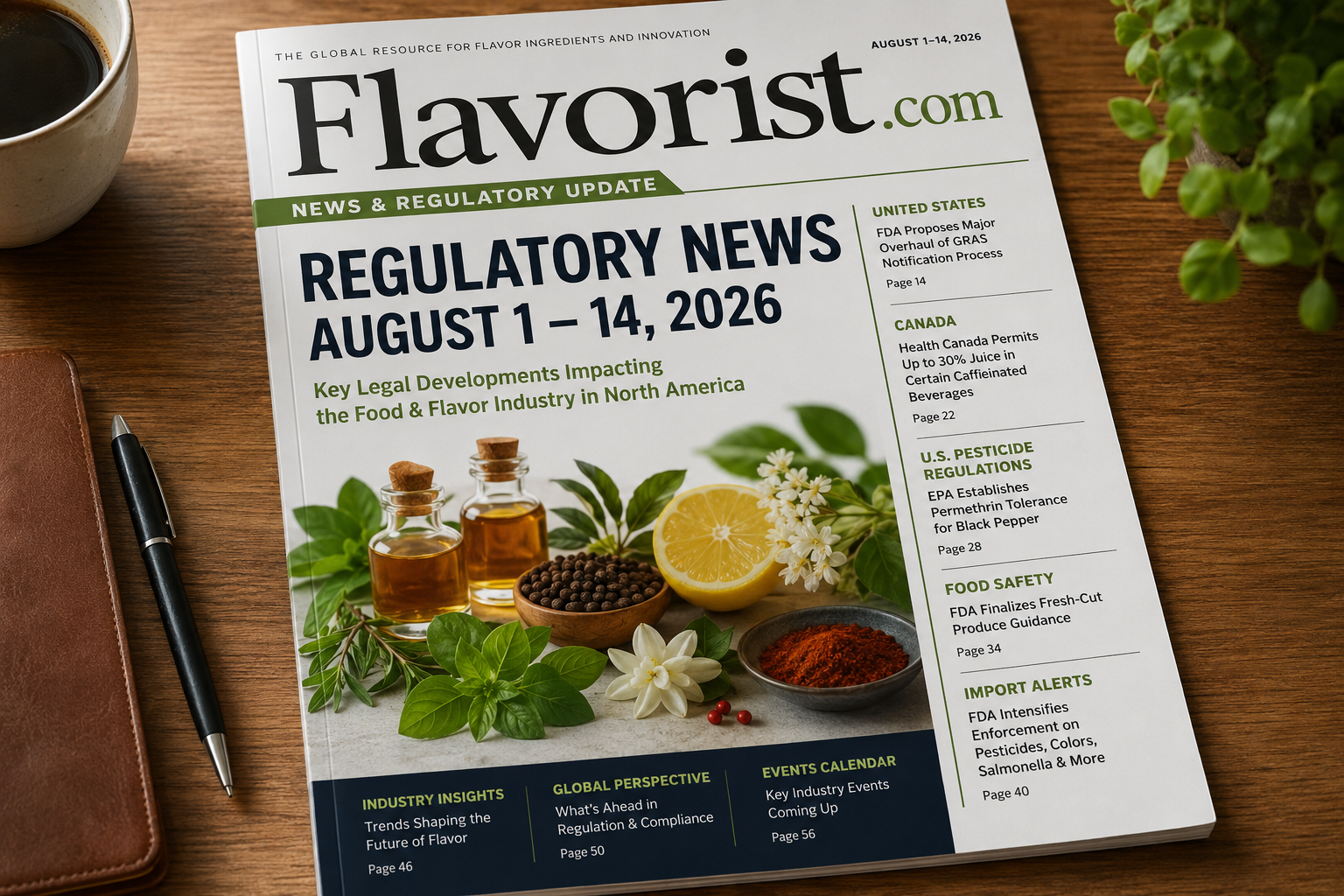
Friday August 14, 2026 – Listed below are regulatory releases from August 1–14, 2026 across the U.S., Canada, and Mexico, prioritizing FDA, EPA, USDA/FSIS, Health Canada/CFIA, the U.S. Federal Register, Mexico’s Diario Oficial, and relevant state-level developments. The most consequential theme for the flavor and ingredient sector is FDA’s proposed overhaul of GRAS notification; several additional measures affect spices, agricultural inputs, fresh-cut foods, supplemented beverages, and imported ingredients.
Seven developments are newsworthy and considered materially relevant, in addition to a significant cluster of FDA import-enforcement updates.
1. FDA proposes mandatory GRAS notification — major implications for flavor and ingredient companies
United States | August 11, 2026 | Proposed Rule | Very High Impact
FDA proposed fundamentally changing the U.S. Generally Recognized as Safe (GRAS) framework by requiring manufacturers to notify FDA of certain conclusions that substances added to human or animal food are GRAS. Currently, companies can reach an independent or “self-GRAS” conclusion without submitting that determination to FDA. The proposal would significantly narrow that pathway and increase federal visibility into substances entering the food supply. (Federal Register)
The rule is particularly consequential for the flavor industry. FDA’s own economic analysis specifically recognizes substances evaluated through Flavor and Extract Manufacturers Association expert panels, estimating roughly 1,740 association expert-panel GRAS substances already introduced into commerce. FDA envisions streamlined submissions for certain existing GRAS substances after a final rule takes effect. (Federal Register)
Industry impact: Flavor houses should begin inventorying self-GRAS/FEMA-GRAS substances, underlying safety dossiers, intended-use levels, exposure analyses, expert-panel records and customer documentation. New flavor substances could face additional filing, documentation and commercialization lead-time requirements.
Source: [FDA / Federal Register – Substances Generally Recognized as Safe] (Federal Register)
2. EPA establishes a permethrin residue tolerance for imported black pepper
United States | August 3, 2026 | Final Rule | High Impact for spice/flavor supply chains
EPA issued a final rule establishing a 0.1 ppm tolerance for permethrin residues on black pepper, effective August 3. The petition was submitted by the American Spice Trade Association. Importantly, the tolerance is effectively an import tolerance: EPA states there was no U.S. registration for permethrin use on black pepper when the rule became effective. (Federal Register)
EPA determined that the 0.1 ppm tolerance satisfies the FFDCA safety standard. The level harmonizes the U.S. with the European Union’s 0.1 ppm limit and Canada's 0.1 ppm level for pepper-spices, although it is above the Codex 0.05 ppm MRL. EPA specifically noted that harmonization should facilitate international trade. (Federal Register)
Industry impact: This is directly relevant to pepper importers, seasoning companies, spice extractors, oleoresin manufacturers and flavor companies sourcing black pepper internationally. Lots previously facing potential U.S. regulatory problems solely because of trace permethrin can now legally contain residues up to 0.1 ppm. Supplier specifications and pesticide-residue testing programs should be updated accordingly.
Source: [EPA / Federal Register – Permethrin; Pesticide Tolerances] (Federal Register)
3. EPA exempts a new Bt protein used in corn from pesticide-residue tolerance requirements
United States | August 7, 2026 | Final Rule | Medium–High Impact
EPA established an exemption from the requirement for a pesticide tolerance for Bacillus thuringiensis eCry1Gb.1Ig protein when used as a plant-incorporated protectant in field corn, sweet corn and popcorn. The rule became effective August 7, 2026, following a petition by Syngenta Seeds. (Federal Register)
A tolerance exemption means there is no numerical maximum residue limit required for the specified protein when the protected corn is produced in accordance with applicable regulatory conditions. EPA concluded the exemption satisfies the FFDCA safety standard, including the statutory protections applicable to infants and children. (Federal Register)
Industry impact: The immediate effect falls primarily on agricultural biotechnology and corn production, but downstream food companies should also monitor it. Corn is a major feedstock for starches, sweeteners, maltodextrins, fermentation substrates, alcohol, carriers, flavor systems and numerous processed-food ingredients. The decision can facilitate commercialization and supply-chain use of corn varieties containing the PIP without a separate residue tolerance being required for the protein.
Source: [EPA / Federal Register – eCry1Gb.1Ig Protein Tolerance Exemption] (Federal Register)
4. EPA exempts a pesticide-formulation polymer from food-residue tolerance requirements
United States | August 7, 2026 | Final Rule | Medium Impact
EPA also finalized a tolerance exemption covering a polymer identified as CAS No. 1186225-21-7, used as an inert ingredient in pesticide formulations. The exemption removes the need to establish a numerical maximum residue level when residues of the polymer occur on food or feed commodities through permitted pesticide uses. The rule took effect August 7. (Federal Register)
EPA classified the material under its low-risk-polymer framework, concluding that it meets the applicable molecular-weight and chemical criteria and that a numerical tolerance is unnecessary to protect public health. The agency expressly considered possible residues across raw and processed agricultural commodities and drinking water. (Federal Register)
Industry impact: This is less directly significant to flavor formulation than the GRAS proposal, but it matters upstream. Food, spice, botanical and agricultural-ingredient suppliers may encounter crops treated with pesticide formulations containing this inert material without requiring a specific residue limit for the polymer. Procurement and pesticide-compliance teams should recognize the new exemption when reviewing pesticide-residue declarations and supplier documentation.
Source: [EPA / Federal Register – Polymer Tolerance Exemption] (Federal Register)
5. FDA finalizes updated food-safety guidance for ready-to-eat fresh-cut produce
United States | August 12, 2026 | Final Guidance | High Impact for processors
FDA released final guidance titled “Guide to Minimize Biological Hazards in Ready-to-Eat Fresh-Cut Produce.” It replaces FDA’s 2008 fresh-cut fruit and vegetable guidance and finalizes the draft issued in 2018. The guidance is designed to help processors comply with CGMP, hazard-analysis and risk-based preventive-control requirements under 21 CFR Part 117. (Federal Register)
The document applies to ready-to-eat fresh-cut produce with water activity above 0.85. FDA added or clarified recommendations involving antimicrobial process controls, supplier-program measures to control pathogens, and time/temperature control. Although guidance is formally nonbinding, it communicates FDA’s current regulatory expectations and can strongly influence inspections and preventive-control assessments. (Federal Register)
Industry impact: Relevant businesses include processors of cut fruit, vegetables, herbs and botanical ingredients, as well as companies incorporating fresh-cut components into prepared foods. Flavor and ingredient manufacturers using fresh herbs or produce-derived materials should review supplier controls, sanitation procedures, microbial specifications and cold-chain verification against the new recommendations.
Source: [FDA / Federal Register – Fresh-Cut Produce Guidance] (Federal Register)
6. Health Canada permits up to 30% juice in certain caffeinated supplemented beverages
Canada | August 13, 2026 | Regulatory List Modification | High Impact for beverage/flavor companies
Health Canada modified the List of Permitted Supplemental Ingredients, which is incorporated by reference into Canada's Food and Drug Regulations, to permit certain caffeinated supplemented beverages to contain up to 30% fruit and/or vegetable juice, purée, pulp or nectar. The modification took effect immediately on August 13. Previously, affected products generally could not contain 25% or more of these components. (Canada)
The change applies to qualifying carbonated and non-carbonated water-based beverages, including applicable concentrates and mixes. Health Canada maintained important labeling restrictions: affected caffeinated beverages still cannot use terms such as “juice,” “purée,” “pulp” or “nectar” on the label except where required in the ingredient list. Products exceeding specified caffeine levels also retain caffeine disclosure and cautionary-statement requirements. (Canada)
Industry impact: This creates formulation opportunities for energy/supplemented beverage developers, juice suppliers and flavor companies, particularly products using meaningful quantities of real fruit while combining botanical, caffeine and flavor systems. Reformulated products may require corresponding Supplemented Food Facts changes.
Source: [Health Canada – MASF-2606 Caffeine and L-Asparagine Modification] (Canada)
7. Health Canada corrects L-asparagine conditions and harmonizes supplemented-food regulatory text
Canada | August 13, 2026 | Regulatory List Modification | Medium Impact
The same Health Canada modification also made regulatory-text corrections affecting L-asparagine and caffeine entries in the List of Permitted Supplemental Ingredients. In the French version, the unit associated with the L-asparagine entry was corrected to mg, aligning it with the English version and the intended maximum amount per stated serving. Health Canada also corrected wording across caffeine entries so the English and French regulatory lists operate consistently. (Canada)
Health Canada characterized these elements as editorial/corrective rather than new substantive regulatory obligations. They therefore became effective on August 13 without a transition period. CFIA remains responsible for enforcement of the Food and Drugs Act and associated food regulations. (Canada)
Industry impact: Companies marketing supplemented foods containing amino acids should nevertheless update regulatory databases and specifications so automated formulation and label-review systems reflect the corrected unit. This is particularly important where Canadian bilingual regulatory data are incorporated into global specification-management software, since an incorrect unit can produce significant formulation or compliance errors.
Source: [Health Canada – List of Permitted Supplemental Ingredients Modification] (Canada)
8. FDA intensifies import enforcement across pesticides, colors, Salmonella, heavy metals and misbranding
United States | August 3–14, 2026 | Enforcement / Import Alerts | High operational impact
FDA published or updated a substantial series of Detention Without Physical Examination (DWPE) import alerts during the period. Food-related updates included imported foods appearing misbranded on August 10; Salmonella-related food and seafood alerts and a heavy-metal contamination alert on August 13; and processed foods and agricultural commodities with pesticide violations plus foods containing illegal or undeclared colors on August 14. Earlier updates covered acidified/low-acid canned foods, foreign facilities refusing FDA inspection, aquaculture products containing unapproved drugs, cheese microbiological contamination and insanitary ready-to-eat foods. (FDA Access Data)
DWPE allows FDA to detain covered shipments without individually examining each shipment when the agency has sufficient information indicating that products may violate U.S. law.
Industry impact: Flavor and ingredient importers should pay particular attention to pesticides, undeclared colors, heavy metals, Salmonella and supplier inspection history. Botanical extracts, spices, colors, seafood-derived flavor materials and imported specialty ingredients can fall into these risk categories. Supplier-list screening should therefore be integrated with import-alert monitoring.
Source: [FDA – Import Alerts by Publication Date] (FDA Access Data)
Other regulatory activity I reviewed but would not rank as a new material food/flavor law
USDA/FSIS published an August 5 update for small and very small plants introducing a new electronic mechanism for appealing noncompliance determinations, and its August 7 constituent update included updated Salmonella performance-standard category information for raw poultry establishments. These are relevant operational developments for meat/poultry processors but do not change ingredient or flavor legality in the manner of the measures above. (Food Safety and Inspection Service)
FDA also launched/updated its tracker of food-industry commitments to remove petroleum-based certified colors. That is strategically important—the tracker records commitments from numerous major manufacturers and retailers—but it represents voluntary industry commitments rather than a new law or regulation, so I have not counted it among the regulatory actions above. (U.S. Food and Drug Administration)
Mexico
Searches of Mexican federal regulatory sources, including the Diario Oficial de la Federación, did not identify a material new NOM, COFEPRIS food-additive rule, flavor regulation or prepackaged-food labeling amendment published between August 1 and August 14, 2026 that rises to the significance threshold used above. Mexico’s existing NOM-051 labeling framework and its food-additive rules remain highly relevant, but the writer would not characterize an older requirement as August 1–14 “news” merely because compliance activity continued during this period. (DOF)
What matters most for the flavor industry
The FDA GRAS proposal is by far the most strategically important development in this two-week period. Flavor manufacturers should closely monitor the rulemaking because FDA explicitly discusses association expert-panel conclusions—including the large universe of flavor substances historically evaluated under the FEMA-GRAS system—and contemplates submissions covering substances already marketed under independent GRAS conclusions. (Federal Register)
The second tier of immediate commercial importance is EPA's black-pepper permethrin tolerance, Health Canada's caffeinated beverage/juice change, FDA's fresh-cut produce preventive-control guidance, and the heightened import-alert activity involving pesticides and illegal/undeclared colors. Together, these developments affect raw-material specifications, supplier qualification, formulation, label review, food-safety programs and import compliance across the flavor and food-ingredient supply chain. (Federal Register)
Coverage note: “All” regulatory news is difficult to guarantee because North America contains thousands of state, provincial, municipal and agency-level issuers. The results above reflect a broad search of the principal federal regulators and material state developments and are filtered specifically for commercial relevance to food, flavor, ingredients, beverages, spices, additives, manufacturing, labeling and imports rather than routine recalls or unrelated agricultural notices.
###