Europe's Regulatory Shift: Food & Flavor Law Update Major EU & UK Laws, Regulations & Policy Developments | June 27–July 12, 2026
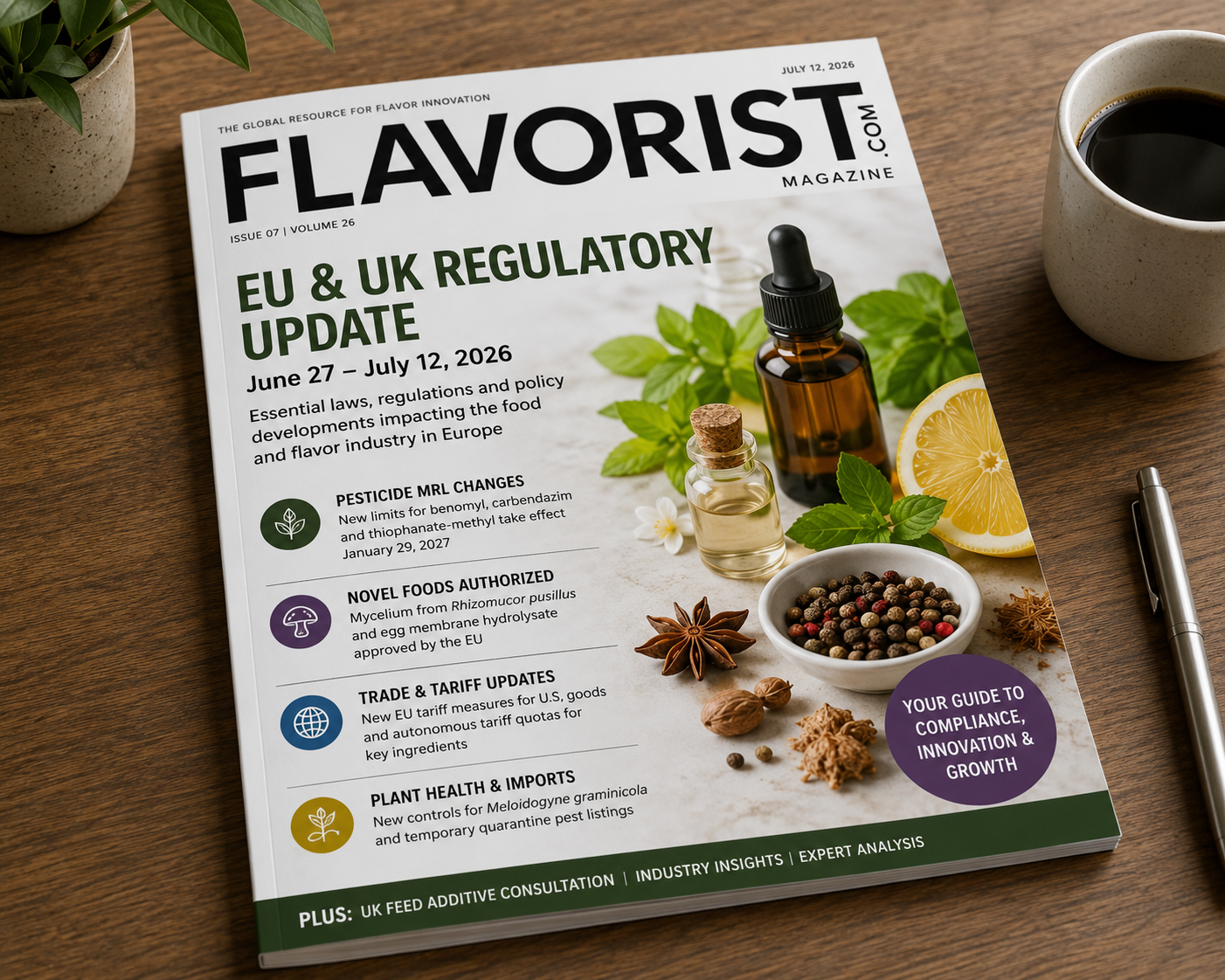
Sources checked for law and regulations released during the period 27 June through 12 July 2026, inclusive, include the EU Official Journal/EUR-Lex, European Commission food-safety materials, EFSA and UK government/regulatory publications.
A. Directly significant food and ingredient legislation
1. Regulation (EU) 2026/1546 — pesticide MRLs
Published: 9 July 2026
Importance: High
This regulation changes maximum residue levels for benomyl, carbendazim and thiophanate-methyl in or on a broad range of foods. It applies from 29 January 2027, subject to specified transitional provisions.
It directly affects importers, ingredient suppliers and manufacturers using fruit, vegetables, herbs, spices, botanicals, concentrates and extracts. Concentration during drying or extraction may increase the commercial significance of residues present in the raw agricultural material. Supplier specifications, residue-testing panels and import-tolerance assessments should therefore be reviewed well before the application date.
This item was correctly included in the earlier report. (EUR-Lex)
2. Implementing Regulation (EU) 2026/1507 — Rhizomucor pusillus mycelium
Published: 6 July 2026
Importance: High for novel-food, alternative-protein and flavour-system businesses
The regulation authorises Rhizomucor pusillus mycelium as a novel food under specified conditions, including use as a whole food, in formulated foods and in supplements. It creates opportunities for fungal-protein foods and for flavour companies developing savoury, masking, mouthfeel and umami systems for mycelium-based products.
The authorisation includes prescribed naming, conditions of use, compositional specifications and five-year proprietary-data protection for the applicant. The earlier report correctly included this measure. (EUR-Lex)
3. Implementing Regulation (EU) 2026/1427 — egg-membrane hydrolysate
Published: 3 July 2026
Importance: High for supplement and functional-ingredient businesses
This regulation authorises an enzymatically produced egg-membrane hydrolysate as a novel food. The legal designation was adjusted because the initially proposed “egg membrane collagen peptides” name did not accurately represent the ingredient’s composition.
The measure affects supplement formulation, ingredient identity, allergen declarations, business-to-business documentation and product claims. Only material meeting the authorised manufacturing and compositional specifications is covered. The earlier report correctly included it. (EUR-Lex)
4. Regulation (EU) 2026/1455 — tariff treatment of US-origin goods
Published: 30 June 2026
Applies: 1 July 2026–31 December 2029
Importance: Potentially very high
This was the most significant omission from the earlier report. The regulation adjusts customs duties and opens tariff quotas for specified goods imported from the United States. Its annexes cover agricultural, seafood and industrial goods, meaning the impact must be assessed at the individual CN-code level.
Food, beverage, flavour and ingredient businesses importing from the US should map their products, raw materials and intermediates against the annexes. Potentially affected areas may include agricultural commodities, processed foods, seafood, chemicals and ingredients used in flavour manufacturing.
The regulation can affect landed costs, sourcing decisions, customs classification, quota availability and supply contracts. Because the legal effect depends on the precise tariff code—not merely the commercial product description—businesses should obtain a customs-classification review for US-origin materials. (EUR-Lex)
5. Council Regulation (EU) 2026/1465 — autonomous tariff quotas
Published: 30 June 2026
Importance: High for certain flavour and chemical ingredients
This regulation amends the EU system of autonomous tariff quotas for selected agricultural and industrial products. It should have been included in the earlier report.
Of particular interest to the flavour industry, the annex includes a zero-duty quota for cyclohex-3-ene-1-carbaldehyde, identified by CAS number and minimum purity. The annex also contains other specialised chemicals and agricultural or industrial inputs.
The regulation may lower import duty costs where an ingredient precisely meets the relevant CN/TARIC description, purity requirement, quota conditions and period. Conversely, a material with a slightly different concentration, isomeric composition or classification may fall outside the quota.
Importers should verify tariff classification, technical specifications, country-of-origin documentation, quota balances and customs-declaration procedures. This is a direct commercial measure, even though it does not regulate food safety or ingredient authorisation. (EUR-Lex)
B. Import, animal-health and supply-chain measures
6. Implementing Decision (EU) 2026/1428 — products of animal origin from China
Published: Within the covered period following adoption on 1 July 2026
Importance: Medium to high for affected importers
The decision amends protective requirements applying to certain products of animal origin imported from China, including treatment of chitosan when classified as a feed material.
It may affect import documentation and border treatment for chitosan and related animal-origin materials. Businesses must still determine whether their product is legally a food ingredient, feed material, additive, processing aid, food-contact input or another regulated category.
The earlier report correctly included it, although the impact is narrower than the novel-food and MRL measures. (EUR-Lex)
7. Implementing Regulation (EU) 2026/1550 — poultry and poultry-meat imports
Published: 3 July 2026
Importance: High for poultry importers and downstream food manufacturers
This measure amends the authorised-country and regionalisation lists for entry into the EU of poultry, poultry germinal products, fresh poultry meat and game-bird meat from Canada, Chile and the United States.
The changes reflect animal-health conditions and alter which defined zones may export specified products to the EU. The immediate impact falls on meat importers, processors, prepared-food manufacturers, stock and broth producers, meat-flavour businesses and companies using poultry-derived ingredients.
Companies should confirm establishment approval, zone eligibility, slaughter or production dates, certificate models and whether the relevant product was produced inside or outside a restricted period. This was omitted from the previous report. (EUR-Lex)
8. Implementing Decision (EU) 2026/1426 — avian-influenza zones within the EU
Published: 30 June 2026
Importance: Medium to high for poultry supply chains
The decision replaces the annex listing protection and surveillance zones established because of highly pathogenic avian influenza outbreaks in EU Member States.
It can restrict movement of poultry, eggs and related products from designated areas and can disrupt supply to meat processors, egg-product manufacturers, prepared-food companies and producers of poultry-derived flavour ingredients. Although directed to Member States, its controls have practical consequences for private operators.
This was also omitted from the earlier report. (EUR-Lex)
C. Plant-health laws relevant to food and flavour raw materials
9. Implementing Regulation (EU) 2026/1432 — Meloidogyne graminicola controls
Published: 6 July 2026
Importance: High for rice and certain plant supply chains
This regulation establishes eradication, containment, survey, demarcation and movement measures for the rice root-knot nematode Meloidogyne graminicola. Its long host list includes commercially important food and flavour crops such as:
- Rice
- Wheat and barley
- Onion and shallot
- Coriander
- Lemongrass
- Capsicum
- Tomato and potato
- Sugar cane
- Soybean and pulses
- Banana
- Lettuce and spinach
It also identifies containment areas in Italy. The regulation can affect production areas, movement of host plants and soil-associated material, agricultural sourcing and availability of certain raw materials.
This was a significant omission from the earlier report. (EUR-Lex)
10. Implementing Regulation (EU) 2026/1433 — import and movement rules for the same pest
Published: 6 July 2026
Importance: High for affected plant importers
This companion regulation amends Annexes II, VII and VIII to Implementing Regulation (EU) 2019/2072. It changes the pest’s quarantine status and the requirements intended to prevent its entry, establishment and spread.
The measure is especially relevant to importers and growers dealing with rooted host plants, planting material, soil-associated commodities and agricultural inputs. Its effect on finished food is indirect, but it may materially affect crop availability and primary-production sourcing.
It should be read together with Regulation 2026/1432. This measure was also absent from the earlier report. (EUR-Lex)
11. Implementing Regulation (EU) 2026/1553 — temporary quarantine-pest list
Published: 10 July 2026
Importance: Medium
This regulation updates the list of plant pests temporarily subject to EU quarantine prohibitions. The listed organisms include pests affecting fruit, vegetable and other crops.
Its relevance to food and flavour manufacturers is primarily through agricultural sourcing and import continuity. Companies importing botanical materials, citrus and fruit ingredients, herbs, spices or natural-flavour source materials should consider whether their commodity and origin combinations are affected.
The earlier report included this measure. (EUR-Lex)
D. Additional binding measure with narrower relevance
12. Implementing Regulation (EU) 2026/1471 — correction of transitional measures
Published: 6 July 2026
Importance: Sector-specific; include where the underlying Regulation 2026/103 affects the business
This regulation corrects the transitional provisions in Implementing Regulation (EU) 2026/103 and applies retrospectively from 5 February 2026.
It is legally binding and falls within the publication period, but its commercial significance depends on the scope of the corrected underlying measure. It should appear in a comprehensive legal register, although it is not as broadly important to food and flavour manufacturers as the MRL, novel-food, customs or plant-health measures. (EUR-Lex)
UK regulatory developments
13. Consultation on revoking Patent Blue V as a feed additive
Published: 10 July 2026
Status: Consultation—not yet law
Importance: High for affected feed and colour-additive businesses
The FSA opened a consultation on revoking the authorisation of Patent Blue V, feed-additive identification number 2a131. The stated reason is that the available evidence was insufficient for the authority to conclude that the additive is safe.
The consultation considers transitional provisions allowing existing stocks to be used and asks businesses to identify trade, technical or other effects. Ministers in England and Wales will make the ultimate decision.
This was omitted from the earlier report and is more directly relevant than several EFSA enzyme opinions previously listed. (GOV.UK)
14. FSA economic-growth goals
Published: 8 July 2026
Status: Policy paper—not legislation
Importance: Medium to high as forward-looking regulatory policy
The policy covers possible national regulation of large food businesses, UK–EU sanitary and phytosanitary alignment and more predictable pathways for innovative products, including cell-cultivated foods.
It was correctly identified previously, but it should be classified as a policy development, not a law or regulation. (GOV.UK)
Items that should not have been presented as new laws
The EFSA food-enzyme opinions in the earlier response should remain in a separate regulatory-science watchlist. An EFSA opinion does not itself authorise a new enzyme use or create an enforceable obligation. A later Commission act is normally required before the legal position changes.
Similarly, the Commission’s plant-protein action plan published on 7 July is strategically important to the food sector, but it is a policy plan rather than binding food law. (EUR-Lex)