North America Food & Flavor Regulatory Intelligence: Major Laws, Regulations & Policy Updates | June 27–July 12, 2026
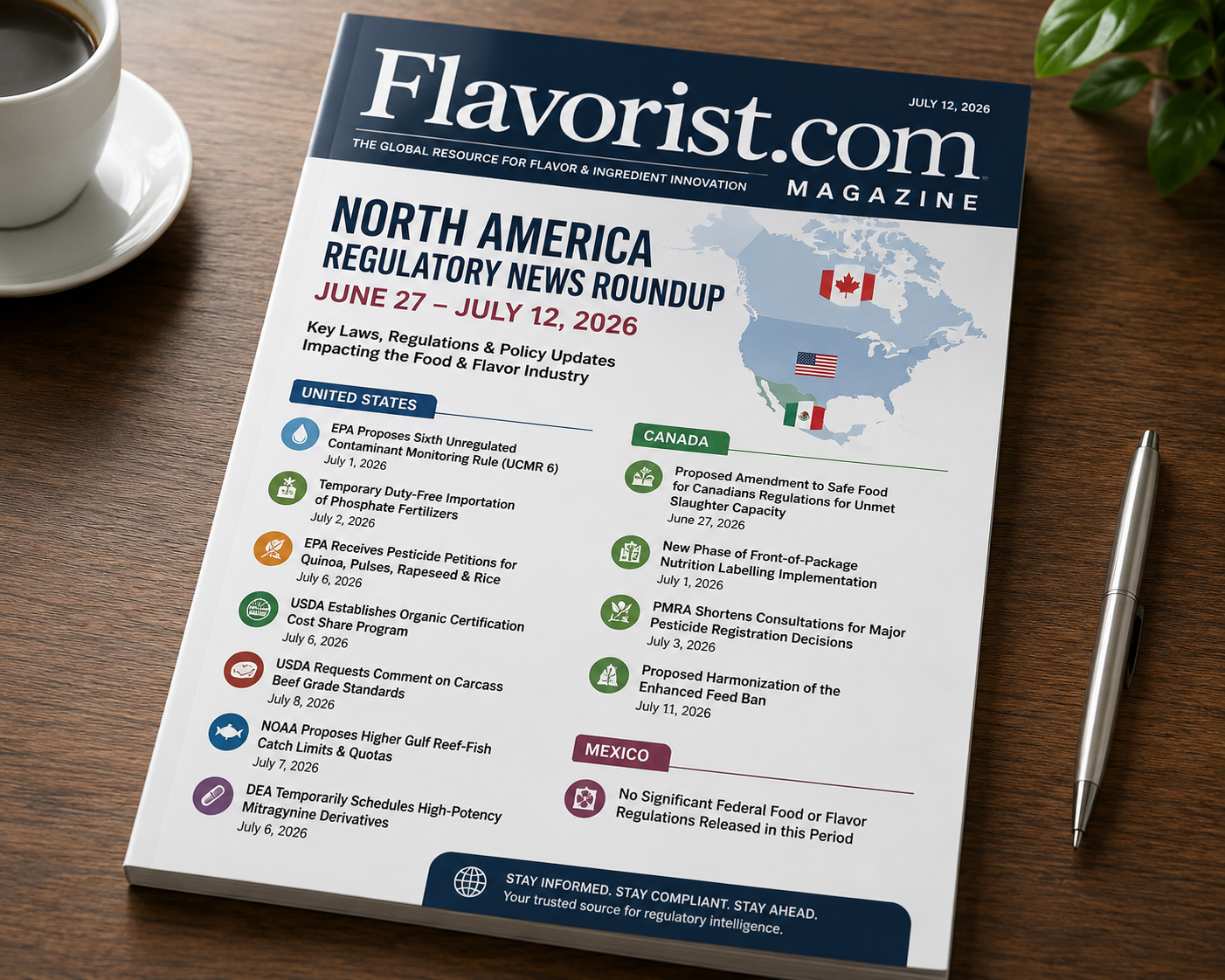
Regulatory scan for North America: June 27–July 12, 2026
Official federal publications and regulator releases from the United States, Canada, and Mexico, were scanned with additional searches for material subnational measures. The period produced relatively few rules directed specifically at flavorings or conventional food additives. The most significant actions instead concern pesticide residues, organic certification, nutrition labeling implementation, drinking-water inputs, agricultural costs, seafood supply, beef grading, and flavored ingestible products.
“Released” means published or formally announced during June 27 through July 12, 2026, even where the measure is only proposed or implements an earlier statute.
1. EPA proposes Sixth Unregulated Contaminant Monitoring Rule
Jurisdiction: United States
Release date: July 1, 2026
Status: Proposed rule
Industry relevance: Water, beverages, food processing, ingredient manufacturing
EPA proposed the sixth Unregulated Contaminant Monitoring Rule, or UCMR 6, under the Safe Drinking Water Act. The proposal would require covered public water systems to collect occurrence data for 30 contaminants that are not presently subject to federal primary drinking-water standards. The monitoring results would become publicly available and could support future regulatory determinations.
Although UCMR 6 directly regulates public water systems rather than food companies, its downstream significance is substantial. Water is a primary ingredient and processing aid in beverages, brewed products, dairy substitutes, sauces, extracts, flavors, confectionery, sanitation systems, and steam generation. Detection of a monitored contaminant near a manufacturing location may prompt customer inquiries, supplier qualification changes, additional incoming-water testing, treatment investment, or contract revisions before EPA sets an enforceable maximum contaminant level.
Flavor and ingredient manufacturers should determine whether their facilities depend on covered public systems, identify which proposed analytes could affect extraction, fermentation, sensory properties, or customer specifications, and assess whether current certificates of analysis address them. Companies operating their own wells are not necessarily directly subject to UCMR, but publicly reported regional results may still influence risk assessments and customer expectations. Comments on the proposal should focus on analytical feasibility, laboratory capacity, reporting burdens, and the practical consequences for industrial water users. (Federal Register)
2. Emergency duty-free importation of phosphate fertilizers
Jurisdiction: United States
Release date: July 2, 2026
Status: Emergency trade action
Industry relevance: Agricultural inputs, commodity pricing, crop-derived flavors and ingredients
The U.S. government declared an emergency and authorized the temporary duty-free importation of certain phosphate products. The notice expressly recognizes phosphate fertilizers as essential inputs for corn, soybeans, wheat, and numerous other crops and connects fertilizer availability to food production and national economic security.
This action does not impose a product-composition or labeling requirement on food manufacturers. Its importance is economic and supply-chain related. Phosphate prices and availability affect planting decisions, yields, acreage allocation, and the cost of agricultural raw materials. Flavor houses and food companies purchasing corn derivatives, soy proteins, wheat-based carriers, botanical extracts, fruit preparations, spices, starches, maltodextrin, dextrose, fermentation feedstocks, or natural flavor precursors could experience indirect effects through farm-level input costs.
Temporary duty relief may ease near-term pressure, but companies should not assume that it guarantees stable fertilizer or crop prices. The duration and product scope of the authorization, shipping capacity, domestic distribution, and future trade policy will determine the actual benefit. Procurement teams should monitor whether suppliers revise crop forecasts or surcharge assumptions and should distinguish this emergency measure from a permanent tariff change. It may also affect sustainability accounting because fertilizer sourcing and application are material contributors to agricultural emissions and life-cycle assessments. (Federal Register)
3. EPA publishes pesticide-residue petitions covering quinoa, pulses, rapeseed and rice
Jurisdiction: United States
Release date: July 6, 2026
Status: Notice of petitions and request for comment; not final tolerances
Industry relevance: Agricultural ingredients, extracts, grains, pulses, oils and residue compliance
EPA announced the filing of pesticide petitions seeking new or revised residue tolerances on several commercially important food commodities. The petitions include proposed uses involving cycloate on quinoa; bromoxynil on rapeseed and dried bean and pea subgroups; cyclobutrifluram on specified commodities; and iptriazopyrid as a new active ingredient for rice. For bromoxynil, the petitioner requested tolerances of 0.01 ppm for the identified crop groups.
These petitions do not yet authorize the uses or establish enforceable tolerances. They begin EPA’s review and public-comment process. Nevertheless, they are important early indicators of potential changes to crop-protection practices and residue profiles. Ingredient companies buying quinoa, pulse proteins, pea or bean fractions, canola or rapeseed oil, rice products, botanical concentrates, or flavors derived from these materials should evaluate whether future uses would affect supplier specifications, multiresidue testing panels, organic or “pesticide-free” claims, and export eligibility.
Tolerance changes can create asymmetry between the United States, Canada, Mexico, and overseas markets. A residue lawful in the United States may lack a corresponding maximum residue limit elsewhere, especially in concentrated extracts where residues can increase during processing. Companies should monitor final EPA decisions rather than treating the petitioned levels as approved. Comments were requested by August 5, 2026. (Federal Register)
4. USDA establishes the Organic Certification Cost Share Program by final rule
Jurisdiction: United States
Release date/effective date: July 6, 2026
Status: Final rule
Industry relevance: Organic producers, handlers, processors, flavor and ingredient suppliers
USDA’s Commodity Credit Corporation issued an immediately effective final rule establishing the Organic Certification Cost Share Program for the 2025 and subsequent program years. Funding through fiscal year 2031 was authorized by federal legislation. The rule codifies eligibility, payment calculations, application procedures, deadlines, and the ability of state agencies to administer assistance agreements.
OCCSP reimburses eligible organic producers and handlers for part of the cost of obtaining or maintaining certification. For the food and flavor sector, the measure may lower certification expenses for farms, processors, extractors, spice handlers, essential-oil operations, flavor manufacturers, warehouses, and repackers within certified organic supply chains. This can help smaller suppliers remain certified and may modestly improve the availability of organic agricultural inputs and certified processing capacity.
The rule does not relax National Organic Program standards, change the definition of organic flavor, or remove certification obligations. Businesses must still maintain compliant organic system plans, records, segregation, approved-material controls, and certification by an accredited agent. Applicants should verify which certification expenses and operations qualify, preserve invoices and proof of payment, and observe the application channel and deadline applicable to their state or local Farm Service Agency office.
Commercial teams should avoid representing cost-share participation as proof of product compliance. It is financial assistance, not a substitute for certification or transaction documentation. (Federal Register)
5. USDA opens review of federal carcass-beef grade standards
Jurisdiction: United States
Release date: July 8, 2026
Status: Request for comments; no standards changed yet
Industry relevance: Meat processors, prepared foods, savory flavors, foodservice and institutional procurement
USDA’s Agricultural Marketing Service requested comments on possible revisions to the United States Standards for Grades of Carcass Beef. The review arose partly from an American Wagyu Association petition seeking additional marbling degrees within USDA Prime so that beef produced using modern high-marbling genetics can be more precisely differentiated.
USDA also requested views on technology, obsolete or new marbling categories, physiological-maturity requirements for cattle under 30 months, usefulness to processors and institutional buyers, consumer understanding, international competitiveness, and alignment with current beef marketing practices. These grade standards are voluntary marketing standards rather than mandatory food-safety rules, but they have major commercial influence in pricing, purchasing specifications, menu claims, and branded-beef programs.
For prepared-food and flavor businesses, revised grading could affect raw-material segmentation and the price relationship between conventional Prime, highly marbled specialty beef, rendered fat, broths, stocks, extracts, reaction flavors, and premium foodservice products. More granular Prime classifications could improve specification accuracy but also create new label, contract, and customer-education questions.
No grade or marbling requirement changed on July 8. Companies should therefore continue using existing USDA terminology and avoid anticipatory claims. Stakeholders may submit data concerning sensory outcomes, yield, processing performance, buyer utility, and the effects of new categories on supply contracts. Comments are due September 8, 2026. (Federal Register)
6. NOAA proposes substantially higher Gulf reef-fish catch limits and quotas
Jurisdiction: United States—Gulf federal fisheries
Release date: July 7, 2026
Status: Proposed rule
Industry relevance: Seafood supply, restaurants, processed foods, seafood flavors and extracts
NOAA Fisheries proposed Amendment 62 for the Gulf reef-fish fishery. The proposal would materially increase commercial and recreational annual catch limits and commercial quotas for the covered stock. For 2026, the commercial annual catch limit would rise from approximately 2.94 million pounds to 4.51 million pounds, while the commercial quota would increase from approximately 2.79 million pounds to 4.28 million pounds. Further increases are proposed for 2027 and 2028 onward.
Higher quotas could expand lawful landings and improve supply for processors, distributors, foodservice operators, frozen-food manufacturers, seafood-stock producers, and companies producing marine flavors or extracts. Potential effects include greater seasonal throughput, different procurement prices, increased by-product availability, and new contracting opportunities with Gulf suppliers.
The measure remains proposed, so buyers should not incorporate the higher quantities into firm supply assumptions until NOAA publishes a final rule and confirms implementation dates. Companies should also verify the exact species and management unit covered rather than applying the figures broadly to all Gulf reef fish.
Expanded supply does not alter obligations involving harvest documentation, dealer permits, species identification, country-of-origin labeling, food-safety controls, histamine management where relevant, or state landing requirements. Sustainability and sourcing claims should be reassessed against the final biological findings and management plan, not merely against a larger quota. (Federal Register)
7. NOAA proposes reclassification and new accountability measures for Puerto Rico rainbow runner
Jurisdiction: United States—Puerto Rico federal fisheries
Release date: July 8, 2026
Status: Proposed rule
Industry relevance: Caribbean seafood sourcing and processing
NOAA Fisheries proposed to reclassify rainbow runner from a reef fish to a pelagic fish under the Puerto Rico Fishery Management Plan. Existing commercial and recreational annual catch limits would remain unchanged, but the proposal would establish sector-specific annual catch targets and apply accountability measures used for pelagic species.
The proposed commercial target is 822 pounds, compared with a commercial annual catch limit of 913 pounds. The recreational target would be 7,282 pounds against an annual catch limit of 8,091 pounds. When estimated landings exceed a target, NOAA, in consultation with the relevant council, would determine corrective action. This approach differs from the present reef-fish mechanism, which can lead more directly to reductions in fishing-season length after an overage.
The direct national volume impact is limited because the permitted quantities are small. However, the proposal matters to Puerto Rican dealers, specialty seafood distributors, restaurants, regional processors, and manufacturers using Caribbean fish in prepared dishes, stocks, or flavor bases. Reclassification may alter how closure risks and purchasing windows are forecast even without changing the headline catch limit.
Businesses should maintain species-level procurement records and monitor final accountability provisions. “Pelagic” classification under the management plan is a regulatory category and should not automatically be converted into a consumer-facing sustainability, origin, or production-method claim. (Federal Register)
8. DEA temporarily schedules high-potency mitragynine derivatives used in flavored chewables
Jurisdiction: United States
Release date: July 6, 2026
Status: Temporary controlled-substance scheduling
Industry relevance: Flavored ingestibles, confectionery-format products, contract manufacturing and retailers
The Drug Enforcement Administration temporarily placed mitragynine pseudoindoxyl, also called MGM-15, and associated high-potency substances into federal controlled-substance scheduling. DEA’s notice discusses the marketing of standardized, semi-synthetic products in flavored chewable formats and the use of “research chemical” labeling to evade oversight and broaden consumer appeal.
These products are not conventional foods or lawful flavor ingredients merely because they are sold as gummies, chews, candies, drink shots, or flavored powders. Temporary scheduling creates serious consequences for manufacture, possession, distribution, importing, warehousing, online sales, and contract services involving the listed substances. Food and flavor businesses may encounter risk where a customer asks them to develop a masking flavor, sweetener system, chewable base, coating, or beverage matrix for a novel botanical or kratom-related active.
Companies should strengthen customer and ingredient due diligence, require full chemical identity and regulatory-status documentation, and screen aliases rather than relying on marketing names. Contract manufacturers should review inventory, samples, retained materials, and customer-supplied concentrates. Retailers and fulfillment providers should also evaluate affected products immediately.
The order should not be read as scheduling ordinary culinary flavors or all kratom materials indiscriminately; the exact listed substances and scope control. Nonetheless, the action demonstrates that confectionery form and flavoring do not shield pharmacologically active ingestibles from drug-control law. (Federal Register)
9. Canada enters a new implementation phase for front-of-package nutrition labeling
Jurisdiction: Canada
Relevant implementation date: July 1, 2026
Status: Administrative implementation and regulatory-support transition
Industry relevance: Packaged foods, beverages, flavor systems, formulation and Canadian labels
Canada’s front-of-package nutrition-symbol requirements became fully enforceable for newly imported, manufactured, or retail-packaged products on January 1, 2026. A further implementation milestone began on July 1, 2026: Health Canada assumed responsibility for responding to industry enquiries concerning the intent of the new requirements, while the Canadian Food Inspection Agency remains the primary enforcement body and the Industry Labelling Tool remains the principal operational reference.
The rules require a front-of-package symbol on many prepackaged foods that meet or exceed prescribed thresholds for sodium, sugars, or saturated fat, subject to exemptions and special rules. The July transition is significant because companies now have a clearer route for policy-interpretation questions after the initial compliance period.
Flavor and formulation teams are directly affected even though flavors are not independently “warned.” Flavor carriers, emulsions, sweetening systems, salt-containing seasonings, dairy or coconut components, and formulation changes can shift a finished product across a symbol threshold. A change made to replace synthetic colors or modify flavor delivery may therefore have nutrition-label consequences.
Businesses should retain nutrient calculations, recipe records, threshold analyses, exemption rationales, and label approvals. Questions of regulatory intent may be directed to Health Canada, but product inspection, evidence requests, and enforcement responses remain within CFIA’s compliance framework. (Canadian Food Inspection Agency)
10. Canada—proposed Safe Food for Canadians Regulations amendment for unmet slaughter capacity
Published: June 27, 2026
Status: Proposed regulation
Significance: High for livestock producers, provincial slaughterhouses, meat processors and regional food supply chains
The Canadian Food Inspection Agency proposed a targeted, temporary exemption from certain federal requirements when adequate provincially regulated slaughter capacity is unavailable. The proposal is intended to provide a legal route for livestock to be slaughtered at designated provincial establishments under exceptional capacity constraints, while maintaining specified oversight and food-safety controls.
This is more directly relevant to the food industry than several items in the original report. It could affect where livestock may be processed, the movement and sale of resulting meat, establishment eligibility, recordkeeping, inspection arrangements and regional continuity of supply. Meat processors, prepared-food manufacturers, savory ingredient suppliers and foodservice buyers could experience changes in sourcing options during qualifying capacity shortages.
The measure is not yet binding. It was published for a 60-day consultation ending August 26, 2026. Companies should not assume that meat from an otherwise ineligible establishment automatically qualifies for interprovincial trade or export. Eligibility would depend on the final regulatory language, designated circumstances and applicable inspection conditions.
The Canada Gazette confirms that the proposal was published on June 27, squarely within the requested period. (www.gazette.gc.ca)
Official source: Canada Gazette—Regulations Amending the Safe Food for Canadians Regulations
11. Canada—proposed harmonization of the enhanced feed ban
Published: July 11, 2026
Status: Proposed regulation
Significance: High for animal feed, rendering, meat and dairy supply chains
Canada proposed amendments concerning the country’s enhanced feed ban, the regulatory framework designed to prevent bovine spongiform encephalopathy risks by controlling specified risk material and its entry into animal-feed, pet-food and fertilizer streams. The proposal seeks to harmonize requirements and update related federal regulations.
The measure can affect renderers, feed mills, slaughter establishments, livestock producers, pet-food manufacturers, fertilizer businesses and facilities that segregate, transport or dispose of specified risk material. Food and flavor companies may be affected indirectly through costs and availability of animal fats, meat extracts, gelatin-related inputs, dairy and beef ingredients, rendered materials and feed-dependent agricultural commodities.
Compliance implications could include revised definitions, handling and segregation controls, documentation, disposal routes, cross-agency requirements and alignment between feed and animal-health regulations. Because the proposal concerns upstream controls rather than finished-food labeling, its importance may be missed in a narrow search limited to FDA-style food rules.
The proposal was published in the Canada Gazette on July 11 and carries a 60-day consultation period ending September 9, 2026. The exact operational impact should be evaluated against the complete amendment text once parsed by each affected business. (www.gazette.gc.ca)
Official source: Canada Gazette—Regulations Relating to Harmonization of the Enhanced Feed Ban
12. Canada—PMRA permanently shortens consultations for major pesticide registration decisions
Released: July 3, 2026; effective for decisions from June 29, 2026
Status: Regulatory-administration policy change
Significance: Moderate to high for growers, pesticide registrants and agricultural ingredient buyers
Health Canada’s Pest Management Regulatory Agency announced that consultations on proposed registration decisions for new pesticide active ingredients and major new uses will generally be limited to 30 days, replacing the prior 45-day option. PMRA had tested the shorter period through a pilot program and decided to implement it from June 29, 2026.
This does not establish a new pesticide maximum residue limit or approve a particular agricultural use. Its significance lies in compressing the time available for food companies, grower groups, registrants, environmental organizations and foreign-trade stakeholders to assess major pesticide proposals and submit technical comments.
Ingredient suppliers dealing in fruits, herbs, spices, grains, oils, botanicals or extracts may have less time to evaluate residue implications, processing concentration factors, analytical methods and differences between Canadian and foreign maximum residue limits. A shortened window may be particularly consequential when a proposed use affects crops destined for both domestic sale and export.
PMRA reported that, during the pilot, extensions were requested in some cases, but the 45-day consultation option will no longer routinely be offered. Regulatory and procurement teams should therefore establish quicker internal alerts and residue-review procedures. (Canada)
Official source: Health Canada—Adjusted consultation period for pesticide registration decisions
You may also be interested in reading
Canadian front-of-package nutrition labeling
The July 1 administrative transition concerning responsibility for industry enquiries was not a newly released law or regulation during the period. The underlying labeling regulations were adopted earlier and became enforceable on January 1, 2026. It may be operationally useful, but it should not have been presented as a new regulatory release for this search window.
Canadian jagua blue proposal
This proposal was released on May 14, 2026, although its comment period remained open in July. It should remain outside the primary list because the user specified regulations released from June 27 through July 12.
Phosphate fertilizer tariff action
This can remain as a significant government legal action affecting food-production economics, but it should be placed in a secondary “upstream and trade measures” category rather than alongside food-safety or ingredient regulations.
Fisheries proposals
The NOAA measures are legitimate regulatory proposals, but they are principally relevant to seafood supply rather than the flavor industry broadly. They should be retained only in an extensive report, not necessarily in a tightly focused flavor-regulatory digest.
###
Additional law and regulations relevant to the food and flavor industry in North America released during June 27 through July 12, 2026
Federal — United States
1. FDA Human Foods Program releases updated 2026 Guidance Agenda (June 29, 2026)
On June 29, 2026, FDA's Human Foods Program released its updated 2026 guidance agenda listing priority topics for guidance documents it aims to publish as drafts or finals by the end of December 2026. Several topics matter directly to flavor and ingredient companies: caffeine content labeling in foods and beverages; questions and answers on use of the "healthy" claim; action levels for cadmium and inorganic arsenic in foods for babies and young children; fruit juice and vegetable juice as color additives in food; identity and safety information for new dietary ingredients; and multiple guidances to reduce chemical and microbiological hazards in food. The agenda contains fifteen topics — three new draft or final guidance topics, twelve carried over from the 2025 agenda, and one completed since then — organized under the program's three risk pillars. The juice-as-color-additive guidance is especially significant for flavor houses as the industry reformulates away from synthetic dyes toward fruit- and vegetable-derived colorants, since it will clarify when such juices are regulated as color additives. Guidance documents don't impose legally enforceable requirements but represent FDA's current thinking, and FDA is accepting comments under Docket FDA-2022-D-2088. Source: https://www.fda.gov/food/hfp-constituent-updates/fda-releases-2026-human-foods-program-guidance-agenda
2. White House releases 2026 Unified Regulatory Agenda, setting timeline for GRAS reform (July 3, 2026)
On July 3, 2026, the White House's Office of Information and Regulatory Affairs released its 2026 Regulatory Agenda, listing agencies' projected regulatory actions and timelines. The most closely watched item is a proposed rule that would amend FDA's regulations at 21 CFR parts 170 and 570 to require submission of a GRAS notice for any human or animal food substance purported to be generally recognized as safe under its conditions of intended use. Under the proposal, FDA would maintain a public GRAS notice inventory and clarify how it determines a substance's use is not GRAS. The proposed rule is now tentatively scheduled for publication in December 2026. This would end the "self-affirmed GRAS" pathway that flavor and ingredient makers have relied on for decades. The agenda also lists proposed rules updating nutrient content claims for added sugars; revoking standards of identity for certain canned fruits and vegetables, certain bakery products and cereal flours, and frozen peas; and plans to finalize rules permitting fluid ultrafiltered and microfiltered milk in standardized cheeses. For flavor companies, the GRAS timeline is the headline: mandatory notification would fundamentally change how new flavor ingredients reach the U.S. market. Source: https://www.dailyintakeblog.com/2026/07/2026-regulatory-agenda-released-suggests-rulemaking-regarding-gras-notices/
3. Comment deadlines close on FDA petitions to remove carcinogenic solvents from flavor and color regulations (June 29, 2026)
Two reopened FDA comment periods closed June 29, 2026, both squarely aimed at the flavor and color sector. FDA reopened comments on a food additive petition proposing to remove four solvents — benzene, ethylene dichloride, methylene chloride, and trichloroethylene — currently authorized in 21 CFR 172.560 (modified hop extract) and several Part 173 provisions, explicitly asking manufacturers what practical considerations they would face in phasing out affected uses (Docket FDA-2023-F-5684). In parallel, FDA reopened comments on a color additive petition proposing to remove ethylene dichloride, methylene chloride, and trichloroethylene from regulations covering annatto extract, paprika oleoresin, and turmeric oleoresin (Docket FDA-2023-C-5679), seeking updated data by the same June 29 deadline. These solvents are used in extraction of hop extracts, spice oleoresins, and decaffeination-adjacent processes, so removal would ripple through supplier qualification, extraction methods, and validation for natural color and flavor producers — precisely the ingredients gaining share as synthetic dyes exit the market. Companies that missed the deadline should monitor the dockets, since FDA signaled it may grant the petitions in whole or in part. Source: https://www.flavorist.com/north-america-food-flavor-industry-law-regulatory-news-june-7-17-2026-manufacturer-guidelines-advisory-summary/
4. FDA Food Traceability Rule — lot-level flexibility comment window open through July 15, 2026
Running through this window is the comment period tied to FDA's June 15 public meeting on traceability. FDA held a public meeting on June 15, 2026 on continued implementation of the Food Traceability Rule and areas of remaining concern relating to lot-level tracking and compliance flexibilities, and released a Discussion Paper, "Identifying Additional Flexibilities for Satisfying the Food Traceability Rule's Lot-Level Tracking Requirement," plus a report on traceability readiness tabletop exercises. Regulated entities may submit formal comments on the discussion paper to Docket FDA-2014-N-0053 by July 15, 2026. Context matters here: the original compliance date was January 20, 2026; FDA proposed extending it 30 months to July 20, 2028, and the Continuing Appropriations, Agriculture, Legislative Branch, Military Construction and Veterans Affairs, and Extensions Act of 2026 directed FDA not to enforce the rule before that date, which FDA intends to honor. Manufacturers, packers, and holders of foods on the Food Traceability List — including cheeses, shell eggs, produce, seafood, and ready-to-eat deli items — should use this comment opportunity to shape how lot-level Key Data Elements will be enforced. Source: https://www.fda.gov/food/food-safety-modernization-act-fsma/fsma-final-rule-requirements-additional-traceability-records-certain-foods
State laws taking effect July 1, 2026
5. California AB 660 — standardized food date labels (effective July 1, 2026)
Beginning July 1, 2026, food manufacturers, processors, and retailers selling products in California must comply with AB 660, which establishes standardized terminology for food quality and food safety date labels and prohibits consumer-facing "sell by" dates. Products must display either a quality date or a safety date; if packaging is too small, companies may use "BB" for a quality date or "UB" for a safety date, and stores cannot sell food made on or after July 1 that carries a consumer-facing "sell by" label. Coded inventory-management dates that aren't easily understood by consumers remain permissible, and the law targets food waste caused by consumer confusion between quality and safety dating. The practical impact is national: companies distributing products across the U.S. must decide whether to implement California-specific labeling or adopt the standardized language across all markets, and the size of the California marketplace may drive broader adoption of standardized date labeling industry-wide. Flavor and beverage brands with shorter shelf-life products (juices, dairy-based drinks, fresh formats) face the most immediate relabeling work. Source: https://easconsultinggroup.com/california-food-date-labeling-requirements-take-effect-july-1/
6. California SB 68 — menu allergen disclosure for chain food facilities (effective July 1, 2026)
Effective July 1, 2026, food facilities with 20 or more locations that sell food to consumers must provide written notification of major food allergens that the facility knows or reasonably should know are ingredients in each menu item. The major allergens covered are milk, eggs, fish, crustacean shellfish, tree nuts, wheat, peanuts, soybeans, sesame, and ingredients containing protein from those foods. This is the first U.S. state law mandating written allergen disclosure on restaurant menus at scale, and it lands hardest on chain restaurants, quick-service brands, and their upstream suppliers — including flavor houses, seasoning blenders, and sauce manufacturers — who must now provide complete, accurate allergen documentation for every compound ingredient so operators can populate menu disclosures. Ingredient suppliers should expect a wave of updated specification and allergen-statement requests from California chain customers, and companies supplying proprietary flavor systems will need robust allergen cross-contact controls and documentation. Given California's market size and the compliance systems chains will build to satisfy it, similar disclosure practices are likely to spread nationally, mirroring the trajectory of menu calorie labeling a decade ago. Source: https://www.buchalter.com/insights/2026-california-regulatory-update-food-beverage-textiles-and-beyond/
7. Idaho SB 1270 — cultivated meat labeling requirements (effective July 1, 2026)
Idaho's SB 1270 requires that cultivated meat sold by restaurants or other vendors be labeled with the phrases "lab-grown," "cell-cultivated," or "cell-cultured," and bans cultivated meat not derived from traditional livestock production or wild game harvest from being labeled with specific meat cut terms such as "steak," "roast," "tri-tip," "loin," or "brisket." Notably, the law does not outright ban the term "meat" or general meat terms like "beef" or "chicken," but excludes cell-cultivated animal proteins from terms commonly associated with specific meat cuts. The law takes effect July 1, 2026 and is codified at Idaho Code § 37-1601–1604. For the food and flavor industry, this adds another state-specific labeling regime to the growing patchwork governing alternative proteins — a category that heavily depends on savory flavor systems, and where marketing language on packaging is tightly coupled to formulation claims. Companies developing cultivated or hybrid meat products, and the flavor suppliers supporting them, need state-by-state label matrices, since Idaho's cut-term prohibition differs in structure from laws in Ohio, Mississippi, Colorado, and elsewhere. Source: https://nationalaglawcenter.org/food-law-in-the-states-2026-update/
8. Mississippi HB 1153 — first-in-nation ban on cell-cultured dairy (effective July 1, 2026)
Mississippi enacted House Bill 1153, becoming the first state to ban the manufacture and sale of lab-grown, "cell-cultured" milk products. The law defines a cell-cultured dairy product as one derived from animal cells cultured outside a live animal and flatly states that no person shall manufacture, sell, or offer for sale any cell-cultured dairy product in the state. The act also treats food as "misbranded" as a meat product if it's a manufactured protein product (cell-based, insect, or plant-based protein) unless the label displays a conspicuous qualifying term near any use of the word "meat"; violators may be fined up to $500 per day per infraction, capped at $10,000, and the act comes into force on July 1, 2026. Public institutions including schools and universities must adopt procurement policies avoiding these products, and the state gains stop-sale and embargo authority. This directly affects precision-fermentation dairy proteins and the flavor systems built around dairy analogues; companies in that space must now exclude Mississippi from distribution or reformulate labeling and channel strategies. Source: https://www.agdaily.com/livestock/mississippi-becomes-first-state-to-ban-cell-cultured-dairy/
9. South Dakota — temporary ban on cell-cultured protein sales (effective July 1, 2026)
South Dakota, which already had alternative-protein labeling requirements and prohibitions on spending state money on alternative proteins, passed 2026 legislation temporarily prohibiting persons from selling, offering for sale, holding for sale, or distributing any product containing cell-cultured protein. The prohibition runs from July 1, 2026 to June 30, 2030. This makes South Dakota one of a growing bloc of states (alongside Florida, Mississippi, Nebraska, and others with varying approaches) that have moved from labeling mandates to outright sales prohibitions on cultivated protein — but its sunset structure is distinctive, functioning as a four-year moratorium rather than a permanent ban. For manufacturers and distributors, the compliance point is broad: the prohibition covers products containing cell-cultured protein, which could sweep in hybrid products where cultivated cells are a minor ingredient in an otherwise conventional or plant-based matrix. Flavor and ingredient companies partnering with cultivated-protein startups should map which states are open for pilots and retail launches, as the addressable U.S. market for these products is being carved up state by state, with litigation over similar bans (such as the Florida case) still working through federal courts. Source: https://nationalaglawcenter.org/food-law-in-the-states-2026-update/
10. Virginia HB 402 — cottage food expansion (effective July 1, 2026)
Virginia's HB 402, enacted in April, expands the state's cottage food laws by permitting cottage food operators to sell their products over the internet or by phone — sales previously had to occur in person — and allows cottage food products to be delivered to purchasers by mail or delivery service. Products remain prohibited from being sold outside Virginia and may not be sold in retail food establishments. The law takes effect July 1, 2026. While smaller in scale than the other items here, this matters to the food industry's artisan and small-batch segment: home-based producers of baked goods, jams, spice blends, extracts, and confections gain meaningful new sales channels, expanding the market for small-quantity flavor, extract, and specialty ingredient suppliers that serve this tier. It also reflects a broader 2026 trend of states loosening cottage food restrictions — West Virginia made similar moves this year — which gradually shifts more food production into lightly regulated home settings, with implications for allergen labeling practices and ingredient traceability expectations across the supply chain that serves these micro-producers. Source: https://nationalaglawcenter.org/food-law-in-the-states-2026-update/
Canada
11. CFIA proposes Safe Food for Canadians Regulations amendments for interprovincial meat trade (July 2, 2026)
On July 2, 2026, the Canadian Food Inspection Agency announced proposed targeted, time-limited amendments to the Safe Food for Canadians Regulations to make it easier to move red meat between provinces when unmet slaughter capacity may be contributing to food security and regional economic issues. Announced under the National Food Security Strategy, the proposed exemption would be a one-time, four-year measure applying only where provinces and territories agree to provide oversight (subject to a CFIA risk assessment) and only to low volumes of raw, single-ingredient red meat products. Other amendments would remove unintended work-shift requirements and improve clarity of SFCR requirements. The proposal was published in Canada Gazette, Part I, with comments accepted until August 26, 2026. This is a notable crack in Canada's long-standing rule that only federally licensed establishments may ship meat interprovincially. For processors, further-processors, and seasoning/marinade suppliers serving provincial abattoirs, it could open new regional supply options — though the exemption's restriction to raw, single-ingredient products means value-added and flavored meat products remain federally gated for now. Source: https://www.canada.ca/en/food-inspection-agency/news/2026/07/government-of-canada-takes-action-to-support-interprovincial-trade-of-meat-and-strengthen-food-security.html
Worth noting just outside the window
Three items landed days before June 27 but shape the period: on June 25, 2026, USDA's Agricultural Marketing Service posted its final notice revising orange juice grading standards, confirming the interim changes that defer Grade B Brix allowances for pasteurized orange juice to FDA's standard of identity at 21 C.F.R. 146.140(a) (https://www.federalregister.gov/documents/2026/06/25/2026-12846/united-states-standards-for-grades-of-orange-juice); and on June 22, 2026, the U.S. District Court for the District of Columbia ruled in Aragon v. Rollins that USDA exceeded its statutory authority in approving state SNAP purchase-restriction waivers, vacating approvals for Colorado, Iowa, Nebraska, Tennessee, and West Virginia — a decision with real consequences for beverage and snack makers in those states (https://ofwlaw.com/june-food-and-agriculture-regulatory-recap-5). Also relevant as a background deadline: the International Dairy Foods Association's commitment to remove artificial dyes from milk, cheese, and yogurt served in school meals by July 2026 came due during this window.
###