FDA Launches New Safety Review of Common Food Additives, Including the so-called "Yoga Mat" Chemical
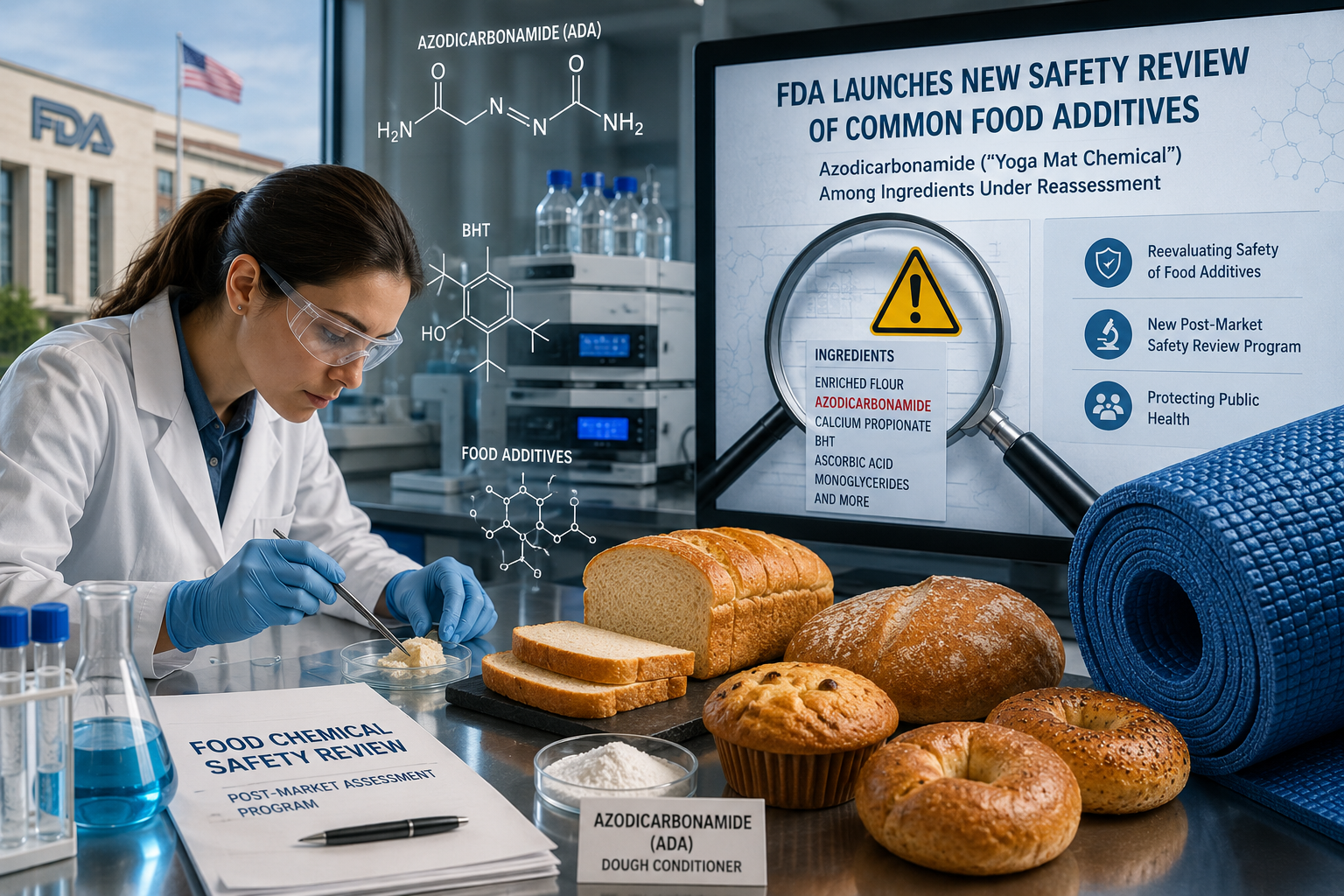
In a significant shift in food safety oversight, the U.S. Food and Drug Administration (FDA) has announced it will formally reassess the safety of two widely used food additives: azodicarbonamide (ADA) and butylated hydroxytoluene (BHT). This decision marks a key step in the agency's broader move to reevaluate chemicals in the food supply based on the latest scientific evidence and potential public health risks, rather than on public concern alone.
The announcement, made in late May 2026, signals a new direction for the agency as it responds to growing calls from consumer advocates and public health officials for more stringent and transparent oversight of food ingredients.
The Two Additives Under the Microscope
The two substances being reviewed are used for very different purposes but share a common history of raising safety questions.
- Azodicarbonamide (ADA): The "Yoga Mat" Chemical
- What it is and its use: ADA is a synthetic chemical used primarily as a dough conditioner and a flour whitening agent. In commercial bakeries, it strengthens dough, improves its texture, and allows for lighter, softer bread rolls and buns. Outside of food, ADA is also used as a foaming agent in the production of synthetic leather and plastic products, including foam rubber for items like yoga mats and shoe soles—hence its unflattering nickname.
- Safety concerns: The primary health concern is that when bread containing ADA is baked, it breaks down into a chemical called semicarbazide (SEM). Long-term studies have linked SEM to certain types of tumors in laboratory animals. For this reason, ADA has been banned as a food additive in the European Union, the United Kingdom, Australia, and China for nearly two decades. In Europe, the ban has been in place since 2005.
- Butylated Hydroxytoluene (BHT): The Common Preservative
- What it is and its use: BHT is a synthetic antioxidant used as a preservative. Its main job is to prevent fats and oils in food from going rancid, which extends the shelf life of many processed products. You can find BHT in a wide range of grocery items, including breakfast cereals, frozen meals, dehydrated mashed potatoes, meat products (like sausage and hot dogs), and chewing gum.
- Safety concerns: Like ADA, BHT has been linked to potential carcinogenic effects in some animal studies, though the results have been mixed and have led to ongoing scientific debate. Consequently, its use in Europe is heavily restricted, allowing it only in specific food categories at very low concentrations.
The FDA's Evolving Approach: From Consumer Concern to Public Health Risk
The decision to review ADA and BHT is part of a larger administrative overhaul at the FDA. The agency is moving away from a previous plan that would have prioritized safety reviews based primarily on levels of consumer concern or media attention. Instead, the FDA has finalized a new framework that will prioritize ingredients based on their real-world risk to public health—meaning the potential for harm and the extent of human exposure.
“Today’s release finalizes our framework for this new, dedicated reassessment program that provides Americans with confidence that the FDA is ensuring chemicals in the U.S. food supply remain safe as new scientific information becomes available,” said Kyle Diamantas, Acting FDA Commissioner, in an official statement.
This initiative follows sustained criticism from Robert F. Kennedy Jr., the Secretary of Health and Human Services, who has publicly pointed to a lack of transparency in the long-standing "Generally Recognized as Safe" (GRAS) system. Under the GRAS system, companies can determine a substance is safe and add it to food without explicit FDA pre-approval, a practice that many food safety advocates argue creates a major loophole.
Industry Response and Next Steps
In response to the FDA's request for information, the baking industry has indicated it is already moving away from ADA. The American Bakers Association, which represents many U.S. baked goods manufacturers, stated that approximately 95% of its 350 member companies no longer use ADA. The association added that the industry is on track to fully remove the ingredient by the end of 2026.
The use of BHT appears more widespread, but precise data is still needed. The FDA has formally requested that food manufacturers provide current information on how both ADA and BHT are being used, including the types of foods they are found in and typical usage levels. This data will be crucial for the agency's scientific review process, which will determine whether these additives can maintain their GRAS status or if restrictions or outright bans will be proposed.
A Broader Context: A Trend of Reassessment
This review of ADA and BHT is not an isolated event. The FDA has recently launched similar safety reassessments for other controversial food chemicals, including butylated hydroxyanisole (BHA) —a close relative of BHT used as a preservative—and Orange B, a rarely used food dye.
These actions signal a new era of stricter regulatory scrutiny for the American food industry. For consumers, the outcome of these reviews could lead to significant changes in the ingredient labels of some of the most common processed foods on grocery store shelves. The FDA is inviting public and industry comments as part of its formal information-gathering process, which will take place over the coming months.
###