Flavor Emulsion: What the Society of Flavor Chemists Want Flavorists to Know
In the current Society of Flavor Chemists syllabus, Emulsions—beverage and bakery are explicitly listed under Liquid Flavor Forms, and flavorist candidates are expected to describe their formulation, production, troubleshooting, applications, stability considerations, and advantages/disadvantages. The syllabus also expects this knowledge to connect with emulsifiers/weighting agents, carriers, preservatives, acidulants/buffers, analytical methods, processing, labeling, and flavor chemistry.
What follows is therefore an SFC-exam-level study guide for a working flavorist, with particular emphasis on beverage and bakery flavor emulsions.
For those determined to become experts in the formulation and application of flavors in beverages, bakery products, and other consumer goods, Flavorist.com will release a 420-page book titled Flavor Emulsion Technology on October 1, 2026.
 Editor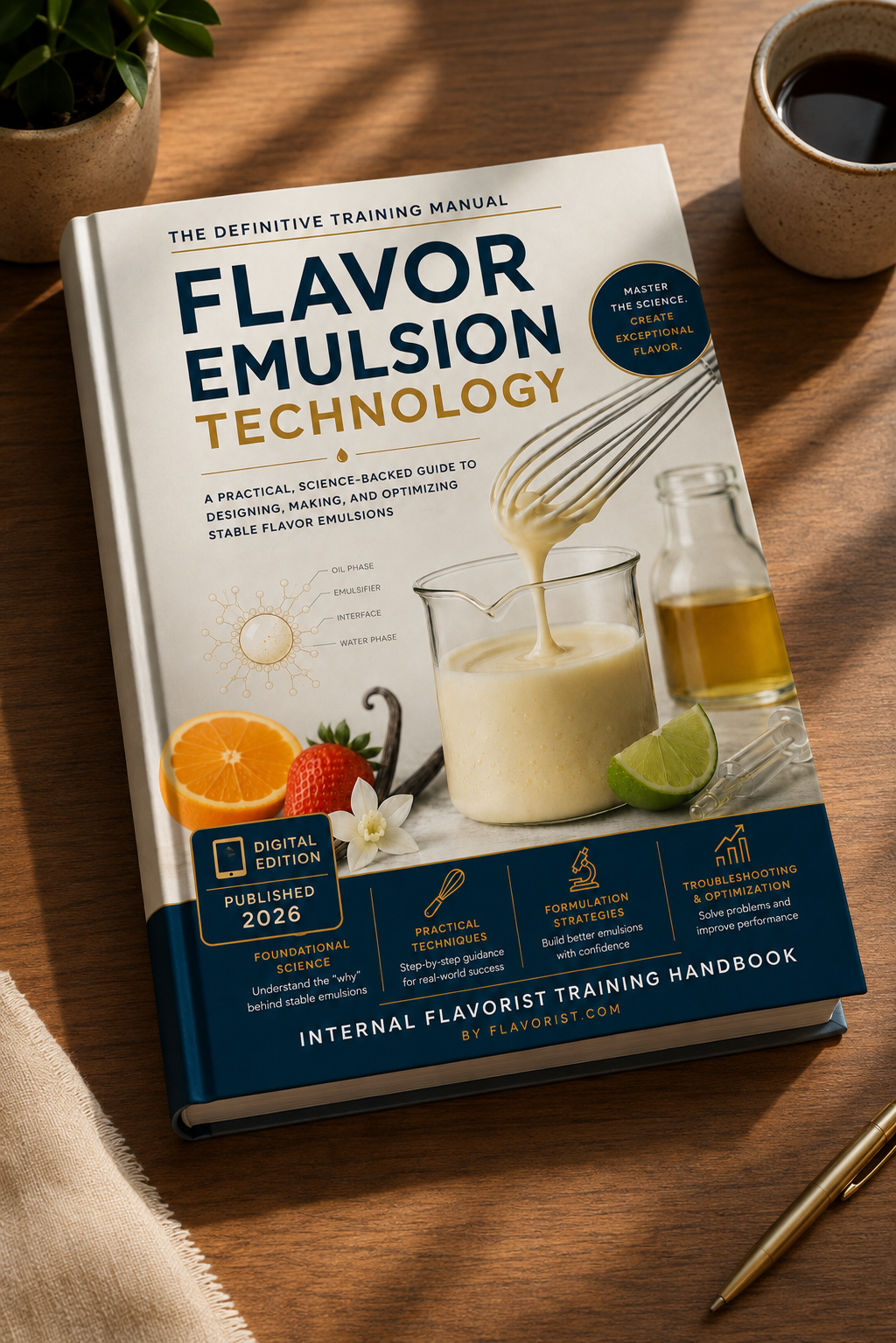
Flavor Emulsions — Complete Flavorist Guide
1. What is a flavor emulsion?
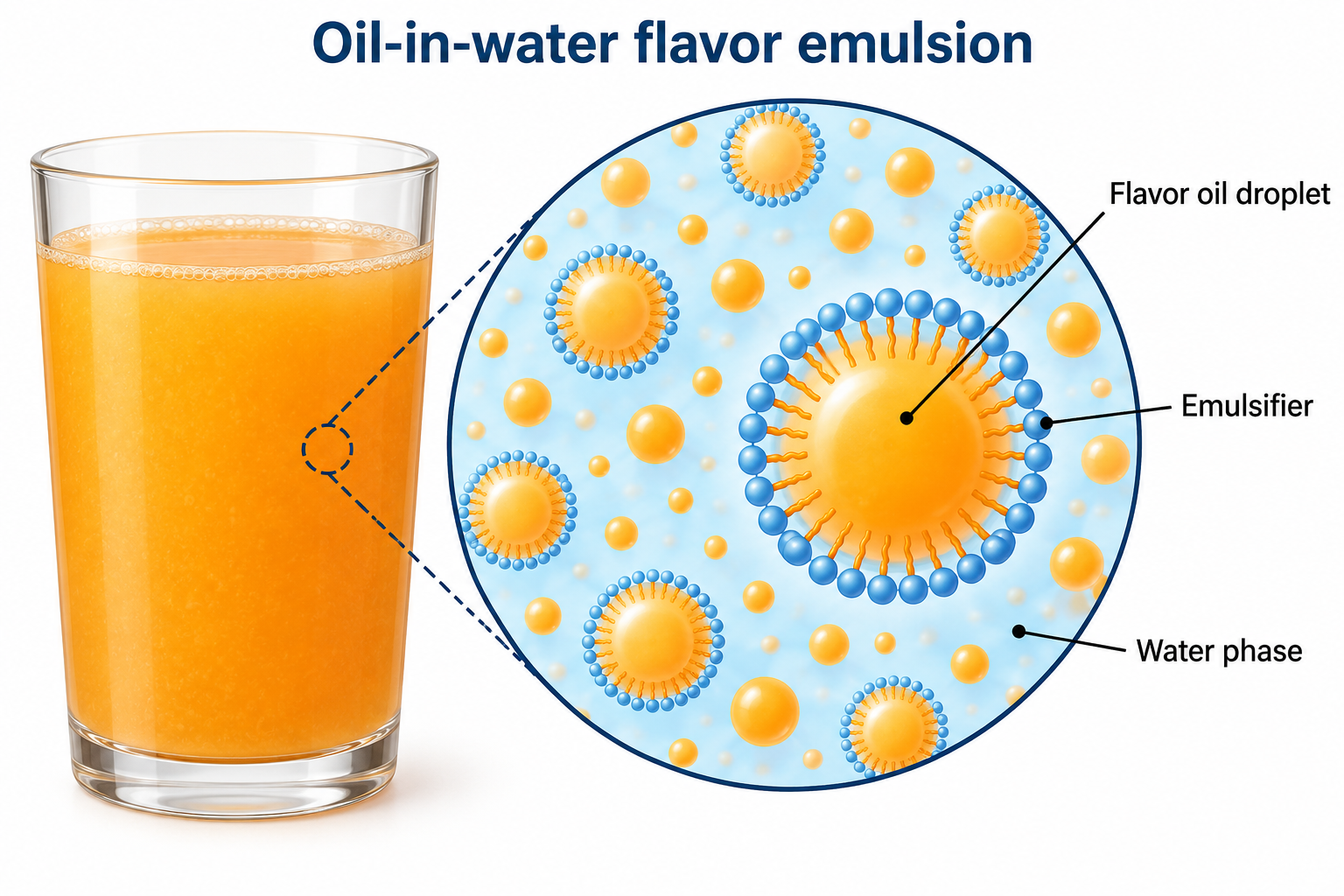
A flavor emulsion is a heterogeneous dispersion of one immiscible liquid phase within another, with the dispersed phase divided into small droplets and kinetically stabilized by an emulsifier.
For most beverage flavor emulsions:
Oil phase → dispersed/internal phase
Water phase → continuous/external phase
Therefore:
Flavor oil droplets in water = oil-in-water (O/W) emulsion.
This distinction matters. A flavor emulsion is not a true solution. A water-soluble flavor may be molecularly dissolved or sufficiently solubilized to appear clear, whereas an ordinary flavor emulsion contains discrete droplets and is thermodynamically unstable. It is engineered to remain kinetically stable for the required shelf life. MDPI
A beverage emulsion is particularly demanding because it normally must survive in two environments:
concentrated flavor emulsion → storage → dilution into beverage → beverage processing → finished-product shelf life.
An emulsion can therefore look perfectly good in the flavor drum yet fail after dilution into the customer's beverage. ScienceDirect
2. Why make a flavor emulsion?
Many flavor-important materials have poor water solubility:
citrus oils, terpenes, essential oils, oleoresin fractions, oil-soluble aroma chemicals, fat-soluble colors and other hydrophobic components.
Adding them directly to a beverage would typically cause separation, surface oil and/or ringing. Emulsification allows these hydrophobic materials to be distributed through an aqueous product. ScienceDirect
The flavorist should consequently think of an emulsion as a delivery system, not merely a physical form of flavor.
Its jobs can include:
flavor delivery + controlled dispersion + cloud/turbidity + color delivery + protection of hydrophobic materials.
3. The basic formulation architecture
A conventional beverage flavor emulsion can be visualized as:
Aqueous phase
Water
- emulsifier
- stabilizer/hydrocolloid if required
- acid/buffer
- preservative
- water-soluble color if appropriate
- other permitted water-soluble ingredients
↓
Oil phase
Flavor oil
- oil-soluble aroma chemicals
- weighting/density-adjusting agent where appropriate
- antioxidant
- oil-soluble color/cloud component where appropriate
↓
Pre-emulsification
↓
Homogenization
↓
Fine O/W flavor emulsion
The SFC syllabus specifically expects working knowledge of emulsifiers and weighting agents as non-flavor ingredients and of their functionality, appropriate use, interactions, labeling and advantages/disadvantages.
4. The oil phase
The oil phase carries the hydrophobic flavor.
Examples include:
citrus oils, folded citrus oils, essential oils, terpenes, oil-soluble aroma chemicals, vegetable oils, oil-soluble colors and other lipophilic materials.
For an orange beverage emulsion, for example, orange oil may form a substantial part of the dispersed phase.
The flavorist needs to know more than the sensory profile of the oil. You should also ask:
What is its density?
What is its viscosity?
How soluble is it in water?
How susceptible is it to oxidation?
Does its composition change during storage?
Will components partition out of the droplet?
Does it promote Ostwald ripening?
This is why citrus emulsions can be much harder to stabilize than emulsions based on highly water-insoluble triglyceride oils. Flavor/essential oils with appreciable water solubility can undergo significant Ostwald ripening. ResearchGate
5. The aqueous phase
The aqueous phase normally represents the continuous phase.
It can contain:
water, gum/starch emulsifier, hydrocolloid stabilizer, acids, buffers, preservatives, sugars/polyols where appropriate, water-soluble colors and other permitted ingredients.
The flavorist must consider:
pH, ionic strength, viscosity, microbial susceptibility, preservative efficacy, emulsifier hydration and compatibility with the customer's final application.
A beverage emulsion that is stable in water may behave differently after exposure to:
acid + sugar + salts + juice solids + preservatives + carbonation + heat.
Therefore application testing is essential.
6. Emulsifier versus stabilizer
These terms should not automatically be treated as synonyms.
An emulsifier primarily helps create and maintain the oil/water interface.
It adsorbs at the droplet surface and reduces the tendency for newly created droplets to recombine.
A stabilizer may instead—or additionally—improve physical stability by modifying continuous-phase rheology, steric interactions or other properties.
Some materials perform both functions.