Flavorist Training Module: Isothiocyanates — Structure, Chemistry, Reactivity, Stability, and Flavor Applications
At the bottom of this page, you will find a "Buy Now" button to purchase the digital files on 25 Commercial Applications of Isothiocyanates in Flavors (10 chapters, approximately 50 pages).
Also read another article:
 Editor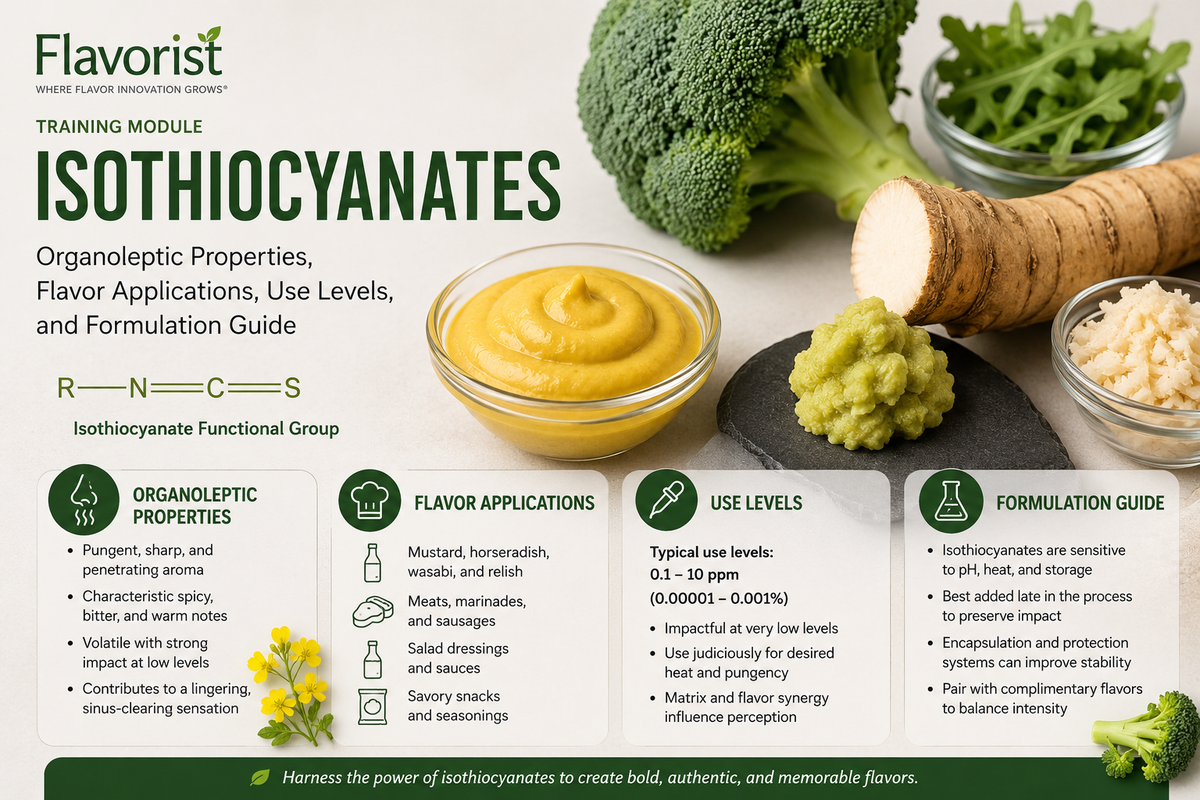
Introduction
Isothiocyanates are one of the most important classes of sulfur-containing flavor compounds found in nature. They are responsible for the pungency, freshness, and characteristic aroma of mustard, horseradish, wasabi, radish, broccoli, cabbage, watercress, arugula, and many other cruciferous vegetables. Although only a relatively small number are used commercially as flavor ingredients, understanding their chemistry allows a flavorist to formulate far more authentic Brassica, vegetable, savory, and condiment flavors.
The flavor contribution of isothiocyanates extends well beyond pungency. Depending on molecular structure, they can contribute green, leafy, peppery, earthy, woody, floral, sulfurous, root vegetable, mushroom, garlic, or sweet botanical nuances. Their remarkable odor potency means that additions are usually measured in parts per million or even parts per billion.
Basic Chemical Structure
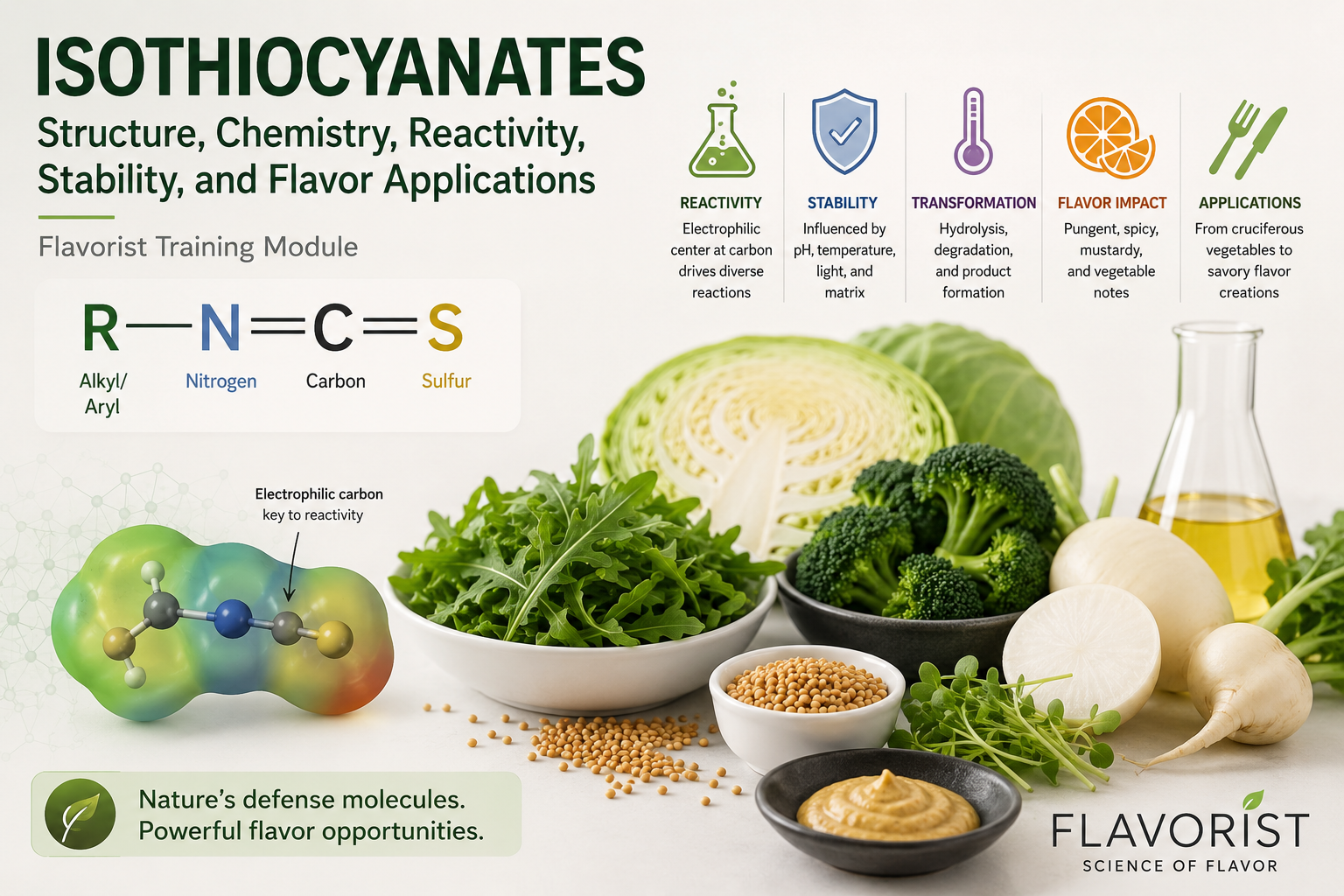
All isothiocyanates possess the same functional group:
R–N=C=S
where R represents an organic substituent attached to the nitrogen atom.
The isothiocyanate functional group consists of a nitrogen atom doubly bonded to carbon and the carbon doubly bonded to sulfur. This highly polarized cumulative double-bond system is responsible for the characteristic chemical reactivity and pungent sensory properties of the entire family.
Unlike thiocyanates (R–S–C≡N), the sulfur atom in isothiocyanates is terminal. The two classes of compounds have completely different chemistry and flavor properties.
The Isothiocyanate Functional Group
The –N=C=S group is highly electrophilic because the central carbon atom is electron deficient. As a result, isothiocyanates readily react with nucleophilic compounds such as:
- amino acids
- proteins
- peptides
- amines
- sulfhydryl compounds
- glutathione
- cysteine
- water (slowly)
- alcohols (under suitable conditions)
This high reactivity explains both their biological activity and their gradual loss during food processing.
General Types of Substituent Groups
The nature of the R group determines nearly every important flavor property.
1. Simple Alkyl Groups
General formula:
R = methyl, ethyl, propyl, butyl, pentyl, hexyl, etc.
Examples:
- methyl isothiocyanate
- ethyl isothiocyanate
- propyl isothiocyanate
- n-butyl isothiocyanate
- hexyl isothiocyanate
These generally produce:
- clean pungency
- green vegetable notes
- mustard character
- cabbage
- broccoli
- radish
Increasing alkyl chain length generally decreases volatility while increasing persistence and body.
2. Branched Alkyl Groups
Examples:
- isobutyl isothiocyanate
- isoamyl isothiocyanate
- 2-methylbutyl isothiocyanate
- tert-butyl isothiocyanate
Branching generally produces:
- smoother pungency
- less harsh mustard character
- cleaner profile
- slightly sweeter perception
- improved blending
These are frequently useful as modifiers rather than impact ingredients.
3. Unsaturated Alkenyl Groups
Examples:
- allyl isothiocyanate
- 3-butenyl isothiocyanate
- 4-pentenyl isothiocyanate
- raphasatin
These compounds exhibit:
- highest volatility
- brightest aroma
- strongest nasal pungency
- fresh-cut vegetable character
- mustard
- horseradish
- radish
The double bond often increases aroma intensity but slightly decreases oxidative stability.
4. Aromatic Groups
Examples:
- benzyl isothiocyanate
- phenethyl isothiocyanate
- 3-phenylpropyl isothiocyanate
Aromatic substitution introduces:
- floral notes
- woody nuances
- balsamic character
- watercress
- leafy vegetables
- peppery greens
These compounds are generally less volatile and considerably longer lasting than allyl isothiocyanate.
5. Cycloalkyl Groups
Examples:
- cyclobutyl isothiocyanate
- cyclopentyl isothiocyanate
- cyclohexyl isothiocyanate
Cycloalkyl substitution generally produces:
- fuller body
- earthy notes
- root vegetables
- persistence
- moderate pungency
These compounds are valuable supporting modifiers.
6. Sulfur-Functionalized Side Chains
Examples:
- sulforaphane
- erucin
- iberin
- iberverin
- alyssin
- hexaraphane
These compounds contain additional sulfur atoms within the side chain as methylthio (-SCH₃) or methylsulfinyl (-S(O)CH₃) groups.
They contribute:
- authentic Brassica aroma
- broccoli
- cabbage
- cauliflower
- kale
- vegetable stems
- lingering freshness
They represent many of the key aroma compounds responsible for the difference between natural vegetables and reconstructed flavors.
Structure–Flavor Relationships
Several general trends are observed.
Increasing molecular weight usually causes:
- lower volatility
- lower vapor pressure
- greater persistence
- less nasal pungency
- greater flavor longevity
Branching generally results in:
- smoother aroma
- cleaner flavor
- reduced harshness
- slightly sweeter perception
Aromatic rings generally contribute:
- floral nuances
- woody notes
- balsamic character
- longer persistence
Sulfur-containing side chains contribute:
- broccoli
- cabbage
- cauliflower
- garlic
- onion
- cooked vegetable complexity
Unsaturation generally increases:
- freshness
- brightness
- impact
- green character
Structure–Pungency Relationships
Pungency is influenced primarily by:
- volatility
- molecular size
- lipophilicity
- receptor interaction
In general:
Allyl > methyl ≈ ethyl > propyl > butyl > pentyl > hexyl
for immediate nasal pungency.
However,
Hexyl > butyl > propyl > allyl
for persistence after swallowing.
Thus a flavorist frequently combines several isothiocyanates to obtain both rapid impact and lasting flavor.
Natural Formation
Isothiocyanates are not normally present in intact plants.
Instead, cruciferous vegetables store stable glucosinolates inside specialized cells.
When tissue is damaged by:
- cutting
- crushing
- chewing
- shredding
- grinding
the enzyme myrosinase hydrolyzes glucosinolates, releasing isothiocyanates within seconds.
This explains why freshly cut mustard, horseradish, radish, cabbage, broccoli, or wasabi rapidly develop their characteristic aroma.
Reactivity
The electrophilic carbon atom readily reacts with nucleophiles.
Important reactions include:
Reaction with amino groups
→ thioureas
Reaction with sulfhydryl groups
→ dithiocarbamates
Reaction with glutathione
→ glutathione conjugates
Reaction with proteins
→ protein modification
Reaction with cysteine
→ cysteine conjugates
These reactions gradually reduce aroma intensity during food storage.
Factors Affecting Stability
Temperature
Heat accelerates decomposition.
Retorting, frying, baking, roasting, and spray drying all reduce isothiocyanate concentration.
Allyl isothiocyanate is particularly susceptible because of its high volatility.
Higher molecular weight compounds generally survive processing better.
Oxygen
Oxidation gradually destroys fresh green notes.
Sulfur-functionalized isothiocyanates may oxidize further to sulfoxides or sulfones.
Air exposure should therefore be minimized.
Moisture
Although relatively stable in dry systems, prolonged contact with water slowly promotes hydrolysis and degradation.
Powdered seasonings generally retain isothiocyanates better than aqueous products.
pH
Acidic environments generally improve stability.
Alkaline conditions accelerate decomposition.
Consequently mustard, horseradish, and wasabi products are usually formulated near mildly acidic pH.
Light
Ultraviolet light accelerates degradation.
Opaque containers greatly improve shelf life.
Metals
Transition metals may catalyze oxidative degradation.
Stainless steel equipment is preferred during manufacture.
Solubility
Most commercial isothiocyanates are:
Practically insoluble in water
Readily soluble in:
- ethanol
- propylene glycol
- triacetin
- medium-chain triglycerides
- vegetable oils
- many food-grade solvents
Consequently commercial flavor materials are usually supplied as dilute solvent solutions.
Volatility
Volatility decreases as molecular size increases.
Highly volatile:
- allyl
- methyl
- ethyl
Moderately volatile:
- propyl
- butyl
- isobutyl
Less volatile:
- hexyl
- cyclohexyl
- aromatic derivatives
- sulfur-functionalized Brassica isothiocyanates
This property strongly influences flavor release during eating.
Typical Flavor Roles
Depending upon structure, isothiocyanates function as:
- impact ingredients
- pungency generators
- authenticity enhancers
- vegetable modifiers
- freshness builders
- persistence enhancers
- sulfur bridges
- complexity contributors
- topnote modifiers
- flavor fixatives
Very few formulations use only one isothiocyanate.
Professional Brassica flavors usually combine several materials to simulate the complex volatile profile of natural vegetables.
Presented below is a compilation of the functional roles isothiocyanates fulfill in flavor and food applications, alongside the corresponding suitable isothiocyanates and their typical usage levels in the finished food. It should be noted that the dosages provided are approximate initial guidelines; precise optimization is contingent upon the target flavor profile, the product matrix, and the applied processing conditions.
Typical Flavor Roles of Isothiocyanates
1. Impact Ingredient (Immediate Pungency)
These compounds provide the first aroma perceived immediately upon smelling or tasting the product. They generate the characteristic "mustard hit" and nasal pungency.
Best isothiocyanates: Allyl isothiocyanate (primary), Ethyl isothiocyanate, Methyl isothiocyanate, Propyl isothiocyanate.
Typical dosage (finished food): 0.05–3 ppm. Premium mustards commonly contain 0.5–2 ppm allyl isothiocyanate. Wasabi and horseradish flavors may contain 0.2–1 ppm depending on desired pungency.
Typical applications: Mustard, horseradish, wasabi, radish, kimchi, pickles, barbecue sauces, meat seasonings, snack seasonings.
2. Pungency Generator
These compounds provide sustained peppery warmth and trigeminal stimulation rather than only initial aroma impact.
Best isothiocyanates: Allyl isothiocyanate, Benzyl isothiocyanate, Phenethyl isothiocyanate, n-Butyl isothiocyanate.
Typical dosage: 0.02–1 ppm.
Typical applications: Gourmet mustard, wasabi, horseradish, Bloody Mary flavors, savory sauces, radish flavors.
3. Authenticity Enhancer
Used in trace quantities to make Brassica flavors taste more natural. These materials often are not individually recognizable but dramatically improve realism.
Best isothiocyanates: Benzyl isothiocyanate, Phenethyl isothiocyanate, 6-Methylthiohexyl isothiocyanate, 7-Methylthioheptyl isothiocyanate, Sulforaphane, Erucin, Raphasatin.
Typical dosage: 0.005–0.3 ppm.
Typical applications: Premium wasabi, broccoli, cabbage, radish, daikon, watercress, arugula, Asian vegetable flavors.
4. Vegetable Modifier
These compounds strengthen fresh-cut vegetable notes and improve the realism of cruciferous vegetables.
Best isothiocyanates: Hexyl isothiocyanate, n-Butyl isothiocyanate, Isoamyl isothiocyanate, Cyclobutyl isothiocyanate, Cyclopentyl isothiocyanate, Sulforaphane, Iberin.
Typical dosage: 0.02–0.5 ppm.
Typical applications: Broccoli, cabbage, kale, Brussels sprouts, cauliflower, vegetable juices, vegetable soups.
5. Freshness Builder
Provides the aroma associated with freshly cut, grated, or crushed vegetables.
Best isothiocyanates: Allyl isothiocyanate, 2-Methylbutyl isothiocyanate, tert-Butyl isothiocyanate, Cyclobutyl isothiocyanate, Benzyl isothiocyanate.
Typical dosage: 0.01–0.3 ppm.
Typical applications: Fresh radish, daikon, broccoli sprouts, mustard greens, refrigerated dips, salad dressings.
6. Persistence Enhancer
These compounds provide lingering pungency after the highly volatile allyl isothiocyanate has dissipated.
Best isothiocyanates: 6-Methylthiohexyl isothiocyanate, 7-Methylthioheptyl isothiocyanate, 8-Methylthiooctyl isothiocyanate, Cyclohexyl isothiocyanate, Hexyl isothiocyanate, Phenethyl isothiocyanate.
Typical dosage: 0.005–0.2 ppm.
Typical applications: Premium wasabi, gourmet mustard, horseradish, Japanese sauces, seafood condiments.
7. Sulfur Bridge
These compounds connect fresh green notes with cooked sulfur notes, improving continuity and complexity in vegetable flavors.
Best isothiocyanates: Erucin, Sulforaphane, Iberverin, Alyssin, Hexaraphane, Raphasatin.
Typical dosage: 0.005–0.1 ppm.
Typical applications: Broccoli, cabbage, cauliflower, Brussels sprouts, vegetable concentrates, plant-based meats.
8. Complexity Contributor
Added at trace levels to increase flavor depth and reproduce the diverse volatile profile of natural vegetables.
Best isothiocyanates: Benzyl isothiocyanate, Phenethyl isothiocyanate, 3-Phenylpropyl isothiocyanate, Cyclopentyl isothiocyanate, Cyclohexyl isothiocyanate, 6-Methylthiohexyl isothiocyanate.
Typical dosage: 0.005–0.2 ppm.
Typical applications: Premium Brassica flavors, gourmet mustard, vegetable seasonings, refrigerated sauces, savory reaction flavors.
9. Topnote Modifier
These highly volatile isothiocyanates brighten the aroma immediately upon opening or smelling the product.
Best isothiocyanates: Allyl isothiocyanate, Methyl isothiocyanate, Ethyl isothiocyanate, tert-Butyl isothiocyanate, Cyclobutyl isothiocyanate.
Typical dosage: 0.005–0.2 ppm.
Typical applications: Mustard, wasabi, horseradish, radish, snack seasonings, dry seasoning blends.
10. Flavor Fixative (Flavor Extender)
Although not fixatives in the perfumery sense, these less volatile isothiocyanates prolong Brassica flavor perception during eating.
Best isothiocyanates: Phenethyl isothiocyanate, Cyclohexyl isothiocyanate, Hexyl isothiocyanate, 6-Methylthiohexyl isothiocyanate, 7-Methylthioheptyl isothiocyanate, 8-Methylthiooctyl isothiocyanate.
Typical dosage: 0.005–0.15 ppm.
Typical applications: Premium wasabi, Japanese condiments, gourmet mustard, refrigerated sauces, vegetable dips, plant-based meats.
Practical Formulation Strategy
Professional Brassica flavors rarely rely on a single isothiocyanate. A balanced system typically combines an impact ingredient (usually allyl isothiocyanate at 0.2–0.8 ppm), an authenticity enhancer (benzyl or phenethyl isothiocyanate at 0.02–0.10 ppm), a vegetable modifier (hexyl or n-butyl isothiocyanate at 0.02–0.20 ppm), a persistence enhancer (phenethyl or long-chain methylthioalkyl isothiocyanates at 0.005–0.05 ppm), and sulfur-bridge compounds such as sulforaphane or erucin (typically below 0.02 ppm). This layered approach produces the natural progression found in fresh Brassica vegetables: an immediate pungent topnote, followed by fresh green vegetable character, then lingering peppery warmth and authentic sulfurous botanical complexity.
Typical Commercial Flavor Applications
Isothiocyanates are used extensively in:
- mustard
- Dijon mustard
- horseradish
- wasabi
- radish
- daikon
- kimchi
- sauerkraut
- broccoli
- cabbage
- cauliflower
- Brussels sprouts
- kale
- watercress
- arugula
- turnip
- rutabaga
- vegetable juices
- Bloody Mary mixes
- savory seasonings
- meat rubs
- soup bases
- bouillon
- ramen seasonings
- plant-based meats
- vegetable concentrates
- refrigerated sauces
- salad dressings
- gourmet condiments
Due to the volume of information, we cannot list everything here. A "Buy Now" button is provided below for purchasing the digital files, which cover 25 commercial applications in flavors and foods across 10 chapters (approximately 50 pages). Additional introductory details about these files can be found at the bottom of this page.
Practical Formulation Guidelines
Because virtually all isothiocyanates possess extremely low odor thresholds, direct weighing of neat material is seldom practical.
Professional flavorists normally prepare serial dilutions of 0.01–1% before formulation.
Multiple isothiocyanates almost always produce more natural flavors than single compounds. Allyl isothiocyanate provides immediate impact, aromatic isothiocyanates contribute elegance, sulfur-functionalized Brassica isothiocyanates add authentic vegetable character, and higher molecular weight alkyl or cycloalkyl isothiocyanates provide persistence and body.
Balancing these materials with green aldehydes, sulfur compounds, pyrazines, yeast extracts, vegetable reaction flavors, and natural Brassica extracts creates the most convincing mustard, radish, horseradish, wasabi, broccoli, cabbage, and cruciferous vegetable flavors.
Key Points for Flavorists
The isothiocyanate family demonstrates one of the clearest examples of structure–odor relationships in flavor chemistry. Small changes in the substituent group profoundly influence volatility, pungency, persistence, freshness, and overall flavor character. Successful flavor formulation depends not on maximizing pungency but on selecting complementary isothiocyanates that reproduce the complete sensory progression of natural Brassica vegetables—from the bright fresh-cut topnote to the lingering peppery, sulfurous, and botanical finish. Mastery of this family enables the flavorist to formulate realistic mustard, horseradish, wasabi, radish, broccoli, cabbage, and other cruciferous vegetable flavors with a level of authenticity that cannot be achieved using allyl isothiocyanate alone.
Isothiocyanates: Typical Commercial Flavor Applications
A professional reference book
This booklet contains 10 chapters that cover 25 important commercial applications of isothiocyanates in food and flavors including
- Mustard & Horseradish Flavors
- Wasabi Flavors
- Radish, Daikon & Turnip Flavors
- Broccoli, Cabbage, Kale & Cauliflower Flavors
- Watercress, Arugula & Leafy Brassica Flavors
- Kimchi, Sauerkraut & Fermented Vegetable Flavors
- Savory Seasonings, Soups & Bouillons
- Plant-Based Meat & Meat Seasonings
- Dressings, Mayonnaise, Dips & Condiments
- Vegetable Juices & Beverage Applications
Each chapter can contain, for every application:
- Target sensory profile
- Primary isothiocyanates
- Secondary isothiocyanates
- Supporting flavor materials
- Recommended dosage of each isothiocyanate (finished food and concentrate)
- Typical ratio between the isothiocyanates
- Processing considerations
- Stability considerations
- Common formulation mistakes
- Overdose symptoms
- Natural extract options
- Example flavor formula philosophy
- Commercial flavorist tips
This booklet serves as an excellent reference resource for corporate flavor libraries and professional flavorists. The digital files are available for purchase at $49 via the link below.
###