Food Chemicals Codex (FCC): Participation Pathways and Industry Benefits for Flavor Professionals
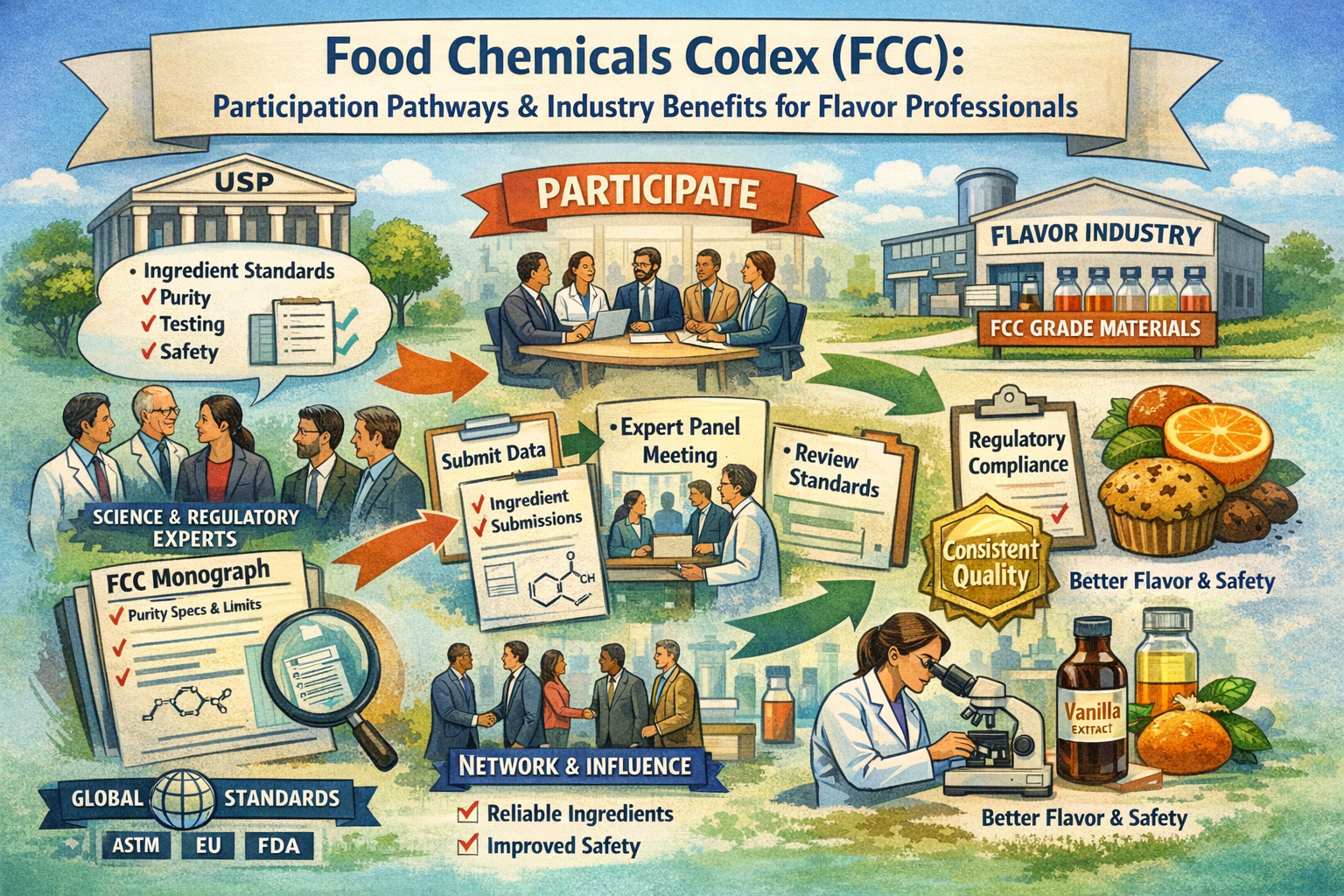
Food Chemicals Codex (FCC): A Practical Guide for Flavorists and the Flavor Industry
1) What is the Food Chemicals Codex (FCC)?
The Food Chemicals Codex (FCC) is an internationally recognized compendium of standards for the purity, identity, and quality of food ingredients, including many materials used in flavors.
- It is published by the U.S. Pharmacopeia (USP), a trusted nonprofit organization known for setting science-based quality standards.
- The FCC provides detailed monographs for individual ingredients.
A monograph is essentially a “technical profile” that defines:- What the ingredient is
- How pure it must be
- How to test it
- What impurities are acceptable (and at what limits)
👉 In simple terms:
Think of FCC as a rulebook that ensures ingredients used in food (including flavors) are safe, consistent, and high quality, no matter where they are produced.
2) Why FCC Matters in the Flavor Industry
Flavor formulations rely heavily on precise chemical ingredients—even small impurities can affect taste, aroma, or safety.
FCC helps ensure:
- Consistency:
A compound like vanillin from different suppliers will behave the same way in your formula. - Safety:
Limits are set for harmful contaminants (e.g., heavy metals, solvents). - Regulatory acceptance:
Many regulatory bodies and customers expect or require FCC-grade materials.
👉 For flavorists, this means you can formulate with confidence, knowing your raw materials meet a recognized standard.
3) Where FCC is Used in the Flavor Industry
A. Raw Material Procurement (Sourcing Ingredients)
When purchasing flavor chemicals, companies often specify “FCC grade”.
- This tells suppliers:
“Your material must meet FCC purity and testing requirements.” - It simplifies supplier qualification and reduces risk.
👉 Example:
If you order citric acid for a beverage flavor, specifying FCC ensures:
- Proper acidity profile
- No off-odors from impurities
- Compliance with food safety expectations
B. Quality Control and Testing
FCC provides analytical methods to verify ingredient quality.
- These may include:
- Identification tests (e.g., IR, GC)
- Purity assays
- Limits for contaminants (lead, arsenic, residual solvents)
👉 In practice:
- QC labs use FCC methods to confirm incoming materials are acceptable
- If a batch fails FCC specs, it is rejected
C. Flavor Formulation and Development
Flavorists rely on FCC-grade materials for predictable performance.
- Impurities can:
- Alter aroma (e.g., sulfur notes from contamination)
- Cause instability
- Interfere with other compounds
👉 FCC ensures:
- Clean sensory profile
- Reproducibility across batches
- Stability in finished products
D. Regulatory and Compliance Work
FCC is widely referenced in global food regulations.
- While not a law itself, it is often:
- Referenced by regulatory agencies
- Required by customers (especially multinational brands)
👉 In audits:
- Using FCC-grade materials demonstrates due diligence and compliance
E. Finished Product Quality Assurance
Even though FCC applies to ingredients (not finished foods), it indirectly impacts final products:
- Better raw materials → better flavor consistency
- Lower contamination risk → longer shelf life
- More predictable behavior in different food matrices
4) What Does an FCC Monograph Typically Include?
Each ingredient in FCC has a standardized structure. Understanding this helps flavorists interpret specs correctly.
- Name and definition
What the ingredient is chemically - Chemical formula / structure
Helps confirm identity - Description
Physical form (powder, liquid, color, odor) - Identification tests
Methods to confirm the substance is correct - Assay (purity)
Minimum % of active compound (e.g., ≥99%) - Impurity limits
Maximum allowed levels of contaminants - Analytical methods
How to perform the tests
👉 This is essentially a complete technical specification sheet, but standardized and globally recognized.
5) Examples of FCC-Relevant Ingredients in Flavors
Common flavor ingredients covered by FCC include:
- Organic acids (citric acid, lactic acid)
- Sweeteners (sucrose, glucose derivatives)
- Solvents (ethanol, propylene glycol)
- Preservatives (sorbates, benzoates)
- Flavor chemicals (e.g., vanillin, benzaldehyde in some cases)
👉 These materials are the building blocks of flavor systems, making FCC highly relevant to daily flavor work.
6) Advantages of Using FCC Standards
- Global credibility
Recognized by regulators and industry worldwide - Consistency across suppliers
Reduces variability in formulations - Improved safety assurance
Clear contaminant limits - Simplified audits and documentation
Easier to demonstrate compliance - Better sensory reliability
Fewer unexpected off-notes
7) Limitations of FCC (Important for Flavorists to Understand)
- Not all flavor compounds are covered
Especially newer or proprietary aroma chemicals - Does not address sensory quality directly
A material can meet FCC but still have slight odor differences - Not a legal requirement everywhere
Though often expected, it depends on region and customer
👉 This means FCC is necessary but not sufficient—flavorists still need sensory evaluation and internal specs.
8) Practical Takeaways for Beginner Flavorists
- Always check if your raw materials are FCC grade
- Understand how to read an FCC monograph
- Use FCC as a baseline standard, not the only quality measure
- Combine FCC compliance with:
- Sensory testing
- Stability testing
- Supplier audits
Summary
The Food Chemicals Codex (FCC) is a foundational quality standard system that ensures food and flavor ingredients are pure, safe, and consistent.
In the flavor industry, it plays a critical role in:
- Ingredient sourcing
- Quality control
- Regulatory compliance
- Reliable flavor formulation
For anyone entering the field, understanding FCC is essential—it is one of the key tools that allows flavorists to build flavors that are not only delicious, but also safe and reproducible at scale.
Membership & Benefits Related to the Food Chemicals Codex (FCC)
Important Clarification First
The Food Chemicals Codex (FCC) itself is not a membership organization.
👉 Instead:
- FCC is a published standards compendium
- It is developed and maintained by the U.S. Pharmacopeia (USP)
So when people ask about “joining FCC,” what they really mean is:
Becoming involved with or a member of USP, or participating in FCC standards development
1) Who Can Become Involved (or “Members”)
While FCC itself has no membership, USP offers multiple ways to participate, especially relevant to the flavor industry.
A. USP Convention Members (Voting Members)
These are individuals selected to participate in USP governance.
- Typically include:
- Scientists
- Regulatory experts
- Industry professionals (including flavor companies)
- Academics
👉 What they do:
- Vote on standards and policies
- Help guide the direction of FCC and other USP compendia
👉 For flavorists:
- Senior technical experts may be nominated through industry organizations
B. Expert Committees & Panels
USP forms Expert Committees and Expert Panels to develop FCC standards.
- Members are:
- Chemists
- Toxicologists
- Analytical scientists
- Industry specialists
👉 What they do:
- Write and revise FCC monographs
- Set purity standards and analytical methods
👉 For flavor professionals:
- This is the most direct way to influence FCC content
C. Industry Participants / Stakeholders
Companies in the flavor and food industries can participate by:
- Submitting data for new monographs
- Commenting on proposed standards
- Collaborating with USP on technical issues
👉 Typical participants:
- Flavor houses
- Ingredient suppliers
- Food manufacturers
D. Subscribers / Users (Most Common Form of “Membership”)
Most companies interact with FCC by purchasing access to it.
- FCC is available as:
- Online subscription
- Printed compendium
👉 This is how:
- QC labs
- Flavorists
- Regulatory teams
use FCC in daily work
2) What USP (and FCC) Can Do for Participants / Members
Even though FCC is not a membership body, USP provides significant value to those involved with it.
A. Establishes Trusted Ingredient Standards
USP develops FCC standards that:
- Define ingredient purity
- Set contaminant limits
- Provide validated testing methods
👉 Benefit:
- Companies can rely on globally accepted benchmarks
- Reduces disputes between suppliers and customers
B. Supports Regulatory Compliance
FCC is widely referenced by regulators and customers.
👉 USP helps members:
- Align with food safety expectations
- Prepare for audits
- Demonstrate due diligence
👉 For flavor companies:
- Using FCC standards strengthens regulatory credibility
C. Provides Scientific and Technical Leadership
USP brings together global experts to:
- Evaluate ingredient safety
- Improve analytical methods
- Update standards as science evolves
👉 Benefit:
- Members stay aligned with latest scientific developments
D. Offers Networking and Industry Influence
Through USP participation:
- You interact with:
- Regulators
- Scientists
- Industry leaders
👉 Benefit:
- Opportunity to influence future standards
- Gain visibility in the technical community
E. Enables Contribution to Standards Development
Participants can:
- Propose new ingredient monographs
- Suggest revisions
- Submit supporting data
👉 For flavorists:
- This is powerful because you can:
- Help define how an ingredient is judged globally
- Ensure standards reflect real-world usage
F. Improves Internal Quality Systems
Using FCC standards helps companies:
- Build robust QC protocols
- Standardize supplier requirements
- Reduce variability in formulations
👉 Result:
- Better product consistency
- Fewer quality issues
G. Access to Educational Resources
USP provides:
- Technical documentation
- Workshops and training
- Guidance on analytical methods
👉 Benefit:
- Helps train:
- Junior flavorists
- QC analysts
- Regulatory staff
3) Practical Example (Flavor Industry Context)
Imagine a flavor company sourcing benzaldehyde:
- Without FCC:
- Supplier A: 98% purity
- Supplier B: 99.5% purity
- Unknown impurities
- With FCC:
- Both suppliers must meet:
- Defined purity level
- Specific impurity limits
- Standardized test methods
- Both suppliers must meet:
👉 Result:
- Consistent almond/cherry flavor profile
- Reduced risk of off-notes
- Easier supplier comparison
4) Key Takeaways for Flavorists
- You cannot “join FCC” directly
- But you can engage through the U.S. Pharmacopeia (USP) by:
- Participating in expert panels
- Contributing data
- Using FCC standards daily
👉 For most professionals:
- The real “membership benefit” is access + participation + influence
Final Summary
The Food Chemicals Codex (FCC) is not a membership organization, but a global standards system maintained by USP.
Through USP involvement, individuals and companies in the flavor industry can:
- Help shape ingredient standards
- Ensure product safety and consistency
- Strengthen regulatory compliance
- Gain technical and professional recognition
👉 In practice, FCC serves as a shared language of quality—and participation in its ecosystem allows flavor professionals to operate at the highest industry standard.
What the Food Chemicals Codex (FCC) Can Do for the Food & Flavor Industry
Although the Food Chemicals Codex (FCC) is not a membership organization, it plays a critical, system-wide role in supporting the food and flavor industry through standards developed by the U.S. Pharmacopeia (USP).
1) Establishes a Common Language for Ingredient Quality
One of FCC’s most important roles is creating uniform definitions and specifications for food ingredients.
- It defines:
- What an ingredient is
- How pure it must be
- What impurities are acceptable
👉 Why this matters:
- A flavor company in the U.S., a supplier in Europe, and a manufacturer in Asia can all work from the same standard
- Reduces confusion and disagreements between buyers and suppliers
2) Improves Safety Across the Supply Chain
FCC sets strict limits on contaminants, such as:
- Heavy metals (lead, arsenic)
- Residual solvents
- Toxic by-products
👉 Impact on the industry:
- Protects consumers from unsafe ingredients
- Helps companies avoid recalls and safety incidents
- Supports compliance with global food safety expectations
3) Supports Regulatory Compliance and Audits
FCC is widely recognized by regulators and customers worldwide.
- Often referenced in:
- Internal quality standards
- Supplier specifications
- Audit requirements
👉 For companies:
- Using FCC-grade materials shows due diligence
- Makes regulatory inspections smoother
- Builds trust with major food brands
4) Enables Consistent Flavor Performance
Flavor systems are extremely sensitive to minor chemical variations.
FCC helps ensure:
- High purity → cleaner taste and aroma
- Low variability → consistent batch-to-batch performance
👉 Example:
- A strawberry flavor made today will taste the same months later because raw materials are standardized
5) Strengthens Supplier Qualification and Procurement
FCC simplifies the process of sourcing ingredients.
- Buyers can specify:
- “Must meet FCC standards”
👉 Benefits:
- Easier comparison between suppliers
- Faster qualification process
- Reduced risk of poor-quality materials entering production
6) Provides Validated Analytical Methods
FCC includes tested and standardized lab methods for:
- Identity testing
- Purity assays
- Contaminant detection
👉 Why this is powerful:
- QC labs don’t need to “invent” methods
- Results are consistent and reproducible across companies
7) Supports Innovation While Maintaining Safety
As new ingredients are introduced, FCC:
- Adds new monographs
- Updates existing standards
👉 For the industry:
- Encourages innovation (new flavor compounds, new processes)
- While maintaining scientific control and safety
8) Enhances Global Trade and Market Access
Because FCC is internationally recognized:
- Ingredients meeting FCC standards are more easily accepted globally
👉 Impact:
- Reduces trade barriers
- Facilitates export/import of flavor materials
- Helps companies expand into new markets
9) Improves Finished Product Quality and Shelf Life
Better raw materials lead to:
- Fewer off-notes
- Improved stability
- Reduced risk of degradation
👉 In practice:
- Beverages taste cleaner
- Snacks maintain flavor longer
- Dairy flavors remain stable during storage
10) Builds Consumer Trust
Even though consumers don’t see “FCC” on labels:
- FCC standards contribute to:
- Safer foods
- Consistent taste experiences
👉 End result:
- Stronger brand reputation
- Higher consumer confidence
Key Takeaway for Flavor Professionals
The FCC acts as a foundation of technical reliability in the food and flavor industry.
It helps companies:
- Work with trusted raw materials
- Maintain consistent flavor quality
- Meet global safety expectations
- Operate efficiently across complex supply chains
Final Summary
The Food Chemicals Codex (FCC) is not just a reference book—it is a core infrastructure tool for the entire food and flavor industry.
By standardizing ingredient quality, ensuring safety, and enabling global consistency, FCC allows flavorists and manufacturers to create products that are reliable, scalable, and trusted worldwide.
###