Professional Flavorist System for Pineapple Coconut Yerba Mate: From Formulation Guide to Compound Library to Modular Blocks and Scientific Compatibility Engineering
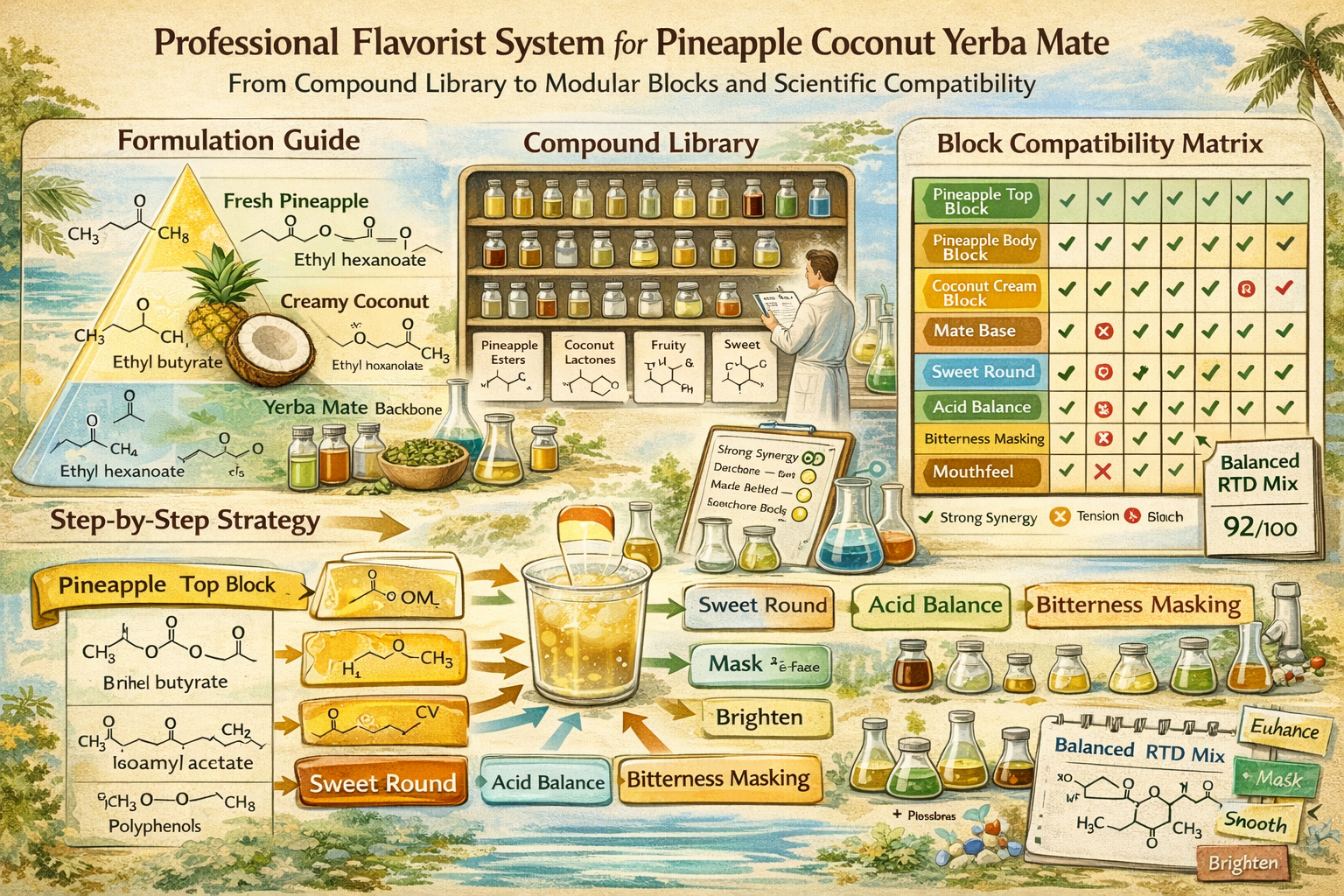
This posting includes a formulation guide, compound library, flavor blocks, and a block compatibility matrix.
A professional formulation guide for developing a Pineapple Coconut Yerba Mate beverage flavor system
🧪 Pineapple Coconut Yerba Mate Flavor
Complete Formulation & Development Guide
1) 🎯 Flavor Target Definition (Before You Formulate)
You are not just making “pineapple coconut”—you are building a layered beverage system:
- Top note (impact): Fresh, juicy pineapple burst
- Heart note (body): Creamy coconut + rounded tropical sweetness
- Base note (foundation): Earthy, slightly bitter **Yerba Mate extract
- Modifier system: Sweetness, acidity, mouthfeel, and masking
👉 Key challenge:
Balancing bright fruit vs. herbal bitterness vs. creamy smoothness
2) 🧩 Flavor Architecture (Pyramid Design)
🔼 Top Notes (0.05–0.3%)
Goal: Immediate tropical freshness
Key compounds:
- Ethyl butyrate → juicy pineapple, diffusive
- Ethyl hexanoate → fruity, sweet, tropical lift
- Allyl hexanoate → sharp pineapple realism
- Methyl butyrate → bright, volatile fruit pop
Support:
- Acetaldehyde (trace) → fresh-cut fruit effect
- Cis-3-hexenol (trace) → natural freshness
👉 Tip:
Too much ester = candy-like → keep natural balance
❤️ Heart Notes (0.3–1.2%)
Goal: Flavor body & identity
Pineapple body
- Ethyl 2-methylbutyrate → ripe fruit depth
- γ-octalactone (trace) → creamy fruit bridge
Coconut system
- γ-nonalactone → creamy coconut core
- δ-decalactone → milky, peachy coconut fullness
- γ-undecalactone → fatty richness
Sweet rounders
- Furaneol → caramelized sweetness
- Maltol / Ethyl maltol → body & warmth
👉 Tip:
Coconut should soften pineapple, not dominate
🔽 Base Notes (0.5–2.0%)
Goal: Authenticity + stability
Yerba mate backbone
- Natural mate extract (water-soluble)
- Polyphenols → bitterness/astringency
- Light smoky/tea nuance
Fixatives & depth
- Vanillin (trace) → smoothness
- Benzyl alcohol → mild floral roundness
- Phenethyl alcohol → soft body
👉 Tip:
Base must anchor flavor without muting top notes
3) ⚖️ Functional System (Critical for Beverages)
🍬 Sweetness system
- Sucrose or HFCS: 6–10% typical RTD
- High-intensity (optional):
- Stevia → natural positioning
- Sucralose → clean sweetness
👉 Balance:
- Pineapple needs higher perceived sweetness
- Coconut needs creaminess, not just sugar
⚗️ Acid system (very important)
- Citric acid → brightness (0.08–0.15%)
- Malic acid → lingering tartness (0.03–0.08%)
👉 Key insight:
- Pineapple = citric dominant
- Overuse → kills coconut creaminess
🧂 Bitterness management (critical)
Yerba mate introduces:
- Caffeine bitterness
- Polyphenol astringency
Masking tools:
- Sodium citrate → buffering
- Glycyrrhizin → natural masking
- Flavor modulators (bitter blockers)
🧈 Mouthfeel system
- Glycerin (0.2–0.5%) → smoothness
- Gum acacia → body
- Pectin (low level) → natural texture
👉 Coconut perception = mouthfeel + aroma synergy
4) 🧪 Example Starter Formula (Flavor Base)
Flavor concentrate (to be dosed at 0.1–0.2% in beverage)
Pineapple top
- Ethyl butyrate → 15%
- Ethyl hexanoate → 8%
- Allyl hexanoate → 3%
- Methyl butyrate → 5%
Coconut heart
- γ-nonalactone → 10%
- δ-decalactone → 6%
- γ-undecalactone → 3%
Sweet & body
- Furaneol → 2%
- Maltol → 2%
- Vanillin → 1%
Green / natural modifiers
- Cis-3-hexenol → 0.2%
- Linalool → 0.5%
Solvent system
- Ethanol / Triacetin / PG → balance to 100%
5) 🧪 Beverage Prototype (RTD Concept)
- Water → q.s.
- Sugar → 8%
- Citric acid → 0.12%
- Malic acid → 0.05%
- Yerba mate extract → 0.2–0.4%
- Flavor → 0.15%
- Glycerin → 0.3%
6) ⚠️ Key Formulation Challenges
1. Flavor clash
- Pineapple (sharp) vs coconut (soft)
✔ Fix: Add lactone bridge + maltol
2. Mate bitterness
✔ Fix:
- Increase sweetness slightly
- Add masking system
- Reduce harsh green notes
3. Volatility loss
- Esters evaporate during processing
✔ Fix:
- Add top notes post-pasteurization
- Use encapsulation if needed
4. Stability
- Lactones can hydrolyze over time
✔ Fix:
- Control pH (3.2–3.8 ideal)
- Use antioxidants if needed
7) 🧠 Advanced Flavorist Techniques
🔬 Block System (fast development)
- Pineapple block → esters + acetaldehyde
- Coconut block → lactones
- Mate block → extract + green modifiers
- Sweet round block → maltol + vanillin
👉 Build separately → blend → adjust ratios
🔬 Sensory tuning strategy
- If “too candy-like” → reduce ethyl butyrate
- If “too herbal” → increase coconut lactones
- If “too flat” → boost ethyl hexanoate
- If “too acidic” → add maltol
8) 🧾 Final Professional Insight
A successful Pineapple Coconut Yerba Mate flavor must achieve:
✔ Bright tropical entry
✔ Creamy, smooth mid-palate
✔ Controlled herbal bitterness
✔ Clean, refreshing finish
👉 The winning profile is not strongest flavor—
it is best balance across systems
Below is a professional 50+ compound flavor library for building a Pineapple Coconut Yerba Mate beverage, organized the way flavorists actually work: by functional blocks, with odor, role, substitutes, and practical usage ranges.
🧪 50+ Compound Flavor Library
Pineapple Coconut Yerba Mate System
🍍 1) Pineapple Top-Note Esters (Impact Layer)
These define fresh, juicy pineapple lift.
Core esters
- Ethyl butyrate
- Odor: Juicy pineapple, candy-fruity
- Role: Primary impact
- Use: 10–80 ppm
- Substitute: Methyl butyrate (brighter, lighter)
- Methyl butyrate
- Odor: Very fresh, volatile pineapple
- Role: Top sparkle
- Use: 5–40 ppm
- Substitute: Ethyl acetate (less specific)
- Ethyl hexanoate
- Odor: Sweet fruity, apple-pineapple
- Role: Juicy body extension
- Use: 5–50 ppm
- Substitute: Ethyl octanoate (heavier)
- Allyl hexanoate
- Odor: Sharp, realistic pineapple
- Role: Authenticity booster
- Use: 0.5–10 ppm
- Substitute: Hexyl acetate
- Ethyl 2-methylbutyrate
- Odor: Ripe fruit, juicy
- Role: Naturalness
- Use: 1–15 ppm
- Substitute: Isoamyl acetate (more banana)
- Isoamyl acetate
- Odor: Banana-fruity
- Role: Tropical blending
- Use: 2–20 ppm
- Substitute: Isoamyl butyrate
- Hexyl acetate
- Odor: Green-fruity
- Role: Freshness balance
- Use: 5–40 ppm
- Substitute: Cis-3-hexenyl acetate
🌿 2) Green / Fresh Modifiers (Natural Lift)
Prevent artificial/candy perception.
- Cis-3-hexenol
- Odor: Fresh cut grass
- Role: Natural freshness
- Use: 0.1–5 ppm
- Substitute: Trans-2-hexenal
- Cis-3-hexenyl acetate
- Odor: Fruity-green
- Role: Fresh fruit realism
- Use: 1–10 ppm
- Trans-2-hexenal
- Odor: Green, leafy
- Role: Sharp freshness
- Use: 0.1–3 ppm
- Linalool
- Odor: Floral citrus
- Role: Lift & diffusion
- Use: 1–20 ppm
- Substitute: Terpineol
- Geraniol
- Odor: Floral rosy
- Role: Tropical rounding
- Use: 0.5–10 ppm
🥥 3) Coconut Lactones (Creamy Core)
These define the coconut identity.
- γ-Nonalactone
- Odor: Coconut, creamy
- Role: Core coconut note
- Use: 5–40 ppm
- Substitute: δ-decalactone
- δ-Decalactone
- Odor: Milky, peachy
- Role: Creaminess
- Use: 5–50 ppm
- γ-Undecalactone
- Odor: Fatty, creamy
- Role: Richness
- Use: 2–20 ppm
- γ-Octalactone
- Odor: Coconut-light
- Role: Top coconut
- Use: 1–15 ppm
- δ-Dodecalactone
- Odor: Heavy creamy
- Role: Long-lasting base
- Use: 1–10 ppm
🍬 4) Sweet & Caramelized Modifiers
Provide roundness and “juicy perception”
- Furaneol
- Odor: Sweet caramel fruit
- Role: Juicy enhancer
- Use: 0.5–10 ppm
- Substitute: Ethyl maltol
- Maltol
- Odor: Warm sweet
- Role: Body
- Use: 5–50 ppm
- Ethyl maltol
- Odor: Cotton candy
- Role: Sweet boost
- Use: 1–20 ppm
- Vanillin
- Odor: Vanilla
- Role: Smoothness
- Use: 1–30 ppm
- Ethyl vanillin
- Odor: Strong vanilla
- Role: Intensity
- Use: 0.5–10 ppm
🍑 5) Fruity Body & Depth Compounds
Bridge pineapple ↔ coconut
- β-Damascenone
- Odor: Fruity, rose, apple
- Role: Complexity
- Use: 0.01–1 ppm
- γ-Decalactone
- Odor: Peachy
- Role: Fruit body
- Use: 1–15 ppm
- Ethyl octanoate
- Odor: Sweet fruity
- Role: Depth
- Use: 2–30 ppm
- Benzaldehyde (trace)
- Odor: Almond/cherry
- Role: Fruit enhancement
- Use: 0.1–2 ppm
🍃 6) Yerba Mate & Herbal System
Supports the Yerba Mate identity
- Mate extract (natural)
- Odor: Herbal, tea
- Role: Base
- Use: 0.1–0.5%
- Caffeine
- Odor: Bitter
- Role: energy + taste
- Use: 50–150 ppm
- Chlorogenic acids
- Odor: Astringent
- Role: tea structure
- Use: trace–50 ppm
- Quinic acid
- Odor: sour/astringent
- Role: realism
- Use: 5–50 ppm
🌰 7) Creamy / Fatty Enhancers
Boost coconut mouthfeel
- Acetoin
- Odor: buttery
- Role: creaminess
- Use: 1–20 ppm
- Diacetyl (trace)
- Odor: buttery
- Role: richness
- Use: 0.1–2 ppm
- Butyric acid (trace)
- Odor: cheesy/fruity
- Role: pineapple realism
- Use: 0.1–2 ppm
🍋 8) Acid & Brightness System
- Citric acid
- Role: brightness
- Use: 0.08–0.15%
- Malic acid
- Role: lingering tart
- Use: 0.03–0.1%
- Lactic acid
- Role: smooth acidity
- Use: 0.01–0.05%
🧪 9) Solvents / Carriers
- Ethanol
- Propylene glycol
- Triacetin
Use: balance system (q.s.)
🧂 10) Modulators & Masking Agents
- Sodium citrate
- Role: buffering
- Glycyrrhizin
- Role: bitterness masking
- Salt (NaCl, trace)
- Role: flavor enhancement
🌸 11) Floral / Exotic Enhancers
- Phenethyl alcohol
- Odor: rose
- Role: softness
- Benzyl acetate
- Odor: fruity floral
- Role: lift
- Nerolidol
- Odor: woody floral
- Role: depth
🌊 12) Advanced Naturalness Boosters
- Dimethyl sulfide (trace)
- Odor: cooked corn
- Role: realism (very low!)
- Methional (trace)
- Odor: potato
- Role: complexity
- 2,3-Hexanedione
- Odor: buttery
- Role: mouthfeel
🧠 13) High-Impact Trace Compounds
- Acetaldehyde
- Odor: fresh fruit
- Use: 1–10 ppm
- Ethyl acetate
- Odor: fruity solvent
- Use: 10–100 ppm
- Terpineol
- Odor: lilac citrus
- Use: 1–10 ppm
- α-Pinene (trace)
- Odor: pine
- Role: freshness
🧾 Final Professional Insight
A complete system is not about number of compounds, but:
✔ Interaction between esters + lactones
✔ Control of bitterness from mate
✔ Balance of acidity and sweetness
✔ Mouthfeel-driven coconut perception
👉 The best formulas typically use 15–30 of these compounds, not all 50.
Here is a complete professional block system for a Pineapple Coconut Yerba Mate beverage, designed exactly the way senior flavorists accelerate development: modular, scalable, and plug-and-play.
🧪 COMPLETE FLAVOR BLOCK SYSTEM
Pineapple Coconut Yerba Mate (RTD Beverage)
🧩 1) SYSTEM OVERVIEW
Instead of building from scratch, you assemble flavor using functional blocks:
| Block | Function |
|---|---|
| 🍍 Pineapple Top Block | Impact / first impression |
| 🍍 Pineapple Body Block | Juicy realism |
| 🥥 Coconut Cream Block | Creamy core |
| 🌿 Mate Base Block | Herbal identity |
| 🍬 Sweet Round Block | Balance & smoothness |
| ⚗️ Acid Block | Brightness |
| 🧂 Masking Block | Bitterness control |
| 🧈 Mouthfeel Block | Texture |
👉 You combine these like LEGO → adjust ratios → finalize
🍍 2) PINEAPPLE TOP BLOCK (IMPACT)
🎯 Purpose
Immediate juicy pineapple burst
🧪 Formula (100 g block)
- Ethyl butyrate → 40 g
- Ethyl hexanoate → 20 g
- Methyl butyrate → 15 g
- Allyl hexanoate → 5 g
- Acetaldehyde (10% solution) → 2 g
- Ethanol → 18 g
⚙️ Usage
- 0.02–0.08% in finished beverage
🔧 Adjustments
- Too candy-like → ↓ ethyl butyrate
- Too weak → ↑ methyl butyrate
🍍 3) PINEAPPLE BODY BLOCK (JUICY CORE)
🎯 Purpose
Natural, ripe pineapple flesh
🧪 Formula (100 g)
- Ethyl 2-methylbutyrate → 15 g
- Hexyl acetate → 15 g
- γ-Octalactone → 5 g
- Furaneol → 2 g
- Maltol → 3 g
- Linalool → 2 g
- Propylene glycol → 58 g
⚙️ Usage
- 0.05–0.15%
🔧 Adjustments
- Too artificial → ↑ hexyl acetate
- Too flat → ↑ furaneol
🥥 4) COCONUT CREAM BLOCK
🎯 Purpose
Creamy, smooth coconut identity
🧪 Formula (100 g)
- γ-Nonalactone → 25 g
- δ-Decalactone → 20 g
- γ-Undecalactone → 10 g
- Acetoin → 5 g
- Vanillin → 3 g
- Ethyl maltol → 2 g
- Triacetin → 35 g
⚙️ Usage
- 0.05–0.20%
🔧 Adjustments
- Too oily → ↓ γ-undecalactone
- Too thin → ↑ δ-decalactone
🌿 5) MATE BASE BLOCK
🎯 Purpose
Authentic **Yerba Mate backbone
🧪 Formula (100 g)
- Mate extract (water soluble) → 60 g
- Quinic acid → 5 g
- Caffeine → 3 g
- Linalool → 1 g
- Ethanol → 31 g
⚙️ Usage
- 0.1–0.4%
🔧 Adjustments
- Too bitter → ↓ caffeine
- Too weak → ↑ mate extract
🍬 6) SWEET ROUND BLOCK
🎯 Purpose
Smooth edges, enhance fruit perception
🧪 Formula (100 g)
- Maltol → 20 g
- Ethyl maltol → 10 g
- Vanillin → 10 g
- Benzyl alcohol → 5 g
- Propylene glycol → 55 g
⚙️ Usage
- 0.02–0.08%
⚗️ 7) ACID BALANCE BLOCK
🎯 Purpose
Brightness + refreshment
🧪 Formula (liquid)
- Citric acid → 70 g
- Malic acid → 30 g
⚙️ Usage
- 0.1–0.2% in beverage
🧂 8) BITTERNESS MASKING BLOCK
🎯 Purpose
Control mate bitterness
🧪 Formula (100 g)
- Sodium citrate → 40 g
- Glycyrrhizin (1% solution) → 10 g
- Propylene glycol → 50 g
⚙️ Usage
- 0.01–0.05%
🧈 9) MOUTHFEEL BLOCK
🎯 Purpose
Simulate coconut cream texture
🧪 Formula (100 g)
- Glycerin → 60 g
- Gum acacia solution → 30 g
- Pectin (low methoxyl) → 10 g
⚙️ Usage
- 0.1–0.3%
🧪 10) COMPLETE PLUG-AND-PLAY FORMULA
🥤 RTD Beverage Prototype (1 kg batch)
- Water → 890 g
- Sugar → 80 g
- Acid block → 1.5 g
- Pineapple top block → 0.4 g
- Pineapple body block → 1.0 g
- Coconut block → 1.2 g
- Mate block → 2.5 g
- Sweet block → 0.5 g
- Masking block → 0.2 g
- Mouthfeel block → 2.7 g
⚖️ 11) FAST TUNING GUIDE
If too “candy pineapple”
→ ↓ Top block, ↑ body block
If too “herbal / bitter”
→ ↑ sweet block + masking block
If coconut not creamy enough
→ ↑ coconut block + mouthfeel
If flavor too flat
→ ↑ ethyl hexanoate (top block tweak)
🧠 12) PROFESSIONAL DEVELOPMENT STRATEGY
Step-by-step workflow
- Build pineapple system alone
- Build coconut system alone
- Balance both (fruit vs cream)
- Add mate LAST
- Fix bitterness
- Adjust sweetness + acid
👉 Never build everything at once
🧾 FINAL INSIGHT
This block system gives you:
✔ Speed (minutes instead of days)
✔ Consistency (repeatable results)
✔ Scalability (lab → production)
👉 Most commercial flavors are built exactly like this.
Below is a full compatibility matrix for the Pineapple Coconut Yerba Mate block system, written the way a flavor developer would actually use it at the bench.
Presented here is block compatibility on a 0–100 scale:
- 90–100 = strongly synergistic
- 75–89 = very compatible
- 60–74 = workable but needs ratio control
- 40–59 = tension present; use carefully
- 0–39 = likely clash unless deliberately designed
Block list
For clarity, these are the blocks being evaluated:
- A. Pineapple Top Block
- B. Pineapple Body Block
- C. Coconut Cream Block
- D. Mate Base Block
- E. Sweet Round Block
- F. Acid Balance Block
- G. Bitterness Masking Block
- H. Mouthfeel Block
1) Full compatibility matrix
A. Pineapple Top Block
A + B Pineapple Body Block
Score: 95/100
Relationship: Strong enhancement
Why it works:
The top block is mainly driven by highly volatile esters such as ethyl butyrate and methyl butyrate, which create immediate impact. The body block contains less volatile fruity and sweet materials that extend the impression after the initial burst fades. Together they create a more realistic pineapple curve: first impact plus juicy flesh.
Risk:
If A is too high and B too low, the flavor becomes artificial, candy-like, or “beverage ester only.”
A + C Coconut Cream Block
Score: 78/100
Relationship: Good, but ratio-sensitive
Why it works:
Sharp tropical esters can sit nicely over creamy lactones. Pineapple provides attack; coconut provides roundness. This is the classic tropical beverage relationship.
Risk:
If the coconut block is too heavy, it suppresses pineapple brightness. If the pineapple top is too strong, the coconut seems disconnected and waxy.
Best use:
Keep pineapple top higher at the opening, but let coconut dominate the mid-palate.
A + D Mate Base Block
Score: 58/100
Relationship: Moderate tension
Why it works:
The fruity brightness can help distract from mate bitterness and herbal roughness.
Why it clashes:
Very volatile fruity esters can feel unnatural on top of a dry, tannic, green-herbal mate base. The sensory problem is not chemical incompatibility alone; it is also profile mismatch.
Best use:
Use A modestly when mate is prominent. Let pineapple body do more of the blending work.
A + E Sweet Round Block
Score: 88/100
Relationship: Strong enhancement
Why it works:
Sweet rounders like maltol and vanillin increase perceived fruit ripeness and soften sharp ester edges. This often makes pineapple feel juicier and more natural.
Risk:
Too much E turns pineapple into candy syrup.
A + F Acid Balance Block
Score: 92/100
Relationship: Strong enhancement
Why it works:
Acids sharpen fruit perception and make pineapple read as fresher and more realistic. Citric acid especially supports pineapple because consumers already associate pineapple with bright acidity.
Risk:
Too much acid strips sweetness and makes the top note seem thin and harsh.
A + G Bitterness Masking Block
Score: 72/100
Relationship: Useful indirect support
Why it works:
Masking does not make pineapple stronger directly, but it reduces mate bitterness that would otherwise interfere with the fruity top.
Risk:
Over-masking can flatten the beverage and reduce natural tea identity.
A + H Mouthfeel Block
Score: 62/100
Relationship: Conditionally helpful
Why it works:
A little mouthfeel makes pineapple seem juicier.
Why it can clash:
Too much viscosity dampens top-note release, reducing aroma lift. High mouthfeel also pushes the beverage away from “fresh and lively” toward “thick and dull.”
B. Pineapple Body Block
B + C Coconut Cream Block
Score: 91/100
Relationship: Strong synergy
Why it works:
This is one of the most important pairings in the whole system. Pineapple body contains less aggressive, fuller fruit materials, while coconut cream contains lactones and creamy notes. These meet in the middle much better than pineapple top plus coconut.
Scientific reason:
Mid-volatility fruit compounds and lactones overlap more smoothly in time and intensity than very sharp esters do.
Risk:
If B is weak and C is strong, the beverage becomes generic creamy tropical instead of pineapple-coconut.
B + D Mate Base Block
Score: 74/100
Relationship: Workable and often necessary
Why it works:
Body fruit materials are better bridges to mate than top-note esters. The pineapple flesh impression can soften herbal dryness and give the beverage a more integrated tropical-tea character.
Risk:
If mate is too bitter or smoky, pineapple body will seem muddled or jammy.
B + E Sweet Round Block
Score: 90/100
Relationship: Strong enhancement
Why it works:
The sweet block supports ripe fruit, fills hollowness, and gives length. This is especially useful when the pineapple body feels watery or incomplete.
Risk:
Too much sweet rounding reduces freshness and turns tropical into confectionary.
B + F Acid Balance Block
Score: 84/100
Relationship: Very compatible
Why it works:
Acid gives shape and brightness to body fruit notes. It prevents pineapple body from becoming flat or overripe.
Risk:
Excess acid can pull the body apart by emphasizing only the sour edge and shrinking the juicy center.
B + G Bitterness Masking Block
Score: 76/100
Relationship: Helpful support
Why it works:
A cleaner background allows pineapple body to read more clearly against mate bitterness.
Risk:
Too much masking can blur the beverage’s adult, tea-like character.
B + H Mouthfeel Block
Score: 85/100
Relationship: Strong enhancement
Why it works:
Mouthfeel increases perceived juiciness and fleshiness. Pineapple body benefits more from mouthfeel than pineapple top does.
Risk:
Too much H makes pineapple feel nectar-like rather than refreshing RTD.
C. Coconut Cream Block
C + D Mate Base Block
Score: 69/100
Relationship: Good but delicate
Why it works:
Coconut can soften bitterness and astringency, creating a smoother beverage. Creamy notes are often useful in tea-based systems to reduce harshness.
Why it can clash:
Mate has green, tannic, slightly earthy notes. Coconut has fatty, creamy, lactonic notes. If the herbal side is too assertive, coconut reads as disconnected or “suntan lotion over tea.”
Best use:
Use a moderate coconut level and support it with mouthfeel and sweet rounding.
C + E Sweet Round Block
Score: 94/100
Relationship: Excellent synergy
Why it works:
Vanillin, maltol, and other rounders reinforce cream perception and make coconut fuller, smoother, and more indulgent.
Risk:
Too much sweetness makes coconut heavy and dessert-like.
C + F Acid Balance Block
Score: 55/100
Relationship: Tense
Why it works:
A little acid helps prevent coconut from feeling dull.
Why it clashes:
Creamy lactones and strong acid pull in opposite sensory directions. Acid sharpens and thins; coconut wants roundness and softness. High acid can make coconut feel broken, chalky, or “watery cream.”
Best use:
Keep acid controlled. Let citric support pineapple, not attack coconut.
C + G Bitterness Masking Block
Score: 80/100
Relationship: Strong support
Why it works:
Coconut is especially vulnerable to interference from bitterness. Masking helps preserve its creamy impression.
Risk:
If you over-mask, the beverage may lose structure and become soft, vague, and overly easy.
C + H Mouthfeel Block
Score: 97/100
Relationship: Exceptional synergy
Why it works:
This is almost always one of the strongest pairings. Coconut perception depends not only on aroma but also on texture. Mouthfeel materials make lactones feel creamier, richer, and more authentic.
Risk:
Too much H makes the beverage heavy, oily, or no longer refreshing.
D. Mate Base Block
D + E Sweet Round Block
Score: 86/100
Relationship: Strong enhancement
Why it works:
Sweet rounders reduce perceived bitterness, soften tannins, and make mate more drinkable without removing its identity.
Risk:
Too much E makes mate seem weak or fake. It can also push the beverage into “sweetened herbal drink” rather than sophisticated energy tea.
D + F Acid Balance Block
Score: 63/100
Relationship: Useful but risky
Why it works:
Some acid can brighten mate and reduce dullness.
Why it clashes:
Acid can exaggerate astringency and make bitterness feel sharper. In tea systems, low pH can make rough herbal edges more obvious if not balanced by sweetness and masking.
Best use:
Use F carefully when D is strong. Never judge F only in water; judge it in the full system.
D + G Bitterness Masking Block
Score: 93/100
Relationship: Essential synergy
Why it works:
This pairing is critical in many mate beverages. The masking block reduces bitterness, metallic harshness, and tannic edges so the base becomes usable in a tropical profile.
Risk:
Too much masking strips authenticity and leaves mate hollow.
D + H Mouthfeel Block
Score: 71/100
Relationship: Helpful support
Why it works:
Texture can reduce astringency perception and soften rough edges.
Risk:
If mouthfeel is too high, the herbal profile becomes muddy and less refreshing.
E. Sweet Round Block
E + F Acid Balance Block
Score: 89/100
Relationship: Classic counterbalance
Why it works:
Sweetness and acidity are among the most fundamental balancing systems in beverages. Acid gives brightness; sweet rounding keeps it from feeling harsh.
Risk:
If both are pushed hard, you get a loud but tiring beverage. If both are too low, the beverage feels flat.
E + G Bitterness Masking Block
Score: 87/100
Relationship: Strong functional synergy
Why it works:
Sweetness reduces perceived bitterness, and masking reduces bitterness directly. Together they are powerful.
Risk:
The beverage may become too easy and lose sophistication or natural tea character.
E + H Mouthfeel Block
Score: 82/100
Relationship: Good enhancement
Why it works:
Roundness plus texture creates fullness and premium body.
Risk:
Combined overuse makes the drink thick, sweet, and tiring.
F. Acid Balance Block
F + G Bitterness Masking Block
Score: 68/100
Relationship: Functional tension
Why it works:
Masking can soften some harshness introduced by acid.
Why it clashes:
Acid often reveals bitterness and thinness, while masking tries to hide them. They can end up fighting each other if the formula is poorly balanced.
Best use:
Use G to correct a real bitter problem, not to cover over-acidification.
F + H Mouthfeel Block
Score: 61/100
Relationship: Moderate
Why it works:
A little mouthfeel can soften sharp acidity.
Why it clashes:
Too much mouthfeel with acid gives an odd sensory contradiction: thick yet sharp, creamy yet sour.
G. Bitterness Masking Block
G + H Mouthfeel Block
Score: 79/100
Relationship: Very useful support
Why it works:
Masking lowers bitterness directly, while mouthfeel reduces roughness perceptually. Together they improve drinkability.
Risk:
Overuse can make the beverage bland and low-energy.
2) Best-performing multi-block combinations
These are the most reliable combinations in practice.
Pineapple realism core
A + B + F
Score: 93/100
Why:
Top impact, juicy body, and acid brightness create believable pineapple.
Watch for:
Do not let F get so high that the pineapple becomes thin.
Tropical fusion core
B + C + E
Score: 95/100
Why:
This is the heart of pineapple-coconut harmony. Body fruit, creamy coconut, and sweet rounding create integrated tropical fullness.
Watch for:
Can drift toward smoothie or candy if over-rounded.
Mate control core
D + G + E
Score: 92/100
Why:
This is your main mate-management system. It preserves herbal identity while controlling bitterness and roughness.
Watch for:
Do not sweeten so much that mate disappears.
Creamy coconut support core
C + H + E
Score: 96/100
Why:
Probably the strongest “coconut feels real” combination in the system. Lactones need both sweetness and texture support.
Watch for:
May become too indulgent for a refreshing RTD.
Full beverage balance core
B + C + D + E + G
Score: 90/100
Why:
This is often better than using the pineapple top aggressively. It yields a more mature, integrated tropical herbal beverage.
Watch for:
You may still need a little A or F to restore opening brightness.
3) Most common clash patterns
Clash 1: A + D + high F
Problem: Harsh tropical-herbal sourness
Why: Sharp esters plus mate bitterness plus strong acidity create sensory fragmentation.
Fix: Lower A, lower F, increase B or E.
Clash 2: C + high F
Problem: Broken coconut, thin creaminess
Why: High acidity undermines creamy lactone perception.
Fix: Reduce F, add H, support with E.
Clash 3: D + low E + low G
Problem: Dry, bitter, uninviting mate
Why: Nothing is controlling bitterness or rounding the base.
Fix: Raise G first, then E carefully.
Clash 4: A + E + too much E
Problem: Candy pineapple
Why: High-volatility esters plus excess sweet rounders feel confectionary rather than natural.
Fix: Reduce E, add B or a small green modifier.
Clash 5: C + H + too much H
Problem: Heavy sunscreen-like coconut
Why: Texture magnifies coconut cream. If pushed too far, it feels oily and cosmetic.
Fix: Reduce H, sharpen with a little B or F.
4) Practical bench-use guide
If your flavor is too sharp
Reduce A or F first.
Then raise B, C, or E depending on the direction you want.
If your flavor is too bitter
Raise G first.
Then consider a smaller increase in E.
Do not immediately bury the beverage in sweetness.
If pineapple is not natural enough
Increase B before increasing A.
Top note gives volume, body gives realism.
If coconut is not convincing
Increase H slightly before pushing C too high.
Many coconut problems are textural, not aromatic.
If the beverage feels flat
Usually one of three issues:
- not enough A
- not enough F
- too much E/H softening the system
If the beverage feels disjointed
Usually too much separation between:
- fruity top and herbal base, or
- creamy coconut and acid brightness
In that case, strengthen the bridging blocks:
- B for fruit-to-base integration
- E for rounding
- G for mate control
5) Recommended target ranges for a balanced RTD style
For a typical refreshing tropical mate beverage, the relative dominance often works best like this:
- B Pineapple Body: high
- C Coconut Cream: medium-high
- D Mate Base: medium
- E Sweet Round: medium
- F Acid Balance: medium
- G Masking: low-medium
- H Mouthfeel: low-medium
- A Pineapple Top: low-medium
That general order usually produces a profile that is tropical, creamy, drinkable, and still recognizably mate-based.
6) Final formulation logic
The block system does not behave like simple arithmetic.
A formula does not improve just because more compatible blocks are added. What matters is:
- timing of perception
top notes, heart notes, and base notes must unfold in a believable order - sensory contrast
a little tension is good; too much gives clash - matrix effect
sweetness, acid, and mouthfeel change how aroma is perceived - bitterness management
mate is usually the limiting factor in this system
The most successful pineapple coconut mate beverages are usually built on this logic:
Body first, cream second, mate control third, top-note sparkle last.
That sequence prevents the beverage from becoming either:
- a candy pineapple drink with tea bitterness underneath, or
- a bitter mate drink with disconnected tropical notes on top.