Fruit and Vegetable Juice Concentrates and Purées: Physical, Sensory, and Functional Reference for Flavor Compounding
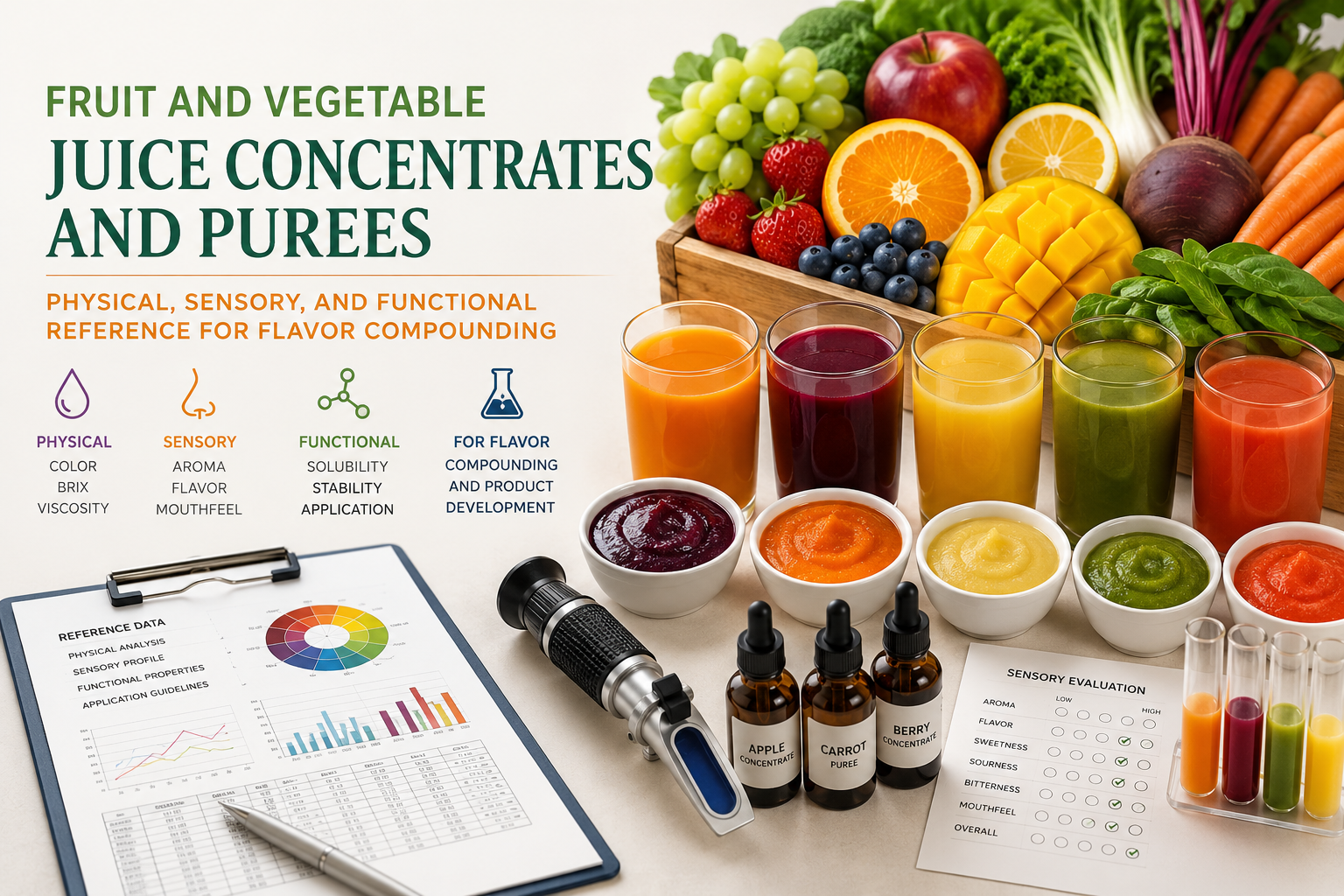
The Society of Flavor Chemists requires certified flavorists to understand fruit and vegetable juice concentrates as a category of flavoring substances. This topic is explicitly listed on the society’s examination syllabus, and trainees may be questioned on it during the exam. Although fruit and vegetable purees are not included on the syllabus, they are presented here as supplementary training material to complete the subject.
Fruit and Vegetable Juice Concentrates: Technical Reference for Flavorist Training
1. Physical Form
Juice concentrates are produced by removing a substantial portion of the water naturally present in fruit or vegetable juice, which increases the density of soluble solids (measured in °Brix) several-fold over the original juice.
Typical physical states encountered:
- Viscous liquids — Most common form for concentrates in the 40–70°Brix range (e.g., apple, grape, orange concentrate). These range from pourable syrups to thick, honey-like liquids depending on Brix level, pectin content, and temperature. Viscosity increases sharply as Brix rises, and cold storage temperatures make this more pronounced.
- Pastes/purée concentrates — Fruits with high pulp or fiber content (mango, banana, guava, tomato) yield thicker, non-Newtonian pastes rather than clear syrups, due to suspended cell wall material and pectin.
- Frozen blocks or slabs — Many concentrates (especially citrus, berry) are stored and shipped frozen at around -18°C to preserve volatile aroma compounds and prevent microbial spoilage, since the high sugar concentration alone is not always sufficient for stability.
- Spray-dried or freeze-dried powders — Some concentrates are carried further to near-total dehydration, producing amorphous, hygroscopic powders (e.g., tomato powder, beet powder, cranberry powder). These are typically fine, sometimes slightly sticky, and require desiccant packaging.
- Clarified vs. cloudy (turbid) types — Clarified concentrates (apple, grape, pear) are transparent, deep amber to gold; cloudy concentrates (orange, tomato, many berries) retain pulp/pectin colloids and appear opaque with characteristic pigmentation.
Color varies widely with the source: pale straw (apple), deep red-purple (grape, blackcurrant, pomegranate), orange-red (carrot, orange), deep red (tomato, beet).
2. Method of Production
A generalized process flow, with variation by fruit/vegetable type:
Step 1 — Raw material preparation Washing, sorting, and grading; removal of stems, pits, seeds, and damaged material.
Step 2 — Extraction/pressing
- Fruits: milling/crushing followed by mechanical pressing (belt press, screw press, or hydraulic press) or, for citrus, rotary/screw-type juice extractors that avoid peel oil contamination.
- Vegetables: often blanched first to inactivate enzymes (especially pectinesterase and polyphenol oxidase, which cause cloud loss and browning) before pressing or pulping.
Step 3 — Enzymatic treatment (optional, product-dependent) Pectinase, amylase, and/or cellulase enzymes are added to break down cell wall polysaccharides, improving yield and, for clarified products, easing subsequent clarification.
Step 4 — Clarification (for clear concentrates) Fining agents, centrifugation, ultrafiltration, or diatomaceous earth filtration remove suspended solids, colloids, and haze-forming pectin.
Step 5 — Aroma/essence recovery Before thermal concentration, volatile aroma compounds are stripped off under vacuum in an essence recovery unit and condensed separately. This step is critical because subsequent evaporation would otherwise drive off the same delicate top-note volatiles that give the juice its characteristic fresh smell. The recovered aqueous essence is often reintroduced into the finished concentrate or sold separately as a flavoring fraction.
Step 6 — Concentration
- Vacuum evaporation (multi-stage, falling-film or TASTE—Thermally Accelerated Short Time Evaporator systems): the dominant industrial method; operates under reduced pressure to lower boiling point and minimize heat damage.
- Freeze concentration: water is removed as ice crystals rather than vapor; preserves flavor and heat-labile nutrients far better but is costlier and used for premium or highly heat-sensitive products (some berry and citrus lines).
- Reverse osmosis / membrane pre-concentration: often used as a first-pass step to reduce water content before final evaporation, lowering thermal load.
Step 7 — Essence/aroma back-blending Recovered volatiles are dosed back into the concentrate to restore character lost during heating.
Step 8 — Standardization and packaging Brix, acid, and color are standardized batch-to-batch; product is packaged aseptically into drums, totes, or bag-in-box, or frozen into blocks; some lines proceed to spray-drying for powder form.
3. Organoleptic Characteristics
For a flavorist, concentrates are evaluated across the same axes used for any flavor raw material:
Aroma
- Depends heavily on whether essence has been reincorporated. Non-back-blended concentrates can smell "flat," "cooked," or "jammy" due to loss of top notes and formation of heat-generated compounds (furanones, caramelized notes).
- Common heat-derived notes across many fruit concentrates: cooked-fruit, stewed, slightly caramelized, sometimes a "canned" character.
- Fresh, back-blended concentrates retain more of the ester-driven, green, or citrus-peel top notes typical of the fresh fruit.
- Vegetable concentrates (tomato, carrot, beet) often carry vegetal, green, earthy, or slightly sulfurous notes depending on processing intensity.
Taste
- Dominant sweetness from concentrated sugars (fructose, glucose, sucrose ratios vary by fruit).
- Acidity concentrated proportionally — citric (citrus, berries), malic (apple, grape), tartaric (grape).
- Some bitterness or astringency can develop from concentrated phenolics/tannins, especially in grape, pomegranate, and cranberry concentrates.
- Vegetable concentrates: tomato shows pronounced umami/savory character alongside acidity; beet shows earthy sweetness.
Mouthfeel
- Viscosity itself contributes a "richness" perception in application; pectin content affects body and coating character on the palate during evaluation.
Color as an organoleptic cue
- Color intensity is itself a strong perceptual anchor — flavorists should note that a deeper-colored concentrate is often (though not always accurately) perceived as more "flavorful" or "natural."
Off-note risks to screen for
- Browning/Maillard notes from excess heat exposure.
- Fermented or acetic notes from raw material spoilage before processing.
- Metallic or "cooked cardboard" notes from oxidation, particularly in stored citrus and apple concentrates.
4. Solubility
- Water solubility: Nearly all liquid juice concentrates are fully miscible with water in any proportion, since they are themselves concentrated aqueous sugar/acid solutions — this is the basis of reconstitution into "juice from concentrate" products.
- Ease of dilution: High-Brix concentrates may require gentle warming or agitation to fully disperse without localized sugar clumping, especially below refrigeration temperature where viscosity spikes.
- Alcohol/oil systems: Liquid concentrates are essentially insoluble in non-polar solvents (oils, most flavor solvents like triacetin or benzyl alcohol) due to their high water and sugar content; they will not incorporate into oil-based flavor bases without emulsification.
- Powdered concentrates: Freeze-dried or spray-dried forms are highly hygroscopic and generally water-soluble/dispersible, though some fiber-rich powders (tomato, beet) show partial insolubility with sediment (pulp fraction) remaining suspended rather than truly dissolving.
- pH-dependent solubility issues: In high-acid concentrates (citrus, berry), any added proteins or certain gums used in later formulation can show reduced solubility or precipitation, relevant when the flavorist is building the concentrate into a finished beverage base.
Practical note for training purposes: flavorists should always taste and smell a concentrate both as-is and after standard reconstitution to water-diluted juice strength (matching the original fruit's typical Brix), since the concentrate's isolated profile can be misleading — heat and processing artifacts are often masked or better contextualized once diluted back to consumption strength.
Commonly Used Fruit and Vegetable Juice Concentrates: Market List and Applications in Flavor Compounding
1. Fruit Juice Concentrates Commonly Available Commercially
Citrus family
- Orange juice concentrate (65–70°Brix)
- Lemon juice concentrate (~45–50°Brix)
- Lime juice concentrate
- Grapefruit juice concentrate
- Tangerine/mandarin concentrate
Pome/stone fruit
- Apple juice concentrate (clarified, 70–72°Brix — the most widely used base concentrate in the industry)
- Pear juice concentrate
- Peach concentrate/purée concentrate
- Apricot concentrate/purée
- Plum concentrate
Berries
- Grape juice concentrate (white and red/Concord types, 68°Brix)
- Blackcurrant concentrate
- Raspberry concentrate
- Strawberry concentrate/purée
- Blueberry concentrate
- Cranberry concentrate
- Elderberry concentrate
- Blackberry concentrate
Tropical fruit
- Pineapple juice concentrate
- Mango purée concentrate
- Passion fruit concentrate
- Guava concentrate
- Banana purée concentrate
- Papaya concentrate
- Lychee concentrate
Pomegranate and other specialty fruit
- Pomegranate concentrate
- Cherry concentrate (tart/sour cherry most common)
- Fig concentrate
- Date concentrate (used mainly as a sweetening/body agent)
Vegetable juice concentrates
- Tomato paste/concentrate (measured as % TSS, typically 28–36% or higher for "hot break" paste)
- Carrot juice concentrate
- Beet juice concentrate (also a major natural colorant)
- Celery juice concentrate
- Pumpkin/squash concentrate
- Sweet potato concentrate
2. Applications in Flavor Compounding
Juice concentrates are rarely used as the entire flavor system; they are functional building blocks layered with essential oils, esters, aldehydes, and other aromatic materials. Their main roles fall into four categories:
A. Flavor/Character Contribution
They supply authentic top, mid, and background notes that synthetic aromatics alone cannot replicate — particularly the "juicy," "natural," or "real fruit" character that label-conscious formulations require. Apple and grape concentrates in particular are used as flavor extenders across a wide range of unrelated fruit flavors because their mild, sweet-acid backbone blends invisibly into many profiles without introducing a competing identity.
B. Sweetness and Acid Balance
Concentrates carry natural sugars (fructose, glucose, sucrose) and organic acids (citric, malic, tartaric) that shape the sweet/sour balance of the finished flavor, often reducing the need for separate added sweeteners or acidulants in the compound.
C. Mouthfeel and Body
Pectin, pulp, and residual fiber in cloudy/purée-type concentrates contribute viscosity and "richness," useful in flavors intended for beverages, dairy, or confectionery applications where a thin, watery mouthfeel would read as artificial.
D. Color
Many concentrates double as natural colorants (grape skin/must, blackcurrant, beet, tomato, carrot), allowing the flavorist or the client's food technologist to reduce or eliminate separate color additions — an increasingly important function under clean-label formulation pressure.
E. Labeling Function ("Natural Flavor with Other Natural Flavors" / WONF systems)
Because concentrates are recognized as natural fruit/vegetable derivatives, they allow a flavor to be declared "Natural Flavor" or built into a WONF (With Other Natural Flavors) formulation, supporting a fruit's name on the front label.
3. Functional Roles and Typical Dosage Ranges (parts per 100 of finished flavor compound)
These are general industry-typical ranges used in flavor compounding; actual levels depend heavily on the finished application (beverage, confectionery, dairy, bakery), the Brix of the concentrate itself, and whether the concentrate is the primary flavor driver or a supporting player.
| Concentrate | Primary Functional Role | Typical Dosage (parts/100) |
|---|---|---|
| Apple juice concentrate | Flavor extender, sweetness/body base, neutral carrier for other fruit flavors | 10–40 |
| Grape juice concentrate | Flavor extender, color contributor, sweetness base | 5–30 |
| Orange juice concentrate | Primary character in citrus flavors, acidity/juiciness | 15–50 |
| Lemon/lime juice concentrate | Acid/tartness note, top-note brightness | 2–15 |
| Pear juice concentrate | Neutral sweetness extender similar to apple | 10–30 |
| Peach/apricot concentrate | Primary or supporting character note, body | 10–35 |
| Strawberry concentrate/purée | Primary character, color, mouthfeel | 10–40 |
| Raspberry/blackberry concentrate | Primary character note, tartness, color | 5–25 |
| Blackcurrant concentrate | Primary character, strong color contribution | 5–20 |
| Cranberry concentrate | Tartness/acidity, primary or supporting character | 5–20 |
| Pomegranate concentrate | Primary character, tannic/astringent note, color | 5–20 |
| Pineapple concentrate | Primary character, acid-sweet balance | 10–30 |
| Mango/passion fruit/guava purée concentrate | Primary tropical character, body/mouthfeel | 10–35 |
| Cherry concentrate | Primary character, tart-sweet balance | 5–25 |
| Tomato paste/concentrate | Savory/umami character (culinary and savory flavor systems) | 5–30 |
| Carrot juice concentrate | Vegetal sweetness, color, savory-sweet balance | 5–20 |
| Beet juice concentrate | Primarily color function, mild earthy-sweet note | 2–15 (as colorant); higher if flavor-driven |
| Celery juice concentrate | Savory/vegetal top note in culinary flavor systems | 2–10 |
Notes on interpreting these ranges:
- The lower end of a range typically applies when the concentrate is a supporting/background material (e.g., apple concentrate used at 10 parts to round out a tropical fruit flavor).
- The upper end applies when the concentrate is the flavor identity itself (e.g., orange concentrate as the dominant material in an orange beverage flavor).
- Because concentrates are aqueous, high inclusion levels affect the water activity and overall stability of the compound; flavorists must balance concentrate loading against preservation requirements (some compounds require added preservative or refrigerated/frozen storage above certain concentrate thresholds).
- Concentrate dosage also interacts with essence/aroma back-blending: a flavor built with 30 parts apple concentrate plus reincorporated apple essence oil will taste noticeably "fresher" than the same 30 parts of concentrate alone, since heat-driven flavor loss during evaporation is only partially compensated by the base concentrate itself.
Training exercise suggestion: Have trainees build a simple two-part comparison — one flavor compound using apple juice concentrate at 10 parts as an extender in a peach flavor, and one at 30 parts — and evaluate at what inclusion level the apple character becomes detectable and begins to compete with, rather than support, the peach identity. This builds intuition for the point at which a "functional" material crosses into being a "character-defining" one.
Fruit and Vegetable Purées: Technical Reference for Flavorist Training
Purées differ fundamentally from concentrates and clarified juices in one key respect: the whole comminuted flesh (and sometimes skin) of the fruit or vegetable is retained rather than separated out as pressed juice. This makes purées structurally, texturally, and sensorially distinct materials, even when derived from the same raw fruit as a juice concentrate.
1. Physical Form
General state Purées are homogenized, semi-thick to thick, non-Newtonian fluids or soft pastes composed of macerated pulp, cell wall fragments, fiber, skin particles (in some cases), and the natural juice/serum fraction, all held together by pectin and suspended solids.
Consistency spectrum
- Thin/pourable purées: peach, apricot, mango at lower solids content — flow readily but retain visible body and cloudiness.
- Thick/spoonable purées: banana, guava, avocado-adjacent tropical purées, tomato purée — behave more like a soft paste, showing yield stress (they hold their shape briefly before flowing).
- Chunky/particulate purées: some commercial purées deliberately retain small fruit particulates (strawberry, mango) for a "with pieces" visual and textural effect, distinguishing them from smooth purées intended purely as flavor/process ingredients.
Concentration levels Purées are sold at varying concentration:
- Single-strength purée: reflects the natural solids content of the fruit with minimal water removal (e.g., banana purée ~20-24°Brix reflecting the fruit's natural sugar).
- Concentrated purée: partially dewatered (similar evaporation logic to juice concentrates) to increase solids, reduce shipping weight/volume, and extend stability — e.g., mango purée concentrate, tomato paste (a concentrated vegetable purée, standardized by %TSS).
Color and appearance Purées generally show more opacity and a "fuller," less translucent appearance than clarified concentrates, because the suspended pulp scatters light. Color tends to be closer to the visual appearance of the fresh cut fruit than a juice would be — mango purée is a dense, opaque orange-yellow; strawberry purée a deep, slightly muddy red-pink (rather than the brighter, clearer red of a filtered strawberry juice concentrate); tomato purée a dense brick-red.
Storage forms
- Frozen block or pail — most common for food manufacturing and flavor house use, preserving fresh character and preventing microbial spoilage.
- Aseptic packed (drums, bag-in-box) — thermally processed and packed to be shelf-stable at ambient temperature.
- Canned — particularly common for tomato purée/paste.
- Frozen IQF (individually quick frozen) pulp/pieces that are later comminuted into purée form by the end user.
2. Method of Production
Step 1 — Raw material selection and washing Ripe (sometimes deliberately overripe for tropical fruit, to maximize sugar and aroma development) fruit is washed, sorted, and inspected. Vegetable purées (tomato, pumpkin) follow parallel washing/sorting.
Step 2 — Preparation Removal of stems, pits, seeds, calyxes, and inedible skins where required (peach, mango, apricot pits removed; some purées retain skin for color/fiber, e.g., some apple and tomato purées).
Step 3 — Blanching (heat inactivation) Many fruits and virtually all vegetables are blanched briefly before pulping to inactivate enzymes such as polyphenol oxidase (browning) and pectinesterase/pectin methylesterase (which would otherwise degrade pectin and cause the purée to separate or lose viscosity/cloud during storage). Blanching also softens tissue for easier pulping.
Step 4 — Pulping/comminution Fruit is passed through a pulper-finisher (a rotating paddle forcing material through a perforated screen), which separates pulp from seeds, stones, and coarse skin fragments while controlling particle size via screen mesh selection. Screen size determines whether the final purée is smooth or retains fine particulates.
Step 5 — Homogenization (optional, product-dependent) High-pressure homogenization or colloid milling further reduces particle size, improving smoothness and suspension stability (preventing serum separation during storage). This is common for purées intended for beverage or dairy applications requiring a fine, stable texture.
Step 6 — Deaeration Vacuum deaeration removes entrapped air/oxygen prior to thermal processing, reducing oxidative browning and off-flavor development, and improving heat transfer efficiency in subsequent pasteurization.
Step 7 — Thermal treatment
- Pasteurization/hot-fill: sufficient heat treatment to achieve microbial stability while preserving as much fresh character as feasible; used for aseptic-packed purées.
- Concentration (if a concentrated purée is desired): vacuum evaporation similar to juice concentrate production, though purées require gentler, often lower-temperature, higher-viscosity-tolerant evaporator designs (e.g., scraped-surface evaporators) because of their higher viscosity and fouling tendency compared to clear juice.
Step 8 — Preservation route (choice depends on end use)
- Freezing: preferred where maximum fresh flavor retention is required (most premium fruit purées for flavor/beverage use are frozen).
- Aseptic processing: ultra-high-temperature short-time (UHT) treatment followed by aseptic filling, giving ambient shelf stability with somewhat more heat-derived flavor change than freezing.
- Chemical preservation (sulfites, benzoates, sorbates) : sometimes used for purées intended for further industrial processing rather than direct sensitive flavor work, since preservatives can themselves introduce sensory notes flavorists must screen for.
Step 9 — Packaging Frozen pails/blocks, aseptic bags-in-drum, or canned formats depending on preservation route.
3. Organoleptic Characteristics
Aroma
- Purées generally retain a closer, more "whole fruit" aromatic impression than clarified juice concentrates because they contain the intact pulp matrix, including some fat-associated and cell-bound volatiles not extracted into pressed juice.
- Cooked/heated notes are a major consideration: even mild thermal processing produces characteristic "cooked fruit," jammy, or stewed-fruit notes distinct from the fresh fruit (e.g., cooked-peach vs. fresh-peach; this shift is a critical reference point in training — flavorists should learn to identify exactly which notes emerge from heat versus which are inherent to the ripe fruit).
- Tropical purées (mango, banana, guava) tend to show more pronounced fermented/estery notes if the fruit was very ripe at processing, and can develop a slightly "boozy" or overripe character if held too long before use.
- Vegetable purées (tomato) show cooked, umami, and sometimes sulfurous notes depending on processing intensity (raw tomato vs. hot-break tomato paste show markedly different aromatic profiles).
Taste
- Sweetness and acidity are present at levels closer to the natural fruit than in a concentrate, since purées are not typically concentrated to the same Brix extremes as juice concentrates (with the exception of concentrated purées like mango purée concentrate or tomato paste).
- Body/richness on the palate is more pronounced due to retained pulp and pectin — this "fullness" is one of the primary reasons purées are chosen over concentrates in certain applications.
- Some purées (banana, avocado-type) contribute a starchy or "creamy" taste dimension not found in clear juice.
Mouthfeel — a defining characteristic Unlike juice concentrates, purées are chosen specifically for their contribution to mouthfeel: viscosity, pulpiness, and a "coating" sensation on the palate that more closely simulates biting into the fresh fruit. This is central to their functional role in flavor and food applications (discussed further below).
Color More opaque, denser, and generally closer to the color of the fruit's flesh than a clarified concentrate; this matters when a flavorist or product developer is also responsible for advising on visual authenticity alongside flavor.
Off-note risks to screen for
- Cooked/caramelized notes from excess thermal exposure during blanching or concentration.
- Oxidative/browning notes if deaeration or enzyme inactivation was insufficient.
- Fermented or overripe notes from raw material that was too mature at processing.
- "Green"/unripe or tannic notes if underripe fruit was used, particularly in mango and banana purées.
4. Solubility
- Water dispersibility, not true solubility: Purées do not "dissolve" in water in the way a sugar-based concentrate does; rather, they disperse to form a cloudy suspension/emulsion-like system. The pulp and pectin fractions remain suspended rather than going into true molecular solution.
- Stability of dispersion: Homogenized purées disperse more evenly and resist sedimentation better than coarsely pulped ones; standing purées may show serum separation (a clear liquid layer separating from settled pulp) if not adequately homogenized or stabilized, which flavorists should recognize as a normal physical characteristic requiring re-mixing before use, not necessarily spoilage.
- Oil/non-polar solvent systems: Purées are essentially incompatible with oil-based or non-polar flavor solvent systems without emulsification; their high water content and hydrophilic pulp structure prevent uniform incorporation into oil bases.
- Viscosity-dependent handling: High-viscosity purées (banana, mango concentrate, tomato paste) require mechanical shear (mixing, homogenizing) to incorporate evenly into a flavor or food base; simple stirring may leave the material unevenly distributed.
- pH interactions: Acidic purées (berry, citrus-adjacent) can cause localized pectin gelation or protein precipitation when combined with certain dairy or protein-containing bases, a practical consideration when purées are used in flavor systems intended for dairy or protein-beverage applications.
Comparative Note for Training: Purée vs. Concentrate
| Attribute | Juice Concentrate | Purée |
|---|---|---|
| Retains pulp/fiber | No (clarified) / minimal (cloudy) | Yes, by definition |
| Primary functional value | Sweetness, acidity, flavor character, color | Mouthfeel, body, "whole fruit" authenticity, flavor character |
| Typical solubility behavior | True solution in water | Suspension/dispersion in water |
| Aroma fidelity to fresh fruit | Depends on essence back-blending | Generally closer to fresh due to retained pulp matrix, but with more pronounced cooked notes from thermal processing |
| Common flavor application | Extender, base, character note in beverages | Body/texture contributor in dairy, bakery, confectionery, and beverage-with-pulp applications |
Training exercise suggestion: Have trainees taste a mango purée and a mango juice concentrate side by side, both diluted to equivalent Brix with water, and identify (a) which mouthfeel cues signal purée versus concentrate blind, and (b) which aromatic notes are present in the purée but absent in the concentrate, and vice versa. This builds the sensory vocabulary needed to decide which material — or combination of both — best serves a given flavor brief.
Commonly Used Fruit and Vegetable Purées: Market List and Applications in Flavor Compounding
1. Fruit and Vegetable Purées Commonly Available Commercially
Stone fruit
- Peach purée
- Apricot purée
- Plum purée
- Nectarine purée
- Cherry purée (sweet and tart/sour types)
Tropical fruit
- Mango purée
- Banana purée
- Guava purée
- Papaya purée
- Passion fruit purée (technically pulp/juice-purée hybrid, includes seeds/pulp fraction)
- Pineapple purée
- Lychee purée
- Coconut purée/cream (functionally treated as a purée in flavor work)
Berries
- Strawberry purée
- Raspberry purée
- Blackberry purée
- Blueberry purée
- Blackcurrant purée
- Redcurrant purée
Pome fruit
- Apple purée (sauce-style)
- Pear purée
- Quince purée
Citrus (less common as purée, but exists)
- Whole citrus purée (includes peel/pith fraction — used for authentic bitter-peel character)
Other fruit
- Fig purée
- Date purée
- Prune purée
- Pomegranate arils/purée
Vegetables
- Tomato purée/paste
- Pumpkin purée
- Carrot purée
- Sweet potato purée
- Beet purée
- Butternut squash purée
- Avocado purée (botanically a fruit, functionally handled like a vegetable purée in savory/culinary flavor work)
2. Applications in Flavor Compounding
Purées serve a distinct set of functions compared to concentrates, driven primarily by their retained pulp structure:
A. Mouthfeel and Textural Authenticity
This is the single most important reason a flavorist reaches for a purée instead of, or alongside, a concentrate. Purées deliver a "bite," body, and coating sensation that signals "real fruit" to the palate, particularly important in dairy (yogurt, ice cream), bakery fillings, and smoothie/beverage-with-pulp applications where a thin, purely liquid flavor profile would read as artificial or "juice-like" rather than "fruit-like."
B. Flavor Character and Depth
Purées often carry deeper, rounder, more "ripe" character notes than juice concentrates because the pulp matrix retains certain fat-associated and cell-bound aromatics not present in pressed juice. Banana, mango, and avocado purées in particular contribute a creamy, rounded quality difficult to replicate with esters and aldehydes alone.
C. Visual/Appearance Matching
When a finished product (yogurt, jam, fruit-on-the-bottom dairy, bakery filling) needs visible fruit specks or a naturally cloudy, "home-made" appearance, purée inclusion directly supports this beyond what the flavor compound itself does — the flavorist works closely with the food technologist here since the purée is often dosed into the base product, not just the flavor compound.
D. Savory/Culinary Flavor Systems
Vegetable purées (tomato, pumpkin, sweet potato, carrot, avocado) are foundational in savory flavor work — soups, sauces, snack seasonings — contributing umami, sweetness, and body simultaneously.
E. Natural/Clean-Label Positioning
Like concentrates, purées support "made with real fruit" or "natural flavor" labeling claims, often more convincingly than concentrates because the intact pulp is visibly/texturally verifiable in the finished product.
3. Functional Roles and Typical Dosage Ranges (parts per 100 of finished flavor compound)
These ranges reflect general industry practice; actual dosage depends on whether the purée is being used inside the flavor compound itself (less common due to stability/shelf-life constraints) or dosed directly into the food base alongside a supporting flavor compound (far more common in practice — noted where relevant).
| Purée | Primary Functional Role | Typical Dosage in Flavor Compound (parts/100) |
|---|---|---|
| Peach purée | Primary character, body, ripe-fruit roundness | 10–35 |
| Apricot purée | Primary/supporting character, body | 10–30 |
| Mango purée | Primary tropical character, creamy mouthfeel | 15–40 |
| Banana purée | Primary character, creamy/starchy body, extender for tropical blends | 10–35 |
| Guava purée | Primary character, characteristic musky-floral note | 10–30 |
| Passion fruit purée | Primary character, tartness, characteristic seed-pulp note | 5–20 |
| Strawberry purée | Primary character, color, pulpy mouthfeel | 15–40 |
| Raspberry/blackberry purée | Primary character, seed-note authenticity, tartness | 10–30 |
| Blueberry purée | Primary character, color, mild body | 10–30 |
| Apple purée (sauce-style) | Extender, body/mouthfeel base, neutral sweetness carrier | 10–30 |
| Cherry purée | Primary character, tart-sweet balance, body | 10–30 |
| Pineapple purée | Primary character, acid-sweet balance, fibrous mouthfeel | 10–30 |
| Coconut purée/cream | Primary character, fatty/creamy mouthfeel | 10–35 |
| Fig/date/prune purée | Body, sweetness, "dried fruit" depth note | 5–20 |
| Tomato purée/paste | Umami/savory primary character | 10–40 |
| Pumpkin/sweet potato/carrot purée | Primary character (culinary), sweetness, body | 10–30 |
| Avocado purée | Fatty mouthfeel, body (savory/culinary systems) | 5–20 |
| Beet purée | Color plus mild earthy-sweet note | 2–15 |
Notes on interpreting these ranges:
- Because purées carry significant water content, fiber, and no strong intrinsic preservation system, dosing them within a flavor compound at high levels raises microbial stability and shelf-life concerns; many flavor houses instead supply a purée as a separate co-ingredient to be dosed by the manufacturer directly into the food matrix (yogurt base, filling, beverage) at levels of 3–15% of the final product, working alongside a lower-dosed, more concentrated flavor compound that reinforces top notes.
- The lower end of the range applies when the purée is a texture/body support material rather than the primary flavor identity (e.g., apple purée included at 10 parts purely to add body to a berry flavor).
- The upper end applies when the purée is the flavor identity and the intended application (dairy, bakery filling) specifically wants visible pulp/texture cues (e.g., strawberry purée at 35–40 parts in a "real fruit pieces" yogurt flavor system).
- Purée inclusion level interacts directly with viscosity and processability of the finished flavor — high-viscosity purées (banana, mango, tomato paste) may require the flavor house to adjust the compound's overall consistency (or supply the purée separately) to remain pumpable/meterable on the customer's production line.
- As with concentrates, cooked/heat-derived notes intensify with any additional thermal processing the purée undergoes after leaving the flavor house (e.g., baking, retort sterilization in the final food product), so flavorists should evaluate purées not only as-is but after simulating the customer's expected downstream heat treatment.
Training exercise suggestion: Present trainees with three yogurt base prototypes — one using only a flavor compound (no purée), one with 10% strawberry purée dosed into the base plus a light-dose flavor compound, and one with 25% strawberry purée plus flavor compound — and have them map how perceived "realness," sweetness, tartness, and mouthfeel shift across the series. This builds the practical judgment needed to recommend the right purée/compound split to a customer's product development team, rather than treating purée dosage as a fixed formulation rule.
Addendum: Additional Fruit and Vegetable Juice Concentrates and Purées
A. Additional Juice Concentrates
Melons
- Watermelon juice concentrate
- Cantaloupe/muskmelon concentrate
- Honeydew concentrate
Application note: Melon concentrates are notoriously difficult to concentrate without heavy character loss — their volatile profile is dominated by delicate, short-chain aldehydes that degrade quickly under heat. In flavor work they are used mainly as a background/body extender (5–15 parts/100) rather than a character driver; the melon "identity" in most commercial flavors is carried by synthetic aromatics with the concentrate contributing sweetness and subtle authenticity notes.
Additional citrus
- Blood orange concentrate
- Clementine/satsuma concentrate
- Yuzu concentrate
- Kumquat concentrate
- Bergamot juice concentrate (distinct from bergamot peel oil)
- Key lime concentrate
Application note: These function as primary character notes in premium/specialty citrus flavors (10–30 parts/100), often layered against a base of standard orange or lemon concentrate rather than used alone, since their availability and cost typically limit them to top-note "signature" positioning.
Exotic/specialty fruit
- Kiwi juice concentrate
- Dragon fruit (pitaya) concentrate
- Starfruit (carambola) concentrate
- Tamarind concentrate
- Acerola concentrate (also used for natural vitamin C content)
- Acai concentrate
- Goji berry concentrate
- Noni concentrate
- Mangosteen concentrate
- Sea buckthorn concentrate
- Chokeberry (aronia) concentrate
- Mulberry concentrate
- Elderberry concentrate (noted in original list, included here for cross-reference)
- Gooseberry concentrate
- Persimmon concentrate
- Rhubarb concentrate
- Quince concentrate (juice form, distinct from quince purée)
Application note: Acai, goji, noni, mangosteen, and sea buckthorn are typically functional/marketing-driven inclusions in "superfruit" beverage flavors rather than dominant sensory contributors — their inherent flavor is often mild, astringent, or even unpalatable at high levels, so dosage is usually low (2–10 parts/100), calibrated to support label claims rather than deliver primary character. Tamarind concentrate, by contrast, is a strong sour-savory character note used at 5–15 parts/100 in tropical and culinary/savory flavor systems.
Additional vegetable juice concentrates
- Cucumber juice concentrate
- Bell pepper (capsicum) juice concentrate
- Chili pepper concentrate
- Ginger juice concentrate
- Spinach/kale/leafy green concentrate (used for color as much as flavor)
- Cabbage juice concentrate
- Onion juice concentrate
- Garlic juice concentrate
- Radish juice concentrate
- Parsley/herb juice concentrates
- Wheatgrass/barley grass concentrate
Application note: Cucumber concentrate functions as a fresh, green top-note material (2–10 parts/100), extremely potent and easily overdosed. Ginger, onion, and garlic concentrates are primary savory character drivers in culinary flavor systems (5–20 parts/100). Leafy green concentrates are used predominantly as natural colorants with minor flavor contribution (2–8 parts/100), and their inherent grassy/bitter notes must be managed carefully so they don't intrude into fruit-forward profiles.
B. Additional Purées
Melons
- Watermelon purée
- Cantaloupe/melon purée
Application note: Melon purées retain more authentic fresh character than melon concentrates since no evaporative heat step is applied, making them the preferred choice over concentrate when true melon identity is required (10–30 parts/100 in beverage/dairy applications).
Additional tropical/exotic purées
- Kiwi purée
- Dragon fruit (pitaya) purée
- Jackfruit purée
- Durian purée
- Soursop (guanabana) purée
- Tamarillo purée
- Rambutan purée
- Longan purée
- Star apple purée
- Sapodilla purée
- Acai purée (pulp form, distinct from the thinner concentrate)
Application note: Durian and jackfruit purées carry very strong, polarizing sulfurous/estery notes and are dosed narrowly (5–15 parts/100) even in target-market applications where the character is desired; overdosing rapidly overwhelms a formulation. Dragon fruit and rambutan purées are comparatively mild and used more for color/texture (dragon fruit's visible black seed flecks are often a deliberate visual inclusion) than potent flavor character (10–25 parts/100).
Additional berry/temperate purées
- Gooseberry purée
- Boysenberry purée
- Loganberry purée
- Huckleberry purée
- Mulberry purée
- Elderberry purée
- Persimmon purée
- Rhubarb purée
- Quince purée (distinct entry from quince concentrate, noted for cross-reference)
Application note: Rhubarb purée is unusual in that its flavor identity is almost entirely acid/tartness with minimal inherent aromatic character — it is used functionally as a sour/tart body contributor (10–25 parts/100) paired with a separate rhubarb aromatic top-note material to complete the profile, since the purée alone reads as "sour and fibrous" without a distinct "rhubarb" smell.
Additional vegetable purées
- Bell pepper (capsicum) purée
- Chili pepper purée
- Cucumber purée
- Corn purée
- Pea purée
- Zucchini/summer squash purée
- Onion purée
- Garlic purée
- Ginger purée
- Cauliflower purée
- Broccoli purée
- Artichoke purée
- Olive purée (technically a fruit, handled as savory/culinary)
Application note: These vegetable purées are used almost exclusively in savory flavor and culinary seasoning systems (soups, snack coatings, sauces) rather than sweet/beverage flavor work, contributing body, natural sweetness (corn, pea, roasted bell pepper), and authentic vegetable character. Dosage ranges are wide (10–40 parts/100) since in many savory applications the purée itself functions as a primary ingredient of the finished flavor base rather than a minor supporting note.
Updated Comparative Note
With this addendum, the two original tables (concentrates and purées) should now be read as covering four practical groupings a flavorist encounters:
- Mainstream commodity fruits (apple, orange, grape, strawberry, peach, etc.) — high-volume, well-characterized, used across nearly all flavor categories.
- Berries and specialty fruits (cranberry, pomegranate, blackcurrant, kiwi, dragon fruit) — mid-volume, often primary character drivers in premium or "better-for-you" positioning.
- Superfruit/functional-marketing fruits (acai, goji, noni, sea buckthorn, mangosteen) — low-dosage, label-claim-driven rather than flavor-driven.
- Vegetables and culinary materials (tomato, carrot, beet, onion, garlic, bell pepper, ginger) — split between beverage/sweet applications (carrot, beet) and savory/culinary systems (onion, garlic, chili), each with distinct dosage logic.
Training exercise suggestion: Have trainees sort a randomized list of 20 concentrate/purée names (mixing all four groupings above) into these four categories from memory, then check their answers against typical commercial usage. This tests whether trainees have internalized why a material is used — as a character driver, extender, colorant, or marketing claim — rather than just memorizing names.
###