Vanilla: Physical Form, Production, Organoleptic Properties, and Solubility: What Flavorists Need to Know, according to the Society of Flavor Chemists
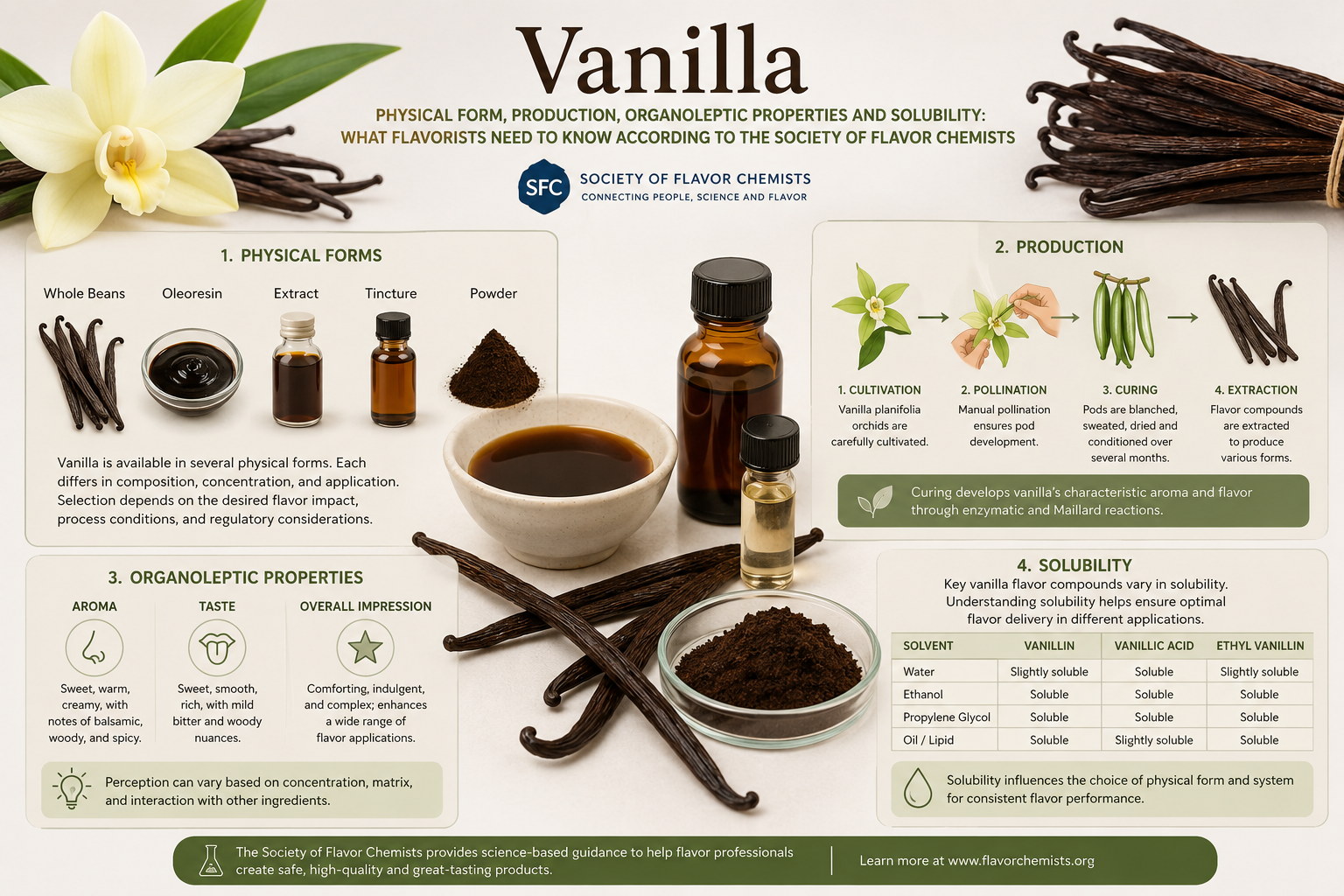
Vanilla is a cornerstone flavoring substance in the food and beverage industry. The Society of Flavor Chemists mandates that all certified flavorists possess a thorough understanding of this ingredient and its diverse applications. The following overview covers only the fundamentals; comprehensive training requires far more in-depth study.
For those seeking advanced knowledge, detailed training materials on vanilla (Part 1) and its applications (Part 2) and vanilla compounds (Part 3) and compounding of vanilla compounds (part 4) are available for purchase. This two-part (part1/part2 or part 3/part4) set, totaling approximately 30 or 20 pages, is priced at $49 and the set of four parts (about 60 pages) $79. It serves as an excellent resource for flavor houses, ingredient companies, food and beverage companies, and aspiring professionals looking to deepen their expertise. The curriculum covers the following key areas:
Doc 1 — Vanilla: Flavorist Technical Reference
- Scope and Purpose (incl. Learning Objectives)
- Botanical Background and Species
- Physical Form
- Method of Production
- 4.1 Pollination
- 4.2 Harvesting
- 4.3 Curing — the biochemical core of vanilla flavor
- 4.4 Extraction
- Organoleptic Characteristics
- Solubility and Physicochemical Behavior
- Physicochemical Reference Data
- Comparative Profiles by Varietal and Growing Region
- Extract Folds and Concentrates
- Natural vs. Synthetic and Nature-Identical Vanillin
- Adulteration and Authentication
- 11.1 Common adulteration practices
- 11.2 Authentication methods
- Regulatory Framework
- Quality Control and Specification Parameters
- Stability, Storage, and Shelf Life
- Application and Matrix Behavior
- Market and Crop Risk Context
- Glossary
- Review Questions
- Answer Key
Doc 2 — Vanilla in Flavor Applications (Part 2)
- Scope and Purpose (incl. Learning Objectives)
- Functional Roles of Vanilla in a Flavor System
- 2.1 Character-impact note
- 2.2 Background / rounding note
- 2.3 Sweetness and richness modifier
- 2.4 Base note / anchor
- 2.5 Fixative-like carryover
- Flavor Categories and Applications
- 3.1 Dairy and Creamy
- 3.2 Bakery and Confectionery
- 3.3 Chocolate and Cocoa
- 3.4 Fruit Flavors (Rounding/Blending Use)
- 3.5 Beverage
- 3.6 Spice, Holiday, and Warm Blends
- 3.7 Savory-Adjacent, Tobacco, and Alcohol-Character Flavors
- Applications by Physical Form of Vanilla
- 4.1 Whole Cured Bean / Pod
- 4.2 Liquid Extract (Alcohol-Based)
- 4.3 Vanilla Paste
- 4.4 Vanilla Powder
- 4.5 Oleoresin / Absolute
- 4.6 Isolated Vanillin (Natural or Synthetic)
- 4.7 Ethyl Vanillin
- Dosage Reference Summary
- Worked Dosage Conversion Example
- Regulatory Use-Level Ceilings
- Synergists and Complementary Materials
- Off-Notes and Common Formulation Defects
- Worked Formulation Examples
- 10.1 Vanilla Ice Cream Flavor Compound (Character-Impact)
- 10.2 Cola Flavor (Background Note)
- 10.3 Milk Chocolate Flavor (Modifier)
- 10.4 Strawberry Flavor (Rounding Note)
- Practical Guidance for Formulation Decisions
- Review Questions
- Answer Key
Part 3 — Vanilla Flavor Compounds by Species and Region
- Scope and Purpose (incl. Learning Objectives)
- Overview: How Many Compounds, and Which Matter
- Chemical Classes of Vanilla Flavor Compounds
- Master Compound Reference Table
- Species-Level Compound Profiles
- 5.1 Vanilla planifolia
- 5.2 Vanilla tahitensis
- 5.3 Vanilla pompona
- Case Study: The Heliotropin Myth
- Regional Variation Within Vanilla planifolia
- What Actually Drives Regional Variation
- 8.1 Genetics / species
- 8.2 Terroir
- 8.3 Curing practice and harvest timing
- 8.4 Grade
- Compound Ratios as Quality and Authenticity Markers
- Practical Application Guidance
- Master Comparative Summary Table
- Glossary Addendum
- References and Further Reading
- Review Questions
- Answer Key
Part 4 — Vanilla Flavor Notes, Ingredients, and the Top/Heart/Base Structure
- Scope and Purpose (incl. Learning Objectives)
- The Flavor Pyramid Concept Applied to Vanilla
- Why Vanilla Is Inherently a Heart/Base-Weighted Flavor
- Flavor Notes (Facets) of a Basic Vanilla Flavor
- 4.1 Vanillic / Sweet Core Note
- 4.2 Creamy / Dairy Note
- 4.3 Caramelic / Sweetness-Enhancer Note
- 4.4 Balsamic / Resinous / Woody Note
- 4.5 Floral / Powdery Softening Note
- 4.6 Smoky / Phenolic Depth Note (trace)
- 4.7 Fresh / Bright Top Note
- Layer Assignment: Which Ingredients Carry Top, Heart, and Base
- Worked Example: A Basic Vanilla Flavor Compound
- Safety and Handling Notes
- Practical Guidance for Balancing the Pyramid
- Glossary Addendum
- References and Further Reading
- Review Questions
- Answer Key
"Explain physical form, method of production, organoleptic characteristics and solubility of vanilla"
Physical Form
Vanilla is derived from the cured seed pods (commonly called "beans," though botanically they're capsules) of orchids in the genus Vanilla, primarily Vanilla planifolia. The finished cured bean is:
- Long and slender (15–23 cm), dark brown to nearly black
- Leathery, pliable, and slightly oily/waxy to the touch when properly cured
- Filled with thousands of tiny black seeds and an oily, aromatic pulp
- Sometimes coated with fine crystalline deposits of vanillin ("givre" or frost) on high-quality, well-cured pods
Commercially, vanilla appears in several derived forms: whole cured beans, vanilla paste, vanilla powder (ground cured bean), vanilla extract (alcohol-based liquid), vanilla oleoresin, and isolated/synthetic vanillin.
Method of Production
Cultivation: Vanilla is grown from a climbing orchid vine trained on trees or trellises, typically in tropical, humid climates within about 20° of the equator.
Pollination: The flowers are hermaphroditic but structurally self-incompatible — a membrane (rostellum) separates the anther and stigma. In vanilla's native Mexico, the Melipona bee performs pollination naturally, but this bee doesn't exist in most other growing regions. Everywhere else, pollination is done by hand, flower by flower, using a small stick or blade to lift the membrane and press pollen onto the stigma. This must be done within a few hours of the flower opening (flowers bloom once, for a single morning), which is a major reason vanilla is so labor-intensive and expensive.
Harvesting: Pods take about 8–9 months to mature after pollination. They're harvested at a specific stage — just as the tip begins to yellow — since picking too early or late affects flavor development.
Curing: This is the step that actually creates vanilla's flavor (green pods are essentially odorless). Curing typically has four stages:
- Killing/blanching — hot water immersion or sun exposure stops vegetative growth and starts enzymatic reactions
- Sweating — pods are wrapped and kept warm and humid, allowing enzymes to break down glucovanillin into free vanillin
- Slow drying — sun-drying by day, sweating in boxes at night, over several weeks, reducing moisture
- Conditioning — beans are stored in closed boxes for months, allowing flavor compounds to mature and mellow
Extraction: Cured beans are then macerated/percolated in ethanol and water (for extract), or processed into paste, powder, or oleoresin.
Organoleptic Characteristics
- Aroma: Sweet, warm, balsamic, with floral, woody, and slightly smoky or tobacco-like undertones depending on origin
- Taste: Sweet, rich, creamy, with a lingering warmth
- Color: Extracts range from pale amber to deep brown-black
- Texture (paste/pod): Oily, sticky, resinous
The dominant flavor compound is vanillin, but several hundred minor volatile compounds contribute to the complexity — including guaiacol, anisyl alcohol, and various phenolic and lactone compounds that shift with terroir and curing method.
Solubility
- Vanillin and most flavor compounds are poorly soluble in cold water but dissolve well in ethanol, which is why extraction uses alcohol/water mixtures
- Vanillin is also soluble in glycerin, propylene glycol, and oils to varying degrees
- This is why vanilla "extract" (alcohol-based) delivers flavor and aroma more efficiently than water infusions, and why baking with alcohol-based extract allows better flavor release upon heating (though some volatile aromatics do evaporate with heat)
Differences Across Varietals, Regions, and Production Methods
Varietals and Growing Regions
| Origin/Varietal | Organoleptic Profile |
|---|---|
| Madagascar/Bourbon (V. planifolia) | Classic "vanilla" flavor — rich, sweet, creamy, balanced; the benchmark most people associate with vanilla; high vanillin content |
| Mexico (V. planifolia, native origin) | Spicier, woodier, slightly darker/muskier profile with a more complex, less purely sweet character |
| Tahiti (V. tahitensis) | Distinctly different species — floral, fruity (cherry, anise, licorice notes), less vanillin, more anisyl compounds; used more in perfumery and delicate desserts |
| Indonesia | Smokier, woodier, more phenolic/tobacco-like, often sharper and less sweet; frequently used in processed foods for its robust, heat-stable flavor |
| Uganda | Similar to Madagascar but often slightly fruitier and less refined in curing consistency |
| India | Full-bodied, spicy-sweet, sometimes with a slight bitterness |
| Papua New Guinea | Bold, dark, somewhat similar to Indonesian profile |
The chemical basis: V. planifolia is naturally higher in vanillin; V. tahitensis is genetically distinct and higher in anisyl alcohol/heliotropin-like compounds, giving its floral-fruity signature. Terroir (soil, altitude, rainfall) and microbial activity during curing further shape the secondary compound profile.
Methods of Production
- Pollination: Hand-pollination (nearly universal outside Mexico's native bee range) versus natural bee pollination doesn't change flavor directly, but affects yield, cost, and pod uniformity.
- Harvesting timing: Beans picked too green lack precursor compounds for full vanillin development; overripe beans can split and lose quality during curing.
- Curing method variations:
- Traditional Bourbon method (Madagascar/Réunion): slow, careful sun/sweat cycling produces the classic balanced, sweet profile
- Mexican curing: often shorter/different humidity handling, contributing to spicier notes
- Indonesian curing: sometimes faster or less meticulous, yielding a more phenolic, smoky character
- Longer conditioning periods generally produce mellower, more complex, less "raw" flavor
- Extraction method: Percolation versus cold maceration versus supercritical CO2 extraction all pull different ratios of volatile versus non-volatile compounds, affecting aroma intensity and flavor rounding.
Extract Folds and Concentrates
"Fold" refers to the concentration standard for vanilla extract, based on U.S. FDA/international norms requiring a single-fold (1x) extract to contain the equivalent of 13.35 oz of vanilla beans per gallon of extract at minimum 35% alcohol.
- Single-fold (1x): Standard baseline extract strength; typical for retail pure vanilla extract
- Double-fold (2x): Twice the bean concentration per volume — more intense flavor, often used in professional/commercial baking where flavor must survive high-volume dilution or heat processing
- Triple-fold (3x) and higher (up to 10-20x): Used in industrial food manufacturing (ice cream, commercial baked goods) where strong, consistent flavor is needed in small doses
- Vanilla oleoresin/absolute: A highly concentrated, alcohol-free extraction (often via solvent or CO2 extraction) used in flavor and fragrance industries; far more concentrated than any "fold" extract and typically not diluted for direct culinary use
- Vanilla paste: Not a "fold" concentration exactly, but a blend of extract with vanilla bean seeds/pulp and a thickener (often sugar syrup), giving both concentrated flavor and visual appeal (the seed specks)
Higher folds don't necessarily mean "better" flavor — they mean more concentrated for use cases requiring less volume, and the flavor balance (sweetness, spice, florality) still depends on the bean origin and curing quality behind it.
###