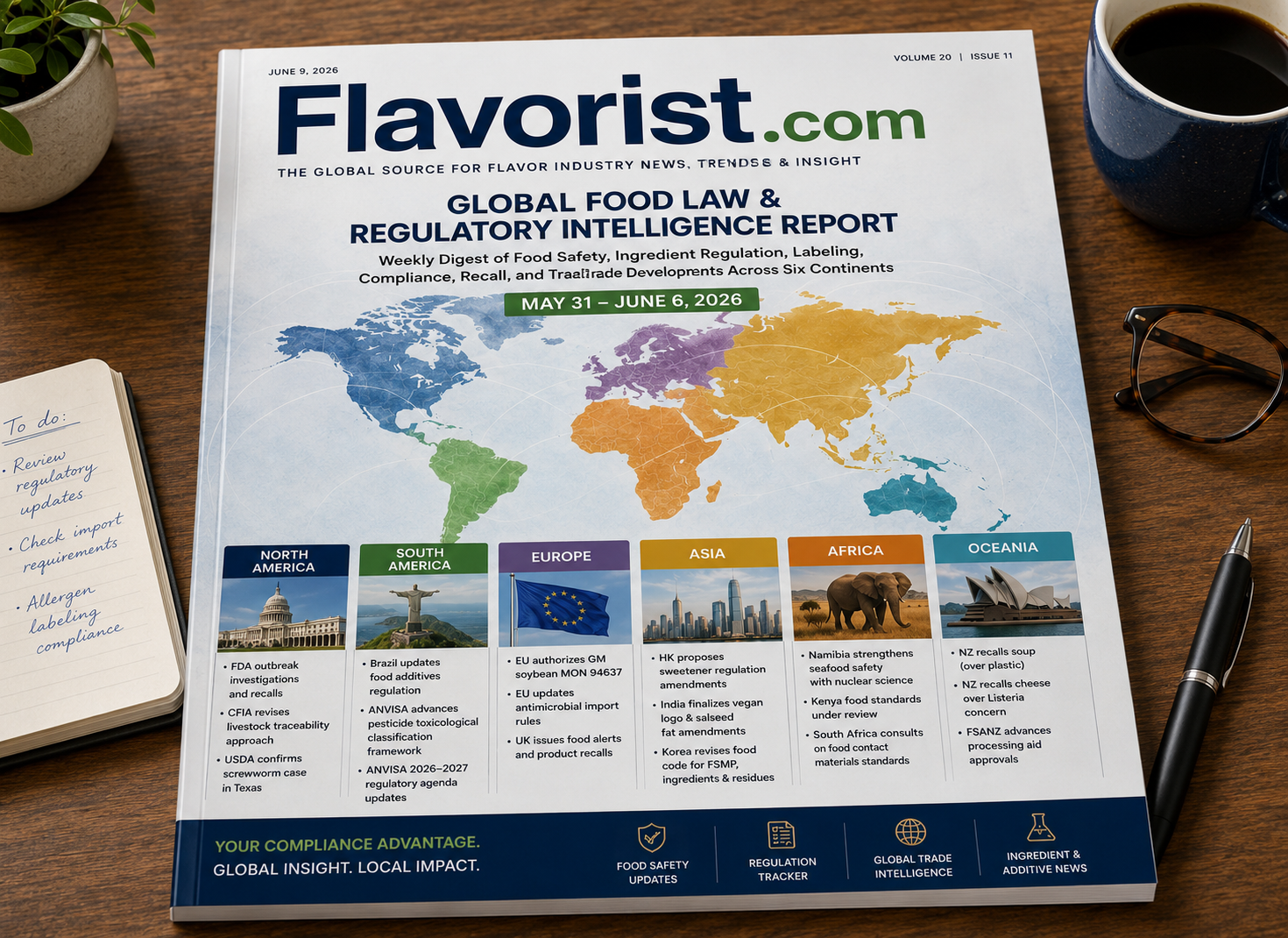
Global Food Law & Regulatory Intelligence Report: May 31 – June 6, 2026
Weekly Digest of Food Safety, Ingredient Regulation, Labeling, Compliance, Recall, and Trade Developments Across North America, South America, Europe, Asia, Africa, and Oceania.
Nouth America Food & Flavor Industry Law and Regulatory News Digest: Released May 31 – June 6, 2026
1. FDA investigates Listeria outbreak tied to soft ricotta/requeson cheese
On June 3, 2026, FDA reported an outbreak investigation involving Listeria monocytogenes linked to Clover Hill Dairy requeson/soft ricotta products. FDA said 8 illnesses, 7 hospitalizations, and 1 death were reported across Maryland, New York, and Virginia. Clover Hill Dairy issued a voluntary recall, and Maryland suspended the company’s operating license. This is important for dairy flavor, cheese, cultured dairy, and foodservice suppliers because it shows intensified state-federal coordination around soft-cheese pathogen control, distributor tracing, and retailer repacking risks. (U.S. Food and Drug Administration)
2. FDA expands Salmonella investigation involving moringa capsules
On June 3, 2026, FDA updated its Salmonella outbreak investigation involving moringa leaf powder products. Total Nutrition Inc. of Deer Park, New York expanded its recall on June 2 to include another lot of TNVitamins and Doctor’s Pride moringa capsules. Although this is a dietary supplement case, it matters to the food/flavor industry because botanical powders, “green” ingredients, wellness flavor systems, and functional beverage inputs often share similar supply-chain risks: pathogen contamination, dry-ingredient controls, supplier verification, and recall expansion management. (U.S. Food and Drug Administration)
3. FDA finds Clostridium botulinum in powdered milk ingredient linked to infant formula outbreak
On June 3, 2026, FDA updated its investigation into the ByHeart infant formula botulism outbreak, reporting that on-site inspections identified Clostridium botulinum in a powdered milk ingredient. FDA reported 48 illnesses and 48 hospitalizations, with no deaths, and said the root-cause investigation is now focused on ingredients. For dairy, flavor, nutrition, and infant-food suppliers, this is a major regulatory signal: dry dairy ingredients can carry severe low-moisture food safety implications, and FDA is emphasizing recall execution, ingredient surveillance, and compliance controls. (U.S. Food and Drug Administration)
4. CFIA revises Canada’s livestock traceability regulatory approach
On June 3, 2026, the Canadian Food Inspection Agency announced a revised approach to livestock traceability regulations. CFIA plans to move ahead with updated traceability requirements for goats, sheep, cervids, and pigs, while not moving forward at this time with new cattle and bison movement-reporting requirements. The proposal includes shorter event-reporting timelines for some parties and expanded identification/reporting requirements. This affects meat, dairy, savory flavor, rendered ingredient, and animal-derived ingredient supply chains because traceability rules influence disease containment, market access, and documentation expectations. (Canada)
5. USDA confirms New World screwworm case in Texas calf
On June 3–4, 2026, USDA confirmed a New World screwworm case in a Texas calf, according to Reuters. USDA halted movement of animals within a 20-km area, released sterile flies, increased surveillance, and sent response teams. Reuters reported this was the first Texas case since 1966 and noted potential livestock-industry impacts. While Reuters says the pest poses no food safety issue, it is still regulatory-relevant for meat, dairy, animal-derived flavors, gelatin, tallow, and savory ingredient supply chains because animal movement controls can disrupt livestock logistics. (reuters.com)
South America Food & Flavor Industry Law and Regulatory News Digest: Released May 31 – June 6, 2026
During the period of May 31 through June 6, 2026, regulatory activity in South America was relatively limited compared with North America and Europe. However, several developments were particularly relevant to food manufacturers, flavor companies, ingredient suppliers, and compliance professionals operating in the region.
1. Brazil: ANVISA Updates Food Additives and Processing Aids Regulation
Brazil's National Health Surveillance Agency, ANVISA, published Normative Instruction No. 432/2026, updating Brazil's positive lists for food additives and processing aids. The measure revises authorized substances, usage conditions, and maximum permitted levels for several additive categories.
The amendment updates portions of the existing regulatory framework established under IN 211/2023 and reflects ANVISA's continuing effort to align Brazilian food additive legislation with international scientific evaluations and Codex Alimentarius recommendations. According to regulatory specialists monitoring the publication, the update includes additions of new substances, revisions of use restrictions, and adjustments to maximum limits for certain additives and processing aids. (LinkedIn)
For the flavor industry, this is one of the most important regulatory developments of the week because many flavor systems contain carrier solvents, stabilizers, emulsifiers, processing aids, and functional additives that must comply with local positive lists. Any change in permitted uses or concentration limits may require reformulation, specification updates, or regulatory reviews of products already on the Brazilian market.
Food manufacturers exporting into Brazil should review formulations against the revised lists and verify that ingredient suppliers have updated compliance documentation. Regulatory affairs teams should also assess whether existing registrations, notifications, or product dossiers require amendment.
The update demonstrates ANVISA's continued movement toward modernization of food regulations while maintaining a science-based authorization framework for food ingredients and additives. Brazil remains one of the largest food and beverage markets in the world, making additive regulation changes highly significant for multinational flavor houses and ingredient suppliers. (LinkedIn)
Source:
Brazil Updates Food Additives and Processing Aids Regulation
2. Brazil: ANVISA Advances Pesticide Toxicological Classification Framework
During late May and continuing into early June 2026, ANVISA advanced implementation of a structured strategy for assigning toxicological classifications and reference doses to pesticide active ingredients under Brazil's Globally Harmonized System (GHS)-based framework. The initiative was highlighted in regulatory reporting during the week and represents an important food-sector development. (infoAlimentario)
Although the measure is directed primarily at agricultural chemicals, it has direct implications for food and flavor industries because pesticide residue management remains a key component of food safety compliance. Regulatory authorities increasingly use toxicological reference values when establishing maximum residue limits, conducting risk assessments, and evaluating imported agricultural commodities.
For flavor manufacturers that depend on fruit, botanical, spice, herb, tea, coffee, and essential-oil raw materials, changes in toxicological classifications can ultimately influence sourcing strategies, supplier qualification programs, residue testing requirements, and market-access decisions.
The new framework aims to improve transparency and consistency in pesticide evaluation by formally incorporating toxicological classifications into official monographs. This provides regulators and industry with clearer scientific benchmarks when assessing potential risks associated with agricultural chemicals used throughout the food supply chain.
The development also signals Brazil's continuing effort to harmonize aspects of its regulatory system with internationally recognized toxicological assessment methodologies. Companies sourcing agricultural materials from Brazil or exporting foods into Brazil should monitor subsequent regulatory actions that may affect residue standards, risk assessments, or compliance obligations.
While not a flavor-specific regulation, the initiative has long-term significance because pesticide regulation directly affects the quality and regulatory status of many flavor raw materials derived from agricultural commodities. (infoAlimentario)
Source:
ANVISA establishes toxicological classification and reference doses for pesticide active ingredients
3. Brazil: Continued Development of ANVISA Regulatory Agenda 2026–2027 for Food Sector
Regulatory stakeholders continued reviewing and preparing for implementation of food-related initiatives contained within ANVISA's Regulatory Agenda 2026–2027, which includes dozens of food-sector topics targeted for review, revision, or modernization. Food regulatory observers highlighted ongoing industry engagement during the May 31–June 6 period as companies evaluate upcoming compliance impacts. (Food Compliance International)
The agenda identifies numerous food-related projects involving ingredient standards, food authorization pathways, food safety requirements, packaging regulation, and modernization of existing rules. ANVISA has indicated that food regulation remains a major priority area within the broader health-surveillance agenda. (Food Compliance International)
For flavor manufacturers, the agenda is important because it provides visibility into future regulatory changes before formal rulemaking begins. Early awareness allows companies to conduct gap analyses, prepare scientific data packages, budget for compliance activities, and engage in public consultations when opportunities arise.
Several food-related topics under consideration involve modernization of regulatory processes, review of existing standards, and potential harmonization with international approaches. Although individual rulemakings may take months or years to finalize, companies operating in South America often use the regulatory agenda as an early-warning system for future compliance obligations.
Brazil's food market is the largest in South America, meaning regulatory developments originating from ANVISA often influence regional regulatory trends and business strategies throughout Latin America. Consequently, multinational food and flavor companies closely monitor agenda developments even before specific regulations are proposed.
The continuing focus on food-sector modernization reflects broader efforts to improve regulatory predictability, transparency, and efficiency while maintaining food safety protections. (Food Compliance International)
Source:
ANVISA Regulatory Agenda 2026–2027 Overview
Overall South America Regulatory Trend (May 31 – June 6, 2026)
The dominant regulatory theme across South America during this period was Brazilian regulatory modernization, particularly involving:
- Food additives and processing aids.
- Agricultural chemical oversight affecting food supply chains.
- Long-term regulatory planning through ANVISA's 2026–2027 agenda.
- Continued alignment with international scientific and food-safety standards.
These developments are especially relevant for flavor houses, ingredient suppliers, beverage manufacturers, dairy companies, confectionery producers, and multinational food businesses that rely on regulatory harmonization and market access within South America's largest economy. (LinkedIn)
Asia Food & Flavor Regulatory News: May 31–June 6, 2026
1. Hong Kong proposes amendments to Sweeteners in Food Regulations
On June 2, 2026, Hong Kong proposed amendments to the Sweeteners in Food Regulations to better align with Codex, Mainland China, and other major trading-partner standards. The proposal would bring polyhydric alcohols / polyols under regulatory scope, expand the permitted sweetener list, and set maximum permitted levels for specific sweetener-food combinations. The Centre for Food Safety said about 98% of 900 tested samples complied with the proposed limits. For flavor and beverage companies, this is important because sweetener systems are central to reduced-sugar drinks, confectionery, dairy desserts, bakery fillings, tabletop sweeteners, and flavored nutraceutical products. Companies selling into Hong Kong should review sweetener declarations, polyol use, and maximum-use calculations before the public consultation and transition period. (FEHD)
2. Hong Kong steps up frozen confection factory inspections
On June 3, 2026, Hong Kong’s CFS and FEHD announced stepped-up inspections of frozen confection factories as summer approached. Inspections focus on cleaning and disinfection of mixing and dispensing machines, utensils, licensing compliance, and statutory hygiene standards. CFS also issued guidance for frozen confections prepared at points of sale. This matters to dairy, ice cream, soft-serve, dessert, and flavor suppliers because hygiene failures in retail-prepared frozen products can quickly trigger regulatory scrutiny and affect flavored dairy systems. (FEHD)
3. Hong Kong finds soft ice-cream sample above coliform legal limit
On June 5, 2026, Hong Kong CFS announced that a locally manufactured soft ice-cream sample exceeded the legal coliform limit. The factory was instructed to stop selling and dispose of affected product, clean and disinfect the premises, and improve food-safety practices. The legal limit under the Frozen Confections Regulation is not more than 100 coliform bacteria per gram. This is directly relevant to frozen dessert manufacturers and flavor suppliers serving soft-serve, dairy beverage, and ice-cream applications. (FEHD)
4. India publishes final FSSAI amendment on salseed fat restriction
On June 3, 2026, FSSAI uploaded a final Food Safety and Standards Amendment Regulation relating to omission of a restriction provision on salseed fat. This affects edible-fat, confectionery-fat, bakery-fat, chocolate-compound, and flavor-carrier applications because specialty fats can influence texture, melting profile, release of flavor compounds, and labeling compliance. Companies using Indian edible oils or exporting fat-containing foods to India should review the final amendment. (FSSAI)
5. India publishes final Vegan Foods amendment on vegan logo
Also on June 3, 2026, FSSAI uploaded the final Food Safety and Standards Vegan Foods Amendment Regulations, 2026, relating to specification of the vegan logo. This is important for plant-based flavors, dairy alternatives, meat alternatives, confectionery, beverages, and clean-label products because vegan positioning depends heavily on compliant labeling and ingredient substantiation. Flavor houses should confirm that carriers, solvents, processing aids, enzymes, and natural flavor sources support vegan claims. (FSSAI)
6. Vietnam releases 15 draft food testing and quality-control standards
On June 1, 2026, Vietnam’s Ministry of Health released 15 draft TCVN national standards for consultation, covering food, beverages, dietary supplements, infant formula, testing methods, microbiology, contaminants, nutrients, and laboratory quality control. The comment deadline is July 30, 2026. This matters to food and flavor companies because testing standards determine how compliance is verified, especially for beverages, fortified products, infant nutrition, and functional foods. (ChemLinked)
7. South Korea revises Food Code for FSMP, ingredients, and residues
On June 2, 2026, ChemLinked reported that South Korea MFDS issued Notice No. 2026-40 amending the Food Code. The update adds statistical microbiological criteria for certain special medical-purpose foods, expands approved food ingredients, revises pesticide and veterinary-drug residue limits, and updates testing methods. Most changes took effect immediately, while some testing-method changes take effect January 1, 2027. This affects functional foods, FSMP, botanical ingredients, dairy, beverages, and flavor raw materials. (ChemLinked)
8. Indonesia updates registration requirements for collagen foods and non-dairy creamers
On June 1, 2026, Indonesia BPOM updates were reported for processed foods containing collagen and powdered non-dairy creamers. Collagen in processed foods is capped at 10 g per serving or package, while powdered non-dairy creamer is reclassified as a medium-high-risk product requiring stricter registration documentation and SPPT SNI approval. This matters to flavored beverages, coffee mixes, creamers, beauty-from-within products, and dairy-alternative systems. (ChemLinked)
Europe Food & Flavor Regulatory News: May 31–June 6, 2026
1. EU authorizes genetically modified soybean MON 94637
On June 4, 2026, the EU published Commission Implementing Decision (EU) 2026/1185, authorizing foods, food ingredients, and feed containing, consisting of, or produced from genetically modified soybean MON 94637. EFSA had issued a favorable opinion, concluding the soybean was as safe as conventional comparators and raised no nutritional concern. The authorization is valid for 10 years and does not cover cultivation. This matters to food and flavor companies using soy derivatives, emulsifiers, protein systems, lecithin, plant-based foods, and compound flavor carriers. (Alimentibevande.it)
2. EU updates import rules tied to antimicrobial-use restrictions
On June 5, 2026, the EU published Commission Implementing Regulation (EU) 2026/1189, consolidating and updating third-country lists for animals and animal-origin foods entering the EU under rules restricting certain antimicrobial medicinal products. The regulation supports enforcement of EU bans on growth-promotion antimicrobials and antimicrobials reserved for human medicine. This is important for meat, dairy, gelatin, animal fats, savory ingredients, and animal-derived flavor raw materials imported into Europe. (EUR-Lex)
3. EU expands emergency measures for sheep pox and goat pox in Romania
On June 5, 2026, the EU published Commission Implementing Decision (EU) 2026/1217, amending emergency measures for sheep pox and goat pox in Romania. The measure adjusted restricted zones after additional outbreaks and prohibited movements of ovine and caprine animals from affected areas, with broader movement restrictions extending to July 31, 2026. This affects sheep/goat dairy, meat supply chains, animal-derived savory flavors, and regional export logistics. (EUR-Lex)
4. UK FSA issues food alert for all frozen products from Inarah’s Frozen Foods
On June 4, 2026, the UK Food Standards Agency issued a Food Alert for Action covering all frozen products sold under Inarah’s Frozen Food, Inarah’s Fine Food, and New York Crispy packaging. The FSA said the company could not demonstrate that products had been produced and handled safely, and the products may be unsafe to eat. This is directly relevant to frozen-food manufacturers, co-packers, distributors, and seasoning/flavor suppliers serving frozen snacks and meals. (Food Standards Agency)
5. UK FSA warns Dalston Pineapple Soda cans may break apart
On June 5, 2026, the UK FSA announced that Dalston Soda Company recalled Dalston’s Pineapple Soda because cans may unexpectedly break apart and create sharp edges. Affected products include 330 ml single cans and 4 x 330 ml multipacks with August 4, 2027 best-before dates. This matters to beverage companies because packaging defects can trigger recalls even when the formulation itself is not unsafe. (Food Standards Agency)
6. UK FSA issues undeclared barley allergy alert for Waitrose hot cross buns
On June 4, 2026, the UK FSA reported that Waitrose & Partners recalled 4 Richly Fruited Hot Cross Buns because barley was present but not declared on the label. The alert applies to packs with a June 6, 2026 best-before date. For bakery, flavor, and ingredient suppliers, this highlights the continuing regulatory risk around allergen labeling, especially where cereal-derived ingredients, malt notes, flavor carriers, or bakery inclusions are involved. (Food Standards Agency)
Africa Food & Flavor Regulatory News: May 31–June 6, 2026
Only limited Africa-specific food law/regulatory news releases found in this exact window. The strongest relevant items are below.
1. Namibia: IAEA highlights nuclear testing for seafood safety
On June 5, 2026, the IAEA released a feature on how nuclear and isotopic science is being used to strengthen seafood safety in Namibia. The item is regulatory-relevant because seafood export markets depend heavily on official testing, contaminant monitoring, laboratory capability, and internationally trusted analytical methods. For food and flavor companies, this matters especially where seafood extracts, fish sauces, marine ingredients, savory flavors, and export-oriented seafood supply chains are involved. Better testing capability supports detection of contaminants, verification of product safety, and compliance with importing-country requirements. It also strengthens confidence in Namibia’s fish and seafood sector, which is important for regional trade and international market access. (iaea.org)
2. Kenya: KEBS food standards under systematic review closed June 4
Kenya Bureau of Standards listed several food-related standards under systematic review with a June 4, 2026 closing date, including milk and milk products and processed fruits and vegetables. Although circulation began earlier, the review period closed during the requested window, making it relevant for regulatory monitoring. Systematic review can lead to confirmation, revision, or withdrawal of standards. For flavor companies, this matters because dairy, fruit preparations, beverages, jams, fillings, and processed fruit systems often depend on national standards for identity, quality, testing, labeling, and trade compliance. Suppliers selling into Kenya should monitor whether these reviews result in updated technical requirements. (kebs.org)
3. South Africa: food-contact material standards consultation closed June 6
A South Africa-linked standards notice highlighted food-contact material standards with public comments accepted until June 6, 2026. The standards referenced regenerated cellulose food-contact materials and migration testing for substances such as 1,4-dichlorobenzene and 2-methyl-1,3-butadiene. This matters to flavor and food manufacturers because packaging migration can affect food safety, flavor integrity, shelf life, and compliance for beverages, confectionery, bakery, dairy, and ready-to-eat products. Packaging-contact rules are especially important for aroma compounds, oils, solvents, and high-fat food matrices that may interact with packaging materials. (linkedin.com)
Overall trend: Africa’s activity during this week was more about standards, testing capacity, and food-safety infrastructure than major new food laws.
Oceania Food & Flavor Regulatory News: May 31 – June 6, 2026
During the period of May 31 through June 6, 2026, regulatory activity in Oceania was dominated by food-safety enforcement, recalls, and ongoing Food Standards Australia New Zealand (FSANZ) regulatory actions. The most significant developments for food manufacturers, flavor houses, ingredient suppliers, dairy companies, beverage producers, and regulatory affairs professionals are summarized below.
1. New Zealand recalls Pams Chicken Laksa Soup due to hard plastic contamination
On June 3–5, 2026, New Zealand Food Safety (NZFS), part of the Ministry for Primary Industries (MPI), announced a recall of Pams Chicken Laksa Soup (500 g) because the product may contain hard plastic foreign matter. Retailers were instructed to remove affected products and display recall notices, while consumers were advised not to consume the soup. (MPI NZ)
Although this is a single-product recall, it highlights one of the most common regulatory risks facing the food industry: foreign-material contamination. For flavor manufacturers and ingredient suppliers, the incident serves as a reminder that contamination risks can originate anywhere in the supply chain, including packaging operations, ingredient handling, processing equipment, and filling lines.
The recall is particularly relevant to manufacturers of prepared meals, soups, sauces, seasoning systems, and foodservice products. Regulators increasingly expect robust preventive controls, foreign-material detection programs, supplier verification systems, and effective traceability mechanisms capable of supporting rapid recalls.
The event also illustrates the importance of New Zealand's recall framework under the Food Act, where businesses must rapidly identify affected lots, notify regulators, communicate with retailers, and protect consumers from potential hazards. Companies exporting foods into New Zealand should review their foreign-material prevention programs and recall readiness procedures.
Source:
MPI Recall Notice – Pams Chicken Laksa Soup
(MPI NZ)
2. New Zealand recalls Emborg Emmentaler Cheese over possible Listeria contamination
During the week, New Zealand Food Safety continued regulatory actions related to the recall of Emborg Emmentaler Cheese (200 g) because of the possible presence of Listeria monocytogenes. MPI reiterated that consumers should not eat the affected product and supported the recall process undertaken by the importer. (MPI NZ)
Listeria remains one of the most closely monitored foodborne pathogens worldwide because it poses serious risks to pregnant women, older adults, and immunocompromised consumers. For dairy processors, cheese manufacturers, and dairy-flavor suppliers, the incident reinforces the need for environmental monitoring programs, hygienic design, sanitation validation, and finished-product testing where appropriate.
The recall is particularly significant because cheese and other refrigerated ready-to-eat products can support Listeria survival and growth under certain conditions. Regulatory authorities throughout Oceania continue to emphasize preventive controls rather than relying solely on end-product testing.
For flavor houses supplying cultured dairy systems, cheese flavors, dairy ingredients, and savory dairy notes, the case serves as another reminder that food-safety compliance increasingly extends beyond flavor composition and into broader supply-chain risk management.
Source:
MPI Recall Notice – Emborg Emmentaler Cheese
(MPI NZ)
3. FSANZ continues processing approvals for new food-processing aids
Food Standards Australia New Zealand (FSANZ) continued implementation of recently approved amendments involving several food-processing aids, including approvals for enzyme preparations such as endo-1,4-beta-xylanase and alpha-amylase used in starch processing and alcohol production. These approvals remain part of the agency's ongoing modernization of the Australia New Zealand Food Standards Code. (Food Standards Australia New Zealand)
For the flavor industry, processing-aid approvals are highly significant because enzymes frequently influence raw-material conversion, fermentation performance, sugar generation, extraction efficiency, and ingredient functionality. Beverage manufacturers, distilled-spirit producers, starch processors, and fermentation-based ingredient suppliers are among the sectors most affected.
The approvals also demonstrate FSANZ's continued reliance on scientific risk assessment when evaluating new processing technologies. Companies developing enzyme-enabled manufacturing processes should monitor upcoming applications and gazettal activities because changes to approved processing aids can create opportunities for improved yields, lower costs, and enhanced product quality.
Source:
FSANZ Board Communiqué – April 2026 Meeting Decisions
(Food Standards Australia New Zealand)
4. FSANZ regulatory notifications advance Food Standards Code amendments
FSANZ continued issuing formal notifications and regulatory circulars associated with amendments and applications under the Australia New Zealand Food Standards Code. These notifications form part of the legal process through which proposed changes become enforceable food standards across both countries. (Food Standards Australia New Zealand)
While these procedural notices may not attract significant public attention, they are critically important to regulatory affairs teams. They provide advance visibility into changes involving food additives, processing aids, novel foods, ingredients, labeling requirements, and compositional standards.
For flavor manufacturers, monitoring FSANZ notifications is often the earliest indication that regulatory requirements affecting flavor ingredients, solvents, carriers, enzyme systems, or food applications may change in the future. Many multinational flavor companies use these notices as an early-warning mechanism for compliance planning and formulation review.
Source:
FSANZ Gazette and Notification Circulars
(Food Standards Australia New Zealand)
Key Oceania Regulatory Themes (May 31 – June 6, 2026)
The major themes affecting the food and flavor industry across Australia and New Zealand during this period were:
- Food recalls involving foreign-material contamination.
- Continued vigilance regarding Listeria and dairy-product safety.
- Ongoing modernization of the Australia New Zealand Food Standards Code.
- Regulatory approvals for processing aids and enzyme technologies.
- Enhanced focus on traceability, recall readiness, and preventive food-safety systems. (MPI NZ)
These developments are particularly relevant to flavor houses, ingredient manufacturers, dairy companies, beverage producers, bakery suppliers, fermentation businesses, and regulatory professionals operating throughout Oceania.
###