How Oreo’s Endless Flavor Innovation Keeps the 114-Year-Old Cookie Brand Relevant
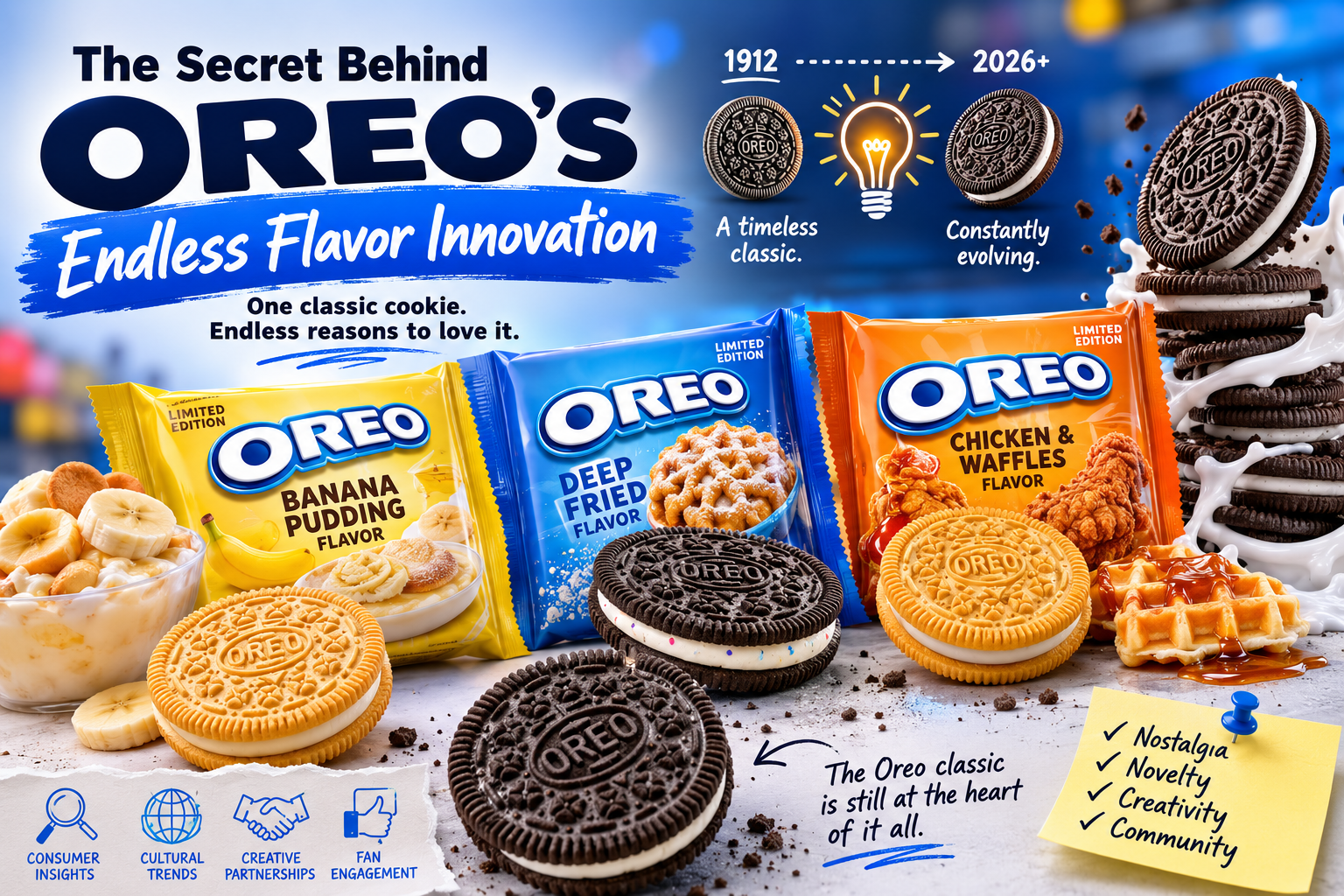
Friday August 28, 2026 – Few packaged-food brands have remained as recognizable for more than a century as Oreo. Yet the world’s best-selling cookie is not relying solely on nostalgia or its familiar combination of chocolate wafers and vanilla crème. Instead, owner Mondelēz International has transformed Oreo into something closer to an innovation platform, continually introducing unexpected flavors, limited editions and cultural collaborations that give consumers new reasons to talk about—and buy—the brand.
A recent Food Dive interview with Chrissy Briganti, senior director of Oreo innovation highlights how central this strategy has become. Oreo’s product pipeline has included everything from Strawberry Milkshake, Brownie Batter and Birthday Cake to Candy Corn. In August 2026, the company pushed the experimentation even further by releasing three limited-edition varieties simultaneously: Banana Pudding, Deep Fried and Chicken & Waffles.
Oreo Uses New Flavors to Keep an Old Brand Fresh
The fundamental challenge facing Oreo is one encountered by nearly every legacy consumer brand: how do you protect what generations of customers already love while remaining interesting to younger consumers?
Oreo’s answer is to keep the classic product at the center of the business while using limited editions to explore new tastes and cultural moments. Briganti told Food Dive that the majority of Oreo’s business still comes from its core products. The unusual releases therefore function less as attempts to reinvent Oreo than as ways of starting new conversations around it.
That distinction is important. Consumers who simply want the original Oreo can continue buying it, while adventurous shoppers encounter a constantly changing assortment alongside it. Every new flavor creates another potential occasion for social-media posts, taste tests, retailer displays and conversations among consumers.
Oreo says its innovation teams monitor developments far beyond the cookie aisle. They study broader food and gastronomic trends, conduct social listening, work with outside partners and analyze where consumer interest appears to be gaining momentum. Current innovation has focused particularly on three areas: nostalgic desserts, experiential foods such as state-fair treats, and unexpected combinations of sweet and savory flavors.
Banana Pudding, Deep Fried and Chicken & Waffles Reflect Bigger Food Trends
Oreo’s three 2026 limited editions illustrate that research process.
Banana Pudding taps into demand for familiar, nostalgic desserts. The variety combines banana and vanilla-pudding-flavored crème between vanilla wafers. Deep Fried Oreo seeks to reproduce the indulgent experience of fried fairground desserts, while Chicken & Waffles embraces the increasingly popular collision of sweet and savory flavors.
What makes the launch particularly interesting from a marketing perspective is that Oreo did not simply introduce three products. Through its “Twist, Lick, Vote” campaign, consumers can vote on which flavor should return nationally in 2027. Mondelēz said developing the three varieties required more than a year of research, demonstrating that products designed to feel spontaneous and playful can require substantial R&D behind the scenes. Oreo’s announcement explains the three flavors and voting campaign
The voting mechanism also turns product development into consumer engagement. Instead of Oreo announcing what shoppers will receive next year, fans participate in choosing it. That gives the company both promotional attention and information about consumer preferences.
Limited Editions Create Urgency and Experimentation
There is also a well-established consumer-behavior rationale behind limited-edition products.
Research published in Psychology & Marketing has found that scarcity messages associated with limited editions can make products appear more special, unique or valuable. Other research on limited-edition food and beverages has linked perceived scarcity and anticipated regret—the feeling that consumers might miss their opportunity—to increased purchase intention. Research on limited-edition scarcity and consumer behavior
For Oreo, that means a strange flavor does not necessarily have to become a permanent bestseller to provide value. Its temporary nature can itself stimulate trial. Consumers may buy a package because they are curious, because friends are discussing it or simply because they know they will not be able to find it indefinitely.
That makes limited-edition innovation particularly useful for an established product. Oreo can generate novelty without permanently cluttering its core portfolio.
Oreo Has Been Localizing and Reinventing the Cookie for Decades
Although Oreo’s current pace of innovation feels very contemporary, experimentation is deeply rooted in the brand’s international growth strategy.
Oreo was introduced in the United States in 1912 and today is sold in more than 100 countries. Mondelēz describes it as the world’s top-selling cookie. Over time, the company has adapted Oreo to local tastes with varieties such as green-tea-ice-cream Oreos in China and other market-specific flavors and formats. Mondelēz’s Oreo brand history and global overview
The scale is enormous. Mondelēz says more than 60 billion Oreo cookies are sold annually, including more than 20 billion in the United States. Food Dive reports that annual Oreo sales exceed $4 billion, making the cookie a major contributor to a company that generated approximately $38.5 billion in net revenue in 2025.
Oreo also predates Mondelēz itself by a century. Mondelēz International was created in 2012 when Kraft Foods separated its North American grocery business, leaving brands including Oreo, Cadbury and other global snack businesses inside the newly named Mondelēz International. Mondelēz’s corporate history explains the 2012 separation
Collaborations Turn Oreo Into a Cultural Brand
Flavor innovation is only one part of the strategy. Oreo increasingly collaborates with other major brands and entertainment properties to enter conversations that extend beyond packaged cookies.
Mondelēz and Hershey, for example, combined two powerful snack brands in Reese’s Oreo Cookies and Reese’s Oreo Cups after consumers had already been posting their own Reese’s-and-Oreo combinations online. Food Dive reported on the Reese’s-Oreo collaboration
Oreo has also partnered with K-pop supergroup BTS on a campaign spanning more than 80 countries. That collaboration included an Oreo inspired by hotteok, a Korean sweet pancake, along with a purple wafer designed to connect with BTS fandom and Korean culture. Marketing Dive’s coverage of the Oreo-BTS partnership
These collaborations broaden Oreo’s relevance. Rather than competing only with other cookies, the brand can participate in entertainment, fandom, restaurants, confectionery and social-media culture.
Why Oreo’s Innovation Strategy Matters
Oreo’s approach is particularly well suited to the way consumers now snack. Mondelēz’s 2026 State of Snacking study describes a marketplace shaped by seemingly contradictory desires: consumers want both nostalgia and novelty, as well as health and indulgence. Six in 10 consumers in the markets surveyed snack at least once a day, while roughly half occasionally replace meals with snacks. The research was produced by Mondelēz with Mintel and Black Swan Data, so it should be understood as company-sponsored consumer research, but its findings help explain the strategic environment in which Oreo is operating. Explore Mondelēz’s 2026 State of Snacking research
Oreo’s advantage is that it can satisfy both sides of the nostalgia-novelty equation. The familiar black-and-white cookie provides continuity, while Banana Pudding, Chicken & Waffles, BTS editions, Reese’s collaborations and whatever comes next provide constant surprise.
That may be the most important lesson from Oreo’s strategy. Innovation does not necessarily require abandoning what made a brand successful. For a 114-year-old product, innovation can instead mean creating an endless stream of new experiences around an unmistakably familiar core.
As Mondelēz explores additional Oreo flavors, partnerships, foodservice opportunities and categories beyond traditional retail cookies, the brand’s biggest asset may no longer be simply the Oreo itself. It is the company’s ability to continually make an old cookie feel new. (San)
###