IFRA and the flavor industry — what an SFC flavorist should know
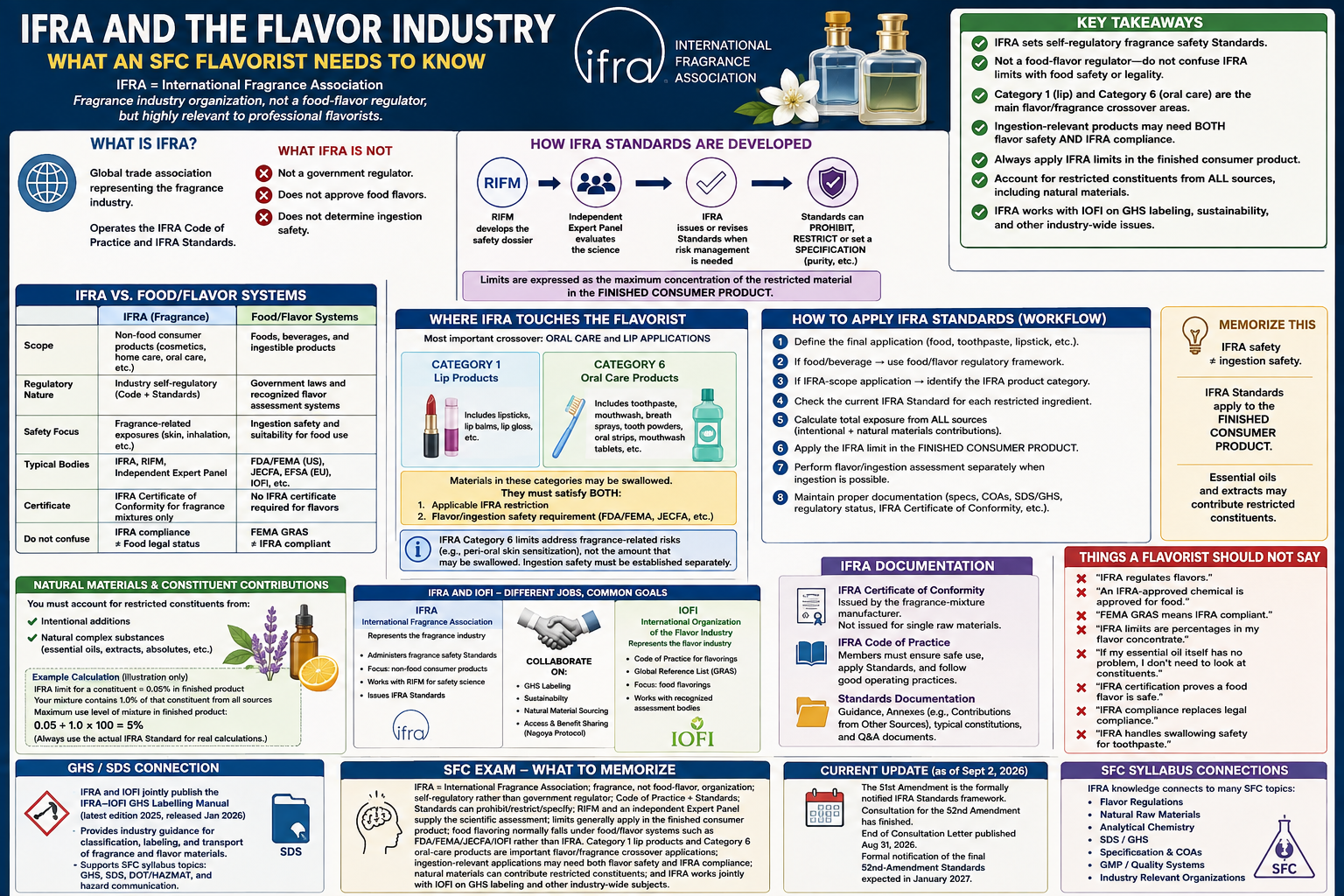
The International Fragrance Association (IFRA) is primarily a fragrance-industry organization, not a food-flavor regulatory body. However, the Society of Flavor Chemists deliberately includes IFRA in Section VII of its January 2026 syllabus under “Industry Relevant Organizations.” The reason is that flavor and fragrance chemistry overlap heavily: the same aroma chemicals, essential oils, extracts, suppliers, analytical methods, hazard classifications, and sometimes even finished-product applications occur in both industries. (Flavor Chemists)
The SFC syllabus does not give a separate detailed IFRA curriculum. It expects candidates to understand the flavor industry broadly—including raw materials, production, legal/regulatory considerations, documentation and related organizations—and lists IFRA as one of the organizations a professional flavorist should recognize. (Flavor Chemists) So the appropriate SFC level is not “memorize every IFRA limit.” It is: know what IFRA does, where its scope begins and ends, why a flavorist encounters it, and how to handle a product that sits at the flavor/fragrance boundary.
The essential distinction
| Question | What a flavorist should know |
|---|---|
| What is IFRA? | The global trade association representing the fragrance industry. Its central product-stewardship system is the IFRA Code of Practice and IFRA Standards. (IFRA) |
| Is IFRA a government regulator? | No. IFRA operates an industry self-regulatory system. Compliance with its Code and Standards is mandatory for IFRA members, but the Standards do not replace national or regional law. (IFRA) |
| Does IFRA approve food flavors? | No. IFRA Standards generally concern fragrance mixtures used in non-food consumer products. Food-flavor safety and legality are handled through food law and flavor-specific systems such as FDA/FEMA in the U.S., JECFA, EFSA/EU rules, IOFI guidance, etc. (IFRA) |
| Then why does a flavorist care? | Because flavorists use many of the same aroma chemicals and natural raw materials as perfumers; because oral-care and lip applications can cross the flavor/fragrance boundary; and because IFRA and IOFI cooperate on GHS/SDS matters, sustainability, natural-material sourcing and other issues. |
| Who performs the safety work? | IFRA works principally with the Research Institute for Fragrance Materials (RIFM). RIFM develops the safety dossier; an independent Expert Panel evaluates the science; IFRA then issues or revises Standards where risk management is needed. (IFRA) |
| What can an IFRA Standard do? | Prohibit a material, restrict its use/concentration, or impose a specification such as a purity criterion. (IFRA) |
| Where is an IFRA quantitative limit expressed? | Normally as the maximum concentration of the restricted material in the finished consumer product, not simply in the fragrance concentrate. (IFRA) |
| Does an IFRA Certificate make a food flavor legal? | No. An IFRA Certificate of Conformity is intended for a fragrance mixture and is prepared by the fragrance-mixture manufacturer. IFRA specifically says raw-material suppliers should not issue an IFRA Certificate for a single raw material. (IFRA) |
Where IFRA actually touches the flavorist's work
The most important crossover is oral-care and other products with foreseeable incidental ingestion. IFRA states that its Standards generally concern non-food fragrance applications, but oral-care materials may legitimately be viewed as either flavor or fragrance depending on the regulatory framework. Toothpaste, mouthwash, breath sprays, tooth powders, oral strips and mouthwash tablets fall into IFRA Category 6. Lip products—including lipsticks and balms—are Category 1. (IFRA)
This creates a very important two-part safety test. A material used in a Category 1 or Category 6 application may need to satisfy both the applicable IFRA restriction and the appropriate food/flavor safety requirement because small amounts may be swallowed. IFRA Standards themselves contain a “Flavor Requirements” statement explaining that materials in these ingestion-relevant categories must also be recognized as safe for flavor use under the flavor-industry framework. (IFRA)
For a flavorist, the conceptual separation is critical:
IFRA safety ≠ ingestion safety.
For toothpaste and mouthwash, for example, IFRA explains that its Category 6 exposure limits address risks such as peri-oral skin sensitization; those limits are not themselves a determination of the safe amount that may be swallowed. Flavor/food safety must be established separately. (IFRA)
So if you are making a mint flavor for a beverage, you normally would not calculate an IFRA Category 6 limit. If you are making essentially the same mint profile for a toothpaste or mouthwash, IFRA becomes relevant in addition to flavor-safety requirements.
The raw-material overlap
A flavorist should also understand why IFRA appears frequently on documentation for materials such as essential oils, extracts and common aroma molecules. A citrus oil, mint oil, spice oil or aroma chemical may be sold into both flavor and fragrance markets.
For natural complex substances, IFRA compliance can be less obvious because a restricted constituent may be present naturally rather than intentionally added as a pure chemical. IFRA therefore publishes an Annex on Contributions from Other Sources and instructs users to account for restricted constituents contributed by natural complex substances. Supplier analytical data should be used where available; IFRA's typical-composition information can help where appropriate. (IFRA)
That concept is worth knowing for an SFC interview:
Adding zero grams of a restricted chemical directly does not necessarily mean the formula contains zero of that chemical.
An essential oil or extract may contribute it.
For example, suppose an IFRA Standard hypothetically allows a constituent at 0.05% in the finished consumer product, and your flavor/fragrance mixture contains 1.0% of that constituent from all sources. The theoretical maximum dose of that mixture would be:
0.05 ÷ 1.0 × 100 = 5% mixture in the finished product.
That is only an illustration of the calculation; actual limits must always come from the current IFRA Standard for the material and application.
IFRA and IOFI: do not confuse their jobs
For an SFC candidate, IOFI versus IFRA is perhaps the most important organizational distinction.
IOFI — International Organization of the Flavor Industry represents the global flavor sector. Its Code of Practice concerns the manufacture, handling and safe intended use of flavorings, and its Global Reference List compiles flavoring materials considered safe for their intended use by recognized assessment bodies. (IOFI)
IFRA — International Fragrance Association represents the fragrance sector and administers fragrance safety standards.
They are separate organizations, but they collaborate because the industries share chemistry, companies, supply chains and occupational/environmental issues.
One major example is the IFRA-IOFI GHS Labelling Manual. It gives fragrance and flavor companies industry-specific guidance for classification and labeling under the UN Globally Harmonized System and transport-dangerous-goods framework. This directly connects to the SFC syllabus topics of GHS, SDS, DOT/HAZMAT and hazard communication. (IFRA) The Manual is guidance rather than legislation or an IFRA safety Standard. The latest published edition identified by IFRA is the 2025 edition, released in January 2026. (IFRA)
There are other flavor/fragrance collaborations. IFRA and IOFI jointly operate a Sustainability Charter covering responsible sourcing, environmental impact, employee well-being, product safety and transparency. (IOFI) They have also developed joint guidance concerning the Nagoya Protocol and Access and Benefit Sharing, particularly relevant to companies sourcing botanicals and other biological natural materials. (IFRA)
Those issues are not normally part of day-to-day flavor formulation calculations, but they explain why IFRA is considered an industry-relevant organization for a professional flavor chemist.
How IFRA Standards work
The IFRA Code of Practice essentially puts three responsibilities on member companies: ensure safe use and regulatory compliance, apply the IFRA Standards, and follow good operating practices. (IFRA)
A flavorist working on a crossover application should therefore use a workflow like this:
- Define the final application first. Food/beverage, toothpaste, mouthwash, lip product, cosmetic, household product, etc. IFRA applicability follows the finished application, not simply whether someone internally calls the composition a “flavor.”
- For ordinary foods and beverages, use the food/flavor regulatory framework. Do not impose IFRA limits merely because a raw material also happens to be a fragrance ingredient.
- For an IFRA-scope application, identify the IFRA product category and consult the current Standard for each relevant restricted ingredient.
- Calculate total exposure from every source, including intentional additions and constituents contributed by essential oils/extracts/NCS materials.
- Apply the IFRA limit at the finished-product level. Do not confuse the concentration in the compound with concentration in the consumer product.
- Perform the flavor/ingestion assessment separately when ingestion is possible. An ingredient being IFRA-compliant does not make it automatically acceptable as a flavoring substance, and flavor approval does not automatically make it IFRA-compliant.
- Maintain the appropriate documentation: raw-material specifications, COAs, SDS/GHS data, regulatory status, supplier constituent information and—where truly applicable—an IFRA Certificate of Conformity for the mixture.
That workflow ties IFRA directly into several other sections of the SFC syllabus: flavor regulations, natural raw materials, analytical chemistry, SDS/GHS, specifications, COAs and GMP/quality systems. (Flavor Chemists)
Things an SFC candidate should not say
These distinctions are commonly where confusion arises.
| Incorrect statement | Correct understanding |
|---|---|
| “IFRA regulates flavors.” | IFRA primarily governs fragrance-industry self-regulation. |
| “An IFRA-approved chemical is approved for food.” | IFRA status and food/flavor regulatory status are separate. |
| “FEMA GRAS means IFRA compliant.” | FEMA GRAS concerns flavor use; IFRA compliance concerns fragrance applications and IFRA Standards. |
| “IFRA limits are percentages in my flavor concentrate.” | Restrictions normally refer to the finished consumer product. |
| “If my essential oil itself has no problem, I don't need to look at constituents.” | Restricted constituents contributed by natural complex substances may have to be included in the calculation. |
| “IFRA certification proves a food flavor is safe.” | An IFRA Certificate is not a food-safety approval and is intended for fragrance mixtures. |
| “IFRA compliance replaces legal compliance.” | It does not. Applicable national/regional law always remains controlling. |
| “IFRA handles swallowing safety for toothpaste.” | IFRA Category 6 addresses fragrance-related exposure; ingestion/flavor safety must also be established separately. |
What should you memorize for the SFC exam?
Flavorists do not need to memorize hundreds of IFRA Standards or every IFRA category merely because IFRA appears in the syllabus. The January 2026 SFC syllabus simply places IFRA among the professional organizations a flavor chemist should know. (Flavor Chemists)
Flavorist candidates should be prepared to explain from memory:
IFRA = International Fragrance Association; fragrance, not food-flavor, organization; self-regulatory rather than government regulator; Code of Practice + Standards; Standards can prohibit/restrict/specify; RIFM and an independent Expert Panel supply the scientific assessment; limits generally apply in the finished consumer product; food flavoring normally falls under food/flavor systems such as FDA/FEMA/JECFA/IOFI rather than IFRA; Category 1 lip products and Category 6 oral-care products are important flavor/fragrance crossover applications; ingestion-relevant applications may need both flavor safety and IFRA compliance; natural materials can contribute restricted constituents; and IFRA works jointly with IOFI on GHS labeling and other industry-wide subjects.
That is a very strong SFC-level response.
A model SFC verbal-interview answer
If an interviewer asks, “What does IFRA have to do with the flavor industry?”, a concise answer would be:
“IFRA is the International Fragrance Association and primarily administers the fragrance industry's self-regulatory safety program, not food-flavor regulation. It is relevant to flavorists because flavors and fragrances share many aroma chemicals and natural raw materials, and because some applications—especially toothpaste, mouthwash and lip products—cross the flavor/fragrance boundary. In those applications an ingredient may have to satisfy both IFRA requirements and flavor-safety requirements. A flavorist should also recognize IFRA's collaboration with IOFI on GHS classification and labeling, natural-material issues and sustainability. IFRA compliance never replaces applicable food law or FEMA, JECFA, IOFI or other flavor-specific requirements.”
That captures what the SFC syllabus is most likely testing when it includes IFRA.
One important current update
As of September 2, 2026, the 51st Amendment remains the formally notified IFRA Standards framework. The consultation for the 52nd Amendment has finished; IFRA published its End of Consultation Letter on August 31, 2026, and says formal notification of the final 52nd-Amendment Standards is now expected in January 2027. So a flavorist should not treat the proposed 52nd-Amendment consultation material as the presently operative final Standard. (IFRA)
For study, the primary documents are the Society of Flavor Chemists syllabus, the IFRA Standards guidance and documentation, and the IOFI resources and Code of Practice.
###