M&M's to Temporarily Drop Blue and Brown Candies as Mars Switches to Natural Food Colors
June 24, 2026
M&M's Temporarily Retires Blue and Brown: Inside the 85-Year-Old Icon's "MAHA Makeover"
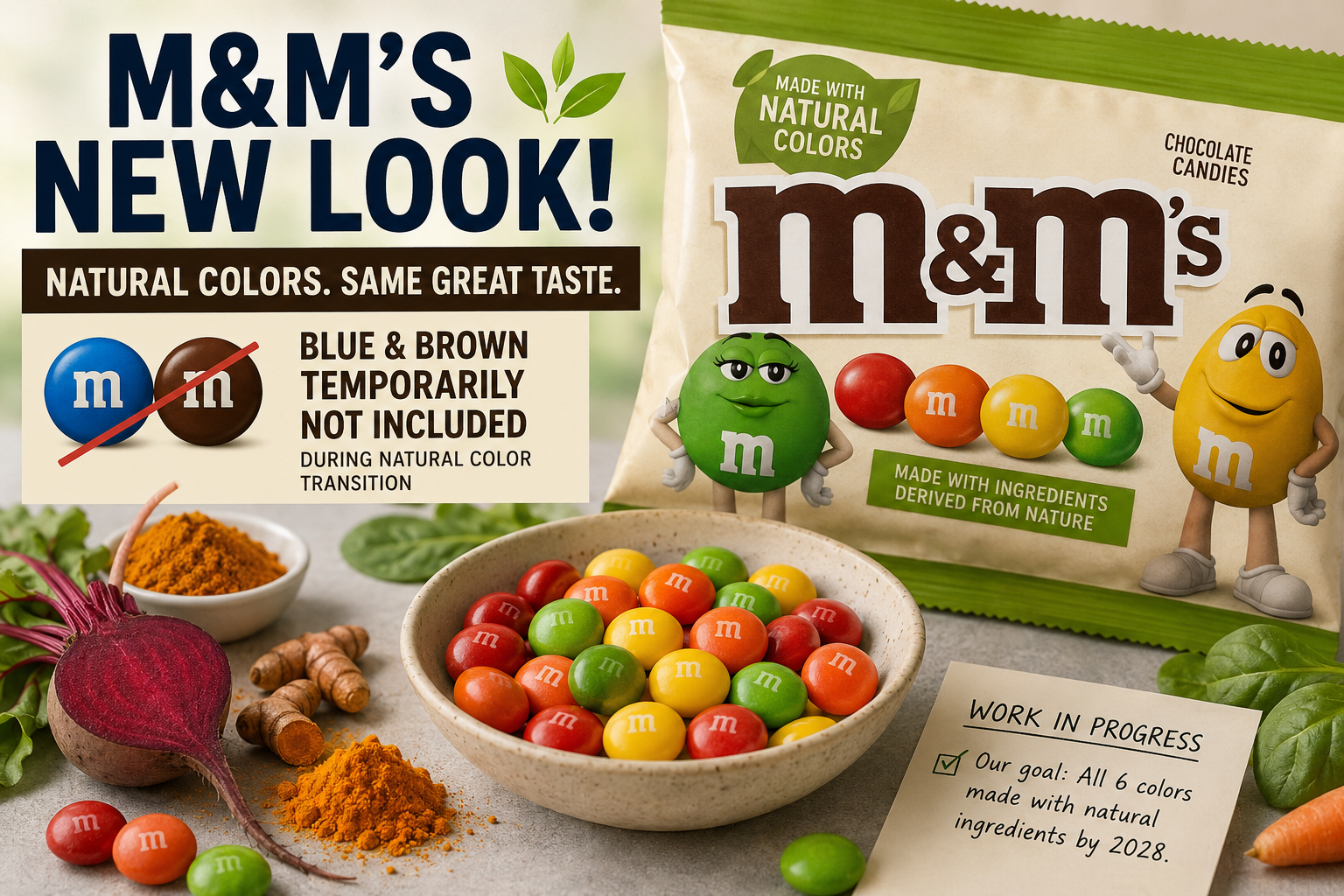
For nearly nine decades, the simple pleasure of biting into an M&M's has been intertwined with its rainbow of vibrant colors. But change is coming to the classic candy shell. In a move driven by the national "Make America Healthy Again" (MAHA) movement, M&M's parent company, Mars, is transitioning to natural food dyes. This August, the brand will debut its first artificial dye-free version—but two iconic shades, blue and brown, will be temporarily missing from these new bags .
The Great Dye Debate: Why the Change is Happening
The push for change stems from a broader shift in U.S. food policy. Health and Human Services Secretary Robert F. Kennedy Jr. has been a vocal advocate for removing synthetic, petroleum-based dyes from the food supply, citing concerns over potential health impacts, particularly behavioral issues in children . While the FDA has not issued an outright ban on all artificial dyes, it has reached a "mutual understanding" with the food industry to progressively phase them out .
In response, Mars is one of over two dozen major food companies, including General Mills and PepsiCo, that have pledged to eliminate synthetic colors . The company is initially introducing naturally colored options for M&M's, Skittles, Starburst, and Extra gum, available exclusively on Amazon .
The Blue and Brown Bottleneck
While Mars successfully replicated red, orange, yellow, and green using natural sources like beets and turmeric, a significant hurdle arose with the two remaining colors .
The primary challenge was the "cerulean" blue introduced in 1995 . To replace the synthetic Blue No. 1, the company turned to spirulina, a blue pigment derived from algae . However, this natural alternative proved to be both costly and complex. Reports indicate that achieving the desired vibrant blue requires up to seven times the amount of pigment compared to its artificial counterpart, driving up costs significantly . The cost of high-concentration spirulina extract can exceed $100 per pound, while bulk turmeric costs roughly $9 to $11 per pound .
The manufacturing process presented another obstacle. The thick, viscous spirulina mixture has been known to "gum up" and clog factory spray nozzles, causing production issues and requiring a massive overhaul of equipment . Mars has already begun upgrading over 300 machines across its facilities to handle the new ingredient . The brown M&M's color, which relies heavily on blue pigment as a base, was consequently also affected .
Icon in Transition
Anton Vincent, who heads Mars's North American snacks business, described the reformulation as "a daunting situation" and acknowledged, "You're messing with an 85-year-old icon" . Mars has dedicated approximately 100 employees and invested millions of dollars to overcome these challenges . Claire Hewitt, a senior director for ingredient transformation at Mars, called it "the hardest thing I've had to do in my career" .
This isn't the first time Mars has attempted this transition. A similar initiative launched in 2016 was quietly shelved due to a perceived lack of consumer demand . However, the current regulatory and political landscape has renewed the company's commitment. There was even discussion of launching a three-color bag of red, orange, and yellow M&M's, but the idea was reportedly rejected because the palette looked too much like a sunset .
What This Means for M&M's Fans
For now, the new, naturally colored M&M's (featuring only red, orange, yellow, and green) will be sold in limited quantities on Amazon, while the original artificially colored version with all six signature colors will remain on store shelves . Mars is actively working towards offering naturally colored M&M's in all six signature colors by 2028 .
While the absence of blue and brown marks a significant moment for the iconic candy, it is presented as a temporary measure. The rainbow may be missing a couple of colors for now, but the company's long-term goal is to bring back a full spectrum of naturally derived hues.
###