The Complete Flavorist's Guide to Commercial Distillates: Production, Physical Properties, Sensory Evaluation, Solubility, Applications, Dosage, Labeling, and Regulatory Compliance
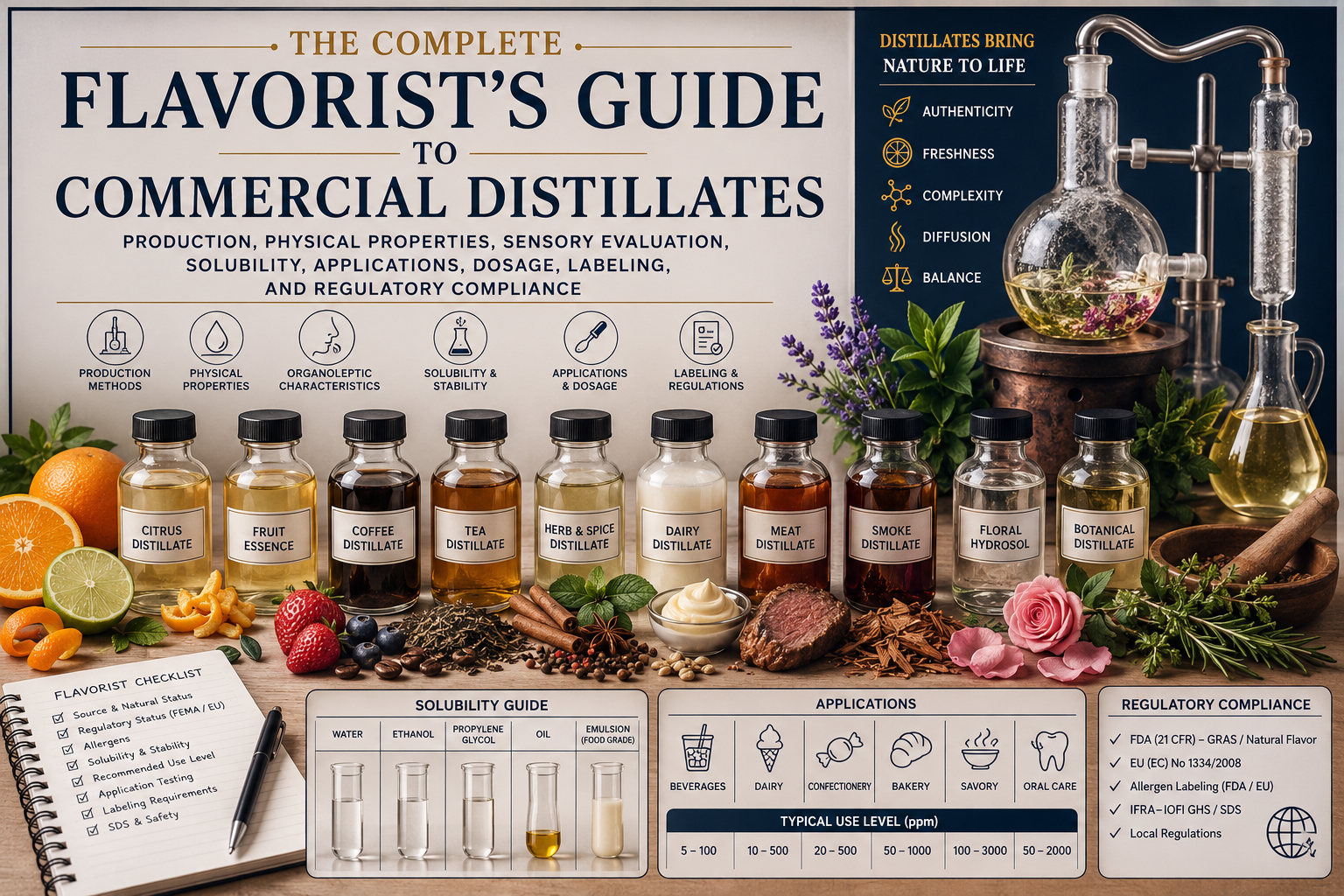
Below is a practical flavorist training guide to commercial “distillates”. It covers the commercial families flavorists actually encounter, how to use them, and what to check before formula release.
1. What “distillate” means in flavor work
A distillate is a volatile flavor fraction obtained by vaporizing aroma compounds from a raw material and condensing them. It may be oil-soluble, water-soluble, alcoholic, or carried on a substrate. Under U.S. labeling rules, a distillate can qualify as a natural flavor when derived from permitted natural source materials and used primarily for flavoring. (eCFR)
In U.S. regulation, many essential oils, oleoresins, solvent-free extractives, and natural extractives including distillates are recognized as GRAS for intended flavor use, subject to good manufacturing practice and source-specific safety limits. (eCFR)
2. Main commercial distillate families
| Family | Typical physical form | Production method | Organoleptic profile | Solubility | Typical use level in finished food/beverage |
|---|---|---|---|---|---|
| Fruit essence / fruit distillates | Clear mobile liquid; aqueous, alcoholic, or emulsion-ready | Vacuum stripping or aroma recovery from juice/concentrate | Fresh top-note, peel, pulpy, juicy, sometimes fermented | Often water/alcohol soluble; some citrus fractions oil-soluble | 5–200 ppm; beverages often 10–100 ppm |
| Citrus oil distillates / folded oils / terpeneless fractions | Clear to pale yellow oil | Steam/vacuum distillation, fractional distillation, deterpenation | Orange/lemon/lime/grapefruit peel, aldehydic, zesty, waxy, juicy | Oil-soluble; soluble in ethanol; poor in water unless emulsified | 1–50 ppm in beverages; 10–300 ppm in confectionery/bakery |
| Herb and spice distillates / essential-oil fractions | Clear to amber oil | Steam or hydrodistillation; fractional cuts | Characteristic botanical impact: minty, clove, cinnamon, basil, thyme, peppery | Mostly oil/alcohol soluble; limited water solubility | 0.1–50 ppm, depending potency |
| Mint distillates | Clear to pale yellow oil or crystalline menthol-containing fraction | Steam distillation and fractional rectification | Peppermint/spearmint, cooling, green, sweet, mentholic | Oil/alcohol soluble; low water solubility | 5–500 ppm; oral care can be much higher |
| Floral distillates / hydrosols | Essential oil or aromatic water | Steam distillation of petals/leaves | Rose, orange blossom, lavender, geranium; delicate, floral, fresh | Hydrosols water-soluble; oils oil/alcohol soluble | Hydrosols 0.05–2%; oils 0.1–20 ppm |
| Coffee distillates | Aqueous or alcoholic brown-to-clear liquid; sometimes concentrated | Aroma recovery during roasting, grinding, extraction, evaporation | Fresh brewed, roasted, sulfurous, smoky, phenolic, caramelic | Often water/alcohol soluble | 10–500 ppm; higher in coffee bases |
| Tea distillates | Aqueous/alcoholic liquid | Steam/vacuum stripping of tea extract or leaves | Black/green tea, hay, floral, tannic impression, leafy | Water/alcohol soluble | 20–500 ppm |
| Cocoa/chocolate distillates | Aqueous/alcoholic or oil-soluble fractions | Aroma recovery from roasted cocoa, liquor, powder, shells | Cocoa top-note, roasted, nutty, brown, sometimes acidic | Depends on carrier; many are water/alcohol soluble | 10–300 ppm |
| Dairy distillates | Oil-soluble or emulsified liquid; sometimes butterfat-based | Steam/vacuum distillation of butter, cream, cheese, milk fat | Butter, cream, cheese, cultured, lactonic, diacetyl-like | Usually oil-soluble; emulsifiable | 5–500 ppm |
| Meat/seafood distillates | Aqueous, oily, paste-like, or dry plated | Distillation/aroma recovery from cooked meat, stock, seafood, fats | Cooked, brothy, roasted, fatty, sulfurous, savory | Often water-soluble if stock-derived; oil-soluble if fat-derived | 10–1000 ppm in savory systems |
| Fermentation distillates | Clear aqueous/alcoholic liquid | Distillation of fermented substrates | Winey, beery, yeasty, vinegary, fruity esters, fusel notes | Water/alcohol soluble | 10–500 ppm |
| Alcoholic beverage distillates | Ethanol-water liquid | Distillation of wine, beer, spirits, botanicals | Rum, whiskey, brandy, gin, wine, oak, fusel, ester | Water/alcohol soluble | 20–1000 ppm; check alcohol contribution |
| Vinegar / acid distillates | Clear aqueous acidic liquid | Distillation of vinegar or fermented acids | Acetic, sharp, fermented, pickled | Water-soluble | 0.01–0.3% |
| Smoke distillates / purified smoke condensates | Brown aqueous liquid or dry powder | Condensation and fractionation of smoke; purification | Smoky, phenolic, BBQ, bacon, charred | Usually water-soluble; some oil-soluble | 50–2000 ppm; tightly regulated |
| Botanical water distillates / hydrolates | Clear aromatic water | Steam distillation; aqueous condensate separated from oil | Light, fresh, true-to-source but weak | Water-soluble | 0.1–5% |
3. Physical form and handling
Most distillates fall into four physical forms:
Oil phase distillates are clear to amber mobile liquids. Examples: citrus distillates, mint fractions, spice oils, butter distillates. They are usually insoluble in water, soluble in ethanol, propylene glycol to varying degrees, triacetin, MCT oil, vegetable oil, or flavor emulsions.
Aqueous distillates are clear to pale liquids with low solids. Examples: coffee aroma distillate, tea distillate, fruit essence, vinegar distillate, hydrosols. They are usually water-soluble but microbiologically vulnerable if low alcohol/low acid.
Alcoholic distillates contain ethanol as the natural capture solvent or carrier. Examples: rum, whiskey, wine, botanical, vanilla-type fractions. They are easy to dose into beverages, but alcohol contribution and local alcohol labeling rules must be checked.
Plated or spray-dried distillates are powders on carriers such as maltodextrin, gum acacia, starch, salt, sugar, or silica. They are used for dry beverages, seasonings, snacks, bakery mixes, and encapsulated top-notes.
4. Method of production
The main production technologies are:
Steam distillation: Steam passes through botanicals, spices, herbs, mint, citrus peel, or other materials. Volatiles co-distill, condense, then separate into oil and hydrosol.
Hydrodistillation: Raw material is boiled in water. Common for some flowers, herbs, and traditional botanical materials.
Vacuum distillation: Lower pressure reduces boiling temperature, preserving heat-sensitive fruit, coffee, tea, dairy, and savory volatiles.
Fractional distillation: A crude oil or essence is separated into cuts. This produces high-impact fractions such as citrus aldehyde fractions, mint dementholized fractions, terpeneless oils, or spice top-note cuts.
Molecular / short-path distillation: Used for high-boiling or heat-sensitive fractions, removal of waxes, concentration of desirable lactones or sesquiterpenes, and cleanup of heavy oils.
Aroma recovery during concentration: Common in juice, coffee, tea, cocoa, and dairy processing. Volatile aroma is stripped before evaporation and added back or sold as essence.
Smoke condensation and purification: Smoke volatiles are condensed, fractionated, and purified to reduce tar/PAH risk before use.
5. Organoleptic training notes
Distillates are usually top-note tools. They give freshness, authenticity, lift, diffusion, and source identity. They rarely provide complete flavor by themselves.
A flavorist should evaluate every distillate at three levels:
- Neat blotter or cap note: impact, cleanliness, oxidation, sulfur, solvent, phenolic or burnt defects.
- Dilution in carrier: 1%, 0.1%, and 0.01% in ethanol, PG, water, oil, or finished base.
- Application test: beverage, dairy, confectionery, seasoning, bakery, oral care, or other target system.
Common sensory descriptors:
| Source | Positive notes | Possible defects |
|---|---|---|
| Citrus | fresh peel, juicy, aldehydic, zesty | oxidized, terpene, pithy, bitter, sulfur, solvent |
| Fruit | fresh, ripe, pulpy, green, jammy | cooked, fermented, sulfury, weak, yeasty |
| Coffee | fresh brew, roasted, nutty, caramel | burnt, stale, rubbery, sulfur overload |
| Tea | leafy, floral, hay, tannic impression | musty, woody, smoky, flat |
| Dairy | creamy, buttery, cultured, cheesy | rancid, sweaty, butyric, oxidized fat |
| Meat/seafood | brothy, roasted, fatty, umami-like | fecal, amine, rancid, sulfury, fishy |
| Smoke | BBQ, charred, bacon, phenolic | tarry, medicinal, harsh, bitter |
| Floral | fresh, petal, honeyed, green | soapy, metallic, musty, allergenic concern |
6. Solubility rules flavorists must know
Solubility is often the difference between a successful flavor and a haze, ring, sediment, or bloom failure.
Water-soluble distillates: fruit essences, coffee/tea distillates, hydrosols, vinegar distillates, many alcoholic beverage distillates.
Oil-soluble distillates: citrus oil fractions, spice essential oil fractions, mint oils, butter distillates, fat-derived meat distillates.
Alcohol-soluble but water-limited: many essential oils, terpeneless oils, floral oils, botanical fractions.
Emulsion-required: citrus oils, spice oils, mint oils, smoke oil fractions, fat-based dairy/meat notes in beverages.
Dry-use forms: spray-dried or plated distillates are best for seasonings, dry beverage powders, bakery mixes, instant soups, and snack coatings.
Practical bench test: add the distillate at intended use level to the real finished matrix, then hold at cold, room, and elevated temperature. Check turbidity, oil ring, sediment, aroma loss, color shift, and package interaction.
7. Applications and dosage guidance
Use levels vary by supplier strength, carrier, legal limits, and target matrix. The table below gives training ranges only; final use must be justified by application trials and regulatory review.
| Application | Common distillates | Typical dosage |
|---|---|---|
| Carbonated soft drinks | citrus fractions, fruit essence, botanical distillates | 5–100 ppm |
| Still beverages | fruit essence, tea, coffee, floral hydrosols | 10–300 ppm |
| Alcoholic beverages | spirit distillates, botanical gin-type fractions, oak/rum/brandy notes | 20–1000 ppm |
| Dairy drinks / yogurts | fruit essence, dairy distillate, vanilla/brown distillates | 20–500 ppm |
| Ice cream | citrus, fruit, coffee, cocoa, dairy, mint | 50–1000 ppm |
| Hard candy | citrus, mint, spice, fruit top-notes | 20–500 ppm |
| Chewing gum / oral care | mint, spice, citrus, cooling fractions | 0.05–2% depending product |
| Bakery | butter, vanilla/brown, citrus, spice | 50–1000 ppm |
| Savory snacks | smoke, meat, cheese, spice, onion/garlic-type distillates | 100–3000 ppm |
| Soups/sauces | meat, seafood, vegetable, smoke, vinegar | 100–3000 ppm |
| Plant-based meat/dairy | dairy, meat, smoke, fermentation, fat distillates | 100–5000 ppm |
| Coffee/RTD coffee | coffee distillate, dairy, cocoa, vanilla/brown | 50–1000 ppm |
| Tea/RTD tea | tea distillate, citrus, floral, fruit | 20–500 ppm |
8. Labeling and regulatory points
United States
A distillate may be declared within “natural flavor” when it meets the FDA definition: derived from natural source materials such as spices, fruits, vegetables, herbs, meat, seafood, dairy, fermentation products, etc., and used primarily for flavoring rather than nutrition. (eCFR)
Some essential oils, oleoresins, solvent-free extractives, and natural extractives including distillates are listed in 21 CFR 182.20 as GRAS for intended use. (eCFR)
Do not assume every distillate is automatically permitted. Verify FEMA GRAS status, FDA status, supplier regulatory statement, source material, residual solvent status, and limits for naturally occurring toxicants. FEMA’s Expert Panel evaluates flavor ingredients for safety under intended use. (FEMA)
Major U.S. food allergens now include milk, egg, fish, crustacean shellfish, tree nuts, wheat, peanuts, soybeans, and sesame. Distillates from these sources need allergen review, especially if protein carryover is possible. (U.S. Food and Drug Administration)
European Union
EU flavoring rules are governed primarily by Regulation (EC) No 1334/2008, which defines flavoring categories, safety requirements, and the Union List of permitted flavoring substances. (Food Safety)
The term “natural” has stricter composition and source rules in the EU than many flavorists expect. EFFA notes that “natural flavouring substance(s)” may be used only where the flavoring part contains exclusively natural flavoring substances. (effa.eu)
EU Regulation 1334/2008 also manages certain naturally occurring undesirable substances, and Annex III sets maximum levels for some substances in specified foods; examples of concern for botanicals include coumarin, thujone, estragole, methyleugenol, safrole, and related compounds, depending on source and food category. (effa.eu)
EU allergen labeling is governed by Regulation (EU) No 1169/2011. Flavorists must check whether carriers, solvents, or source materials introduce declarable allergens. (Eur-Lex)
GHS / SDS / transport
Flavor houses should classify and label distillates for workplace and transport hazards. IFRA–IOFI publishes GHS classification and labeling guidance for flavor and fragrance materials, including natural complex substances. (IFRA)
Common hazard drivers include flammability, aspiration hazard, skin sensitization, aquatic toxicity, peroxide formation, and specific constituents such as limonene, pinene, eugenol, cinnamaldehyde, menthol, methyl salicylate, safrole-type materials, or phenolic smoke compounds.
9. Flavorist checklist before using a distillate
For every commercial distillate, request:
- Product specification and sensory standard.
- Source material and botanical name where applicable.
- Natural status by target market.
- FEMA number or regulatory basis where applicable.
- EU status and Union List relevance if selling in Europe.
- Allergen statement.
- GMO, vegan/vegetarian, halal, kosher, organic status if needed.
- Residual solvent statement.
- Pesticide/heavy metal/PAH statement where relevant.
- SDS and GHS classification.
- Storage conditions and shelf life.
- Solubility data in water, ethanol, PG, oil, and final matrix.
- Recommended dosage range by application.
- Heat, pH, light, oxygen, and packaging stability.
10. Practical formulation advice
Use distillates to create lift and authenticity, not body. Build body with extracts, reaction flavors, oleoresins, acids, sugars, lactones, pyrazines, sulfur compounds, fats, or carrier systems as appropriate.
Dose low first. Many distillates are powerful and become harsh, solvent-like, terpenic, sulfury, rancid, or medicinal when overdosed.
Protect oxidation-prone materials. Citrus, mint, spice, and fat-derived distillates often need nitrogen blanketing, full containers, low temperature, antioxidants where permitted, and short open-container time.
Always test in the real application. A distillate that is beautiful in ethanol may disappear in dairy, bloom in carbonated beverages, become bitter after baking, or turn harsh in high-acid systems.
This is training guidance, not a substitute for supplier documentation and jurisdiction-specific regulatory review.
###