Neutralization Reactions in Flavor Chemistry Chemical basis, formulation factors, practical examples, and shelf-life impact for flavorists and flavor trainees
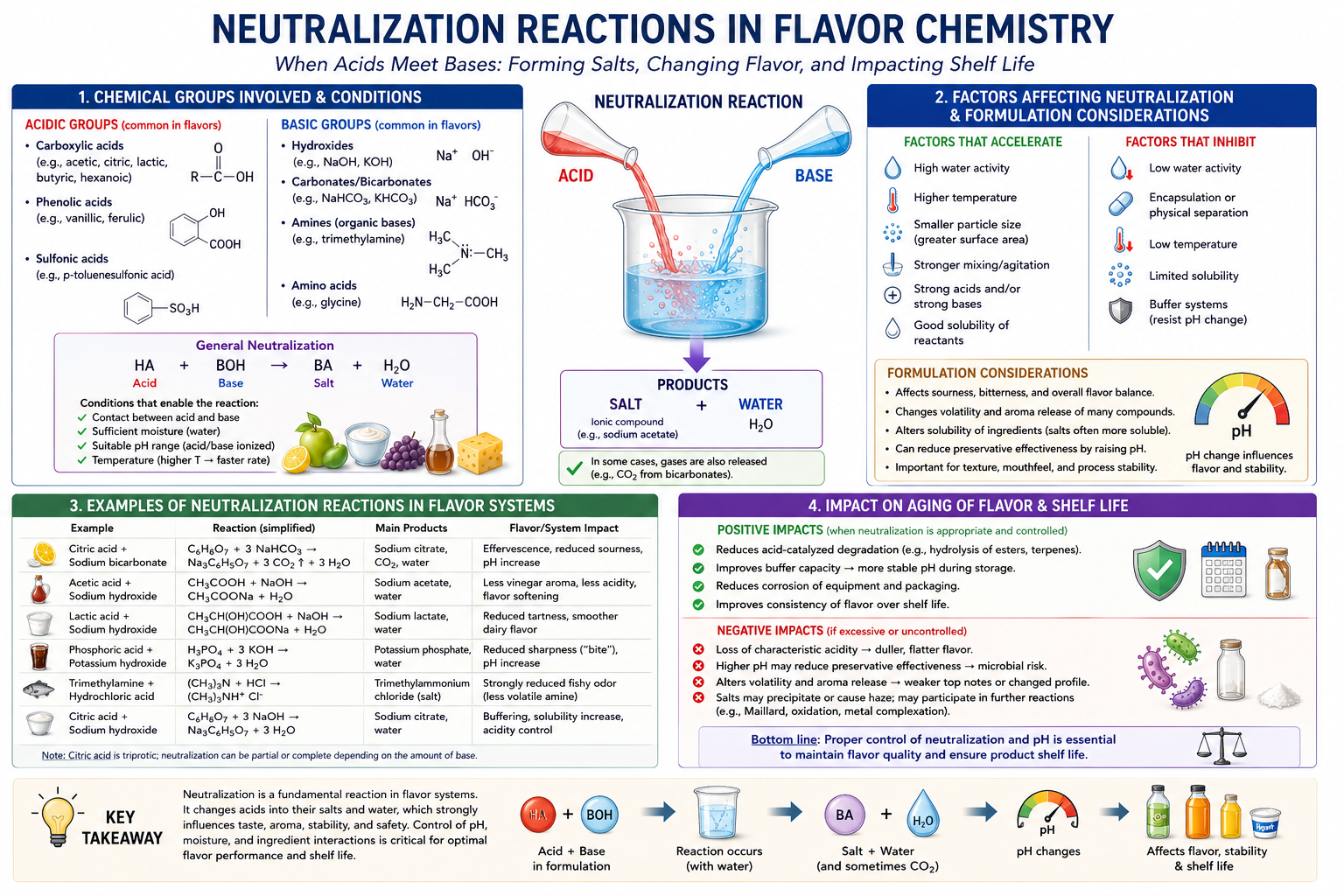
Neutralization is among the dozens of chemical reactions and physical processes related to flavors that the Society of Flavor Chemists requires certified flavorists to understand and consider when formulating flavors.
Neutralization Reactions in Flavor Chemistry
Chemical basis, formulation factors, practical examples, and shelf-life impact for flavorists and flavor trainees.
Contents
1. Chemical Groups Involved and Conditions Required
Neutralization is one of the most common yet often overlooked reactions encountered in flavor development, beverage formulation, food processing, and flavor storage. Although it is usually described as a simple acid-base reaction, in flavor chemistry it can strongly affect flavor character, volatility, solubility, stability, mouthfeel, preservation efficacy, and shelf life.
Fundamental Definition
A neutralization reaction occurs when an acid reacts with a base to form a salt and usually water.
Where HA is the acid, BOH is the base, and BA is the resulting salt. In flavor systems, complete neutralization is uncommon. More often, partial neutralization occurs, creating a mixture of acids, salts, and unreacted components.
Acidic Functional Groups Commonly Encountered
Carboxylic Acids
These are the most important acidic groups in flavor chemistry. Examples include acetic acid, butyric acid, hexanoic acid, octanoic acid, citric acid, malic acid, tartaric acid, and lactic acid.
Functional group: R–COOH
Phenolic Acids
Examples include vanillic acid, ferulic acid, and caffeic acid. These can undergo neutralization under alkaline conditions.
Sulfonic Acids
These are less common but may appear in specialty ingredients, processing aids, or technical additives.
Typical carboxylic acid neutralization:
Basic Functional Groups and Alkaline Materials
Amines
Amines are important in savory and marine flavor systems. Examples include trimethylamine, dimethylamine, and methylamine.
Amino Acids
Glycine, alanine, and glutamic acid can act as both acids and bases because they contain amino and carboxyl groups.
Food-Grade Bases
Common alkaline materials include sodium hydroxide, potassium hydroxide, sodium bicarbonate, potassium bicarbonate, and calcium carbonate.
Conditions Required
- Contact between acid and base: The acid and base must be dissolved or sufficiently dispersed to interact.
- Appropriate pH range: Reaction is favored when acidic and basic components are ionized and available for acid-base exchange.
- Moisture: Water greatly accelerates neutralization by enabling ion mobility.
- Temperature: Higher temperature generally increases dissolution, molecular movement, and reaction rate.
2. Factors Accelerating or Inhibiting Neutralization and Formulation Considerations
Factors Accelerating Neutralization
- Higher water activity: Beverages, sauces, and dairy systems react much faster than dry powders.
- Fine particle size: Smaller particles provide greater surface area, faster dissolution, and faster acid-base contact.
- Increased temperature: Heat increases molecular motion and speeds dissolution.
- Strong acids and strong bases: Strong acids such as hydrochloric or phosphoric acid and strong bases such as sodium hydroxide or potassium hydroxide react rapidly.
- Mixing energy: High-shear mixing increases contact frequency and accelerates equilibrium.
Factors Inhibiting Neutralization
- Low water activity: Dry flavor powders often show very limited neutralization.
- Encapsulation: Spray-dried acids or coated bicarbonates physically separate reactive ingredients.
- Low temperature: Cold storage reduces ion mobility and reaction rate.
- Limited solubility: Undissolved components react more slowly.
- Buffer systems: Citrate and phosphate buffers resist pH change and reduce the visible effect of neutralization.
Formulation Considerations
Preservation Systems
Preservatives such as sorbic acid and benzoic acid function best in their acidic forms. Neutralization can reduce their antimicrobial effectiveness.
Flavor Balance
Neutralization changes sourness, saltiness, bitterness, freshness, and overall flavor lift.
Volatile Release
pH changes can alter the volatility and headspace concentration of aroma compounds, especially top notes.
Solubility Changes
Salt formation often improves water solubility. For example, sodium citrate is more water-soluble than citric acid crystals in many systems.
3. Examples of Neutralization Reactions in Flavor Chemistry
Example 1: Citric Acid and Sodium Bicarbonate
This reaction is common in effervescent beverages, instant drink powders, and confectionery systems. It generates carbon dioxide, raises pH, and reduces sourness.
Example 2: Acetic Acid Neutralization
Acetic acid contributes vinegar aroma and sharpness. Neutralization decreases vinegar character and forms sodium acetate, changing the overall flavor profile.
Example 3: Lactic Acid Adjustment in Dairy Flavors
Lactic acid contributes yogurt-like, cultured dairy notes. Partial neutralization reduces acidity, softens tartness, and alters the balance of dairy flavor systems.
Example 4: Phosphoric Acid in Cola Systems
Phosphoric acid provides sharp acidity and a characteristic cola bite. Partial neutralization reduces impact and can make the flavor seem less fresh or less bright.
Example 5: Amines Neutralized by Acids
Fishy odors often arise from trimethylamine. Acid neutralization converts volatile amines into less volatile ammonium salts, dramatically reducing fishy aroma.
Example 6: Sodium Citrate Formation
Neutralization of citric acid with sodium hydroxide forms sodium citrate. Sodium citrate is widely used to buffer beverages, stabilize dairy systems, and control acidity perception.
4. Impact on Flavor Aging and Shelf Life
Positive Impacts
- Reduced acid-catalyzed degradation: Partial neutralization can slow hydrolysis, rearrangement, and decomposition of acid-sensitive flavor compounds such as esters, terpenes, and some aldehydes.
- Improved buffer capacity: Neutralized systems may better resist pH drift, helping maintain consistent flavor during storage.
- Reduced corrosion: Lower acidity can reduce metal packaging corrosion and associated oxidative effects.
Negative Impacts
- Loss of characteristic acidity: Citrus, berry, cola, and yogurt profiles may become dull, flat, or less fresh.
- Increased microbial risk: Excessive pH increase can weaken acid-based preservation hurdles and reduce preservative performance.
- Altered aroma release: Neutralization can change partition behavior, volatility, and headspace aroma intensity.
- Secondary reactions: Salts formed during neutralization may contribute to metal complexation, crystallization, precipitation, or changes in Maillard chemistry.
Summary for Flavorists
Neutralization reactions occur whenever acidic and basic ingredients interact, producing salts and often water. The most important participants in flavor systems are carboxylic acids such as citric, malic, lactic, acetic, and phosphoric acids, along with alkaline materials such as sodium bicarbonate, potassium bicarbonate, sodium hydroxide, and amino compounds. Water, temperature, particle size, and mixing accelerate neutralization, while low moisture, encapsulation, and buffering systems inhibit it.
Neutralization is encountered in beverages, dairy products, confectionery, savory flavors, seafood processing, and pH-adjusted flavor systems. During storage, it can improve stability by reducing acid-catalyzed degradation, but excessive neutralization may flatten flavor, reduce preservative effectiveness, alter aroma release, and ultimately shorten product shelf life.