New Research: Why a Common Water Contaminant Poses a Greater Cancer Threat to Children
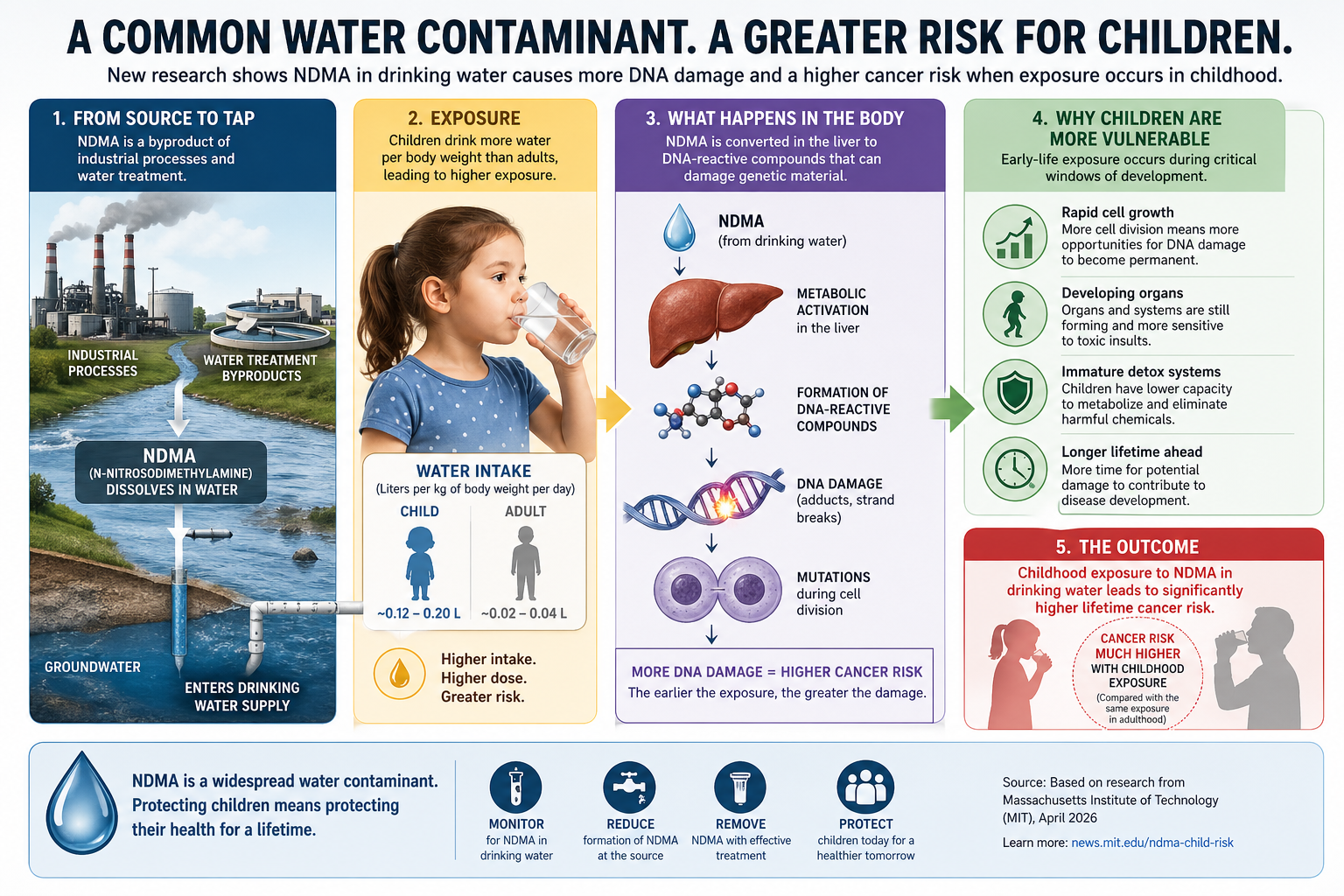
A recent study from the Massachusetts Institute of Technology has revealed a concerning biological reason why a widespread environmental pollutant may be significantly more dangerous for children than adults. The findings, published in Nature Communications in April 2026, provide a crucial missing piece of the puzzle linking early-life exposure to a chemical called NDMA with an elevated risk of cancer.
Understanding NDMA: A Hidden Hazard with a Decades-Long History
To understand the study's importance, some background on the chemical itself is essential. N-Nitrosodimethylamine, or NDMA, is not an intentionally manufactured product but an unintended byproduct. It can form during various industrial processes, as well as in the production of certain pesticides and rubber products. It is also found in tobacco smoke and can form in processed foods, particularly cured meats and beer.
Public health concerns about NDMA in drinking water came to a head in the 1990s and early 2000s in communities like Wilmington, Massachusetts. There, pollution from an industrial site led to NDMA contamination of the town's water supply. A subsequent 2021 Massachusetts Department of Health report suggested a troubling link between this contamination and a higher-than-expected number of childhood cancer cases diagnosed between 1990 and 2000. The contaminated wells were eventually shut down in 2003, but the questions about NDMA’s specific dangers to children remained. More recently, NDMA has also been detected as an impurity in some common medications, including certain types of the heart drug valsartan and the diabetes drug metformin, leading to global recalls and renewed scientific scrutiny.
The New Discovery: Not Just Exposure, but Biology
The MIT research team set out to determine why younger individuals appear more vulnerable. Their study compared the effects of low-level NDMA exposure in juvenile and adult mice.
The key finding was not about the initial damage, but the body's response to it. When NDMA enters the body, a liver enzyme called CYP2E1 breaks it down. This process, however, creates harmful byproducts that attach to DNA, forming initial lesions known as adducts. The scientists observed that both young and adult mice developed these initial DNA adducts at similar levels.
The crucial divergence happened next. In the young, rapidly growing mice, the cellular repair machinery attempting to fix these adducts triggered a massive buildup of severe secondary damage—specifically, double-stranded DNA breaks. These dangerous breaks can introduce permanent mutations that ultimately lead to liver cancer. In stark contrast, adult mice showed almost none of these catastrophic breaks and far fewer mutations, with their livers remaining largely healthy.
The study concluded that the engine behind this heightened vulnerability is cell division. A child’s liver is in a state of active growth, with cells dividing quickly. This rapid proliferation converts initial, repairable DNA damage into permanent, dangerous mutations before the body has time to fix it. Adult liver cells, which are mostly in a resting state, have a critical window of time to perform accurate repairs.
“The double-stranded breaks were exclusively observed in the young,” the researchers noted, emphasizing that the initial damage had profoundly different consequences depending on age.
Broader Implications for Safety and Adult Risk
This research delivers a powerful message for public health and chemical safety testing. Traditionally, toxicological studies to assess a chemical's cancer-causing potential rely heavily on adult animal models. The MIT team’s findings strongly suggest that this paradigm may completely miss the extreme vulnerability of younger populations, leading to safety limits that might not be protective enough for children.
The study is also careful not to declare adults immune to NDMA’s effects. Other experiments showed that when cell division in adult mice was artificially stimulated—for example, by a hormone that triggers liver growth—they, too, began to accumulate mutations at a much higher rate. The researchers point out that conditions causing chronic liver stress in adults, such as a high-fat diet, viral infections, or chronic alcohol consumption, could increase cellular proliferation and potentially reopen this window of vulnerability.
This study not only sheds new light on historical cancer cluster cases but also serves as a call to action for modern safety assessments. By understanding the profound interplay between a chemical’s damage and the dynamic biology of a growing body, scientists hope to identify and mitigate risks before exposure occurs, making a compelling case that cancer prevention strategies must account for the unique sensitivity of childhood.
###