Polarimetry in the Flavor Industry: Fundamental Theory, Analytical Function, Reporting Standards, Industrial Relevance, and Critical Advantages & Limitations
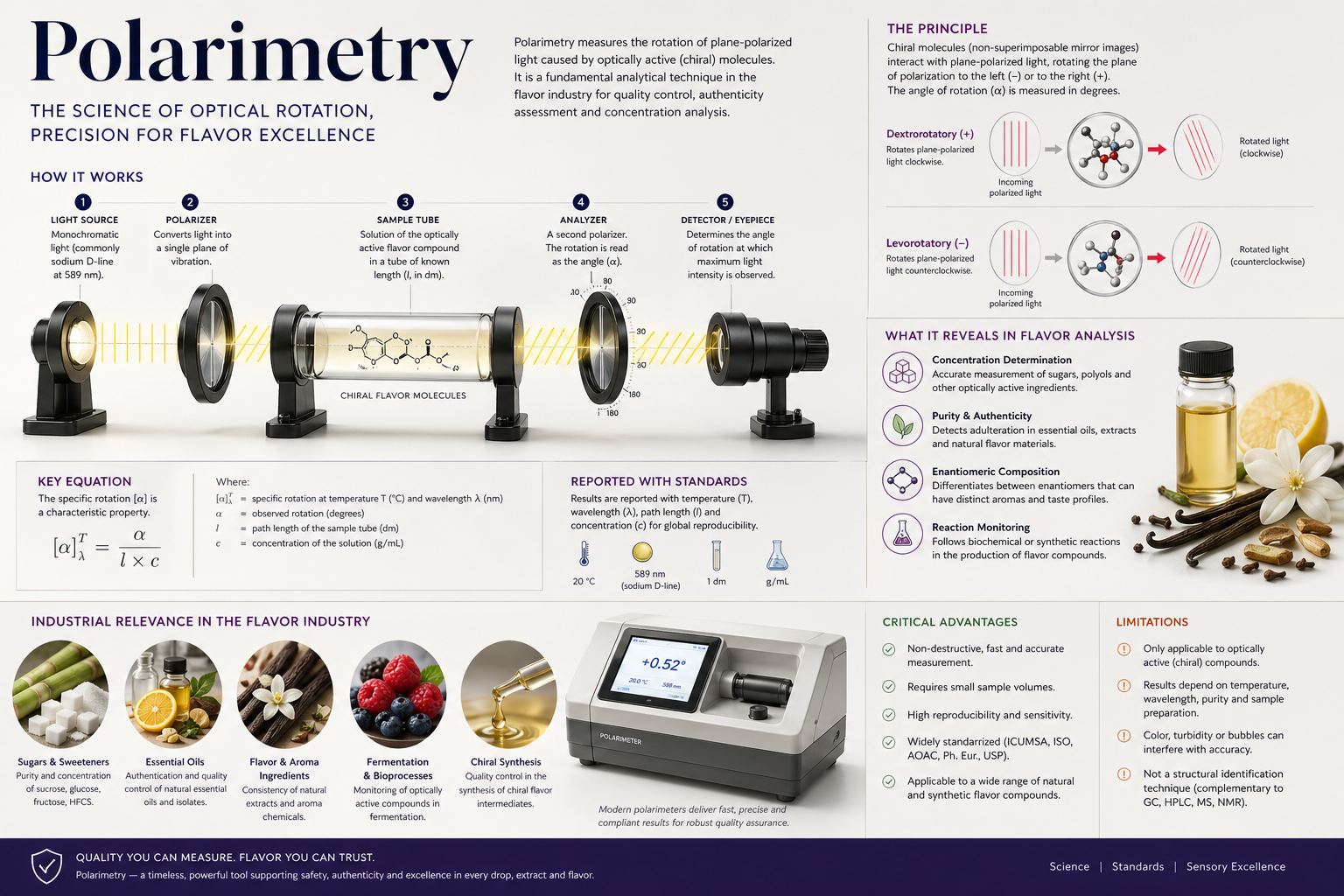
Polarimeter
1. Theory of the Polarimeter
The polarimeter is a precision instrument designed to measure the optical rotation exerted by chiral (optically active) substances. Its operation relies on the properties of plane-polarized light and molecular chirality.
Fundamental principles
Natural light oscillates in all planes perpendicular to its direction of propagation. When passed through a polarizer (e.g., a Nicol prism or Polaroid® filter), the emerging light oscillates in a single plane — this is plane-polarized light. Optically active compounds (e.g., sugars, amino acids, steroids, many drugs) contain chiral centers that interact differently with the two circular components of polarized light, causing a net rotation of the polarization plane.
🔁 Levorotatory (–) : rotates counterclockwise (to the left)
Biot's law — Observed rotation
where:
α = observed rotation (degrees)
[α]λT = specific rotation (physical constant at wavelength λ and temperature T)
l = path length of sample tube (decimeters, dm)
c = concentration (g/mL for pure liquids; for solutions g/100 mL in most pharmacopoeial conventions).
Optical rotation is wavelength-dependent (optical rotatory dispersion) and temperature-sensitive, hence strict standardization is required.
2. Function of the Polarimeter
A polarimeter determines the precise angle and direction of optical rotation. Modern instruments achieve high accuracy (often ±0.01°) using photoelectric detection, while classical instruments use a half-shade device for visual null detection.
Key components & their roles
Usually a sodium vapor lamp (λ = 589 nm, Na D-line) or mercury lamp providing monochromatic light. Wavelength must be specified because rotation varies with λ.
Generates plane-polarized light from the source. Fixed orientation, acts as the reference plane.
Precision tube with optically flat ends, standard path lengths: 0.5 dm, 1 dm, 2 dm. Contains liquid (solution or pure compound).
Second polarizer that can be rotated. Aligned to detect the new polarization plane after the sample; maximum transmission indicates null position.
Human eye (telescope) or photodetector. Many instruments include a Faraday modulator for superior sensitivity and automated reading.
Measurement procedure (null detection)
- With no sample (or pure solvent blank), rotate analyzer to find the point of minimum light transmission – this sets the zero reference (0°).
- Introduce the optically active sample into the light path.
- Rotate analyzer again until the null condition is re-established.
- The angular displacement between the two analyzer positions gives the observed rotation α (sign indicates dextro/levo).
3. Reporting of Measures & Standardization
Observed rotation alone is not transferable because it depends on path length, concentration, temperature, solvent and wavelength. Therefore, measurements are converted into specific rotation — a physical constant characteristic of a pure chiral compound.
Specific rotation formula
where c is in g/100 mL (standard pharmacopoeial convention). For neat liquids: [α]λT = α / (l · ρ), with ρ = density (g/mL).
Standard reporting format
Interpretation: At 25 °C, using sodium D-line (589 nm), the specific rotation is +66.3 degrees for a concentration of 1.00 g/100 mL in chloroform, measured in a 1 dm tube (assumed unless specified).
Inclusion of solvent, temperature & wavelength
- λ Wavelength index (D, 365 nm, 546 nm etc.)
- T Temperature in °C (critical, rotation changes ~0.1–0.5°/°C).
- solvent Must be indicated because solute–solvent interactions affect rotation.
- c and l Concentration and tube length should be transparent.
Optical purity & enantiomeric excess (ee)
For a non-racemic mixture, the enantiomeric excess is derived from specific rotation compared to that of the pure enantiomer:
and the composition: % major enantiomer = 50 + ee/2 , % minor = 50 – ee/2.
Molar rotation (molecular comparison)
Sometimes used to compare absolute molecular contributions:
Units: deg·cm²·dmol⁻¹.
📊 Summary table: key quantities
| Term | Symbol | Meaning | Typical units |
|---|---|---|---|
| Observed rotation | α | Raw instrument reading | degrees (°) |
| Specific rotation | [α]λT | Standardized constant (pure compound) | deg·mL·g⁻¹·dm⁻¹ (or deg·cm²·g⁻¹) |
| Path length | l | Sample tube length | dm (1 dm = 10 cm) |
| Concentration | c | Mass/volume (often g/100 mL) | g/100 mL or g/mL |
| Enantiomeric excess | ee | Purity of excess enantiomer | % |
Important notes for accurate reporting
- Temperature control: measurements should be performed at ±0.1 °C to ensure reproducibility.
- Blank correction: solvent or blank rotation must be subtracted.
- Concentration linearity: verified at high concentrations, as deviation may occur due to aggregation or chromophore interference.
- Instrument calibration: using certified quartz control plates or sucrose solutions.
- Wavelength specification: use of sodium D-line is universal, but other wavelengths are permissible if clearly reported.
Reporting example — in practice
A researcher measures an unknown sugar solution (1.00 dm tube, c = 2.50 g/100 mL water, T=22 °C, λ=589 nm) and obtains α = +4.85°. The specific rotation is computed as:
[α]D22 = (100 × +4.85) / (1.00 × 2.50) = +194°.
Optical rotation: dextrorotatory, consistent with D‑fructose reference.
If the literature value for pure enantiomer is +200°, the enantiomeric excess = (194/200)×100 = 97% ee.
Instrument summary & measurement workflow
Light source → polarizer → sample tube → analyzer (rotatable) → telescope / eyepiece. Half-shade prism enhances sensitivity.
LED or laser source, precise Faraday modulator, photodetector, microprocessor. Auto-null principle yields α, specific rotation, concentration, and even optical purity.
Sucrose solutions (e.g., 10 g/100 mL water, α ~ +34.6° at 20 °C, 1 dm) or quartz control plates certified to specific rotation values.
Polarimeter in the Flavor Industry
1. Polarimeter fundamentals (Theory & Function)
The polarimeter measures the rotation of plane-polarized light caused by chiral (optically active) molecules — a property central to many natural and synthetic flavor ingredients. Observed rotation (α) is converted into specific rotation [α]λT, a reproducible physical constant.
Standard reporting includes temperature, wavelength (usually sodium D‑line, 589 nm), solvent, and concentration. The sign (+ = dextrorotatory, – = levorotatory) differentiates enantiomers.
2. Why polarimetry is indispensable for flavor chemistry
Natural flavors and their synthetic counterparts often consist of chiral molecules. Different enantiomers of the same compound may have dramatically different odor profiles, potencies, or even off-notes. Polarimetry provides a rapid, non-destructive method to assess enantiopurity, origin authenticity, and quality consistency.
2.1 Enantiopurity & sensory quality
Many flavor compounds exist as pairs of enantiomers: for instance, (R)-carvone smells like spearmint, whereas (S)-carvone gives a caraway/dill character. Polarimeters quickly verify which enantiomer dominates and detect racemization or adulteration.
Specific rotation ≈ –62° (in ethanol) → spearmint odor, high optical purity required for natural spearmint oil
Specific rotation ≈ +62° → caraway/ dill. Using polarimetry, producers distinguish mint vs. caraway contamination.
(R)-Limonene (orange odor, [α]≈ +115°); (S)-Limonene (piney/ turpentine, [α]≈ –113°). Rotation confirms citrus oil origin.
Floral/lavender; (S)-Linalool is less intense. Polarimetry helps monitor biotechnological production.
2.2 Quality control & adulteration detection
Natural flavor extracts (essential oils, oleoresins) possess characteristic optical rotation ranges established by standards (ISO, FCC, EOA). A deviation from the expected specific rotation signals adulteration with synthetic racemates, wrong botanical source, or thermal degradation.
2.3 Process monitoring in flavor manufacturing
During enzymatic resolutions, fermentation, or chiral synthesis of high-value flavor molecules (e.g., ethyl lactate, γ-decalactone, nootkatone), polarimetry provides real-time feedback on enantiomeric excess. It is cheaper and faster than chiral HPLC for routine in-process checks.
2.4 Authenticity & geographical indication
Many Protected Designation of Origin (PDO) flavor ingredients rely on chiral signatures. For example, genuine vanilla extract shows a specific rotation around –40° to –55° due to (+)-vanillin and related glycosides. Synthetic vanillin (racemic) is optically inactive. Polarimetry differentiates natural Bourbon vanilla from synthetic imitation.
2.5 Flavor stability & shelf-life testing
Chiral compounds can racemize over time under heat, light, or extreme pH, leading to flavor drift or off-notes. Tracking specific rotation changes helps define shelf-life and storage conditions. A decrease in absolute rotation indicates racemization — directly impacts sensory acceptance.
2.6 Regulatory & monograph compliance
Flavor specifications according to FCC (Food Chemicals Codex), JECFA, and ISO often include specific rotation limits. Polarimeters provide legally defensible data for batch release and import/export documentation. Examples:
| Compound / oil | Typical [α]D20 | Relevance |
|---|---|---|
| Orange oil (cold pressed) | +94° to +99° | Detect terpene dilution or addition of synthetic limonene |
| Menthol crystals (natural) | –49° to –50° | Natural menthol is levorotatory; synthetic menthol nearly zero |
| α-Bisabolol (chamomile) | –55° to –65° | Enantiomeric ratio linked to plant source |
| Lactic acid (natural flavor) | +2.5° to +3.5° | L(+)-lactic acid vs racemic blend used in flavor formulations |
3. Polarimetry in the flavor lab – procedure & data interpretation
Flavor houses and essential oil suppliers follow standardized protocols to ensure reliable results:
- Sample preparation: dilute essential oils or flavor extracts in a suitable transparent solvent (ethanol, hexane, or water). Concentration chosen to give measurable α between 0.5°–10°.
- Temperature control: 20.0°C or 25.0°C ±0.1°C using a circulating water bath.
- Wavelength: sodium D-line (589 nm) unless otherwise specified.
- Calculation of specific rotation: using formula [α]λT = (100·α)/(l·c) and comparison with reference values.
Measurement of enantiomeric excess (ee) in flavor molecules
If a natural (R)-linalool has [α]D = –19.5° and a purified isolate shows –18.2°, the ee = (–18.2/–19.5)×100 ≈ 93.3% ee, indicating high optical purity and therefore premium quality for natural floral notes.
4. Advantages & limitations for flavor analysis
Measurement takes 1–2 minutes; ideal for incoming goods inspection.
Sample can be reused for sensory or further GC analysis.
Low operational cost, minimal waste – green analytical technique.
Dark or turbid samples need dilution or filtration.
Complex essential oils give net rotation; complementary GC needed for individual compounds.
Minor enantiomers (<1%) not detectable; use chiral GC for high precision.
Despite limitations, polarimetry is the first-line screening tool in flavor quality assurance. It is often combined with sensory evaluation and chiral gas chromatography to fully characterize flavor authenticity.
5. Real-world case studies in flavor industry
🍦 Natural vanillin extract vs. synthetic
Vanilla planifolia extract contains (+)-vanillin (optically active due to glycosidic chiral precursors). Specific rotation range: –40° to –55°. Synthetic ethyl vanillin or lignin-based vanillin is racemic and optically inactive (α ≈ 0). Polarimetry provides a 5-minute authenticity test before expensive isotope analysis.
🌿 Menthol mint oils
Natural cornmint oil (Mentha arvensis) has [α]D20 = –30° to –34°, rich in (–)-menthol. Adulteration with synthetic menthol (racemic, near-zero rotation) is easily spotted. A shift from –32° to –15° indicates >50% synthetic filler. Global flavor houses enforce polarimetry limits in supplier specifications.
🥥 Gamma- and delta-lactones (coconut, peach, creamy flavors)
(R)-γ-Decalactone has more intense fruity-coconut character than the (S) enantiomer. During biocatalytic production, polarimetry monitors enantioselectivity. Specific rotation values are tabulated, allowing quick optimization of reaction conditions.
6. Alignment with flavor standards & guidelines
International flavor authorities often publish optical rotation criteria in monographs. Examples from FCC 12th Edition:
| Flavor substance | FCC specification ([α]D20) |
|---|---|
| L-Menthol | –49° to –51° (c=10, ethanol) |
| Citral (lemongrass oil) | +12° to +18° (neat) |
| Orange terpenes | +95° to +100° |
| Eucalyptol (1,8-cineole) | 0° to +2° (optically inactive but impurity check) |
Polarimetry data is accepted in GRAS notifications and EU flavoring substance evaluations (EFSA) as part of identity criteria. 🧾
7. Future relevance: automation & micro-volume polarimeters
Miniaturized, temperature-controlled polarimeters with micro cells (50–200 µL) are gaining traction in flavor R&D. They allow measurement of expensive natural isolates with minimal sample consumption. Integration with LIMS (Laboratory Information Management System) ensures full traceability. In-line process polarimeters are being developed for continuous flavor manufacturing (e.g., enantioselective enzymatic reactors).
Polarimetry: Advantages & Limitations
1. Method overview
Polarimetry measures the rotation of plane-polarized light caused by chiral molecules. In the flavor industry, it is widely used for enantiopurity screening, adulteration detection, essential oil authentication, and process monitoring. However, like any analytical technique, it has distinct strengths and inherent weaknesses. Understanding these is critical for proper application and data interpretation.
2. Advantages of Polarimetry
Measurement takes 1–3 minutes from sample preparation to result. No complex columns, gradients, or derivatization steps. Requires minimal training, making it ideal for routine QC in flavor manufacturing.
The sample is completely recovered after measurement (unless diluted). Precious natural extracts, expensive isolates, or proprietary flavor bases can be analyzed and then used for sensory evaluation or further GC/MS analysis.
No organic solvents (except for dilution), no consumable columns, no high-pressure pumps. Instrument maintenance is minimal – mainly lamp replacement and cell cleaning. Environmentally benign compared to chiral HPLC.
Polarimetry gives immediate information on net chirality. For single-component systems (e.g., menthol, carvone, lactic acid), enantiomeric excess can be calculated quickly without chiral stationary phases.
For known compounds with established specific rotation, polarimetry can determine concentration in binary or simple solutions – useful for verifying natural extracts or fermentation broths.
Pharmacopoeias (USP, EP, JP), FCC (Food Chemicals Codex), ISO standards for essential oils all include specific rotation specifications. Decades of historical data enable robust pass/fail criteria.
Inline or at-line polarimeters can monitor biocatalytic resolutions or fermentation processes, providing immediate feedback for reaction optimization and endpoint determination.
3. Limitations of Polarimetry
The measured rotation is the sum of contributions from all optically active components. In a flavor extract containing 20+ terpenes, esters, lactones, the net rotation cannot be attributed to a single compound without separation. This often leads to misleading conclusions if used alone.
Turbidity, suspended particles, or dark-colored samples scatter light, causing unreliable or impossible readings. Filtration or dilution is necessary, increasing preparation time and potentially altering composition (loss of volatile compounds).
Typical polarimeters have an angular resolution of ±0.01° to ±0.001°. To detect a 1% enantiomeric impurity, the specific rotation difference must be large. In practice, enantiomeric excess below 90–95% may be poorly quantified; chiral GC or LC is required for trace enantiomer detection (down to 0.1%).
Specific rotation alone cannot identify an unknown compound. Many different molecules can have similar [α] values. It must be paired with orthogonal methods (GC-MS, NMR, IR, chiral chromatography) for definitive identification.
Optical rotation varies with temperature (approx. 0.1–0.5°/°C) and solvent polarity/hydrogen bonding. Uncontrolled conditions produce non-reproducible results. Strict thermostatting (±0.1°C) and documented solvent use are mandatory, increasing operational demands.
Rotation changes with λ. Using non-standard wavelengths (e.g., LED sources) without calibration leads to incomparable data. The industry standard is the sodium D-line (589 nm); deviations must be explicitly reported.
When α < 0.05°, measurement uncertainty becomes significant. Dilute flavor extracts (e.g., 0.1% vanillin in ethanol) may not produce measurable rotation without concentrating the sample, which is impractical.
Highly colored compounds (e.g., carotenoids in paprika oleoresin) can attenuate light intensity, reducing signal-to-noise even if they are optically inactive. May require decolorization steps.
4. Comparative analysis: Polarimetry vs. Chiral chromatography (HPLC/GC)
| Parameter | Polarimetry | Chiral GC / HPLC |
|---|---|---|
| Analysis time | 1–3 min | 15–60 min |
| Selectivity | Low (net rotation of mixture) | High (individual enantiomers separated) |
| Detection limit (ee) | ~2–5% (practical) | 0.1–0.5% ee |
| Sample preparation | Minimal (dilution) | Derivatization may be needed, filtration |
| Cost per analysis | Very low | Moderate to high (columns, solvents, standards) |
| Quantitation without calibration | Possible for known [α] | Requires calibration curves for each enantiomer |
| Destructive? | Non-destructive | Destructive (sample consumed) |
| Ideal use case | QC screening, bulk enantiopurity, process monitoring | Trace enantiomer analysis, identification, unknown flavors |
Polarimetry and chiral chromatography are complementary, not competitive. Most flavor labs use polarimetry as a rapid first-line filter; suspicious samples are then analyzed by chiral GC-MS for confirmation.
5. Flavor industry case: When polarimetry works vs. when it fails
✅ Success scenario: Peppermint oil QC
Pure Mentha piperita oil has [α]D20 between –30° and –18°. The matrix is well-characterized, and the net rotation correlates strongly with menthol/menthone ratio. a polarimetry check takes 2 minutes; a deviation >±3° triggers further investigation. This saves thousands of dollars in unnecessary chiral analysis.
❌ Failure scenario: Complex citrus terpene blend
A mixture of d-limonene ([α]≈+115°), linalool ([α]≈ –19°), and β-pinene ([α]≈ –22°) yields unpredictable net rotation. Two different blends could produce identical α yet have vastly different flavor profiles. In this case, polarimetry alone is insufficient — GC-FID or chiral GC is mandatory.
6. Mitigating limitations – best practices
- Temperature control – Use a thermostatted cell holder (accuracy ±0.1°C) and report measurement temperature.
- Wavelength standardization – Always use sodium D-line (589 nm) unless justified; calibrate with quartz control plates or sucrose solutions.
- Sample clarification – Centrifuge or filter turbid extracts through 0.45 µm PTFE membranes; degas if bubbles present.
- Matrix correction – For mixtures, measure the rotation of a known reference standard or use subtractive polarimetry with isolated fractions.
- Orthogonal validation – Apply polarimetry only as a screening tool; confirm critical batches with chiral GC or LC.
- Modern digital polarimeters – Use instruments with LED sources, automatic null detection, and internal temperature sensors to reduce operator error.
7. Conclusion: Value and boundaries in modern flavor analysis
Polarimetry remains an essential, rapid, low-cost technique for assessing chirality in flavor ingredients. Its advantages in speed, simplicity, and non-destructive analysis are unmatched for routine quality control. However, its severe limitations in selectivity, sensitivity to minor enantiomers, and requirement for optically clear solutions mean that it cannot replace chiral chromatography or spectroscopic methods. The most competent flavor laboratories use polarimetry as a powerful first-line filter, then deploy advanced techniques when needed. Understanding these advantages and limitations ensures correct interpretation and avoids costly analytical errors.