North America Food & Flavor Regulatory Digest: July 13–31, 2026 — Key FDA Color Additive Actions, State Cultivated Protein Bans, CUSMA Trade Shifts, and Allergen Disclosure Mandates
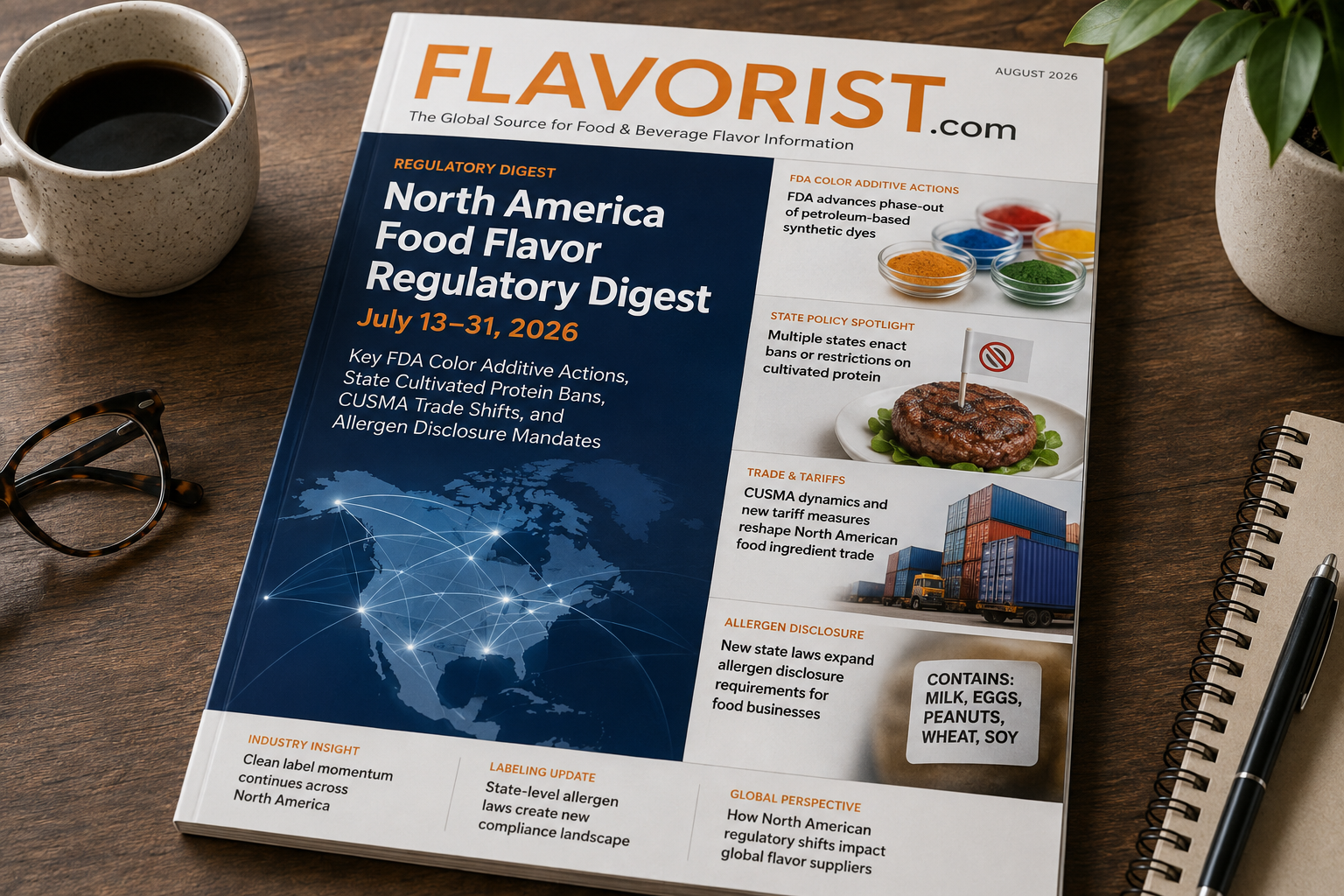
Here is a comprehensive summary of law and regulatory news for the food and flavor industry in North America released during July 13–July 31, 2026, organized by jurisdiction.
🇺🇸 UNITED STATES — FEDERAL
1. FDA Revokes Orange B and Proposes Revoking Citrus Red No. 2
Released: July 22, 2026
The FDA issued a final order revoking the authorized use of Orange B as a color additive in food, concluding its use has been abandoned by industry. Simultaneously, the FDA proposed revoking the authorization for Citrus Red No. 2 (used on orange skins since 1959) on the same basis. The agency is accepting public comments on the Citrus Red No. 2 proposal through August 24, 2026. Both actions are part of the broader effort to phase out petroleum-based synthetic dyes.
🔗 FDA Press Release | Federal Register – Final Rule (Orange B) | Federal Register – Proposed Rule (Citrus Red No. 2)
2. FDA Issues Multiple FSVP Warning Letters to Food Importers
Posted: July 21, 2026
The FDA posted warning letters to several food importers—including Shang Hao Jia, Inc., Beauty Store LLC, Balkanica LLC, and IJAJ Group Inc. dba Sanz Wholesale Foods—for failures to develop required Foreign Supplier Verification Programs (FSVP) for imported foods. The letters were issued by FDA’s Office of Inspections and Investigations.
🔗 FDA Warning Letters | Food Safety News Report
3. FDA Human Foods Program Constituent Update — Color Additives & Outbreak Closure
Released: July 23, 2026
The FDA published its HFP Constituent Update reiterating the color-additive actions above and noting the closure of the Salmonella outbreak linked to moringa leaf powder (first identified in January 2026). The agency also posted new recalls and announced the release of the NARMS Strategic Plan for 2026–2030.
🔗 AFDO Federal Register Update | FDA Constituent Update
4. FDA GRAS Mandatory Notification Rule Delayed to December 2026
Announced: July 3, 2026 (via OMB Unified Regulatory Agenda)
The FDA’s proposed rule to make GRAS (Generally Recognized as Safe) notices mandatory—rather than voluntary—has been pushed back to December 2026. If finalized, substances claimed as GRAS would be presumed not GRAS unless the notification requirement is met. The agency is also considering a transition mechanism for existing self-GRAS determinations.
🔗 MoFo Regulatory Roundup | Packaging Law Article
5. USDA, HHS & EPA Update MOU on Chemical Residues in Food
Released: July 10, 2026
The three agencies announced an updated Memorandum of Understanding reaffirming coordinated federal activities concerning drug residues, pesticide residues, and chemical contaminants (including heavy metals) in meat, poultry, and egg products.
🔗 LawBC Recent Federal Developments
6. FSIS Expands Trace Metals Analysis to Multi-Ingredient Processed Products
Announced: July 10, 2026 | Effective: July 20, 2026
USDA’s FSIS announced it will extend its trace metals analysis to include multi-ingredient processed products containing meat or poultry sampled under existing programs.
🔗 FSIS Constituent Update – July 10, 2026
7. Cyclospora Outbreak Linked to Iceberg Lettuce — Taylor Farms Recall
Recall Announced: July 17, 2026
Taylor Farms de Mexico voluntarily removed all iceberg lettuce sourced from central Mexico from the U.S. market and initiated a recall of Marketside-brand products sold at Walmart. The FDA investigated a multistate Cyclospora outbreak linked to shredded iceberg lettuce served at Taco Bell locations. On July 19, the FDA updated that a previously reported positive sample was a false positive after re-review.
🔗 FDA Outbreak Investigation
8. FDA Food Recalls (Posted July 21–22, 2026)
- Pumpkin Tree Peter Rabbit Organics Banana & Strawberry Fruit Puree Pouches (4 oz) — potential presence of soft plastic.
- Sprig & Sprout / Fresh and Ready Spicy Breakfast Burritos — undeclared soy allergen.
- Midwest Poultry Services white and brown cage-free shell eggs — potential Salmonella Enteritidis contamination.
🔗 FDA Recalls Page | AFDO Federal Register Update
9. DEA Temporarily Schedules High-Potency Mitragynine Derivatives in Flavored Products
Released: July 6, 2026
The Drug Enforcement Administration temporarily placed mitragynine pseudoindoxyl (MGM-15) and associated high-potency substances into federal controlled-substance scheduling. The DEA’s notice specifically discussed the marketing of these substances in flavored chewable formats (gummies, candies, drink shots) and the use of “research chemical” labeling to evade oversight. This has direct implications for flavor and contract manufacturing houses developing masking flavors or delivery systems for novel botanical actives.
🔗 Federal Register Notice via Flavorist.com Regulatory Scan
10. FDA Pharmacy Compounding Advisory Committee Reviews Peptides
Meeting Dates: July 23–24, 2026
The FDA’s PCAC met to review seven peptides for eligibility to be compounded under Section 503A, following the April 2026 removal of twelve peptides from the Category 2 “do not compound” list.
🔗 Amanecia Health Follow-Up
🇨🇦 CANADA
11. CFIA Recalls Our Finest Shrimp Ring Over AOZ Contamination
Date: July 28, 2026
The Canadian Food Inspection Agency recalled Our Finest brand Shrimp Ring with Mild Cocktail Sauce due to the presence of 3-amino-2-oxazolidinone (AOZ), a veterinary drug metabolite.
🔗 Canada Recalls Portal
12. CFIA Issues Class 1 Listeria Recall for Quebec Charcuterie
Date: July 13, 2026
CFIA announced a Class 1 recall for charcuterie products from Boucherie Charcuterie Lyn Tremblay Inc. (Charlevoisienne and Joe Smoked Meat brands) after Listeria monocytogenes was detected in routine testing. Products included diced bacon and smoked meat distributed through retail, foodservice, and online channels.
🔗 Meatingplace Report
13. Health Canada Assumes FOP Labeling Intent Enquiries
Transition Date: July 1, 2026
Health Canada officially took over responding to industry enquiries related to the intent of Canada’s front-of-package (FOP) nutrition symbol requirements, while CFIA remains the primary enforcement body. The FOP rules became fully enforceable January 1, 2026.
🔗 CFIA Implementation Guidance
14. CFIA Proposes Interprovincial Meat Trade Amendments
Published: July 2, 2026 (Canada Gazette, Part I)
CFIA proposed targeted, time-limited amendments to the Safe Food for Canadians Regulations to ease interprovincial trade of raw, single-ingredient red meat where unmet slaughter capacity exists. The proposal includes a one-time, four-year exemption (subject to provincial agreement and CFIA risk assessment). Comments accepted until August 26, 2026.
🔗 Government of Canada News Release
🇺🇸 UNITED STATES — STATE LEVEL
15. Texas Enacts Warning Label Law for 44 Chemical Ingredients
Signed: July 21, 2026
Governor Greg Abbott signed SB 25, requiring consumer warning labels on foods containing any of 44 listed chemical ingredients. The law builds on the “MAHA” movement and will require QR-code-linked disclosures.
🔗 Holland & Knight Analysis
16. New Hampshire Restricts Synthetic Color Additives in School Meals
Signed: July 2, 2026 | Effective: July 1, 2028
Governor signed SB 577, prohibiting public elementary and secondary schools from offering foods containing Red Dye No. 3, Citrus Red No. 2, and Orange B as part of school breakfast or lunch programs. The law also encourages schools to avoid offering foods containing Blue No. 1, Blue No. 2, Green No. 3, Red No. 40, Yellow No. 5, and Yellow No. 6.
🔗 National Ag Law Center – 2026 Update Part 2
17. California AB 660 Standardized Date Labeling Now in Effect
Effective: July 1, 2026 (ongoing enforcement)
California’s AB 660 mandates standardized date-label terminology statewide: “BEST if Used by” for quality dates and “USE by” for safety dates. Consumer-facing “sell by” dates are prohibited. The law applies to food items manufactured on or after July 1, 2026.
🔗 Foster Garvey Alert | PIRG Article
18. California SB 68 (ADDE Act) — First State to Mandate Restaurant Allergen Disclosure
Effective: July 1, 2026
California’s Allergen Disclosure for Dining Experiences (ADDE) Act requires restaurant chains with 20+ locations nationwide to disclose the presence of all nine major food allergens directly on physical and digital menus.
🔗 Everybite Analysis | Spencer Fane Alert
19. Idaho, Mississippi & South Dakota Cultivated Protein Laws Take Effect
Effective: July 1, 2026
- Idaho SB 1270: Requires cultivated meat to be labeled “lab-grown,” “cell-cultivated,” or “cell-cultured” and bans specific meat-cut terms (steak, roast, brisket, etc.).
- Mississippi HB 1153: First-in-the-nation ban on manufacture and sale of cell-cultured dairy products.
- South Dakota: Temporary four-year ban (through June 30, 2030) on sale of any product containing cell-cultured protein.
🔗 National Ag Law Center – 2026 Update
🌎 TRADE & TARIFFS
20. U.S. Declines to Renew CUSMA in Current Form
Date: July 2026
Following the July 2026 CUSMA Joint Review, the United States declined to renew the agreement in its current form, triggering annual reviews through 2036 while the agreement remains in force. This creates sustained uncertainty for North American food and flavor trade.
🔗 Canadian Institute Food Law Agenda
21. Trump Imposes 50% Tariff on Select Canadian Goods
Announced: July 20, 2026 | Effective: August 19, 2026
President Trump signed proclamations imposing a 50% tariff on select Canadian goods (motor vehicles, alcoholic beverages, and dairy products) to address perceived discriminatory trade practices.
🔗 ANAC Regulatory Update
22. New U.S. “Forced Labour” Tariffs Replace Section 122 Duties
Announced: July 23, 2026 | Effective: July 24, 2026
The U.S. announced new tariffs on multiple trading partners including Canada. A 10% tariff applies to goods exported from Canada to the U.S. that are not CUSMA-compliant.
🔗 ANAC Regulatory Update
Note: Items such as the USDA Organic Certification Cost Share Program (announced July 2), the FSIS public health alert for beef jerky (July 3), and the CFIA plant-based egg labeling guidance (July 2) fell just outside the July 13–31 window. The California and South Dakota laws listed above took effect July 1 but are included here because their enforcement and implementation continued to generate regulatory guidance and compliance activity throughout late July 2026.