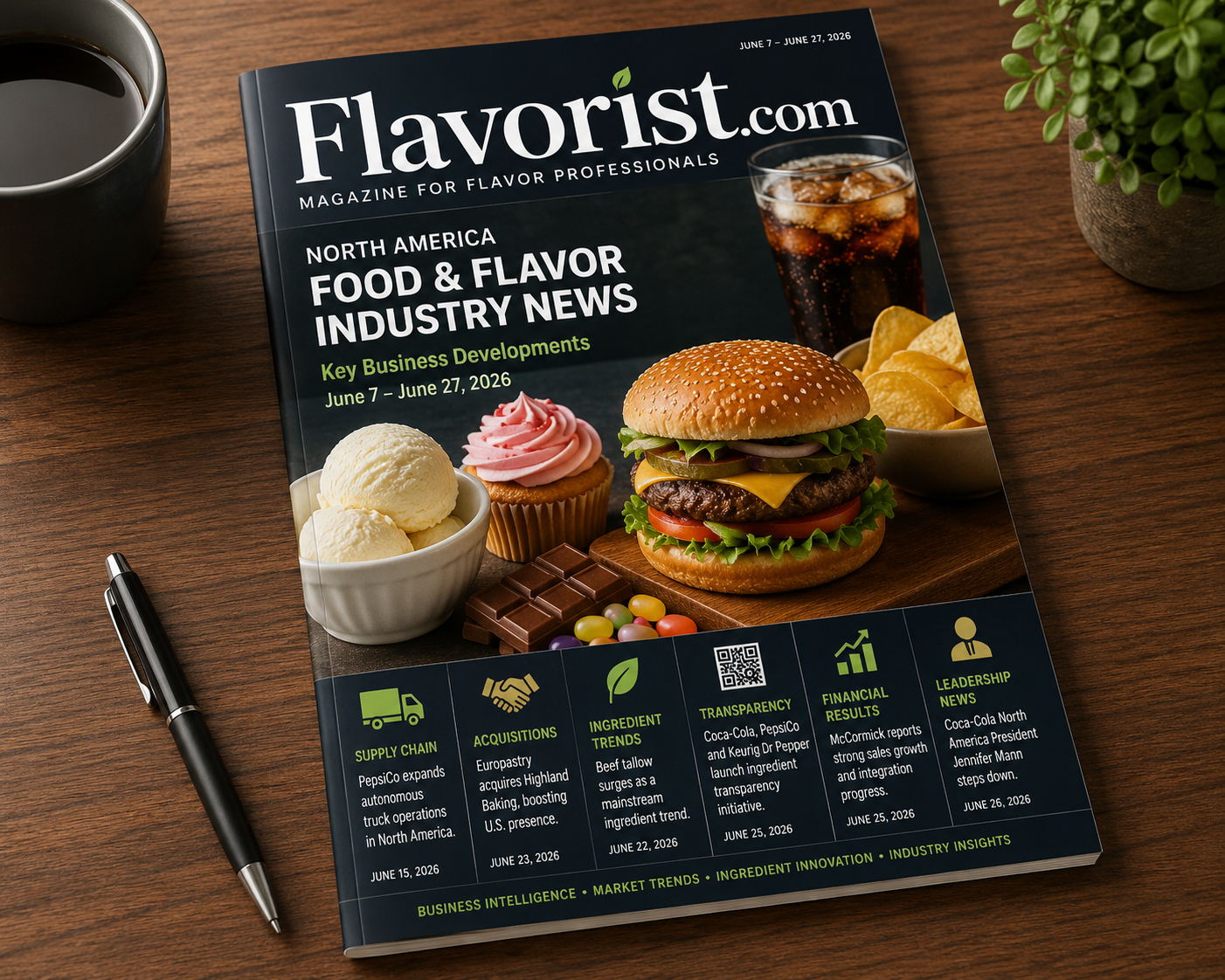
North American Food & Flavor Industry Business Intelligence Report Coverage Period: June 7–27, 2026
Jelly Belly Repositions Its Brand for a New Generation (Published June 12, 2026)
Jelly Belly announced a strategic brand repositioning designed to expand its appeal beyond its traditional consumer base while preserving the premium flavor reputation that has distinguished the company for decades. Following its acquisition by Ferrara, the confectionery company has been refining its portfolio by emphasizing high-quality everyday flavors rather than novelty products that appeal only to niche consumers. Company executives explained that modern shoppers, particularly younger adults, increasingly seek products offering authentic taste experiences, premium ingredients, and opportunities for flavor discovery instead of purely gimmick-based candies. As part of this strategy, Jelly Belly is targeting what it describes as "social epicureans"—consumers who enjoy exploring unique food experiences and sharing them on social media. The company also intends to simplify merchandising, strengthen retailer partnerships, and improve product accessibility across North America. Innovation efforts will continue to focus on seasonal assortments, premium gifting products, and recognizable flavor profiles while reducing the emphasis on extreme or unconventional flavors that generated publicity but limited repeat purchases. Industry analysts note that the repositioning reflects broader consumer trends favoring premiumization, experiential snacking, and products that balance nostalgia with contemporary tastes. For ingredient and flavor suppliers, the announcement reinforces growing demand for authentic fruit flavors, natural flavor systems, and premium sensory experiences in confectionery.
News source: Food Dive – How Jelly Belly is repositioning its brand for "social epicureans" (Food Dive)
Fresh Del Monte and Dole Continue Premium Fruit Innovation (Published June 8, 2026)
A Food Dive report highlighted how major produce companies, particularly Fresh Del Monte and Dole, are reshaping the fresh fruit market through premium product innovation. The article focused on Fresh Del Monte's Rubyglow pineapple, a specialty variety developed over years of breeding and sold at a premium price to consumers seeking differentiated food experiences. Unlike traditional commodity produce, these specialty fruits are marketed similarly to premium packaged consumer goods, emphasizing exclusivity, superior sweetness, visual appeal, and unique flavor profiles. The report explained that both Del Monte and Dole are investing heavily in research and breeding programs to create fruits with improved taste, texture, appearance, and shelf life. Retailers increasingly welcome these differentiated offerings because they command higher margins while helping stores distinguish themselves from competitors. The strategy also reflects changing consumer preferences toward premium foods that provide memorable eating experiences rather than simply satisfying nutritional needs. For the flavor industry, the trend is particularly significant because consumer expectations for authentic, naturally intense fruit flavors continue to rise across beverages, confectionery, dairy, and snack products. Successful commercialization of premium produce varieties may also influence future flavor development as ingredient manufacturers seek to replicate the sensory characteristics of these premium fruits in processed food applications.
News source: Food Dive – Innovation is reshaping the premium pineapple market (Food Dive)
BMI/Fitch Solutions Highlights Long-Term AI Trends for Food and Beverage (Published June 8, 2026)
Fitch Solutions' BMI released its annual long-term megatrends report examining how artificial intelligence will transform industries through 2050, including the food and beverage sector. The report identified AI as one of the most disruptive technologies affecting food manufacturing, product innovation, ingredient development, and supply chain management. According to BMI, food manufacturers are expected to increasingly deploy AI to accelerate product formulation, optimize flavor development, forecast consumer preferences, improve quality assurance, and manage procurement risks. AI-driven analytics are also anticipated to shorten product development cycles by helping companies identify emerging consumer flavor preferences earlier than traditional market research methods. The report further suggests that digital technologies will improve manufacturing efficiency by reducing waste, enhancing predictive maintenance, and optimizing production scheduling. Food companies that successfully integrate AI into research and development could gain competitive advantages through faster commercialization of innovative products and improved responsiveness to evolving consumer demand. Although the publication covers numerous industries globally, its findings are particularly relevant for North American food and flavor companies that continue investing heavily in digital transformation initiatives. For ingredient suppliers, the report reinforces expectations that AI-assisted formulation, flavor prediction, and consumer analytics will become increasingly important competitive capabilities over the next decade.
News source: Fitch Solutions (BMI) – Food & Drink Research
PepsiCo Expands Autonomous Truck Operations in North America (Published June 15, 2026)
PepsiCo announced a significant expansion of its autonomous freight partnership with Gatik, marking another step in the company's long-term strategy to modernize its North American supply chain. The multiyear agreement will increase the deployment of driverless middle-mile trucks transporting products between PepsiCo manufacturing plants, distribution centers, and retail locations. According to the company, autonomous transportation will improve delivery reliability while helping address persistent labor shortages affecting commercial trucking throughout North America. PepsiCo noted that these routes are particularly valuable in regions where recruiting qualified drivers has become increasingly difficult. Beyond labor efficiency, autonomous trucking is expected to lower transportation costs, improve route optimization, reduce fuel consumption, and support PepsiCo's sustainability objectives through more consistent vehicle operations. Industry analysts view the investment as part of a broader digital transformation occurring across food manufacturing, where companies are investing in artificial intelligence, automation, and connected logistics to improve operational resilience. For ingredient suppliers and flavor manufacturers, more reliable transportation networks can reduce inventory disruptions and shorten lead times for time-sensitive ingredients. The announcement demonstrates how supply chain technology has become a competitive differentiator rather than merely a logistics function, with large food manufacturers increasingly investing in automation to strengthen service levels while managing operating costs.
News source: Food Dive – PepsiCo expanding autonomous truck use in its supply chain
Mondelez Announces 2026 CoLab Tech Startup Cohort (Published June 16, 2026)
Mondelez International unveiled the newest group of companies selected for its 2026 CoLab Tech accelerator, highlighting the company's continued investment in breakthrough technologies that could reshape food manufacturing and ingredient innovation. The selected startups are developing solutions across precision fermentation, sustainable proteins, animal-free fats, advanced packaging, artificial intelligence, biotechnology, ingredient traceability, and process optimization. Several companies focus specifically on producing next-generation food ingredients, including fermentation-derived fibers, alternative proteins with improved functional performance, and specialty fats designed to replicate conventional ingredients while reducing environmental impact. Mondelez will work closely with these startups to evaluate commercialization opportunities across its global snack portfolio, providing technical expertise, manufacturing knowledge, and potential market access. The accelerator reflects the company's strategy of identifying disruptive technologies before they become mainstream and integrating promising innovations into future product development pipelines. For flavor and ingredient suppliers, the announcement signals continued industry interest in fermentation-based ingredients, clean-label solutions, sustainable raw materials, and AI-assisted product development. The initiative also demonstrates how major food manufacturers increasingly rely on partnerships with emerging technology companies to accelerate innovation rather than developing every technology internally, allowing faster adaptation to changing consumer preferences and sustainability expectations. (Food Dive)
News source: https://www.foodbusinessnews.net/articles/30506-mondelez-highlights-startups-selected-for-colab-tech-2026
JBS USA to Close Pennsylvania Beef Plant and Memphis Facility (Published June 16, 2026)
JBS USA announced plans to permanently close its beef processing facility in Souderton, Pennsylvania, along with its Empire Packing operation in Memphis, Tennessee, as part of a broader effort to optimize its North American production network. The Pennsylvania facility processes approximately 2,000 cattle per day and employs around 1,700 workers, while the Memphis plant employs roughly 200 people producing value-added meat products. Company executives said production will be transferred to other JBS facilities that offer greater operational efficiency and more modern manufacturing capabilities. JBS indicated that the closures are intended to strengthen long-term competitiveness by concentrating production within facilities capable of operating at higher efficiency levels. The decision reflects ongoing consolidation across the North American meat industry as processors adapt to changing livestock availability, labor costs, automation investments, and evolving customer demand. While the closures will affect local employment, JBS emphasized its intention to maintain overall production capacity through its broader manufacturing network. The announcement also illustrates how protein manufacturers continue investing in larger, more technologically advanced facilities that improve productivity while lowering operating costs. The restructuring is expected to enhance manufacturing efficiency and support long-term profitability despite challenging industry conditions. (Food Dive)
News source: https://www.foodbusinessnews.net/articles/30504-jbs-to-shutter-beef-facility-in-pennsylvania
Hoffmann Family of Companies Acquires Cedar Crest Ice Cream (Published June 17, 2026)
The Hoffmann Family of Companies expanded its presence in the North American frozen dessert industry through the acquisition of Cedar Crest Ice Cream, a regional manufacturer recognized for premium ice cream, frozen custard, sherbet, and sorbet. Founded in 1976, Cedar Crest has built a strong reputation among grocery retailers, restaurants, and independent scoop shops throughout the Midwest. Hoffmann stated that Cedar Crest will continue operating under its established brand while benefiting from additional investment, expanded resources, and strategic support. The acquisition complements Hoffmann's ownership of Oberweis Dairy, creating opportunities for collaboration across manufacturing, distribution, and product innovation while preserving each brand's distinct identity. Company executives emphasized that maintaining product quality and regional heritage will remain priorities following the transaction. Industry observers note that the deal reflects continued consolidation within specialty dairy and frozen dessert categories, where regional premium brands remain attractive acquisition targets due to strong consumer loyalty and growth potential. For dairy ingredient suppliers and flavor companies, the acquisition may create additional opportunities for collaborative product development, premium flavor introductions, and expansion into new geographic markets as Hoffmann seeks to accelerate Cedar Crest's long-term growth. (Food Dive)
News source: https://www.foodbusinessnews.net/articles/30521-hoffmann-scoops-up-cedar-crest-ice-cream
Campbell's Completes Transition to Natural Colors Across National Brands (Published June 18, 2026)
Campbell's announced that it has completed the replacement of FD&C artificial colors across its remaining national brands, including Lance crackers and V8 Splash beverages, marking an important milestone in its clean-label strategy. The company replaced synthetic color additives with naturally derived alternatives such as annatto extract and purple carrot juice concentrate while maintaining product appearance and consumer acceptance. Campbell's also reported continued progress converting several smaller regional snack brands to natural coloring systems. The initiative reflects growing consumer demand for simpler ingredient statements and increased retailer preference for products formulated with naturally sourced ingredients. Reformulating established products required extensive research to ensure that alternative coloring ingredients delivered comparable stability, consistency, and visual appeal without compromising product quality or shelf life. The transition is particularly significant for ingredient manufacturers because natural color reformulation often requires simultaneous adjustments to flavor systems, acidity, processing conditions, and overall product formulation. Industry experts believe similar reformulation initiatives will continue throughout the packaged food industry as consumer expectations evolve and retailers increasingly prioritize products featuring recognizable ingredients. Campbell's accomplishment demonstrates that large-scale reformulation projects can be successfully implemented across nationally distributed brands while maintaining manufacturing efficiency and consumer satisfaction. (Food Dive)
News source: https://www.foodbusinessnews.net/articles/30531-campbells-completes-color-shift-in-national-brands
Hershey Reports Early Success from "One " Strategy (Published June 18, 2026)
The Hershey Company reported encouraging results from its "One Hershey" organizational strategy, which combines its confectionery, salty snacks, and protein businesses under a single commercial structure. Company executives said the integrated approach is helping retailers simplify category management while creating broader merchandising opportunities across multiple snacking occasions. Rather than presenting chocolate, salty snacks, and protein products as separate businesses, Hershey now works with retailers to develop unified promotional programs for holidays, sporting events, back-to-school periods, and other seasonal occasions. Management indicated that the strategy has strengthened retailer relationships by providing a more comprehensive portfolio capable of meeting diverse consumer needs through a single supplier partnership. The integrated model also improves internal collaboration among sales, marketing, innovation, and category management teams, enabling faster product launches and coordinated promotional planning. Analysts believe the approach reflects changing consumer behavior, where shoppers increasingly purchase across snack categories rather than limiting themselves to traditional confectionery. For flavor suppliers and ingredient manufacturers, the strategy underscores the convergence of indulgent, savory, and protein-based snack categories, creating opportunities for ingredient innovation that supports multiple product formats. Hershey's early success suggests that portfolio integration may become increasingly common among diversified food manufacturers seeking stronger retail partnerships and improved commercial efficiency. (Food Dive)
News source: Food Dive – Better together: Hershey's combined sweets and snacks business pays off for retailers, consumers
Europastry Expands U.S. Presence Through Acquisition of Highland Baking (Published June 23, 2026)
Spanish bakery company Europastry announced its acquisition of Illinois-based Highland Baking Co., significantly strengthening its manufacturing footprint in the United States. Highland Baking is a major supplier of breads, buns, rolls, and specialty bakery products to restaurants, foodservice operators, and retail customers throughout North America. The acquisition represents Europastry's largest strategic investment in the U.S. market and is expected to increase the company's annual revenue to more than €2 billion while expanding its production capacity across North America. Company executives said Highland Baking's manufacturing expertise, customer relationships, and geographic reach complement Europastry's frozen bakery portfolio and long-term international growth strategy. The combined business plans to invest in manufacturing modernization, product innovation, and expanded production capacity to meet growing demand from quick-service restaurants and retail bakery customers. Analysts view the acquisition as another example of continued consolidation within the bakery sector, where global companies are pursuing acquisitions to gain scale, diversify customer bases, and strengthen regional manufacturing networks. The transaction also creates opportunities for suppliers of flour, enzymes, yeast, specialty grains, flavors, emulsifiers, and bakery ingredients as Europastry expands operations and introduces new products into the North American market. The acquisition reflects continued confidence in the long-term growth prospects of premium bakery and foodservice categories despite broader economic uncertainty. (Food Business News)
Coca-Cola, PepsiCo and Keurig Dr Pepper Launch Ingredient Transparency Initiative (Published June 25, 2026)
The American Beverage Association announced that Coca-Cola, PepsiCo, and Keurig Dr Pepper will expand ingredient transparency by adding QR codes to beverage packaging through the "Good to Know" initiative. Consumers will be able to scan product packages to obtain detailed explanations about ingredient functions, nutritional information, and links to scientific safety assessments from organizations including the U.S. Food and Drug Administration, Health Canada, and the European Food Safety Authority. Beverage manufacturers said the initiative responds to increasing consumer demand for greater transparency regarding ingredients, sweeteners, preservatives, colors, flavors, and functional additives. Rather than simply listing ingredients, the platform explains why each ingredient is used in beverage formulation and summarizes available scientific evidence supporting its safety. Industry observers believe the initiative could become an important model for ingredient communication throughout the food industry, particularly as consumers seek more information about food additives and processing technologies. The program also highlights how digital technologies are enabling manufacturers to provide extensive product information without changing package design. For ingredient and flavor suppliers, greater transparency may encourage increased investment in consumer education, clean-label innovation, and naturally derived ingredients. The initiative reflects an industry-wide effort to build consumer trust while addressing growing public interest in ingredient sourcing, formulation, and product safety. (Food Dive)
Source: https://www.fooddive.com/news/coca-cola-pepsico-keurig-ingredient-transparency-qr-codes/823802/
Beef Tallow Emerges as a Mainstream Ingredient Trend (Published June 22, 2026)
Food manufacturers including Conagra Brands and Utz reported growing interest in beef tallow as consumers increasingly seek traditional cooking fats perceived as more natural than highly refined seed oils. According to industry sales data cited by Food Dive, products containing beef tallow generated approximately $1.1 billion in retail sales during the previous 52 weeks, representing growth of roughly 275% compared with three years earlier. Manufacturers attribute the resurgence to changing consumer preferences influenced by social media discussions, clean-label trends, and demand for ingredients associated with traditional cooking methods. Companies are incorporating beef tallow into snacks, frozen foods, prepared meals, and restaurant menu items to deliver richer flavor, improved texture, and distinctive product positioning. Industry experts caution that while consumer interest has grown rapidly, nutritional science surrounding dietary fats remains complex and evolving. Nevertheless, manufacturers view beef tallow as an opportunity to differentiate products in highly competitive snack and convenience food categories. For suppliers serving the food and flavor industries, the trend creates opportunities in specialty fats, seasonings, savory flavor systems, and product reformulation. The development also demonstrates how consumer perceptions of ingredients can change significantly over time, influencing formulation strategies across multiple food categories and encouraging manufacturers to revisit previously discontinued ingredients. (Food Dive)
Coca-Cola North America President Jennifer Mann Announces Departure (Published June 26, 2026)
The Coca-Cola Company announced that Jennifer Mann, President of its North America operating unit, will step down from her leadership position effective August 1 after nearly three decades with the company. Chief Financial Officer John Murphy will oversee the North American business on an interim basis while Coca-Cola conducts an executive search for her successor. Mann will remain with the company as a senior advisor through April 2027 to support leadership transition and strategic continuity. North America represents Coca-Cola's largest operating division, making the leadership change significant for beverage innovation, commercial strategy, customer relationships, and portfolio development. During Mann's tenure, Coca-Cola expanded investments in zero-sugar beverages, functional drinks, premium hydration products, and digital consumer engagement while strengthening relationships with retailers and foodservice customers. Industry analysts believe the transition comes at an important time as beverage manufacturers continue responding to evolving consumer preferences for healthier products, functional ingredients, and reduced-sugar formulations. The leadership change is expected to influence future priorities involving product innovation, sustainability initiatives, flavor development, and category expansion across Coca-Cola's North American portfolio. For ingredient suppliers, flavor houses, and packaging companies, continuity in strategic partnerships will remain important during the transition period while the company continues executing its long-term growth strategy. (Food Dive)
Source: https://www.foodbusinessnews.net/articles/30578-coca-cola-north-america-president-stepping-down
McCormick Reports Strong Sales Growth and Progress on Unilever Food Business Integration (Published June 25, 2026)
McCormick & Company reported second-quarter financial results showing a 17% increase in net sales to approximately $1.94 billion while providing an update on its planned integration of Unilever's food business. Organic sales increased despite continued consumer pressure, reflecting strong demand across both the Consumer and Flavor Solutions segments. The Consumer division benefited from continued strength in spices, seasonings, and recipe mixes, while the Flavor Solutions business delivered solid growth from foodservice and industrial customers. Management attributed performance to effective pricing, productivity improvements, successful cost management, and continued demand for products supporting home cooking and healthier meal preparation. Although reported net income declined because of acquisition-related costs and integration expenses, adjusted earnings exceeded market expectations. McCormick reaffirmed its full-year guidance and indicated that planning for the Unilever integration remains on schedule. Executives said the acquisition will significantly expand the company's global food portfolio while creating opportunities for product innovation, geographic expansion, and operational synergies. For the food and flavor industry, the announcement reinforces McCormick's position as one of the world's largest flavor companies and highlights continued investment in seasonings, condiments, flavor technologies, and consumer-oriented innovation despite a challenging economic environment. Analysts expect the combined business to strengthen McCormick's competitive position across retail, foodservice, and industrial ingredient markets. (The Wall Street Journal)
###