Purple bubble tea flavor: consumer + flavorist guide
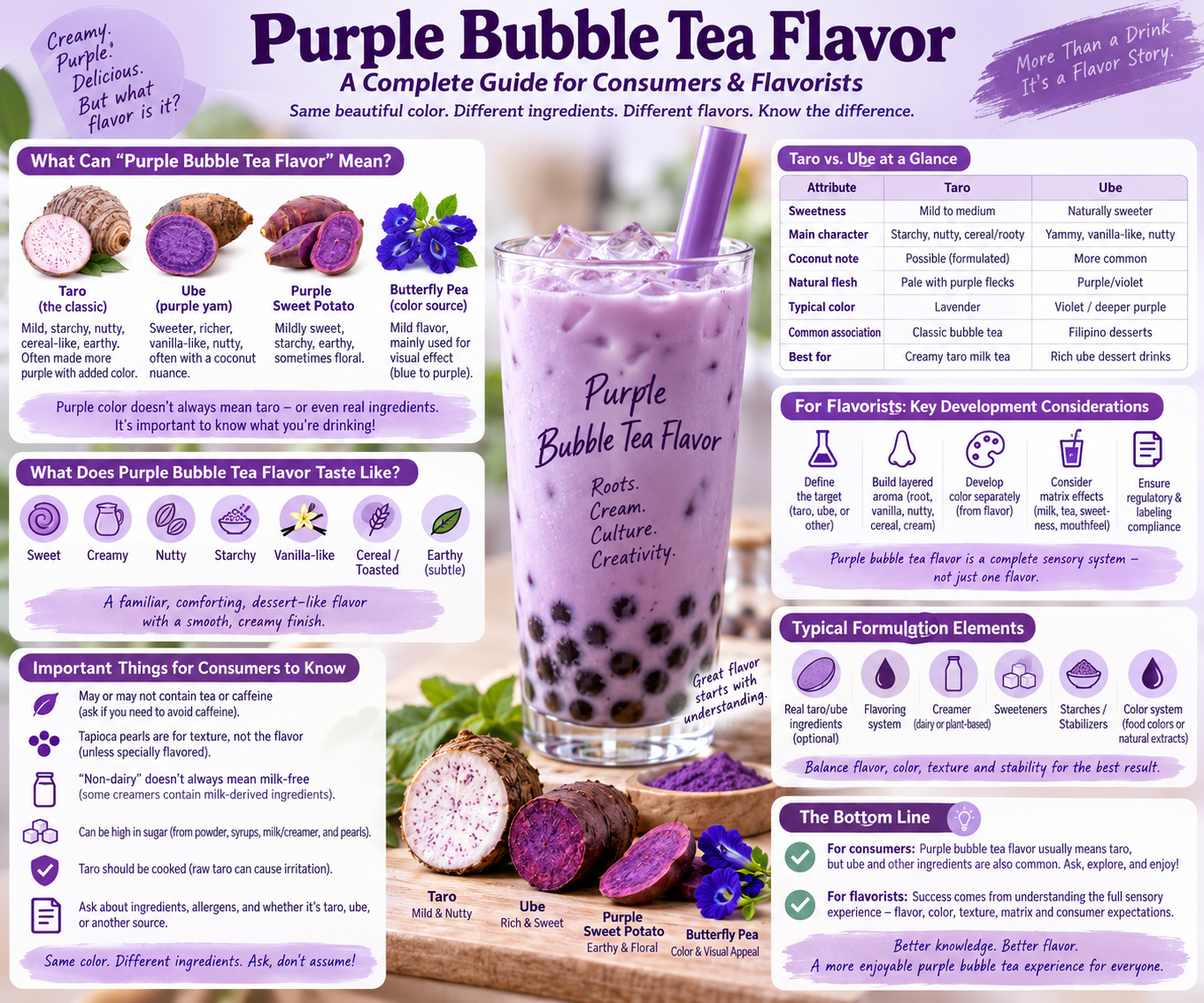
The most useful short answer is: “purple bubble tea flavor” most commonly means taro flavor, especially in the classic bubble-tea context. But purple color alone is not a reliable identifier. A purple drink can instead be ube, purple sweet potato, butterfly-pea-colored milk tea, or a formulated “taro-style” flavor with added color. In 2026, both taro and ube are widely associated with purple boba beverages. (flavorist.com)
There is no regulatory or flavor-industry standard called “purple bubble tea flavor.” For product development, the first job is therefore to decide what the words are supposed to communicate: authentic cooked taro, commercial taro milk tea, ube dessert, purple sweet potato, or simply the familiar creamy lavender-colored boba-shop experience.
What can “purple bubble tea flavor” actually mean?
| Purple beverage identity | Botanical source | Typical sensory character | Color | Important distinction |
|---|---|---|---|---|
| Taro | Colocasia esculenta | Mildly sweet, starchy, nutty, cereal-like, earthy; commercial versions often creamy/vanilla-like | Real taro is normally white/cream with purple flecks; finished taro drinks are often much more purple | This is the classic answer to “purple bubble tea flavor” |
| Ube | Dioscorea alata | Sweeter, richer, yam-like, nutty, vanilla-like and sometimes coconut-like | Naturally violet/purple | Not the same plant or flavor as taro |
| Purple sweet potato | Ipomoea batatas varieties | Mild sweetness, starchy, earthy, sometimes floral | Naturally deep purple | Sometimes used as both flavor ingredient and color contributor |
| Butterfly pea | Clitoria ternatea | Relatively mild flavor; usually used more for visual effect | Blue through purple/magenta depending on pH | It is primarily a color solution, not a substitute for taro flavor |
Ube is a purple yam and is distinct from both taro and purple sweet potato. Its culinary character is commonly described as subtly sweet, nutty, vanilla-like and coconut-like. (Better Homes & Gardens)
What consumers need to know about purple bubble tea flavor
What does purple bubble tea flavor taste like?
When a shop simply presents a pale-purple or lavender milk tea, taro is the most likely flavor identity. The familiar commercial profile is usually:
sweet + creamy + nutty + vanilla-like + soft starchy/root character + a faint toasted/cereal quality.
It is important to distinguish this from the flavor of plain cooked taro. Commercial bubble-tea taro has become its own recognizable flavor category. Manufacturers commonly reinforce real taro character with sweetness, creamer, vanilla-type flavor, additional taro flavor and purple coloring.
For example, currently marketed commercial taro powders show ingredient systems containing glucose or sugar, non-dairy creamer, maltodextrin or starch, taro/taro flavor, vanilla components, stabilizers and added colors. Some formulas use combinations such as Blue 1, Red 40 and Red 3 to create the familiar lavender-purple appearance. (POSSMEI USA ONLINE SHOP)
So a strong purple color does not prove that a beverage contains a lot of actual taro.
Taro versus ube
This is the consumer confusion that matters most.
| Attribute | Taro bubble tea | Ube bubble tea |
|---|---|---|
| Sweetness impression | Mild-to-medium before added sugar | Naturally perceived as somewhat sweeter/dessert-like |
| Main character | Starchy, nutty, cereal/rooty | Yammy, vanilla-like, nutty, richer |
| Coconut impression | Possible in formulated versions | More naturally compatible with a coconut-like dessert impression |
| Natural flesh | Usually pale with purple flecks | Purple/violet |
| Typical commercial color | Lavender/purple | Violet/deeper purple |
| Cultural association | Broad Asian and Pacific cuisines; classic bubble-tea flavor | Especially associated with Filipino desserts |
| Consumer expectation | Creamy taro milk tea | Rich ube-dessert milk tea |
A person who likes vanilla milkshakes, cereal-milk notes and mild nuttiness may prefer the taro-style profile. Someone expecting a richer purple-yam dessert character should specifically order ube rather than assuming any purple drink is ube.
Is purple bubble tea flavor naturally purple?
Sometimes, but often not.
Real ube can contribute substantial purple color because it contains anthocyanin pigments. Purple sweet potatoes also contain anthocyanins. Real taro, however, normally does not create the intensely lavender appearance consumers associate with many taro bubble teas.
That characteristic commercial purple can therefore come partly or almost entirely from approved food colors.
Color and flavor should be treated as two separate questions:
“What makes it taste like taro?” and “What makes it look purple?”
They do not necessarily have the same answer.
Does purple bubble tea contain tea or caffeine?
Not necessarily.
“Taro milk tea” may contain black tea, jasmine/green tea or another brewed tea, but some shops make the drink essentially from taro powder, water or milk, sweetener and ice. A taro flavor powder itself may be caffeine-free while the finished beverage becomes caffeinated because a tea base is added.
In the United States, restaurants generally are not required to tell customers the caffeine quantity in each beverage, so consumers who need to restrict caffeine should ask whether a brewed-tea base is used. (U.S. Food and Drug Administration)
Are the tapioca pearls the purple flavor?
No. Boba/tapioca pearls are a texture component, not the source of taro or ube flavor unless the pearls themselves have been specially flavored.
A purple bubble tea can also be served without tapioca pearls, and adding pearls to another drink does not turn it into taro tea.
“Non-dairy” does not necessarily mean milk-free
This matters particularly with commercial bubble-tea powders.
Some products marketed with non-dairy creamer contain sodium caseinate or whey derived from milk. Current taro powder examples explicitly list milk-derived ingredients despite using the term non-dairy creamer. (POSSMEI USA ONLINE SHOP)
For someone with a milk allergy or someone seeking a vegan drink, asking merely “Do you use non-dairy creamer?” is therefore insufficient. Ask whether the powder and creamer contain casein, caseinate, whey or other milk ingredients.
In the U.S., milk, egg, fish, crustacean shellfish, tree nuts, peanuts, wheat, soy and sesame are the nine federally recognized major food allergens for labeling purposes. (U.S. Food and Drug Administration)
Is taro safe raw?
Taro used as actual food should be properly processed/cooked. Raw taro contains oxalates, including calcium oxalate crystals associated with its characteristic acridity and oral/throat irritation; cooking and processing reduce this problem. (PubMed Central (PMC))
That issue is generally irrelevant to a properly manufactured commercial taro flavor or powder, but it matters when making fresh-taro bubble tea from corms.
Is purple bubble tea healthy?
The word taro, ube, or purple should not by itself be treated as a health claim.
A drink made from a large amount of actual cooked tuber is nutritionally different from one made primarily from glucose, creamer, flavor and color. And a bubble-tea serving can receive sweetness from several places simultaneously: the powder, added syrup, sweetened milk/creamer and cooked tapioca pearls.
For consumers, the meaningful questions are therefore how much sugar is used, how much real taro/ube is present, what milk/creamer is used, what the serving size is and whether sweetened toppings are included.
What flavorists need to know about purple bubble tea flavor
The first technical lesson is that “purple bubble tea flavor” should not be treated as a single flavor target.
A good brief should specify something like:
“Commercial Taiwanese-style lavender taro milk tea: creamy, sweet, nutty, cereal-rooty, lightly vanilla, low earthiness.”
That target is considerably different from:
“Philippine-inspired ube milk tea: cooked purple yam, vanilla/coconut nuance, rich dairy dessert profile.”
And both differ from fresh cooked taro.
The sensory architecture of a taro-type purple bubble tea flavor
For a mainstream taro milk-tea profile, think in sensory layers:
| Layer | Desired perception | Development considerations |
|---|---|---|
| Character note | Recognizable cooked taro/root character | Do not make it simply vanilla |
| Toasted/cereal note | Rice/popcorn/toasted starch nuance | Extremely potent aroma materials can dominate quickly |
| Root/starch body | Cooked tuber, powdered starch | Real taro powder/purée can contribute authenticity |
| Nutty dimension | Soft roasted/nut impression | Usually subtle rather than peanut/almond-specific |
| Cream | Milky, fatty, rounded | Dairy/plant fat changes flavor release significantly |
| Sweet brown notes | Soft caramelized/cooked sweetness | Helps bridge taro to dessert territory |
| Vanilla | Familiar commercial bubble-tea cue | Often stronger in commercial taro than in the raw ingredient |
| Color | Lavender → violet | Must be developed independently of flavor identity |
One particularly important research finding for flavorists concerns 2-acetyl-1-pyrroline (2-AP). Recent work on cooked Lipu taro identified 2-AP as a major characteristic odorant, alongside compounds including methional, nonanal, 1-octen-3-one and (E,E)-2,4-decadienal. Aroma recombination/omission work found 2-AP especially important to cooked-taro aroma. (ScienceDirect) Earlier work had also identified 1-pyrroline and 2-acetyl-1-pyrroline in taro volatiles. (Taylor & Francis Online)
For flavor creation, that does not mean simply adding large quantities of 2-AP. It is an extremely characterful aroma material. The research is more useful as a clue to why convincing cooked taro can have a recognizable toasted rice/popcorn/cereal dimension that a vanilla-only imitation lacks. Actual flavor-material use levels must be based on the supplier specification, regulatory status, purity, matrix and sensory threshold.
Commercial taro character versus authentic taro character
This distinction is extremely important during consumer testing.
An analytically accurate cooked-taro flavor may be rejected as “not taro enough” by consumers accustomed to bubble shops because their reference point is actually:
taro + vanilla + creamer + sugar + lavender color.
In other words, category familiarity can matter more than botanical realism.
A useful development program should therefore maintain at least two references: freshly cooked taro and a leading commercial taro milk tea.
Ube should not simply be “taro plus more purple”
A convincing ube profile needs a different balance.
The core can move toward sweet cooked yam, richer vanilla character, subtle nuttiness, creamy dessert character and coconut-compatible lactonic nuances, with less emphasis on the distinctive toasted-taro signature.
Real ube ingredients are particularly helpful when the marketing identity is explicitly “ube,” because consumers increasingly understand that ube is a genuine Filipino purple yam rather than a generic name for purple food. (Food & Wine)
Three practical formulation routes
| Development strategy | Advantages | Main technical issues |
|---|---|---|
| Real taro/ube dominant | Authentic ingredient story, natural starch/body | Batch variation, sediment, viscosity, weaker aroma, processing burden and potentially less vivid color |
| Flavor + creamer + color | Strong consistency, easy dispersion, predictable sensory profile | Can become generic/vanilla-heavy; ingredient perception and labeling |
| Real ingredient + supplemental flavor + controlled color | Combines ingredient authenticity with sensory consistency | More complex specification and stability work |
For many industrial beverages, the hybrid strategy is useful because actual tuber supplies body and identity while the flavor system restores aroma lost through drying, heat processing or dilution.
Color development is a separate technical discipline
A purple beverage has unusually strong color–flavor congruence requirements. If the liquid looks strongly violet, consumers expect a richer taro/ube experience; a weak aroma can therefore feel especially artificial.
Historically, commercial taro powders have often used combinations of certified blue and red colors. Current products can still be found with Red 40, Blue 1 and Red 3. (POSSMEI USA ONLINE SHOP)
However, U.S. developers should now treat FD&C Red No. 3 as a reformulation issue. FDA revoked its authorization for food use, with the food reformulation deadline taking effect January 15, 2027. As of September 2026, the FDA status page reflects that transition. (U.S. Food and Drug Administration)
Thus, a new long-life purple bubble-tea system intended for the U.S. should not be built around Red 3.
Butterfly pea for purple/blue systems
Butterfly pea flower extract is an interesting natural-source color tool. In the U.S., FDA currently lists butterfly pea flower extract under 21 CFR 73.69 and permits specified uses including teas and dairy/non-dairy drinks. (FDA HFP App)
Its chemistry is especially relevant to beverage developers because its anthocyanins are strongly pH-responsive. Research found approximately magenta coloration in strongly acidic conditions, purple around the transition region and blue across much of the moderately acidic-to-neutral range; heat and storage conditions also affect stability. (PubMed Central (PMC))
That creates an important practical issue: a near-neutral milk tea may make butterfly pea appear too blue rather than the expected lavender-purple. Acidifying a dairy protein system simply to chase a color can introduce protein stability problems. In many formulations it is better to design the complete color system around the actual beverage pH rather than forcing the beverage pH around the pigment.
Matrix effects flavorists should expect
Milk fat, vegetable fat and emulsifiers can suppress or redistribute volatile perception, so the flavor should not be approved in water and assumed to work in the drink.
Tea introduces another major variable. Assam/black tea can contribute malt, tannin and astringency; jasmine or green tea can add floral/green top notes. These can either complement or obscure the root profile.
Sweetness also changes the identity. Lowering sugar does more than make the product less sweet: it can expose earthy, cereal, mineral or vegetal aspects that previously sat below perception. Reformulating a full-sugar taro system for a reduced-sugar product frequently requires rebalancing the flavor itself, not simply removing sweetener.
Plant milks produce their own problems. Oat can reinforce cereal/starch notes; coconut can push the flavor toward ube or tropical dessert; almond can increase perceived nuttiness; soy can introduce beany notes requiring masking.
Texture is part of the purple bubble tea flavor experience
Consumers perceive “flavor” through mouthfeel too.
Taro and yam solids can contribute starchiness, opacity and viscosity. Commercial powders may therefore contain starches, maltodextrin, CMC or related functional ingredients in addition to aroma and color. Examples currently on the market demonstrate exactly this type of system. (Retea)
A thin, watery purple drink with the correct aroma may consequently still fail to read as purple bubble tea flavor.
The development target should include viscosity, opacity, fat level and particulate/sediment perception along with aroma.
Flavorist development checklist
For a commercial project, I would define one specification covering identity, aroma, taste, appearance, texture and stability, rather than asking only for a “taro flavor.”
The key checks are: botanical identity claimed on pack; fresh-taro/ube content if any; tea type and caffeine status; dairy versus plant matrix; sweetness target; target lavender/violet shade; finished pH and Brix; heat treatment; cold versus ambient shelf life; sedimentation; flavor fading; light stability; color shift; allergen implications; natural/artificial flavor labeling; and target-country color regulations.
For sensory QC, particularly useful descriptors are taro/root, toasted cereal, nutty, vanilla, dairy/cream, caramelized sweetness, earthy, vegetal, coconut/lactonic, tea, astringency and aftertaste. Color should be measured separately rather than included in the flavor score.
U.S. labeling points a flavorist or developer should know
Under U.S. rules, flavor declaration depends on whether the flavoring system qualifies as natural, artificial, or a combination under 21 CFR 101.22. (Legal Information Institute) Food color additives have their own regulatory status and labeling rules; certified colors generally need to be declared by their listed names, while requirements for certification-exempt colors differ. (U.S. Food and Drug Administration)
This matters because flavor and color are legally separate functions. A substance sold as a botanical extract may have different regulatory consequences depending on whether its technical function is flavoring, coloring, or both.
Requirements also differ internationally, so a flavor developed for the U.S. should not automatically be assumed compliant in Canada, the EU, UK, Australia, China or Southeast Asian markets.
Bottom line
For consumers, purple bubble tea flavor usually means taro, with a creamy, mildly sweet, nutty, starchy and often vanilla-like profile. Ube is a distinct purple-yam flavor that tends toward a richer vanilla/nutty/coconut-dessert character. Purple color alone tells you surprisingly little about what is actually in the drink.
For flavorists, the important insight is that purple bubble tea flavor is a complete sensory system rather than one aroma:
taro/ube identity + toasted/root character + cream + sweetness + vanilla/nutty accents + appropriate tea + mouthfeel + a tightly controlled purple color.
And for a convincing taro system specifically, current aroma research suggests that the toasted/cereal character associated with 2-acetyl-1-pyrroline deserves substantially more attention than the common practice of treating taro as little more than “vanilla + cream + purple.” (ScienceDirect)
###