Sauces and Dressings: A Review of Properties and Applications
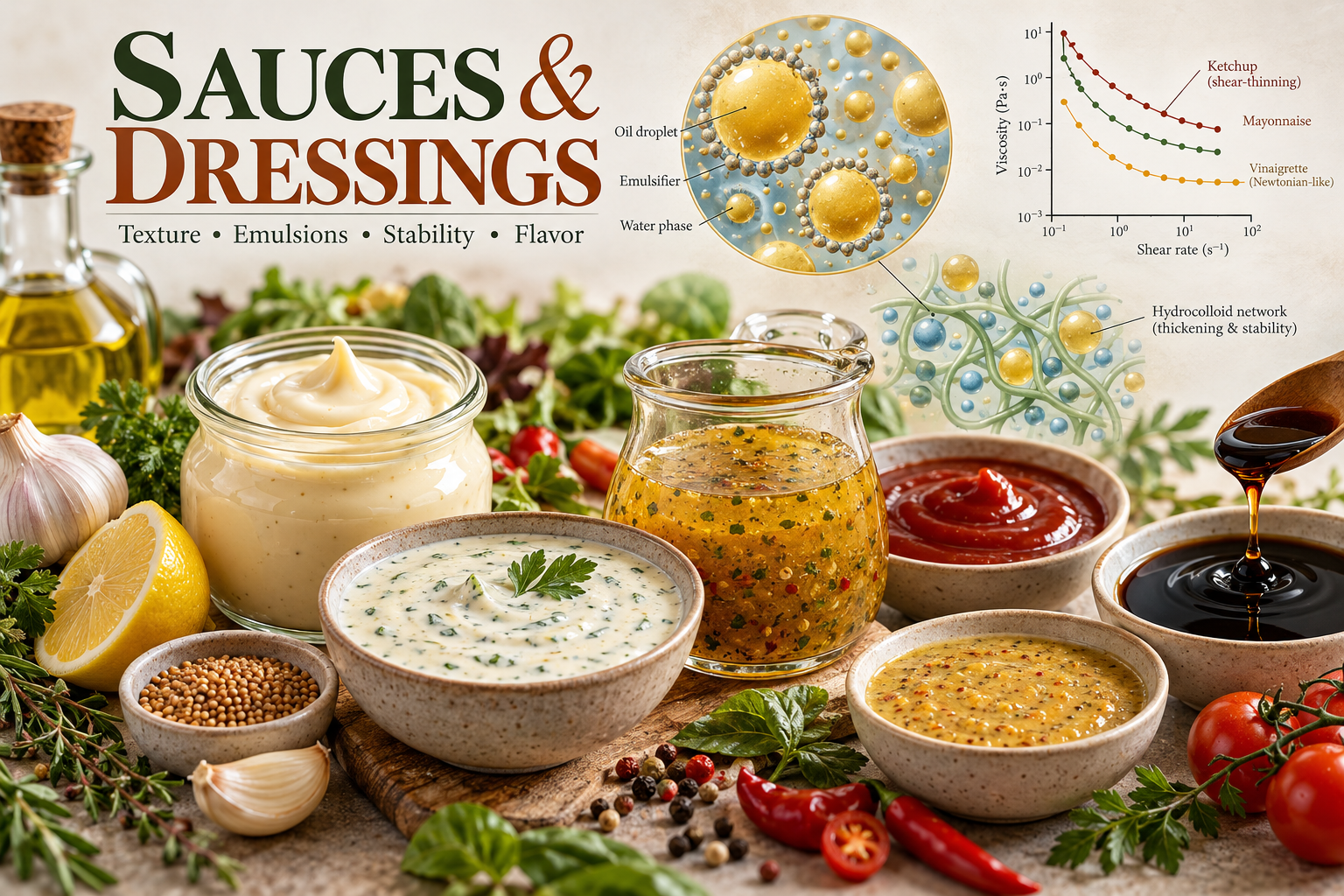
Sikora et al. in 2008 published an excellent review on sauces and dressings.
Sikora, M., Badrie, N., Deisingh, A. K., & Kowalski, S. (2008). Sauces and dressings: A review of properties and applications. Critical Reviews in Food Science and Nutrition, 48(1), 50–77. https://doi.org/10.1080/10408390601079934
This review covers about a decade of research on sauces, salad dressings and mayonnaise. Read through a "how to make them well" lens, it comes down to six things: texture, emulsion stability, flavor, safety, shelf life, and health.
1. Texture: thickeners and gelling agents
Body and mouthfeel come mainly from hydrocolloids, which are polysaccharides and proteins that thicken, gel and stabilize.
Where hydrocolloids come from:
- Plant exudates: gum arabic, karaya, tragacanth, ghatti.
- Seaweed and plant extracts: agar, carrageenans, furcellaran, alginates, and pectin from citrus peel.
- Flours from seeds and tubers: starches, guar gum, locust bean gum (LBG).
- Microbial (fermentation) gums: xanthan gum, the most important, plus gellan, dextran and curdlan.
- Chemically modified: CMC, methylcellulose, HPMC, microcrystalline cellulose, modified starches, and propylene glycol alginate (PGA).
Properties that matter in the kitchen or factory:
- Dissolving behavior:
- Guar, LBG and xanthan hydrate fast and form lumps ("fish eyes") unless dispersed well.
- Gum arabic and CMC dissolve easily, even in cold water.
- Native starch needs heat to swell. Modified starches vary.
- Thickening: gum solutions are shear-thinning, so they thin when stirred or poured and recover at rest. Polysaccharides thicken more efficiently than proteins, so you need less of them.
- Gelling: this can be triggered three ways:
- by heat (agar),
- by ions such as Ca²⁺ or K⁺ (alginate),
- or by both (carrageenan, high-methoxyl pectin).
- A gel can hold about 99% water with only 1% polymer.
- Emulsion and foam stabilization: gums coat droplets and thicken the water phase. This slows droplet movement and prevents syneresis (weeping).
Synergy is a key tool. Blends often outperform either gum alone, and cheap gums can replace expensive ones.
- Xanthan + LBG, guar, tara or konjac: strong viscosity or gels, even though neither gels alone.
- κ-carrageenan + LBG: strong, elastic, shape-holding gels.
- Starch + xanthan or guar: higher viscosity and a lower gelling temperature.
- Mechanisms include competition for water, bridging of swollen starch granules by xanthan, and depletion flocculation.
- Some gums can also weaken a starch gel network, so blend ratios matter.
2. Practical findings on thickening specific products
- Cocoa syrups:
- Agar, carrageenans, CMC and xanthan all worked, to different degrees.
- Lab syrups were less stringy than commercial ones, which consumers preferred.
- With starch plus 0.020–0.030% xanthan, more xanthan reduced pseudoplasticity and hardness.
- More modified starch raised yield stress and viscosity.
- Sweet-and-sour sauces:
- Acetylated distarch adipate (ADA), alone or with xanthan, gave the strongest thixotropic structure.
- Results were tested fresh and after 6 months of storage.
- Potato starch–xanthan and oat starch–oat hydrolysate blends increased firmness, adhesiveness and stringiness.
- Oat starch–xanthan blends lost texture during storage.
- Salad dressings: amaranth starch held viscosity much longer than corn starch, which broke down earlier.
- Starch choice:
- Low-viscosity cook-up modified starches suit sauces and marinades.
- Cold-water-swelling starches suit dry mixes.
3. Emulsions: keeping dressings and mayonnaise from separating
Flavor Emulsion Technology addresses all challenges food scientists need to deal with when making an emulsified food or flavor.
The basics:
- Dressings are oil-in-water emulsions.
- Most non-standardized dressings contain 10–45% oil. Mayonnaise is much higher.
- A "stable" emulsion is one with no visible separation for 2–3 years.
How emulsions fail:
| Type | Mechanisms |
|---|---|
| Physical | creaming (droplets rise), sedimentation, flocculation (clumping), coalescence (merging), partial coalescence (from fat crystals), oiling off, phase inversion, Ostwald ripening |
| Chemical | lipid oxidation, causing rancidity |
| Biochemical | enzymes breaking down interfacial proteins |
Emulsifiers:
- HLB 10–16 suits oil-in-water systems such as dressings. HLB 6–8 suits water-in-oil.
- Blending lipophilic and hydrophilic emulsifiers works synergistically.
- In egg yolk + sucrose ester systems with 35–55% oil:
- more egg yolk strengthened the structure,
- more sucrose ester weakened it.
Protein emulsifiers. A good one adsorbs quickly at the oil–water interface, unfolds, and forms a strong, elastic film.
- Partially denatured proteins emulsify better than native ones.
- Heat severe enough to make proteins insoluble ruins emulsification.
- Examples that worked:
- Milk proteins (Nutrilac): unlike egg yolk, they survive heat treatment, which allows preservative-free products. Viscosity depended on the process: cold process gave low viscosity, while pasteurizing the water phase or end product gave high viscosity.
- Whey proteins:
- About 2% whey protein can replace egg yolk or lecithin.
- Lipase-treated whey extended shelf life.
- Tryptic whey peptides at 0.5–1.5% gave mayonnaise-like rheology and 6-month stability.
- Succinylated whey replaced 20% of the egg yolk, giving more stable, thicker dressings that consumers rated no differently.
- Soy protein:
- Ultrafiltered soy worked at acidic pH.
- Heat- and acid-treated soy isolate worked in low-calorie dressings.
- SUPRO 500E sauces survived freezing and microwave thawing.
- Lupin protein: works as an egg replacer in mayonnaise and dressings. Adding xanthan allows low-fat versions.
- Canola protein + 1% κ-carrageenan or guar: large gains in emulsifying activity and stability.
- Beef and pig plasma proteins at 1–3%: good acid emulsifiers with acceptable sensory results.
Carbohydrate stabilizers:
- Xanthan:
- It is the most widely used stabilizer.
- It stabilizes partly by forming a droplet network through depletion flocculation, not only through yield stress.
- This effect appeared above about 0.1 g/L.
- Flaxseed gum: needs more than 0.45% and pH above 2.8.
- Freedom X-PGA:
- It combines tragacanth-like creaminess with guar–xanthan stability.
- It was stable for over 12 months and 45% longer than PGA at 110 °F.
- β-cyclodextrin (1%) with egg white: less separation and higher viscosity.
- Esterified gums (acacia, guar, inulin) stabilized emulsions at lower doses.
Preventing rancidity:
- Glucose oxidase–catalase lowers dissolved oxygen, but the dose is critical:
- 0.1–0.3 unit/g acted as an antioxidant.
- 0.5–0.7 unit/g became pro-oxidant, even though it still improved emulsion stability.
- Sage and oregano extracts protected best when homogenized into olive oil. Light exposure turned them pro-oxidant.
- Sage extract in liposomes performed as well as the synthetic antioxidant BHT.
4. Microbiological safety: acidity is the main control
- pH is the single most important safety factor.
- Target pH ≤ 4.4. This is below acetic acid's pKa of 4.75 and below the 4.5 limit that inhibits pathogens.
- No foodborne illness has been directly linked to commercial acidic dressings.
- Vinegar: acetic acid above about 1.5% tastes unpleasant, but too little allows spoilage.
- Shelf life: commercial mayonnaise and dressings typically last 9–12 months, limited more by physical and chemical changes than by microbes.
- Pathogen findings:
- Salmonella in an acidic Italian dressing (pH about 3.5) was undetectable after about 5 minutes.
- Mayonnaise (pH 3.9) killed coliforms better than salad dressing (pH 4.5).
- Listeria growth in seafood salad was slowest at pH 3.7, 4 °C, under vacuum.
- Spoilage organisms:
- The main ones are Zygosaccharomyces bailii (yeast) and Lactobacillus fructivorans.
- Their growth limit is around pH 3.55–3.60 and water activity 0.89–0.91.
- Preservatives:
- 1% sucrose fatty-acid esters work as well as or better than 0.1% sodium benzoate.
- To protect sorbate:
- use glass, not PET,
- use citric plus acetic acid,
- add 0.5 g/kg ascorbic acid and 0.075 g/kg EDTA.
- Interaction with oil and Tween 20:
- Tween 20 reduces sorbate's effect at low and medium oil levels.
- Very high oil (46%) inhibits yeast on its own.
- Risky products:
- Unrefrigerated street-vended and table-top chili sauces often carry E. coli contamination.
- Fish sauces and pastes can contain Clostridium spores unless heat-treated.
- Sauces with natural antimicrobial effects: soy sauce kills E. coli O157:H7 at 30 °C. Tabasco reduced Vibrio on oyster surfaces but did not make raw oysters safe.
5. Quality: rheology, processing, flavor and packaging
Processing:
- Higher mixing energy and processing temperature gave smaller, more uniform droplets, higher viscosity and better stability.
- A rotor-stator at 6,000–7,000 rpm was optimal for low-calorie dressings.
- The biggest rheological changes happen in the first 7 days of storage, from droplet coalescence and gum hydration.
Expected behavior:
- Sweet sauces behave like simple Newtonian liquids.
- Dressings are shear-thinning and thixotropic, with a yield stress.
- Modified starch gives mayonnaise a weak-gel structure.
- Structured lipids made from olive oil and caprylic acid prevented separation after refrigeration.
Flavor and sensory:
- Fat is the single most influential factor for texture and mouthfeel.
- More fat or thickness suppresses flavor release: garlic and pepper weaken, and sourness is delayed. Low-fat versions need flavor rebalancing.
- Consumers on average preferred more garlic, pepper and sourness, with lower viscosity and creaminess.
- Droplet size changed aroma:
- larger droplets gave more lemon and citrus notes,
- smaller droplets gave more egg, mustard and butter notes.
- Ingredient substitutions that worked:
- Fermented peanut milk can replace up to 25% of buttermilk in ranch dressing.
- Herb vinaigrettes worked with frozen or freeze-dried herbs at 12–24%, with no effect on consistency.
- Storage problems:
- Tomato sauces develop off-flavors (oxidized aldehydes) within 1–3 months at 25 °C.
- Korean hot sauce loses color and capsaicin over time, so capsanthin works as a quality index.
- A sample hot-sauce base that worked (golden apple):
- Ingredients: 50% fruit purée, 25% water, 10% vinegar, 6% peppers, 4% sugar, 2% spices, 1.1% citric acid, 1% salt, 0.8% xanthan, 0.1% sodium benzoate.
- Process: heat to 85–90 °C for 15–20 minutes, then hot-fill into glass.
Packaging:
- Temperature mattered more than the jar type for mayonnaise stored at 8, 23 and 35 °C.
- Oxygen-permeable packages did show higher peroxide values.
6. Healthier formulations
- Lower fat:
- Fat replacers that worked:
- Oatrim-5 gel, best at 50–70% replacement.
- Microcrystalline cellulose gel at 1–2%, which can replace all but 3% of fat, with the remaining fat kept as a flavor carrier.
- Low-ester amidated pectin.
- Hsian-tsao gum, PGA and xanthan blends.
- Add 0.3–0.5% xanthan for stability.
- Fat replacers that worked:
- Lower cholesterol: lupin protein, reduced-cholesterol egg yolk, and plant sterol or stanol esters such as Benecol.
- Lower sodium:
- Fish sauce tolerated a 75:25 NaCl:KCl substitution.
- Debrined fruit gives lower-sodium hot sauces.
- Blending enzymatically hydrolyzed soy sauce with fermented soy sauce gives low-salt, high-protein soy sauce.
- Functional additions:
- Inulin is a prebiotic and also improves mouthfeel together with xanthan.
- Others include flax and hemp oils, soluble calcium citrate-malate, and lutein emulsions.
Practical takeaways for making good sauces and dressings
- Use gum blends, not single gums. Xanthan with guar or LBG, or starch with xanthan, gives better body at lower cost. Disperse gums well so they don't lump.
- Choose starch for the process. Modified starches like ADA resist breakdown and storage changes better than native starch.
- Build a strong interface. Use egg yolk or proteins (whey, soy, lupin) with the right emulsifier balance, and pair them with a gum to thicken the water phase.
- Homogenize hard. More energy gives smaller droplets and a more stable product.
- Keep pH at or below 4.4, acidified with vinegar. This is the backbone of safety. Add sorbate or benzoate, protected with ascorbic acid and EDTA, against yeast.
- Limit oxygen, light and heat. Natural antioxidants in oil help, but light reverses their effect. Glass packaging and cool storage extend quality.
- Rebalance flavor when cutting fat. Fat masks flavors, so low-fat versions need more seasoning and less thickness.
Gaps the authors flag for future research: better texture measurement methods, linking sensory and instrumental data, new gums, probiotic-fermented sauces, sauces from tropical fruits, and standardized analytical methods.
Below are two illustrative formulas built from the review's findings: a shelf-stable sweet-and-sour sauce (a hot-filled, starch-thickened sauce) and a reduced-fat creamy garlic-herb dressing (an emulsified dressing). Amounts are given as percentages and as grams per 1 kg batch, and each step notes which finding it applies. They are starting points to test and adjust, not validated commercial recipes.
Example 1: Sweet-and-sour sauce (hot-fill, shelf-stable)
Formula (1 kg batch)
| Ingredient | % | Grams | Why it's there |
|---|---|---|---|
| Water | 46.15 | 461.5 | Continuous phase |
| Sugar | 20.0 | 200 | Sweetness; also helps disperse the gums |
| Pineapple juice | 12.0 | 120 | Fruit flavor, natural acidity |
| Distilled vinegar (5% acidity) | 10.0 | 100 | Gives about 0.5% acetic acid, below the ~1.5% level where it tastes unpleasant |
| Tomato paste | 5.0 | 50 | Color and body |
| Soy sauce | 2.5 | 25 | Salt and savory notes |
| Modified starch (acetylated distarch adipate, ADA) | 2.8 | 28 | Main thickener; holds structure over storage |
| Salt | 0.5 | 5 | Seasoning |
| Garlic powder | 0.3 | 3 | Flavor |
| Ground ginger | 0.2 | 2 | Flavor |
| Citric acid | 0.3 | 3 | Fine-tunes pH |
| Xanthan gum | 0.15 | 1.5 | Synergist with the starch |
| Sodium benzoate | 0.1 | 1 | Preservative against yeast and mold |
| Total | 100 | 1000 |
Method, with the reasoning
- Dry-blend the starch, xanthan, benzoate and some of the sugar.
- Xanthan swells so fast it forms "fish eyes" (lumps). Diluting it in sugar first lets it disperse evenly.
- Whisk the dry blend into the cold liquids (water, juice, soy sauce, tomato paste) before heating.
- Native and modified cook-up starches need heat to swell. Adding them hot causes lumping.
- Heat to 85–90 °C and hold for 15–20 minutes, stirring.
- This fully gelatinizes the starch.
- It matches the hot-sauce process in the review and pasteurizes the sauce.
- Starch with xanthan gives higher viscosity and a lower gelling temperature than starch alone.
- Add the vinegar and citric acid near the end of heating.
- Long boiling in acid can break starch down, which is one reason a cross-linked starch like ADA is used.
- Check the pH. Target 3.6–3.8, and never above 4.4.
- pH is the most important factor in killing pathogens in acidic sauces.
- 4.4 is the industry's highest target.
- Benzoate also works better at low pH.
- Hot-fill into clean glass bottles at 85 °C or above, cap, invert briefly, then cool.
- Glass protects preservatives better than PET.
- Hot-filling sterilizes the inside of the container.
- Store cool and dark.
- Tomato-based sauces develop off-flavors within 1–3 months at 25 °C, and faster at 40 °C.
- For bottled sauces, temperature matters more than package type.
Why this works
- ADA, alone or combined with xanthan, gave the strongest thixotropic structure in the authors' own sweet-and-sour work, both fresh and after 6 months.
- Thixotropic means the sauce stays put on the plate but pours when shaken.
- Keep xanthan low (about 0.1–0.2%).
- More xanthan reduced hardness and pseudoplasticity.
- Too much makes a sauce slimy and stringy, and consumers preferred less-stringy products.
- Adding vegetables (peppers, onion, pineapple chunks) works. The review tested sauces with and without vegetables over 6 months.
- Home substitutes:
- Tapioca or cornstarch can replace ADA, but expect more thinning and weeping in storage.
- Measure xanthan on a 0.1 g scale.
Example 2: Reduced-fat creamy garlic-herb dressing (ranch style)
Formula (1 kg batch)
| Ingredient | % | Grams | Why it's there |
|---|---|---|---|
| Water | 37.69 | 376.9 | Continuous phase |
| Canola or sunflower oil | 25.0 | 250 | Dispersed phase; mid-range of the 10–45% typical for dressings |
| Buttermilk | 15.0 | 150 | Tang and creaminess |
| Distilled vinegar (5% acidity) | 8.0 | 80 | Acidity and safety |
| Pasteurized egg yolk | 4.0 | 40 | Main emulsifier |
| Sugar | 3.0 | 30 | Balances the sourness |
| Inulin | 2.0 | 20 | Mouthfeel, prebiotic fiber, synergy with xanthan |
| Whey protein concentrate | 1.5 | 15 | Co-emulsifier; allows less egg yolk |
| Salt | 1.5 | 15 | Seasoning |
| Garlic powder | 0.6 | 6 | The top garlic level tested, which consumers preferred |
| Freeze-dried chives and dill | 0.5 | 5 | Herb flavor without affecting consistency |
| Xanthan gum | 0.3 | 3 | Main stabilizer |
| Mustard powder | 0.3 | 3 | Flavor plus some emulsifying help |
| Black pepper | 0.2 | 2 | Flavor |
| Citric acid | 0.2 | 2 | Drives pH down |
| Guar gum | 0.1 | 1 | Synergy with xanthan |
| Potassium sorbate | 0.05 | 0.5 | Inhibits Z. bailii spoilage yeast |
| Ascorbic acid | 0.05 | 0.5 | Protects sorbate from breaking down |
| Calcium disodium EDTA | 0.0075 | 0.075 | Protects sorbate and binds metals that drive rancidity |
| Total | ≈100 | ≈1000 |
Method, with the reasoning
- Dry-blend the xanthan, guar, inulin, sugar, salt and sorbate. Disperse into the water under high shear and let hydrate for about 10 minutes.
- This avoids fish eyes.
- Gums hydrate best in plain water, before acid and salt-heavy ingredients compete for it.
- Xanthan with guar is a classic synergistic pair: more viscosity per gram than either alone.
- Add the egg yolk, whey protein and mustard to the gum solution.
- Proteins must be at the interface the moment droplets form.
- Don't heat the whey. Heat that makes protein insoluble destroys its emulsifying power.
- Stream in the oil slowly under high shear (rotor-stator at about 6,000–7,000 rpm, or a strong immersion blender).
- More mixing energy gives smaller, more uniform droplets, higher viscosity and better stability.
- The 6,000–7,000 rpm range was optimal for low-calorie dressings.
- Smaller droplets also bring out egg, mustard and buttery notes, which suits a ranch profile.
- Add the vinegar, buttermilk, citric acid, ascorbic acid and EDTA at low speed.
- Fold in the garlic, pepper and herbs at low speed so the herb flecks stay visible.
- Check the pH. Target 3.8–4.0.
- In the review, ranch dressing at pH 4.51 let coliforms survive longer than mayonnaise at pH 3.91.
- Buttermilk raises pH, so measure the finished dressing rather than assuming it is acidic enough.
- Fill into glass or opaque containers with minimal headspace. Refrigerate.
- Glass protects sorbate.
- Less headspace means less oxygen for rancidity.
- Light can turn even natural antioxidants into pro-oxidants.
- Judge the texture after a few days, not right away.
- The biggest rheological changes happen in the first 7 days, as droplets settle and gums finish hydrating.
Why this works
- Two emulsifiers, two stabilizers:
- Egg yolk and whey build a strong interfacial film.
- Xanthan, guar and inulin thicken the water phase and form a weak droplet network.
- That network is what actually stops creaming.
- Safety is layered:
- Low pH is the backbone.
- Sorbate covers spoilage yeast.
- Ascorbic acid and EDTA are the exact sorbate-protecting levels from Castro et al.
- Pasteurized yolk removes the raw-egg Salmonella risk.
- Flavor is tuned for reduced fat.
- Fat and thickness suppress garlic and pepper and delay sourness.
- Seasoning is pushed toward the top tested garlic level.
- Viscosity is kept moderate, since consumers on average preferred higher garlic, pepper and sourness with lower viscosity.
- Optional upgrades from the review:
- Replace up to 25% of the buttermilk with fermented peanut milk without sensory loss.
- Add rosemary or sage extract dissolved in the oil. Homogenized into oil, it outperformed alcohol-dissolved extract.
- For vegan or egg-free versions, replace the yolk with lupin or soy protein isolate.
How the review's findings map onto the two recipes
| Finding | Sauce | Dressing |
|---|---|---|
| Gum synergy | ADA starch + xanthan | Xanthan + guar + inulin |
| Prevent fish eyes | Dry-blend gums with sugar | Dry-blend gums before hydrating |
| Process-resistant starch | ADA for heat and storage stability | Not needed |
| Protein emulsifiers | Not applicable | Egg yolk + whey |
| High-shear homogenization | Not needed | Smaller droplets, more stability |
| pH at or below 4.4 | Target 3.6–3.8 | Target 3.8–4.0 |
| Preservatives | Benzoate | Sorbate + ascorbic acid + EDTA |
| Glass packaging, cool and dark storage | Yes | Yes |
| Fat suppresses flavor | Not applicable | Seasoning raised, viscosity moderate |
| Healthier formulation | Not applicable | 25% oil, inulin, less yolk |
For selling either product: formulas need validation by a process authority and confirmation of preservative limits in your market. EDTA at 75 ppm matches the US limit for dressings.
(Formulations developed from findings reviewed in Sikora et al. (2008), “Sauces and Dressings: A Review of Properties and Applications,” Critical Reviews in Food Science and Nutrition, 48(1), 50–77.)
###