Africa Food & Flavor Regulatory Update for September 16–30, 2026
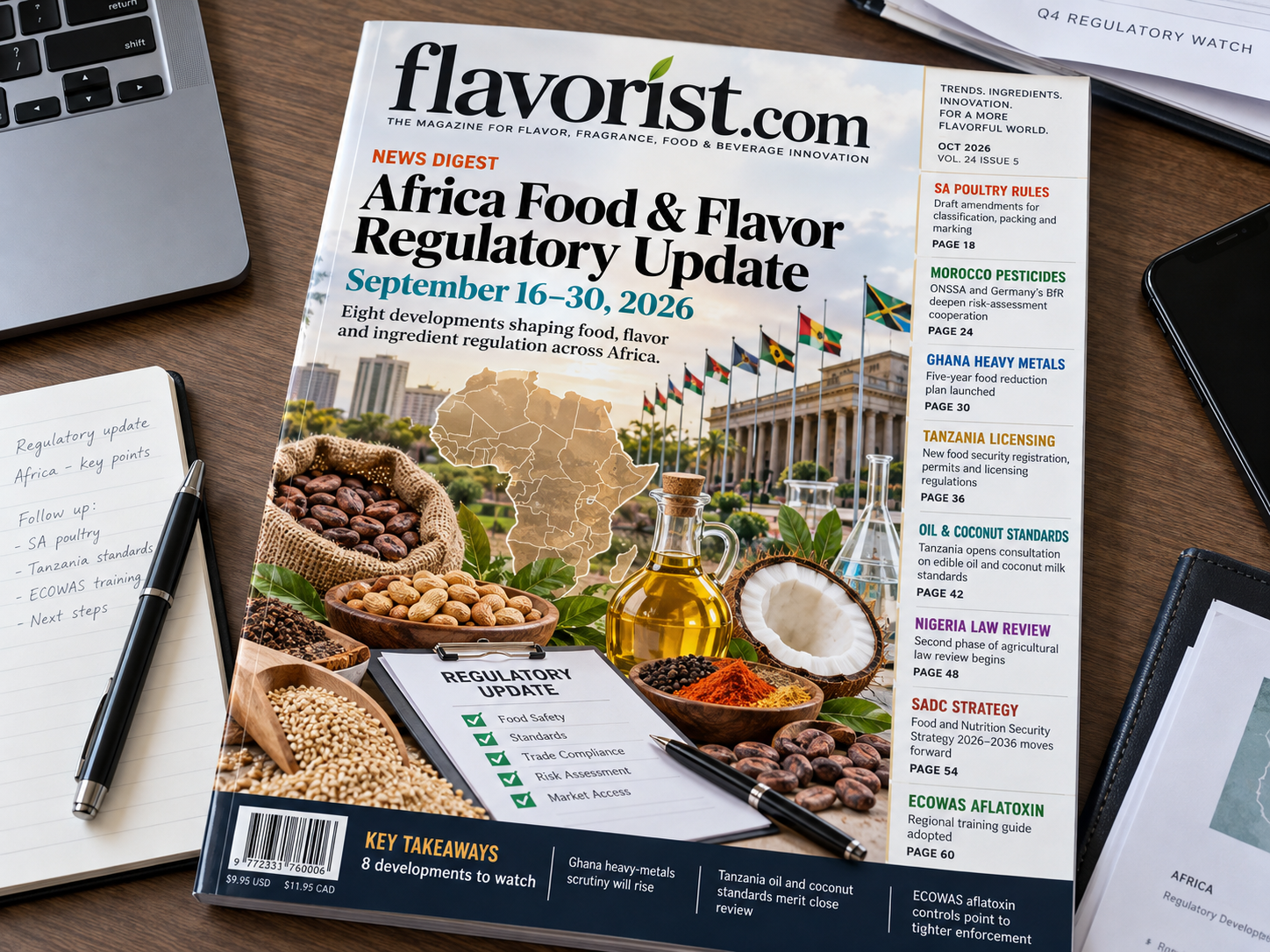
Coverage: official regulators, government gazettes, standards bodies, agriculture and health ministries, and regional organizations across North, West, East, Central and Southern Africa. Topics tracked include food, beverages, flavors, ingredients, additives, contaminants, standards, labeling, agricultural inputs, food safety, traceability and market access.
The second half of September was quiet for formal rulemaking in Africa, especially compared with Europe and Asia over the same period. Eight developments are relevant enough to report. Routine recalls, inspection campaigns and enforcement statistics are left out unless they signal a wider change in compliance expectations.
1. South Africa: draft amendments to poultry meat regulations (Sept. 18)
The Department of Agriculture published Government Notice 7923, which proposes changes to the regulations governing the sale of poultry meat under the Agricultural Product Standards Act. Comments are due by October 18, 2026.
These regulations set the rules for classification, presentation, packing and marking, so any change to product descriptions or compositional requirements will feed into processor and retailer specs and labels. Suppliers of marinades, seasonings, brines, smoke flavors and functional systems for value-added poultry should pay particular attention to how the final text separates plain poultry from processed or treated product. Exporters will need to align with the amended South African requirements, not just their home-country classifications.
Source: Department of Agriculture – Draft legislation for comment
2. Morocco: ONSSA and Germany's BfR deepen cooperation on pesticide risk assessment (Sept. 18)
Morocco's National Office for Food Safety (ONSSA) held a regulatory-science workshop with Germany's Federal Institute for Risk Assessment (BfR) on plant-protection products. The work is part of a broader effort to build ONSSA's capacity to assess phytopharmaceuticals.
No new maximum residue limits came out of this. Still, how Morocco authorizes and assesses pesticides shapes which inputs growers can use and how residues are controlled, and that matters for herbs, spices, citrus oils, fruit and botanical extracts sourced from the country. ONSSA's remit spans plant protection, agricultural inputs, food controls, import/export certification and risk assessment, so stronger science here is likely to show up in future practice. Buyers of Moroccan agricultural materials should keep an eye on authorizations and residue specs.
Source: ONSSA
3. Ghana: five-year plan to cut heavy metals in food (Sept. 22)
Ghana launched its National Strategic Plan for Heavy Metals Reduction in Food 2026–2030, targeting lead, cadmium, mercury and arsenic. The Ministry of Health, Ghana FDA, Ministry of Food and Agriculture, Ghana Standards Authority and Environmental Protection Agency are among the agencies involved.
The plan focuses on surveillance, laboratory capacity, industry compliance, research and public education. Ghana FDA already holds contamination data on selected foods, which gives regulators a basis for targeted action. Cocoa, spices, botanicals, cereals, seafood and vegetables are the obvious exposure points, and heavy-metal specs already affect export access for several of them. The strategy sets no new numerical limits, but more monitoring is likely. Companies buying Ghanaian cocoa derivatives, botanical extracts or spices should check that supplier specs and testing cover all four metals.
Source: Information Services Department, Ghana
4. Tanzania: Food Security (Registration, Permits and Licensing) Regulations, 2026 (Sept. 22)
The Cereals and Other Produce Regulatory Authority (COPRA) published new registration, permit and licensing rules under the Food Security Act. They sit within a wider 2026 package that also covers quality control for cereals and other produce, edible oil, contract farming and designated food commodities.
For anyone handling cereals, pulses or oilseeds, these rules decide who can legally operate in the supply chain. The impact on flavor companies is mostly upstream, through processors, warehouses and traders supplying cereal derivatives, edible oils and botanicals. It is worth confirming whether Tanzanian suppliers fall under COPRA's requirements and whether procurement files show they are compliant.
Source: COPRA – Legal documents
5. Tanzania: consultation on edible oil and coconut milk/cream standards (Sept. 22)
The Tanzania Bureau of Standards (TBS) opened a food-standards consultation running to November 23. The package includes draft standards for olive oil and olive-pomace oil, aqueous coconut milk and coconut cream, and the processing of edible fats and oils.
Oils and coconut products are everyday flavor carriers and formulation bases in sauces, beverages, bakery, dairy alternatives and culinary systems. The drafts may set identity, quality, compositional and contaminant parameters that later become conditions for certification and market access. Importers and local manufacturers should compare their current specs with the drafts and consider commenting where the proposals depart from Codex, supplier specifications or normal manufacturing practice.
Source: TBS – Draft standards
6. Nigeria: second phase of agricultural law review begins (Sept. 24)
The Federal Ministry of Agriculture and Food Security started the second phase of its review of Nigeria's agricultural laws. Phase one found obsolete provisions, overlapping mandates and gaps, along with rules that no longer reflect climate change, new technology, mechanization, private investment or modern food systems.
Phase two moves toward drafting a new legal framework aimed at food sovereignty and agribusiness growth. Nothing is enforceable yet, but the scope is wide: production, commodity markets, investment and food-security regulation could all be affected. Companies sourcing Nigerian cocoa, citrus, ginger, spices and other botanicals should follow the resulting bills, since a reshuffle of regulatory responsibilities could change licensing, quality control, traceability and market rules.
Source: Federal Ministry of Information and National Orientation
7. SADC: Food and Nutrition Security Strategy 2026–2036 moves forward (Sept. 24)
After a technical steering committee meeting with Member States, regional experts and development partners, SADC reported progress on its new Food and Nutrition Security Strategy, which replaces the 2015–2025 framework.
The draft puts more weight on resilient food systems, nutrition, preparedness, accountability and evidence-based policy. It is not binding and says nothing specific about additives or labeling, but regional strategies tend to shape national policy and standards over time. Fortification, nutrition-sensitive foods, food-safety systems and supply-chain resilience are the areas most likely to see follow-on measures. Regional operators should watch how individual member states put it into practice.
Source: SADC
8. ECOWAS: regional aflatoxin control training guide adopted (Sept. 29)
The ECOWAS Commission and national food-safety authorities adopted a Regional Training Guide on Aflatoxin Control. The final technical review took place September 21–22, and the outcome was published September 29. ECOWAS Member States, representatives of the Alliance of Sahel States, Chad and technical partners took part.
The guide is a capacity-building tool, not a new maximum level. Even so, common training should lead to more consistent sampling, surveillance and enforcement across West Africa. Aflatoxins affect maize, groundnuts, tree nuts, spices and other ingredients, and contaminated lots can be rejected for manufacture or export. Buyers of peanuts, spices or cereal-based materials from the region should keep supplier controls tight: moisture and storage specs, certificates of analysis, and risk-based testing.
Source: ECOWAS Food System Resilience Programme
Also on the radar
Egypt. The National Food Safety Authority (NFSA) kept up a heavy enforcement schedule. Its September 20 report covered factory inspections, establishment registration, import/export controls, supplement registration and surveillance of dairy, slaughterhouses and other sectors. The September 27 update recorded 4,130 export certificates (about 185,000 tonnes), 2,174 import consignments, port controls and thousands of establishment inspections. This is enforcement of existing rules rather than new requirements, so it is not counted above. (State Information Service)
Nigeria (livestock). On September 29 the Federal Ministry of Livestock Development announced talks with UNIDO on animal identification, traceability, food safety, laboratory capacity and certification. It could matter for future meat regulation and export access, but for now it is institutional groundwork, not a requirement. (Federal Ministry of Livestock Development)
Key takeaways for flavor and ingredient companies
- Ghana's heavy-metals plan: expect closer scrutiny of cocoa, spices and botanicals.
- Tanzania's oil and coconut standards: comments close November 23; these are core carrier ingredients.
- ECOWAS aflatoxin guide: more consistent enforcement ahead for nuts, grains and spices.
- Tanzania's licensing regulations: confirm upstream commodity suppliers are registered.
Scope: national and regional developments that could be verified from public sources for September 16–30, 2026. Primary sources were checked in South Africa, Nigeria, Ghana, Kenya, Tanzania, Egypt and Morocco, along with SADC and ECOWAS, with broader searches for other jurisdictions. Municipal notices and non-indexed gazette items are not covered. Items released before September 16 are excluded even if their consultation periods ran into the review window.
###