Europe Food & Flavor Regulatory Update: September 16–30, 2026
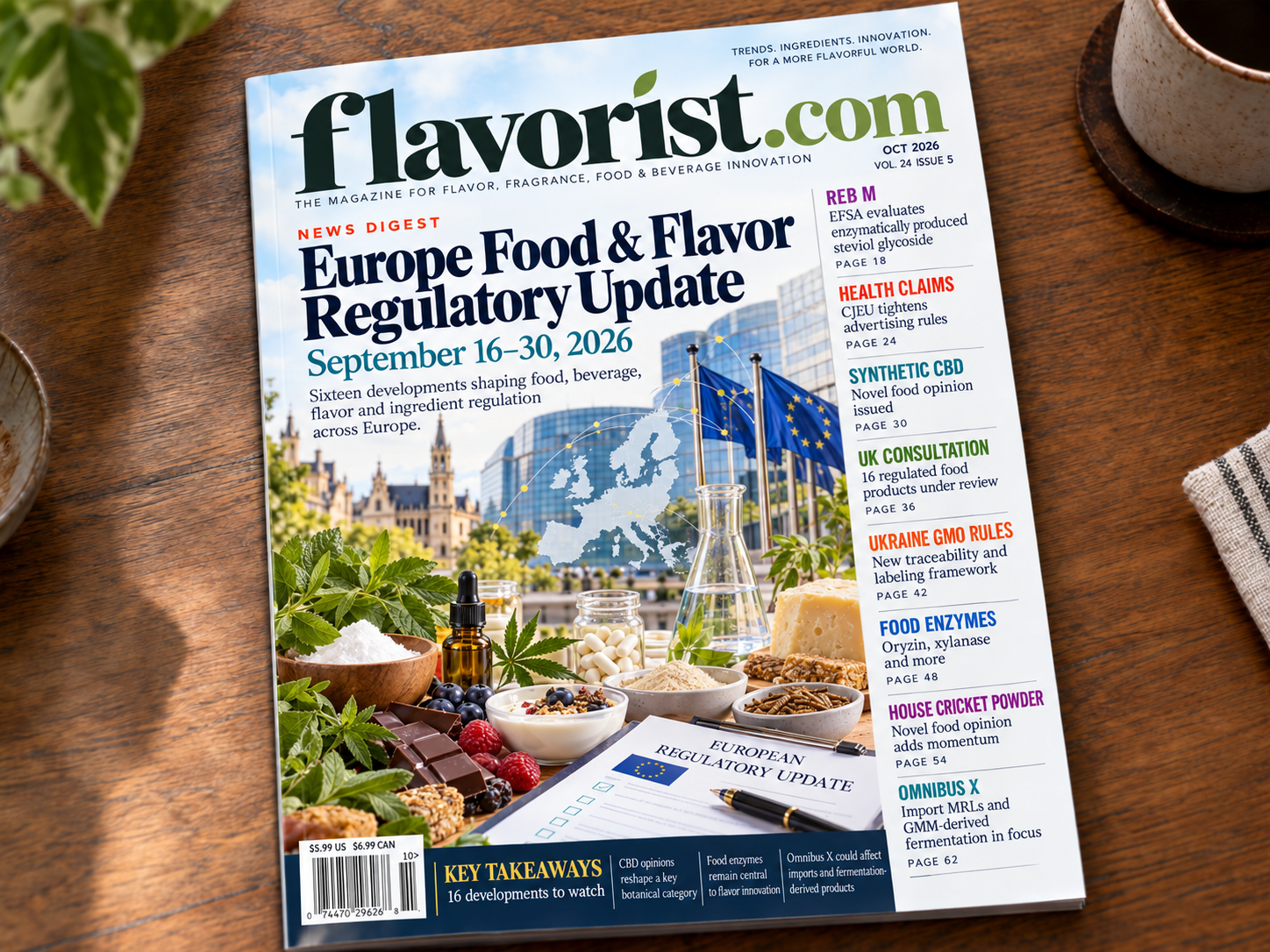
Coverage: European Commission and Council materials, EUR-Lex records, EFSA, the UK Food Standards Agency, EU and national court decisions, national regulators and specialist European food-law reporting. "Europe" here means the EU/EEA plus the UK, Ukraine and other relevant European jurisdictions.
Sixteen developments are relevant to food, beverage, flavor, ingredient, supplement, novel food, enzyme, sweetener, labeling and agricultural supply-chain businesses. Routine recalls and enforcement notices are excluded.
A note on EFSA opinions. Several items below are EFSA scientific opinions. An opinion is an important step, but it is not an authorization. Products can only be marketed once the Commission adopts an implementing measure and the substance is added to the relevant Union list, with whatever specifications, food categories and maximum levels that measure sets.
1. EFSA evaluates enzymatically produced Rebaudioside M (Sept. 17, EU)
EFSA published its safety evaluation of Rebaudioside M made by enzymatic conversion of purified steviol glycosides from stevia leaf extract. Reb M is valued by formulators because its sweetness is closer to sugar than earlier steviol glycosides, with less bitterness and lingering aftertaste.
The evaluation sits within the food additive authorization process under Regulations 1333/2008 and 1331/2008. It is relevant to reduced-sugar beverages, dairy, confectionery, tabletop sweeteners and flavor-modulation systems. Companies looking at this production route should keep the evaluated process and specifications separate from other forms of Reb M already on the market.
Source: EFSA – Food additives
2. CJEU rules on health-claim information in advertising (Sept. 17, EU)
In Case C-657/24, the Court of Justice considered advertising for food supplements under Regulation (EC) No 1924/2006. The question was whether mandatory information that must accompany a health claim, including the statement on the importance of a varied and balanced diet and a healthy lifestyle, has to appear in a written advertisement when it is already printed on the product label.
The practical point is that information on the pack does not automatically cover separate advertising. Supplement and functional food companies using authorized claims should check that the required statements travel with the claim in every medium. Ingredient suppliers to branded functional products may also see customers scrutinize marketing language and substantiation more closely.
Source: CJEU – Case C-657/24
3. CJEU clarifies what counts as a health claim (Sept. 17, EU)
In a second supplement case, C-721/24, the Court looked at whether statements about frequency of intake or route of administration can amount to health claims under Regulation 1924/2006. It also addressed the mandatory wording for reduction-of-disease-risk claims and where it must appear in advertising.
Dosage and usage wording that looks purely descriptive can become a regulated claim if, in context, it implies a link between the food and health. Compliance reviews therefore need to look at the whole advertisement, not only obvious phrases like "supports immunity." Read together, the two September 17 rulings add meaningful case law on how claim conditions apply beyond the label, and they make a good case for reviewing packaging, websites, professional communications and advertising as one system.
Source: CJEU – Case C-721/24
4. EFSA assesses synthetic CBD as a novel food (Sept. 18, EU)
EFSA published an opinion on synthetic cannabidiol under the Novel Food Regulation, the first of several CBD opinions released in September.
CBD applications have built up one of the largest backlogs in the novel food system, and familiarity with the substance is no substitute for authorization. This opinion also shows how much the production route matters: chemically synthesized CBD cannot be assumed to be interchangeable with plant-isolated CBD or with full Cannabis sativa extracts. Companies developing CBD supplements, beverages or confectionery need to match their ingredient exactly to the substance and process that was evaluated.
Source: EFSA – Novel food
5. France: kefir case questions regulators' reliance on Codex (reported Sept. 19, France)
French authorities had ordered a dairy producer either to add characteristic yeasts to products sold as "kefir" or to rename them. The Rennes Administrative Tribunal suspended the order, questioning whether Codex standard CXS 243-2003 could serve as its legal basis when that standard has not been incorporated into binding EU or French law. European food-law outlets covered the decision on September 19.
The case reaches beyond kefir. Codex standards shape regulatory thinking, technical specifications and trade, but they do not carry the same legal weight as directly applicable EU or national law. Manufacturers of fermented foods should still bear in mind the misleading-information rules in Regulation 1169/2011, since consumers may expect a traditional name to signal a traditional composition or method.
Source: Food Compliance International
6. EFSA publishes further CBD novel food opinions (Sept. 21, EU)
Two more cannabinoid opinions followed, one on CBD isolated from Cannabis sativa L. and one on a Cannabis sativa extract. With the synthetic CBD opinion three days earlier, EFSA's work on cannabinoid foods has clearly picked up pace.
The distinction between synthetic CBD, plant-isolated CBD and complex extracts has real commercial weight. Different processes leave different impurity profiles, minor cannabinoids and other constituents, so conclusions and specifications for one type do not carry over to another. Gummy, beverage, supplement and botanical extract businesses should not read any of these opinions as a general clearance for "CBD." Authorization under Regulation (EU) 2015/2283 will turn on the specific substance, its specifications and the conditions of use.
Source: EFSA – Novel food
7. Great Britain consults on 16 regulated food products (Sept. 21, UK)
The Food Standards Agency opened a consultation on 16 applications for authorization in Great Britain. The largest group is human milk oligosaccharides produced by fermentation, including forms of 2'-fucosyllactose, 3-fucosyllactose, 3'-sialyllactose, 6'-sialyllactose, lacto-N-tetraose and lacto-N-neotetraose.
Also included are changes concerning astaxanthin-rich oleoresin from Haematococcus pluvialis and a DHA/EPA-rich marine oil from Schizochytrium. The FSA's recommendations cover conditions of use, maximum levels and labeling. Infant and young-child nutrition, supplement and functional food makers are most affected. Timing matters too: the UK is negotiating an SPS agreement with the EU that could bring dynamic alignment of authorizations, and the FSA says existing GB authorizations could be affected once that agreement takes effect.
Source: GOV.UK – FSA consultation
8. Ukraine: new GMO framework takes effect (Sept. 16–22, Ukraine)
Ukraine brought in a substantially revised framework for genetic engineering and GMOs, intended partly to bring its agri-food rules closer to EU standards.
Specified cultivation, research and commercial activities must now be recorded in an open state register, and traceability requirements through the food chain have been tightened. Foods with GMO content above 0.9% per ingredient must carry "With GMOs" labeling. Cultivation of GM corn in open systems is banned indefinitely, and a five-year moratorium applies to certain GM sugar beet and rapeseed. Unlawful commercialization can lead to large fines and seizure. For ingredient suppliers, the operational impact falls on identity preservation, certificates, supplier documentation and labeling of commodity-derived ingredients going into Ukrainian food production.
Source: Food Compliance International
9. Commission authorizes two GM soybeans and renews a GM maize (Sept. 23, EU)
The Commission authorized two genetically modified soybeans and renewed the authorization of a GM maize for food and feed. EFSA had previously found them as safe as their conventional counterparts under the assessed conditions.
The decisions cover import and use, not cultivation in the EU. They run for ten years, and EU traceability and labeling rules still apply. Since soy and maize derivatives (proteins, oils, starches and more) run through most processed-food supply chains, the approvals matter widely. The Commission acted after Member States failed to reach a qualified majority either way. The European Parliament had objected to the authorization of MON 94313 on September 16, a reminder that GMO approvals remain politically contested even with favorable EFSA assessments.
Source: Food Compliance International
10. EFSA evaluates oryzin food enzyme (Sept. 24, EU)
EFSA published its evaluation of oryzin, a proteolytic enzyme, produced by non-GM Aspergillus strain LP 4-1281, as part of the ongoing EU program to authorize food enzymes.
Enzyme opinions matter to flavor and ingredient businesses because enzymes affect protein hydrolysis, fermentation, texture and the formation of taste-active compounds and flavor precursors. EFSA looks at the production organism, manufacturing process, toxicology and dietary exposure. Suppliers should make sure their commercial preparations match the evaluated strain and specifications. For flavor developers, proteases like oryzin are relevant to savory systems, protein hydrolysates and fermented ingredients.
Source: EFSA – Food enzymes
11. EFSA assesses extended uses for two industrial enzymes (Sept. 25, EU)
EFSA issued opinions on expanded uses of an endo-1,4-β-xylanase from genetically modified Aspergillus oryzae strain NZYM-FA, and of a multi-enzyme preparation (endo-1,3(4)-β-glucanase, endo-1,4-β-xylanase and cellulase) from non-GM Mycothermus thermophiloides strain NZYM-ST.
Approval for one process does not establish safety for others, because new uses can change dietary exposure. Xylanases, glucanases and cellulases are used in grain processing, brewing and baking, so these opinions are of interest to beverage, bakery and fermentation companies. Buyers should check both the enzyme's identity and its permitted uses rather than relying on the generic name.
Source: EFSA – Food enzymes
12. EFSA evaluates spray-dried house cricket powder (Sept. 25, EU)
EFSA published an opinion on spray-dried powder from Acheta domesticus under Regulation (EU) 2015/2283. Insects already appear on the Union list, but each authorization is tied to a specific form, process and set of conditions.
Insect powders add protein along with roasted, savory and cereal-like notes, which makes them relevant to snack, nutrition and alternative-protein developers. Allergenicity is a key issue, given possible cross-reactivity with crustaceans, molluscs and dust mites. Companies should watch for the implementing regulation that sets food categories, maximum levels, specifications and labeling, and flavor developers should plan for both taste masking and allergen control.
Source: EFSA – Novel food
13. EFSA evaluates a three-activity protease preparation (Sept. 28, EU)
EFSA published an opinion on a preparation with carboxypeptidase C, oryzin and leucyl aminopeptidase activities, produced by non-GM Aspergillus strain FP 12-385.
These enzymes cut proteins and peptides at different points, which affects texture, processing behavior and the release of amino acids and peptides that shape taste. That makes the preparation relevant to protein hydrolysates, fermented products and savory ingredients where flavor develops during proteolysis. Flavor houses using enzyme-derived reaction substrates and savory bases should keep good regulatory traceability back to the assessed organism and specifications.
Source: EFSA – Food enzymes
14. Further EU GMO marketing authorizations (Sept. 29, EU)
Commission decisions reported on September 29 authorized products containing, consisting of or produced from GM soybean GMB151 × DAS-44406-6, soybean MON 94313 and maize MON 87460 under Regulation (EC) No 1829/2003.
In practice, this widens the pool of approved commodity streams for EU food and feed, while traceability and labeling obligations continue. Cultivation in the EU is not permitted. Buyers of soy and maize derivatives should keep documentation in order, especially where they make identity-preserved or non-GMO claims. The decisions also show how the EU process divides up: EFSA assesses safety, Member States vote in committee, Parliament can object, and the Commission is legally required to decide when committees deadlock.
Source: Food Compliance International
15. EFSA evaluates aspergillopepsin I (Sept. 30, EU)
EFSA published its evaluation of aspergillopepsin I, a protease produced by non-GM Aspergillus strain LPL 3U-3-10.
Proteases do more than speed up processing. Hydrolysis affects bitterness, umami, mouthfeel and the amino acids and peptides available for later fermentation or reaction flavors, so changes to enzyme authorizations or specifications can ripple through to savory flavors, hydrolyzed proteins and fermented foods. Users should confirm the exact authorized uses and specifications rather than assuming the opinion covers all aspergillopepsin preparations.
Source: EFSA – Food enzymes
16. Council agrees position on the Omnibus X food and feed simplification package (Sept. 30, EU)
The Council of the EU agreed its negotiating position on the remaining part of the Omnibus X package, which covers pesticide residues, plant-protection products, biocides, feed additives, official controls and GMO rules. It is the broadest policy development of the period.
The headline for food companies concerns imports with residues of pesticides banned in the EU for especially hazardous properties. The Council backs lowering those MRLs toward technical zero after an impact assessment, and would extend the scope to some substances posing unacceptable risks to bees or groundwater. Transitional rules could let products that met the old MRLs stay on the market for a time.
The package would also simplify feed additive renewals. It would clarify that qualifying fermentation products made with genetically modified microorganisms are not automatically treated as "produced from GMOs," provided manufacturing controls keep residual GMM material to a minimum. Trilogue negotiations with Parliament come next.
Source: Council of the EU – Press release
Key takeaways for flavor and ingredient companies
- Rebaudioside M: a high-value sweetening and flavor-modulation technology moves forward.
- CBD opinions: could open up or limit a sizeable botanical and functional category.
- Food enzyme opinions: enzymes underpin fermentation, savory and flavor-generation processes.
- UK consultation on 16 products: HMOs and astaxanthin are the ones to watch.
- Omnibus X: pesticide MRLs for imports and the status of GMM-derived fermentation products could have wide supply-chain effects.
Just outside the window: EFSA's September 10 re-evaluation of aspartame-acesulfame salt (E 962) is highly relevant to beverage and flavor companies but falls before September 16, so it is not covered here. (EFSA)
Scope: material regulatory and legal developments that could be verified from public sources for September 16–30, 2026. Recalls, inspection notices, individual pesticide MRL opinions and local authority actions are not covered.
###