Beyond Barbecue: The Science and Future of Smoke Flavors
Why Smoke Continues to Captivate Consumers—and Challenge Flavorists
Smoke is one of humanity's oldest flavor technologies. Long before refrigeration, smoking preserved meat, fish, and cheese while imparting a complex sensory signature that became deeply embedded in culinary traditions around the world. Today, smoke is no longer confined to the smokehouse. It has evolved into a versatile flavor tool, enabling product developers to create authentic sensory experiences across categories ranging from snacks and sauces to plant-based proteins and beverages.
Yet reproducing the taste of smoke is far from straightforward. For flavorists, smoke represents one of the most chemically diverse and technically demanding flavor profiles in the industry.
A Symphony of Chemistry
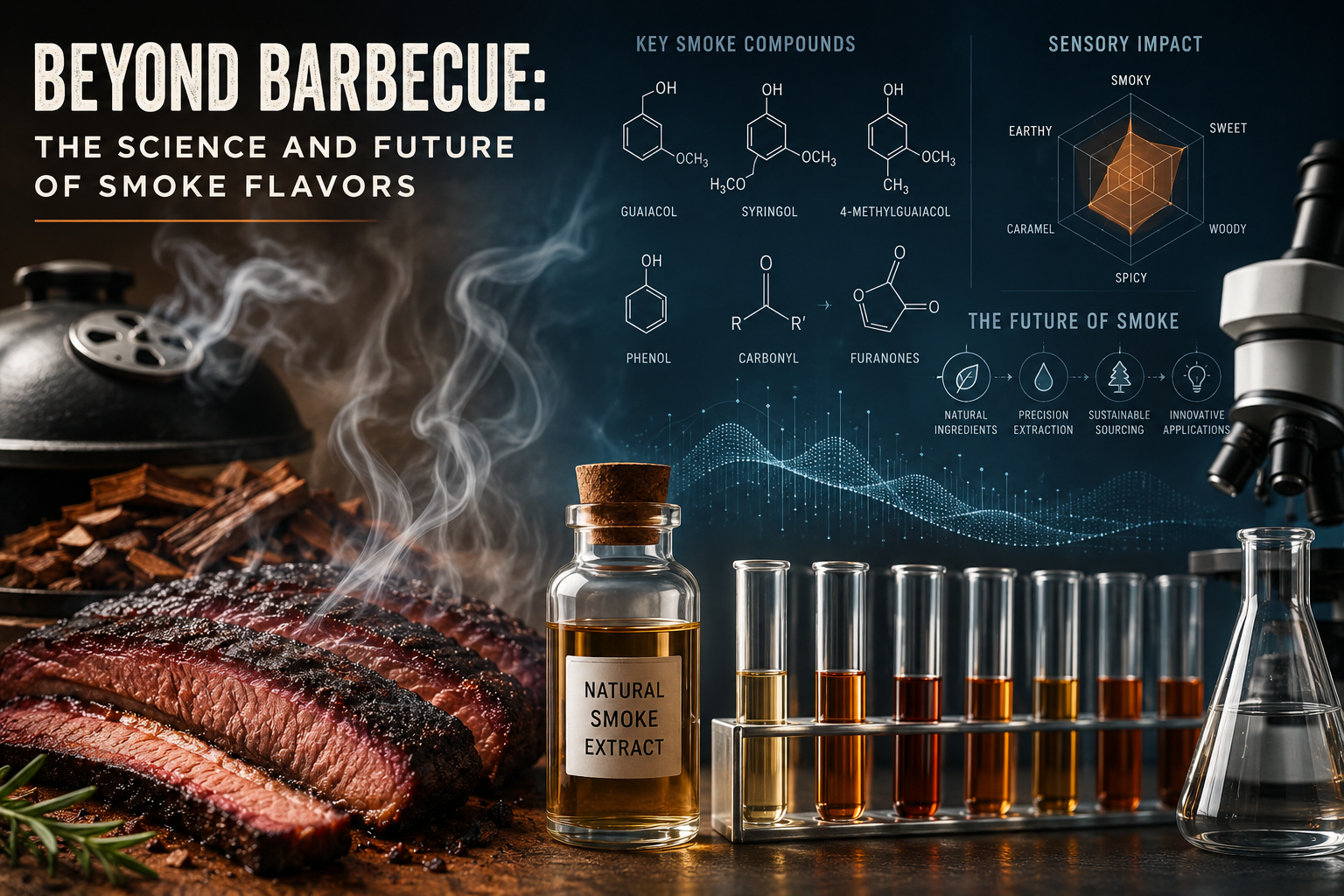
The aroma of wood smoke is generated by the thermal degradation of cellulose, hemicellulose, and lignin. As these structural components break down under controlled temperatures, they produce hundreds of volatile compounds that contribute to the characteristic profile of smoked foods.
Phenolic compounds provide the familiar smoky and medicinal notes, while carbonyl compounds contribute sweet caramelized nuances. Organic acids add brightness and preservative effects, and heterocyclic compounds introduce roasted, toasted, and savory dimensions.
The balance among these compounds depends on numerous variables, including wood species, moisture content, combustion temperature, oxygen availability, and smoke density. The result is that smoke from hickory differs dramatically from oak, applewood, mesquite, or beech—not only in aroma but also in persistence and mouthfeel.
For flavor chemists, understanding these interactions is essential to recreating authentic smoke profiles in a controlled and reproducible manner.
Smoke Without Fire
Commercial smoke flavors are generally produced by condensing natural wood smoke, separating undesirable fractions, and refining the condensate into liquid, powder, or encapsulated formats. This process removes many of the heavier tars while retaining the desirable aroma-active molecules.
Modern purification techniques allow manufacturers to produce cleaner and more consistent smoke flavors than traditional smoking processes, with improved process control and reduced variability.
The ability to standardize smoke intensity is particularly valuable for large-scale food manufacturing, where consistency across production batches is critical.
The Rise of Plant-Based Applications
Few categories have embraced smoke flavors more enthusiastically than plant-based foods.
Consumers often associate smoky notes with grilling, roasting, and protein-rich meals. As a result, smoke flavors play a crucial role in creating the sensory cues that make plant-based burgers, sausages, bacon alternatives, and barbecue products feel familiar and satisfying.
However, success depends on restraint. Excessive phenolic intensity can quickly overwhelm delicate protein systems or amplify off-notes inherent to certain plant proteins. The most successful formulations often combine subtle smoke with Maillard reaction flavors, yeast extracts, umami enhancers, and lipid technologies to create depth without dominance.
Smoke has become less of a headline flavor and more of a structural component within a broader flavor architecture.
Expanding Beyond Savory
Perhaps the most exciting frontier lies outside traditional savory applications.
Craft beverage developers have incorporated smoked botanicals into cocktails and spirits, while chocolatiers use delicate smoke notes to complement cocoa's natural bitterness. Even premium ice creams and caramel desserts have embraced controlled smoke accents to create sophisticated flavor experiences.
These applications demonstrate that smoke functions not only as a taste but also as an emotional cue, evoking campfires, wood-fired ovens, artisanal craftsmanship, and outdoor cooking.
In an era where consumers increasingly seek authenticity and storytelling, smoke delivers both sensory complexity and cultural resonance.
Regulatory and Consumer Considerations
The regulatory landscape surrounding smoke flavors continues to evolve, particularly in regions with stringent food safety requirements. Manufacturers must ensure that smoke-derived ingredients comply with local regulations and are produced through validated processes that minimize undesirable contaminants.
At the same time, consumer demand for transparency is encouraging ingredient suppliers to provide greater clarity regarding sourcing, production methods, and clean-label positioning.
The challenge for flavorists is to balance authenticity, regulatory compliance, and consumer perception while maintaining the desired sensory profile.
Precision Through Technology
Advances in analytical chemistry are transforming the development of smoke flavors.
Gas chromatography-mass spectrometry (GC-MS), olfactometry, and multidimensional analytical techniques enable researchers to identify key aroma-active compounds with unprecedented precision. Combined with sensory science and artificial intelligence-assisted formulation, these tools are accelerating the creation of customized smoke profiles tailored to specific applications and regional taste preferences.
Rather than relying solely on traditional wood sources, future smoke flavors may be engineered with remarkable specificity—designed to complement a particular protein matrix, processing condition, or consumer demographic.
Looking Ahead
Smoke flavors occupy a unique position at the intersection of chemistry, culinary tradition, and consumer psychology. They are simultaneously ancient and innovative, rooted in preservation techniques yet increasingly driven by cutting-edge analytical science.
As food manufacturers seek to deliver richer sensory experiences with greater consistency and sustainability, smoke will continue to evolve from a simple flavor note into a sophisticated design element within modern flavor systems.
For today's flavorists, mastering smoke is not merely about reproducing the aroma of burning wood. It is about understanding how a complex chemical signature can evoke memory, authenticity, craftsmanship, and comfort—all within a few carefully selected molecules.
In that sense, the future of smoke flavors may be less about fire and more about precision.
###