The New Era of Smoke Flavours: How Regulation is Reshaping Innovation
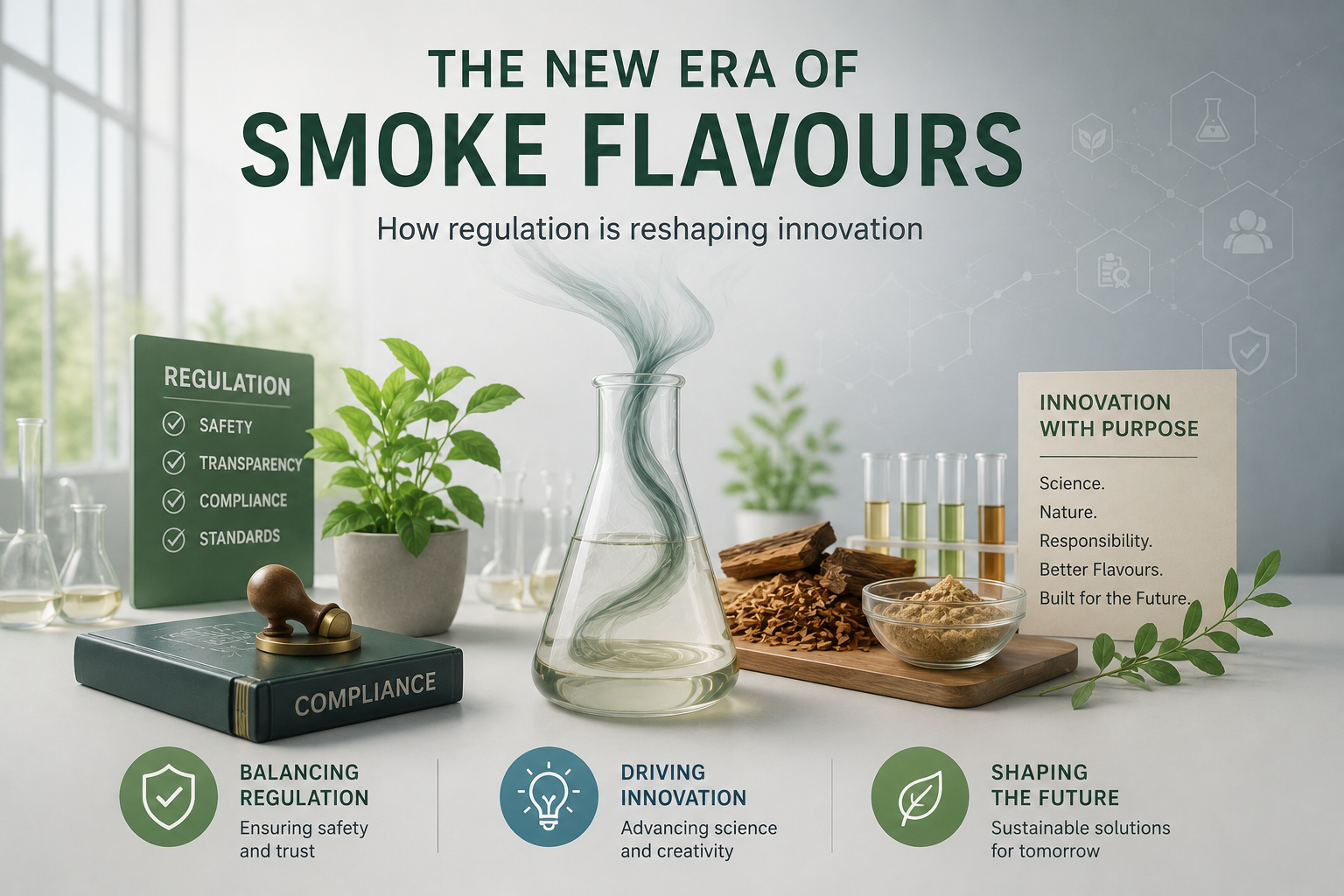
For centuries, smoke has been synonymous with preservation, craftsmanship and culinary tradition. Today, however, smoke flavour is undergoing a profound transformation—not because consumer demand is waning, but because science and regulation are redefining how authentic smoky notes are produced.
The European Union's recent reassessment of smoke flavourings marks a pivotal moment for the flavour industry, challenging ingredient suppliers to rethink conventional technologies and accelerate innovation.
A Regulatory Turning Point
The EU established a harmonized framework for smoke flavourings with Regulation (EC) No. 2065/2003, requiring all primary smoke condensates to undergo rigorous scientific evaluation before authorization for use in food.
Following comprehensive reviews by the European Food Safety Authority (EFSA), concerns were raised regarding the potential genotoxicity of several existing smoke flavouring primary products. Consequently, the European Commission adopted Implementing Regulation (EU) 2024/2067, initiating the withdrawal of the previously authorised smoke flavouring primary products from the Union list while providing transitional periods to allow manufacturers to reformulate products.
For many observers, these developments signalled uncertainty. For innovators, they created an opportunity.
The industry is now moving beyond the traditional concept of capturing smoke toward engineering smoke with greater precision, improved consistency and enhanced safety.
Engineering a Cleaner Smoke
Among the companies embracing this challenge is Besmoke, whose approach reflects a broader shift occurring across the flavour industry.
Rather than simply condensing smoke from controlled combustion, the company has invested in technologies designed to selectively remove undesirable compounds while preserving the volatile molecules responsible for authentic smoky character.
Its proprietary PureTech™ filtration process, developed in collaboration with researchers at the University of Reading Flavour Centre, aims to substantially reduce polycyclic aromatic hydrocarbons (PAHs)—a group of compounds that have long been a focus of toxicological assessment—while maintaining the complexity and depth expected from natural smoke flavour.
The result is not merely a cleaner ingredient but a more consistent one. Greater control over smoke generation and purification enables manufacturers to deliver reproducible flavour profiles across multiple production batches, an increasingly important requirement for global food brands.
Precision Becomes the New Authenticity
Traditionally, smoke flavour development relied heavily on wood selection and combustion parameters. Hickory, oak, beech, applewood and mesquite each contributed distinctive sensory signatures, but natural variability often presented formulation challenges.
Today, advances in analytical chemistry are allowing flavourists to understand smoke at the molecular level.
By combining controlled pyrolysis, selective fractionation and sophisticated purification technologies, developers can fine-tune phenolic intensity, roasted character, sweetness and lingering smoky notes with remarkable accuracy. Smoke is evolving from a broad flavour descriptor into a highly engineered sensory component.
This precision is particularly valuable in applications such as plant-based proteins, where subtle smoke notes can reinforce grilled and roasted perceptions while masking undesirable vegetal characteristics without overwhelming the overall flavour profile.
Sustainability and Consumer Expectations
Consumers increasingly associate smoky flavours with authenticity, artisanal production and open-fire cooking. At the same time, they expect ingredient suppliers to meet higher standards of safety, transparency and environmental responsibility.
These expectations are encouraging manufacturers to adopt cleaner production technologies that maximise flavour efficiency while reducing unwanted process-derived compounds. The industry's response illustrates how regulatory pressure can stimulate technological advancement rather than constrain it.
As manufacturers seek to replace legacy smoke flavourings with next-generation alternatives, investment in advanced filtration, process control and analytical verification is becoming a competitive differentiator.
Looking Ahead
The future of smoke flavour will not be defined solely by the intensity of its aroma but by the sophistication of its design.
Emerging technologies—including advanced chromatography, sensory modelling and artificial intelligence-assisted flavour formulation—are enabling scientists to build smoke profiles with unprecedented precision, tailored to specific food matrices and consumer preferences.
In this new landscape, companies that successfully integrate chemistry, regulatory science and sensory expertise will shape the next generation of smoke flavour solutions.
The story of smoke is therefore no longer just about burning wood. It is about transforming one of humanity's oldest flavour traditions into a modern ingredient platform that meets the demands of regulators, manufacturers and consumers alike.
For flavourists, that journey represents one of the most fascinating intersections of science, technology and culinary heritage—and perhaps the most exciting chapter in the evolution of smoke flavours yet to be written.
###