Citrus for Flavorists — Technical Training Module
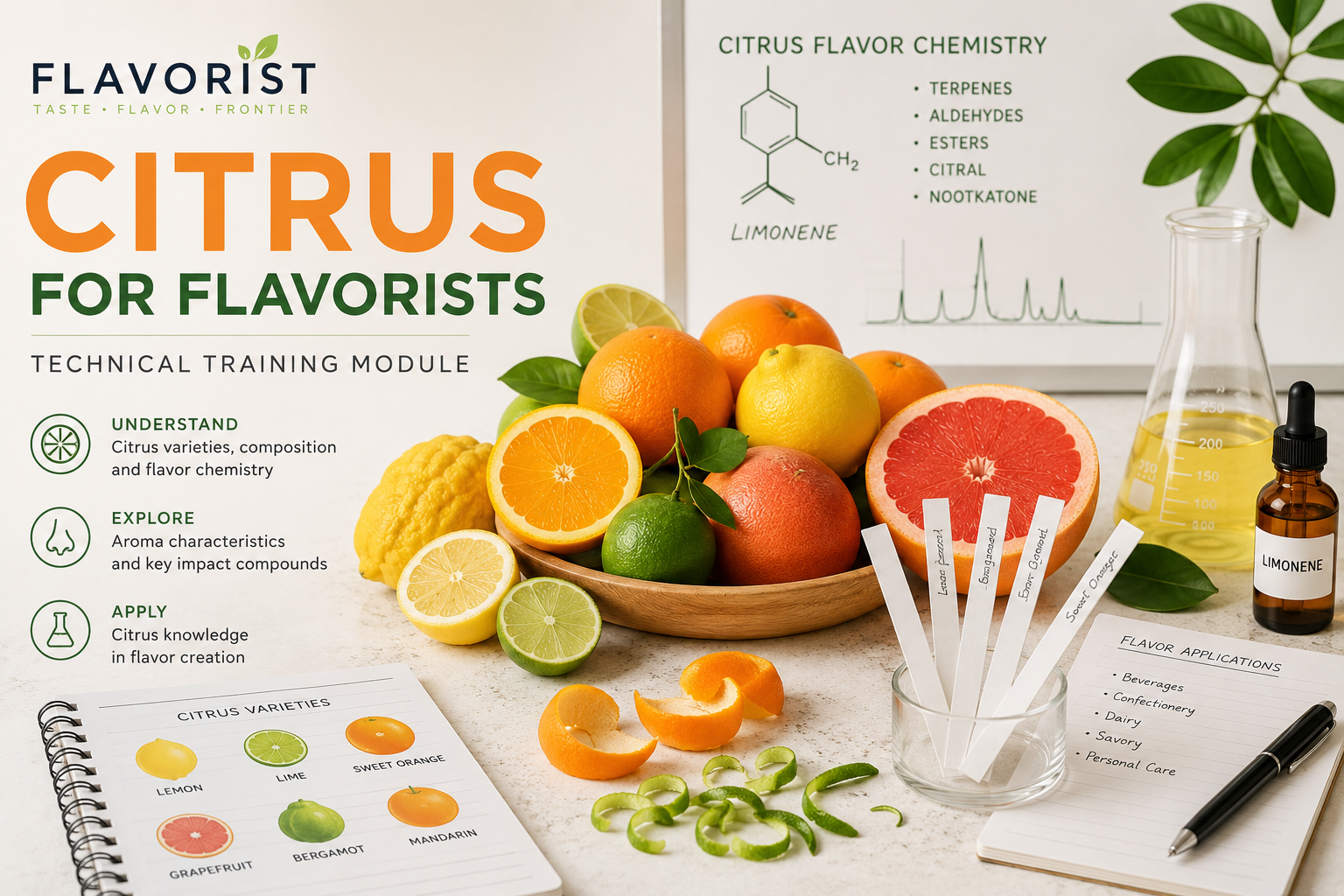
A reference for flavor chemists, application technologists, and R&D trainees working with citrus raw materials.
This training module covers only a few fundamental aspects of citrus raw materials as outlined in the Society of Flavor Chemists examination syllabus, including:
Citrus
- Derivatives and varietals
- Production methods
- Oil folding
- Citrus greening
It is important to note that these topics represent just a small portion of the broader knowledge base that flavorist trainees are expected to develop regarding citrus flavoring materials. For instance, this module does not cover application of citrus materials in flavors.
How to use this module
This module builds from botany to product to defect. Work through it in order: you cannot reason about why a 5-fold orange oil behaves the way it does in a beverage base until you understand where the oil sits in the peel and how it was extracted. Each section ends with Flavorist takeaways — the practical points that should survive after the details fade.
The four pillars covered here are:
- Citrus derivatives and varietals — what the raw materials are
- Methods of production — how the raw materials are made
- Citrus oil folding — how oils are concentrated and stabilized
- Citrus greening — the agronomic threat that shapes supply, price, and quality
1. Citrus Derivatives and Varietals
1.1 The genetic backbone: three ancestral species
Nearly every commercial citrus fruit is a hybrid or back-cross of just three ancestral (wild) species. Understanding this genealogy explains why flavor profiles overlap the way they do.
| Ancestral species | Common name | Flavor character contributed |
|---|---|---|
| Citrus maxima | Pomelo | Body, sweetness, bitter-floral facets, sulfury thiols |
| Citrus reticulata | Mandarin | Soft sweetness, aldehydic "orange" roundness |
| Citrus medica | Citron | Sharp, terpenic, lemon-peel acidity, low juice |
A fourth wild lineage, the papeda group (Citrus micrantha and relatives), contributes to limes and to fragrant Asian citrus such as yuzu.
1.2 Major commercial fruits and their parentage
- Sweet orange (C. sinensis) — a pomelo × mandarin hybrid. The workhorse of the flavor industry. Dominated by limonene with characteristic aldehydes (octanal, decanal), esters, valencene, and the trace character-impact compounds sinensal and wine lactone.
- Bitter / Sour / Seville orange (C. aurantium) — pomelo × mandarin, a different cross. Source of neroli (flower distillate), petitgrain (leaf/twig oil), and the peel oil used in marmalade and liqueur profiles. High in bitter flavonoids.
- Mandarin / Tangerine / Clementine / Satsuma — cultivars and hybrids near C. reticulata. Mandarin oil carries the character-impact compounds methyl N-methylanthranilate (the "candy/grape" mandarin note) and thymol/α-sinensal facets. Cold-pressed mandarin has a distinctive fresh-green top; distilled mandarin is sweeter and rounder.
- Lemon (C. limon) — citron × sour orange. Character driven by citral (geranial + neral), plus β-pinene, γ-terpinene, and trace citronellal. Citral is the make-or-break molecule for lemon character and the most oxidation-sensitive.
- Lime — two commercially distinct types:
- Key / Mexican lime (C. aurantifolia) — papeda-influenced, intense, harsh-fresh; usually distilled for the classic cola/lime profile.
- Persian / Tahiti lime (C. latifolia) — larger, seedless, milder; often cold-pressed.
- Note: distilled lime and expressed lime smell like different materials. Distillation generates cooked/terpene-rearrangement notes (e.g., α-terpineol, 1,4- and 1,8-cineole) that define "lime soda."
- Grapefruit (C. paradisi) — pomelo × sweet orange. Character-impact compound is nootkatone (woody-bitter) plus the ultra-potent sulfur thiol 1-p-menthene-8-thiol (grapefruit mercaptan), detectable at parts-per-trillion.
- Bergamot (C. bergamia) — likely a sour orange × lemon hybrid (genomic marker studies point to lemon as the second parent; citron is sometimes cited instead). Largely non-culinary fruit prized for its oil: linalyl acetate and linalool over a citrus base. The Earl Grey and classic-cologne note. Contains bergapten (a furanocoumarin, phototoxic — relevant for both regulatory and "furanocoumarin-free/FCF" grades).
- Yuzu, Sudachi, Kabosu — aromatic East Asian citrus. Yuzu combines mandarin roundness with grapefruit-like thiols and a distinctive floral-terpene lift; high value, limited supply.
- Calamansi (calamondin) — mandarin × kumquat; sour, aromatic, popular in SE Asian beverage profiles.
- Blood orange — sweet orange pigmented with anthocyanins; aroma adds a raspberry/red-fruit facet on top of orange.
Major Commercial Citrus Species
| Common Name | Scientific Name | Primary Flavor Characteristics |
|---|---|---|
| Sweet Orange | Citrus sinensis | Sweet, juicy, fresh, fruity |
| Lemon | Citrus limon | Bright, acidic, clean, sharp |
| Lime | Citrus aurantiifolia, C. latifolia | Fresh, green, acidic |
| Grapefruit | Citrus paradisi | Bitter, sulfurous, juicy |
| Mandarin | Citrus reticulata | Sweet, floral |
| Tangerine | Mandarin hybrid | Rich, sweet peel |
| Clementine | Mandarin hybrid | Sweet, juicy |
| Bergamot | Citrus bergamia | Floral, tea-like |
| Bitter Orange | Citrus aurantium | Bitter peel, floral |
| Yuzu | Citrus junos | Floral, grapefruit-like |
| Sudachi | Citrus sudachi | Green, herbal |
| Kabosu | Citrus sphaerocarpa | Mild acidic |
| Kaffir Lime (Makrut Lime) | Citrus hystrix | Very green, leafy |
| Pomelo | Citrus maxima | Mild grapefruit |
| Blood Orange | Citrus sinensis varieties | Berry-like, sweet |
1.3 The vocabulary of citrus derivatives
A flavorist must distinguish products by where in the fruit and by what process they originate. These are not interchangeable.
Peel-derived (the flavedo / colored outer peel holds the oil glands):
- Cold-pressed peel oil (essential oil): the primary, most natural-smelling citrus oil. Expressed mechanically, not heated. This is the reference standard for "true to fruit."
- Distilled peel oil: steam- or water-distilled; different profile due to thermal rearrangement. Standard for lime; also used to purify/decolorize.
- Folded oils (2X, 5X, 10X, etc.): terpene-reduced concentrates (see Section 3).
- Terpeneless / sesquiterpeneless oils: oils stripped of monoterpenes and/or sesquiterpenes for solubility and stability.
- Fractions and isolates: specific distillation cuts or purified single compounds (e.g., isolated citral, valencene for conversion to nootkatone).
Juice / aqueous-derived:
- Essence oil (aroma oil / "recovery oil"): the oil-phase aroma recovered when juice is concentrated by evaporation. Smells fresh, "juicy," and top-note-rich — different from peel oil.
- Aqueous essence (water-phase aroma / "essence water"): the water-soluble aroma recovered from the same evaporation step. Contains ethanol, acetaldehyde, low-molecular-weight esters and alcohols — the "just-squeezed" volatiles. Very perishable, low concentration, used to lift juice authenticity.
- Juice concentrate: the non-aroma body; sugars, acids, non-volatiles.
Compounded / labeling terms the flavorist will meet:
- WONF ("With Other Natural Flavors") — a natural citrus flavor rounded out with natural materials from outside the named fruit.
- FTNF ("From The Named Fruit") — all flavor components derive from the named citrus; a premium authenticity claim.
- Type flavors — nature-identical or artificial reconstructions built from aroma chemicals to match a profile at controlled cost/stability.
1.4 Character-impact compounds — the flavorist's shortlist
| Fruit | Key character-impact compound(s) | Sensory note |
|---|---|---|
| Sweet orange | Octanal, decanal, sinensal, valencene | Aldehydic, sweet, peel |
| Mandarin | Methyl N-methylanthranilate, thymol | Candy, grape, warm |
| Lemon | Citral (neral + geranial), citronellal | Sharp, fresh, "lemon" |
| Lime | Citral + terpene rearrangement products | Fresh (pressed) / cola (distilled) |
| Grapefruit | Nootkatone, 1-p-menthene-8-thiol | Woody-bitter, sulfury-fresh |
| Bergamot | Linalyl acetate, linalool | Floral, tea, cologne |
Flavorist takeaways (Section 1):
- Cold-pressed peel oil, essence oil, and aqueous essence are three different smells from the same fruit — know which one a formula needs.
- The most valuable/fragile character sits in trace oxygenated and sulfur compounds, not in the bulk limonene.
- Distilled vs. expressed is a real profile decision, most obvious in lime.
More on Citrus Derivatives
1. Cold-Pressed Citrus Oil
Production: Mechanical expression of peel oil glands without significant heating.
Examples: Orange; Lemon; Lime; Mandarin; Grapefruit; Bergamot; Yuzu.
Major flavor compounds: d-Limonene; β-Pinene; γ-Terpinene; Myrcene; Sabinene; Linalool; Citral; Valencene; Nootkatone.
Characteristics: Most authentic peel aroma; excellent diffusion; highly volatile; oxidation sensitive; seasonal variability.
Applications: Carbonated beverages; juices; confectionery; bakery; dairy; alcoholic beverages; savory seasonings.
Primary function: Citrus backbone; peel identity; natural top note.
2. Folded Citrus Oil
Production: Vacuum distillation removing part of the terpene fraction to concentrate oxygenated compounds.
Examples: 2-fold; 5-fold; 10-fold; 20-fold orange, lemon, lime, and grapefruit oils.
Major flavor compounds: Citral; Linalool; Octanal; Decanal; Valencene; Nootkatone; oxygenated terpenes; reduced d-Limonene.
Characteristics: Stronger aroma; improved beverage stability; reduced oiliness; longer shelf life; lower clouding tendency.
Applications: Carbonated beverages; clear beverages; energy drinks; premium citrus flavors.
Primary function: High-impact citrus flavor; concentrated peel character.
3. Terpeneless Citrus Oil
Production: Removal of most monoterpene hydrocarbons while retaining oxygenated aroma compounds.
Major flavor compounds: Citral; Linalool; Linalyl acetate; α-Terpineol; Valencene; Nootkatone.
Characteristics: Clean citrus profile; reduced harsh peel; excellent clarity; high flavor efficiency.
Applications: Clear beverages; RTD tea; sports drinks; nutraceutical beverages.
Primary function: Clean citrus character; improved beverage performance.
4. Citrus Essence
Production: Recovery of volatile aroma compounds from juice evaporator condensate during concentration.
Major flavor compounds: Ethyl butyrate; Acetaldehyde; Citral; Octanal; Decanal; Ethanol (trace); short-chain esters.
Characteristics: Authentic fresh juice aroma; highly volatile; delicate; natural.
Applications: Juice restoration; premium juices; citrus beverages; NFC juices.
Primary function: Fresh-squeezed juice character.
5. Distilled Citrus Oil
Production: Steam or vacuum distillation of citrus peel oil.
Major flavor compounds: d-Limonene; Citral; Linalool; reduced waxes; reduced pigments; reduced heavy fractions.
Characteristics: Clean; stable; low color; less authentic than cold-pressed oil.
Applications: Beverages; fragrances; functional flavors; household products.
Primary function: Stable citrus top note.
6. Citrus Oleoresin
Production: Solvent or supercritical CO₂ extraction of peel.
Major flavor compounds: Essential oils; waxes; flavonoids; limonoids; carotenoids; terpenes.
Characteristics: Rich peel; highly persistent; heat stable; viscous.
Applications: Savory seasonings; meat coatings; bakery; snack foods.
Primary function: Heat-stable peel character; long-lasting citrus body.
7. Citrus Juice Concentrate
Production: Vacuum concentration of citrus juice.
Major flavor compounds: Natural sugars; organic acids; residual volatile compounds; body components; often reconstituted with citrus essence.
Characteristics: Authentic juice flavor; rich body; reduced top notes.
Applications: Juices; smoothies; dairy beverages; frozen concentrates.
Primary function: Juice body; flavor foundation.
8. Spray-Dried Citrus Powder
Production: Spray drying of citrus oil or juice using encapsulating carriers.
Major flavor compounds: Limonene; Citral; Ethyl butyrate; Linalool; encapsulated citrus volatiles.
Characteristics: Free-flowing; stable; long shelf life; convenient handling.
Applications: Beverage powders; seasoning blends; bakery premixes; instant soups.
Primary function: Dry citrus flavor delivery.
9. Citrus Peel Powder
Production: Drying and milling of citrus peel.
Major flavor compounds: Residual citrus oil; flavonoids; pectin; limonoids.
Characteristics: Natural peel flavor; mild bitterness; fiber-rich; heat stable.
Applications: Bakery; herbal teas; spice blends; functional foods.
Primary function: Authentic peel flavor; visual and nutritional enhancement.
10. Citrus Fiber
Production: Purification of peel fiber following juice extraction.
Major components: Cellulose; hemicellulose; pectin.
Characteristics: Neutral flavor; excellent water binding; improved mouthfeel.
Applications: Dairy; sauces; meat products; plant-based foods.
Primary function: Texture; water retention; mouthfeel.
11. Citrus Pectin
Production: Acid extraction and purification from citrus peel.
Major components: High-methoxyl pectin; low-methoxyl pectin; galacturonic acid polymers.
Characteristics: Odorless; excellent gelling; stabilizing; thickening.
Applications: Jam; jelly; yogurt; fruit preparation; gummies.
Primary function: Gel formation; viscosity; stabilization.
12. Citrus Flavonoid Extract
Production: Extraction from peel and albedo.
Major flavor compounds: Hesperidin; Naringin; Neohesperidin; Diosmin; Rutin.
Characteristics: Bitter; slightly astringent; antioxidant; functional.
Applications: Functional beverages; botanical beverages; nutraceuticals; aperitifs.
Primary function: Bitterness; complexity; health positioning.
13. Citrus Terpene Fraction
Production: Fractional distillation of citrus essential oil.
Major flavor compounds: d-Limonene; α-Pinene; β-Pinene; γ-Terpinene; Sabinene.
Characteristics: Bright; highly volatile; strong diffusion; fresh peel.
Applications: Citrus accords; top-note enhancement; fragrance; beverages.
Primary function: Freshness; peel impact; aroma lift.
14. Citrus Sesquiterpene Fraction
Production: Heavy fraction isolated during citrus oil fractionation.
Major flavor compounds: Valencene; Nootkatone; β-Caryophyllene; α-Humulene.
Characteristics: Rich; low volatility; persistent; warm citrus body.
Applications: Premium beverages; spirits; bakery; savory flavors.
Primary function: Body; depth; persistence.
15. Citrus Aroma Isolates
| Compound | Character | Function |
|---|---|---|
| Citral | Lemon | Identity |
| Valencene | Orange | Body |
| Nootkatone | Grapefruit | Identity; finish |
| Linalool | Floral | Softness |
| Linalyl acetate | Bergamot | Floral elegance |
| Octanal | Orange | Freshness |
| Decanal | Orange | Peel realism |
| Citronellal | Lime | Green freshness |
| α-Terpineol | Citrus flesh | Body |
| β-Pinene | Zest | Fresh peel |
2. Methods of Production
2.1 Where the oil lives
Citrus peel oil is held in balloon-like oil glands (oil sacs) embedded in the flavedo, the colored outer layer of the peel. The white spongy albedo beneath it carries bitter flavonoids and pectin but little oil. Good extraction ruptures the flavedo glands while minimizing contact with albedo, juice, and heat.
2.2 Cold pressing / expression (the primary route for most citrus oils)
Cold pressing is mechanical rupture of the oil glands at ambient temperature, producing the most fruit-true oil. Modern juice plants integrate oil recovery directly into the juicing line. Common equipment:
- FMC / JBT in-line extractor: fingered cups compress the whole fruit; a perforation tube takes juice from the core while peel oil is simultaneously washed off the outside with water, creating an oil-in-water emulsion.
- Brown Oil Extractor (BOE): abrades/rolls the surface of whole fruit to release oil before juicing.
- Pelatrice and Sfumatrice (Mediterranean tradition): the pelatrice abrades the peel surface; the sfumatrice presses already-separated peel. Common for lemon and bergamot.
The recovered oil–water emulsion is then clarified in two stages of centrifugation:
- A desludging / primary centrifuge (finisher) removes peel solids.
- A high-speed polishing centrifuge separates the clean oil phase from the water.
The result is cold-pressed / centrifuged peel oil. Yields are low — on the order of a few kilograms of oil per tonne of fruit — which is why citrus oil price tracks fruit crop conditions closely.
2.3 Essence and aqueous-essence recovery (from the juice side)
When single-strength juice is concentrated into FCOJ (frozen concentrated orange juice) and similar products, the water driven off carries volatile aroma. Plants using TASTE evaporators (Thermally Accelerated Short-Time Evaporators) capture this vapor and condense it, then separate:
- an essence oil (oil phase), and
- an aqueous essence (water phase).
These are prized because they capture "fresh juice" volatiles that cold-pressed peel oil lacks. They are co-products of juice manufacturing, so their availability is tied to juice production volumes.
2.4 Distillation
- Steam distillation volatilizes and re-condenses aroma compounds. Used as the primary method for lime (the signature "cola lime" profile is a distillation artifact) and to produce colorless, more stable oils.
- Neroli is the steam distillate of bitter-orange blossoms; the water co-product is orange flower water.
- Petitgrain is distilled from the leaves and twigs.
- Distillation always risks thermal rearrangement (e.g., generating cineoles, α-terpineol) and loss of the most delicate top notes.
2.5 Extraction and specialty routes
- Solvent extraction / concretes and absolutes: more common in fragrance than flavor; used where heat would destroy character.
- Supercritical CO₂ extraction: near-ambient-temperature extraction with tunable selectivity; yields very clean, top-note-rich extracts without solvent residue or thermal damage. Used for premium citrus and for decaffeination-style selective work. Higher capital cost.
- Winterization: chilling an oil to precipitate and remove waxes and coumarins (the material that would otherwise cloud a cold beverage). Important for producing clear, cloud-stable beverage oils.
2.6 Downstream processing the flavorist should recognize
- Folding / terpene reduction (Section 3).
- Deterpenation and washing to improve water solubility.
- Antioxidant addition (e.g., tocopherols) and nitrogen blanketing / cold storage — citrus oils oxidize readily; storage discipline is part of production quality.
Flavorist takeaways (Section 2):
- Peel oil comes from mechanical expression; essence and aqueous essence are juice-plant co-products — their supply is coupled to juice demand, not oil demand.
- Cold-pressed = most fruit-true; distilled = altered but sometimes the target profile (lime).
- CO₂ and winterization exist to solve heat-damage and cloud problems respectively; reach for them when a brief demands clarity or delicate top notes.
3. Citrus Oil Folding
3.1 The problem folding solves
A raw cold-pressed citrus oil is roughly 90–96% monoterpene hydrocarbons, overwhelmingly d-limonene (plus β-pinene, γ-terpinene, myrcene). These terpenes:
- carry relatively little flavor for their volume,
- are poorly soluble in water/ethanol beverage systems,
- oxidize rapidly to off-notes (carvone, carveol, limonene oxide — "turpentine," "old peel," "cardboard"), and
- can cause cloud, ringing, and flavor fade in finished products.
The oxygenated compounds — aldehydes (citral, decanal, octanal), esters, alcohols, ketones — are where the desirable, fruit-defining flavor lives, and they are more stable and more soluble. Folding concentrates these by removing terpenes.
3.2 What "fold" means
"Fold" expresses the degree of concentration relative to the starting single-fold oil. It is best understood as a ratio of starting volume to finished volume of the oxygenated-enriched oil, driven by how much terpene has been stripped:
- 1X (single-fold): the natural cold-pressed oil, unconcentrated.
- 5X (five-fold): conceptually, terpenes removed such that the flavor-active fraction is concentrated ~5-fold; roughly five parts of single-fold feed yield one part of product.
- 10X and higher: progressively more terpene removed; more concentrated, more stable, more water-compatible.
Fold number is a commercial/technical shorthand, not a precise stoichiometric guarantee; specifications (citral %, optical rotation, GC profile) are what actually define a lot. Always qualify a fold with its analytical spec.
3.3 How folding is done
The dominant method is vacuum fractional distillation:
- The oil is distilled under reduced pressure so it boils at lower temperature, protecting heat-sensitive aldehydes.
- Limonene and other monoterpenes (lower boiling / high volatility as a class) are drawn off as the terpene fraction.
- The oxygenated-rich residue/appropriate cut is retained as the folded oil.
- Repeating or deepening the process raises the fold.
Two related product classes:
- Terpeneless oils: essentially all monoterpenes removed.
- Sesquiterpeneless oils: heavier sesquiterpenes also removed (relevant where those cause haze or heaviness).
Alternative / complementary approaches include liquid–liquid (solvent) partitioning between a polar solvent (e.g., aqueous ethanol) and the terpene phase, and chromatographic / countercurrent techniques for gentle, high-quality concentration where thermal methods would degrade character. The recovered d-limonene is itself a valuable co-product (solvent, cleaning, secondary flavor use).
3.4 Benefits vs. trade-offs
Benefits of folding:
- Higher flavor strength per unit (dose less, ship less).
- Much better water/ethanol solubility → cleaner beverage and clear-liquid applications.
- Greatly improved oxidative and shelf stability (fewer terpenes to go rancid).
- Reduced cloud/ring problems in finished beverages.
Trade-offs / cautions:
- Top-note loss: the terpene fraction, though "low flavor," carries part of the fresh lift; heavily folded oils can smell flatter, "cooked," or less bright than the natural oil.
- Thermal artifacts: repeated distillation can generate off-notes and shift the citral neral/geranial balance in citrus like lemon and lime.
- Profile drift: a 10X is not simply "more of the 1X" — the ratio of surviving components changes, so folded and unfolded oils are not linearly interchangeable.
- Cost: more processing and yield loss → higher price per kg of finished oil.
3.5 Choosing a fold in application
| Application | Typical choice | Why |
|---|---|---|
| Clear/still beverages, hard seltzer | High fold / terpeneless | Solubility + stability, no cloud |
| Cloudy juice drinks | Lower fold or single-fold + emulsion | Cloud is acceptable/desirable; freshness wanted |
| Confectionery, high-heat | Folded | Survives processing, dose economy |
| Fine fragrance-adjacent / "fresh peel" flavor | Single-fold or cold-pressed | Maximum natural top note |
| Long-shelf-life products | Folded + antioxidant | Oxidation control |
Flavorist takeaways (Section 3):
- Folding trades brightness for stability, strength, and solubility by stripping limonene.
- A fold number is a starting point, not a spec — verify by GC and citral %.
- Never assume 5X = "5× of 1X"; the compositional ratios move, so re-balance the formula.
4. Citrus Greening (Huanglongbing, HLB)
4.1 Why a flavorist must care about a plant disease
Citrus greening is the single biggest threat to global citrus supply, and therefore to the price, availability, and quality of every citrus raw material a flavorist uses. Citrus greening or Huanglongbing (HLB) is a devastating disease of citrus worldwide, particularly devastating because of its severe yield reduction in citrus trees followed by tree decline, the absence of resistant citrus varieties, and limited control measures. It directly changes the flavor chemistry of the fruit, so it is both a supply-chain and a bench-level concern.
4.2 The pathogen and its vector
Huanglongbing is caused by the phloem-limited bacterium Candidatus Liberibacter asiaticus (CLas) and is primarily transmitted by the Asian citrus psyllid (Diaphorina citri). The name means "yellow shoot disease." Key facts:
- The bacterium lives in the tree's phloem (nutrient-transport tissue), which is why it is so hard to reach with treatments.
- Three related species exist (Asian CLas, African CLaf, American CLam); the Asian form dominates in Florida and worldwide. The HLB-causing bacterium found in Florida is the Asian species, which occurs in warm low-altitude areas and is transmitted by the Asian citrus psyllid.
- The Asian citrus psyllid feeds on new growth ("flush") and transmits the bacterium; a second vector, the African citrus psyllid (Trioza erytreae), operates elsewhere.
4.3 Symptoms
- Leaves: the diagnostic "blotchy mottle" — an asymmetrical, blotchy yellowing that does not mirror across the leaf midrib (distinguishing it from nutrient deficiency), plus vein yellowing and bright-yellow shoots. Early HLB symptoms on leaves include vein yellowing and an asymmetrical chlorosis referred to as "blotchy mottle," which is the most diagnostic symptom of the disease, especially on sweet orange.
- Fruit: small, lopsided/asymmetrical fruit showing color inversion — the stem (peduncular) end colors while the stylar end (bottom) stays green, the reverse of healthy ripening, which is where the name "greening" comes from. Also small brownish aborted seeds and premature drop. Affected fruit is bitter, sour, and unsalable.
- Tree: progressive decline and eventual death; there is currently no cure. HLB is the most devastating citrus disease worldwide, with no efficient cure currently available.
4.4 Impact on flavor and raw-material quality — the bench-level view
This is the part most relevant to a flavorist. HLB doesn't just reduce how much fruit exists; it degrades what the fruit tastes like:
- Bitterness rises: premature/immature fruit and metabolic disruption elevate bitter limonoids (limonin, nomilin) and bitter flavonoids. HLB-affected fruits become smaller, taste sour and bitter, and are prone to abscission.
- Sugar/acid balance shifts: lower soluble solids (Brix), higher or unbalanced acidity → sour, "unripe," off-balance juice.
- Off-flavors: metallic, medicinal, and harsh green notes reported in affected juice and oil.
- Aroma-compound distortion: studies of symptomatic fruit report lower levels of the desirable oxygenated volatiles (valencene, decanal, ethyl butanoate and other ethyl esters) and higher monoterpenes — i.e., less of the character-defining aroma and more raw terpene. Oils and essences from HLB-stressed groves can therefore drift out of historical specification.
- Immature-fruit effect: because affected fruit drops early, more oil/juice is recovered from under-ripe fruit, compounding bitterness and green character.
Practical consequence: increased lot-to-lot variability. A flavorist should expect natural citrus materials to move around more, tighten incoming-QC specs, and lean harder on blending, WONF/type reconstructions, and aroma chemicals to hold a target profile. As a rough working benchmark, juice studies have found HLB off-flavor can go undetected when symptomatic fruit is only a small share of an otherwise healthy blend (on the order of a quarter), but becomes recognizable above that — a reminder that blending masks the defect only up to a point.
4.5 Current status and management (as of 2025–2026)
There is still no cure, and management is about slowing spread and sustaining trees:
- Vector control: systemic insecticides such as imidacloprid, though resistance to imidacloprid and several other commonly used insecticides has been detected in specific regions.
- Physical exclusion: exclusion netting and Individual Protective Covers (IPCs) have been demonstrated as effective non-insecticide tools to keep psyllids from feeding on young trees.
- Grove hygiene: pathogen-free nursery stock, scouting, and removal of infected trees.
- Therapeutics: trunk-injected antibiotics (e.g., oxytetracycline) are in use, alongside research into new compounds. Pathogen-focused methods under study include antimicrobial compounds, nanoparticle-based delivery, thermotherapy, and metal- or amino-acid–binding proteins, with several therapeutics showing potential.
- Host / genetic approaches: host-level interventions include transgenic citrus expressing antimicrobial proteins and stress- or insect-tolerance genes, plus CRISPR and tolerant-rootstock breeding.
- Detection advances: portable and rapid assays including LAMP, RPA, ddPCR, CRISPR-based tests, and VOC profiling are improving early detection, which is critical because symptoms appear late.
Geographic reality: HLB has moved from Asia through Africa and the Americas. Florida's industry has been severely reduced, and the disease continues to spread in California, where quarantine zones were repeatedly expanded through 2025. In 2025, USDA APHIS and California CDFA repeatedly expanded citrus greening quarantine areas across Orange, Riverside, and San Bernardino Counties following new detections.
4.6 Strategic implications for the flavor house
- Supply/price risk: expect continued tightness and volatility in orange, and knock-on effects in other citrus; build multi-origin sourcing.
- Quality drift: widen and enforce incoming specs (Brix/acid ratio, citral %, limonin/bitterness, GC fingerprint).
- Reformulation resilience: maintain robust nature-identical and WONF "type" versions so profiles can be held when natural oils shift or spike in cost.
- Origin diversification: Brazil, Mediterranean, Mexico, and others carry different exposure and crop timing — useful for hedging.
Flavorist takeaways (Section 4):
- HLB is caused by a phloem bacterium spread by the Asian citrus psyllid, has no cure, and both shrinks supply and degrades flavor (more bitter, sour, green, off-balance).
- Treat natural citrus as a more variable raw material: tighten QC, diversify origins, and keep type/WONF backups ready.
- It is an active, spreading problem (quarantines still expanding in 2025–2026), so sourcing and spec strategy should be reviewed regularly, not set once.
Consolidated glossary
- Flavedo — colored outer peel layer holding the oil glands.
- Albedo — white spongy inner peel; bitter flavonoids, little oil.
- Cold-pressed / expressed oil — mechanically extracted, unheated, most fruit-true.
- Essence oil — oil-phase aroma recovered during juice concentration.
- Aqueous essence — water-phase aroma from juice concentration; fresh, perishable.
- Fold (2X/5X/10X) — degree of terpene reduction / flavor concentration.
- Terpeneless / sesquiterpeneless — oils with mono- and/or sesquiterpenes removed.
- Winterization — chilling to remove waxes/coumarins for clarity.
- WONF / FTNF — labeling terms: "With Other Natural Flavors" / "From The Named Fruit."
- Character-impact compound — the molecule(s) that define a fruit's identity (e.g., nootkatone for grapefruit).
- HLB / Huanglongbing / citrus greening — incurable phloem-bacterial disease vectored by the Asian citrus psyllid.
Prepared as internal flavorist training reference. Citrus greening status reflects 2025–2026 published sources; review periodically as management tools and quarantine maps continue to change.