FDA Puts Caffeine Labeling on Its 2026 Regulatory Agenda as Energy Drink Scrutiny Grows
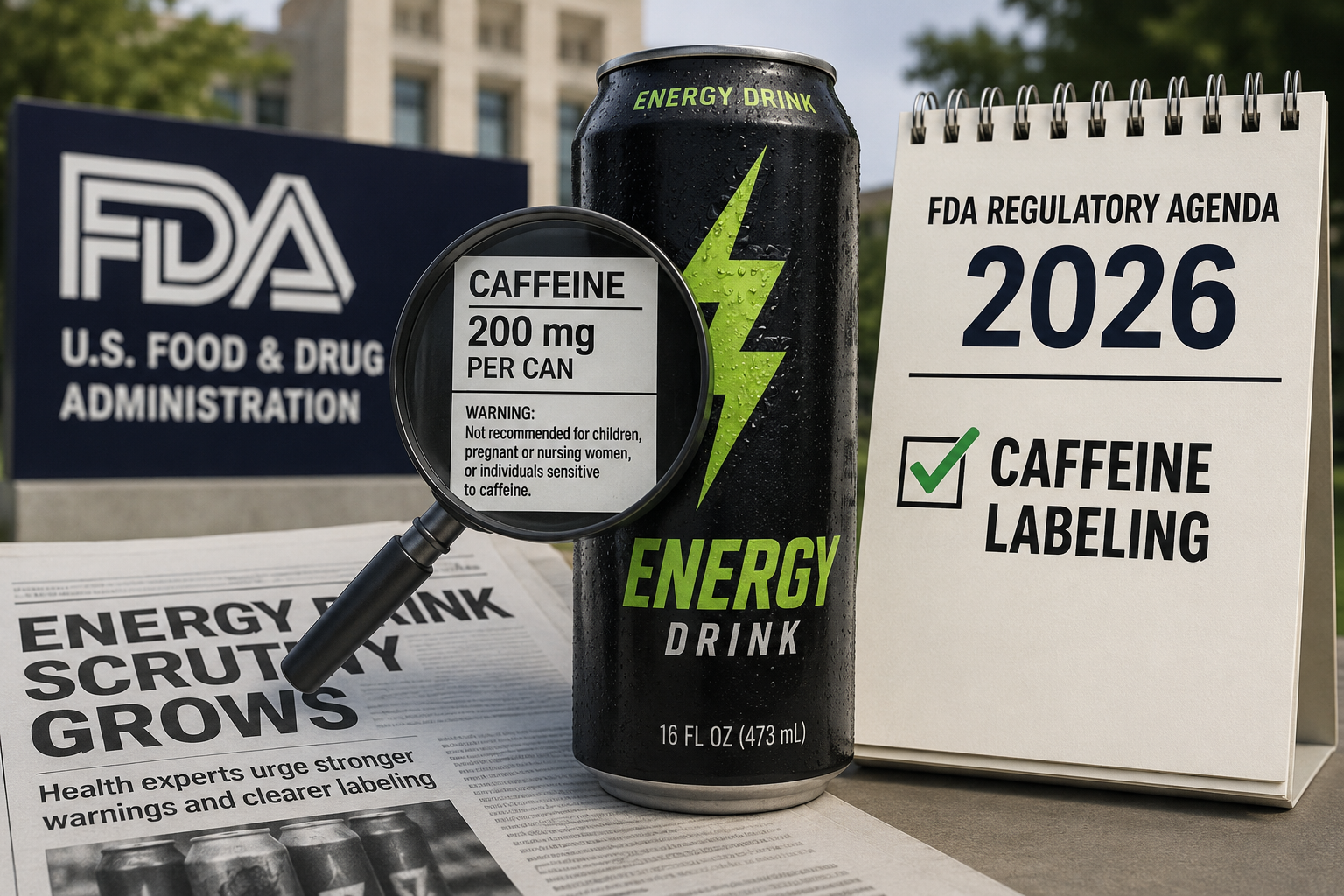
The move follows a wave of lawsuits and state investigations into high-caffeine brands like Celsius and Alani Nu over how they disclose health risks.
Key takeaways
- The U.S. Food and Drug Administration (FDA) has added caffeine labeling guidance to its list of regulatory priorities for 2026.
- The decision arrives amid rising legal and political pressure on energy drink makers accused of downplaying the risks of high caffeine intake, especially for minors.
- Under current rules, companies must list caffeine as an ingredient only when it's added on its own — and they are not required to disclose the exact milligrams a product contains.
- The agenda also revisits the contested "healthy" label claim and broader priorities such as defining ultraprocessed foods and reducing added sugar.
FDA signals new caffeine labeling guidance
The FDA has confirmed that clearer rules for how caffeine content appears on food and beverage packaging are now part of its 2026 regulatory priority list. The agency said it is weighing fresh guidance that could change how — and how much — manufacturers must tell consumers about the caffeine in their products.
The announcement lands at a moment of intensifying scrutiny for energy drinks and other highly caffeinated beverages. Critics, regulators, and plaintiffs' attorneys have increasingly argued that these products fail to adequately warn buyers about potential health effects, with particular concern about their appeal to children and teenagers.
Why now: the Celsius and Alani Nu investigations
Much of the recent pressure has centered on Celsius Holdings, the fast-growing beverage company whose portfolio includes the popular Alani Nu line. In June 2026, Texas Attorney General Ken Paxton opened an investigation into the company after the death of a 17-year-old Alani Nu consumer, who reportedly died from an enlarged heart that was allegedly linked to excessive caffeine consumption.
That case has become a flashpoint in a broader debate about whether energy drink marketing — often built around bright packaging, fitness influencers, and social media reach — draws in younger consumers who may be more vulnerable to caffeine's cardiovascular effects. For regulators, the incident underscores a gap between how much caffeine some products deliver and how clearly that information is communicated on the label.
What the current caffeine rules actually require
To understand why the FDA's move matters, it helps to know how thin today's disclosure requirements really are.
Under existing regulations, packaged foods and drinks must list caffeine in the ingredient statement only when it is added as a standalone ingredient. If caffeine occurs naturally inside another component — say, coffee, tea extract, guarana, cocoa, or chocolate chips — then only that parent ingredient has to appear on the label. The caffeine itself goes unnamed.
In practice, that means a shopper often has to already know which ingredients naturally contain caffeine to gauge what they're consuming. Someone scanning a label for the word "caffeine" might miss it entirely in a product sweetened with chocolate or brewed from coffee.
Just as important: no rule currently forces companies to state the actual amount of caffeine in a serving. Many energy drink brands do disclose milligram counts voluntarily, but that transparency is a choice rather than a legal obligation. And notably, the FDA has never issued regulations written specifically for the energy drink category — leaving a patchwork of general food rules to govern a fast-moving, heavily marketed product segment.
Background: how much caffeine is too much?
Caffeine is one of the most widely consumed stimulants in the world, and for most healthy adults it's considered safe in moderate amounts. The FDA has historically pointed to roughly 400 milligrams a day — about four or five cups of coffee — as a level not generally associated with dangerous effects for healthy adults.
The calculus changes significantly for children and adolescents. Pediatric and health organizations have long cautioned that minors should consume far less, and some recommend that adolescents cap intake well below adult levels, with no caffeine recommended for young children at all. Because a single energy drink can contain 200 milligrams or more, a teenager consuming two in a day can quickly approach or exceed what experts consider prudent — sometimes without any clear sense of the totals involved.
High doses of caffeine can contribute to elevated heart rate, heightened blood pressure, anxiety, sleep disruption, and, in rare and extreme cases, serious cardiac events. Individual sensitivity varies widely, and underlying heart conditions can raise the stakes considerably.
The FDA's history with caffeine enforcement
The agency isn't new to caffeine safety questions, though its past interventions have been fairly targeted. Historically, the FDA has issued warning letters over products it viewed as carrying dangerous caffeine levels, but much of its attention has focused on pure and highly concentrated caffeine sold in bulk powder or liquid form.
Those products posed a particular hazard: because they required consumers to measure and dilute the caffeine themselves, a small mistake in measurement could translate into a toxic — even fatal — dose. In 2018, the FDA tightened its guidance on highly concentrated caffeine to reduce the risk that a mismeasurement or misunderstanding of the instructions could cause serious harm. The current move toward broader labeling guidance would extend the agency's focus from those niche bulk products toward the mainstream beverages millions of people buy off store shelves.
A busy year for FDA food policy
Caffeine labeling is only one item on an ambitious 2026 slate. The agency also flagged plans to clarify guidance around the "healthy" claim — the marketing term brands can use to signal nutritional value.
That issue has its own recent history. The FDA had finalized a rule tightening the criteria for which products can call themselves "healthy," a change that would make the label harder for many packaged foods to earn. But implementation of the rule was delayed, and some industry observers interpreted the pause as a possible opening for the agency to reconsider or revise the underlying definition.
Beyond caffeine and the "healthy" claim, the agency's broader agenda includes efforts to define ultraprocessed foods — a category that has drawn growing scientific and political attention — and to press the food industry to reduce added sugar across products. Taken together, the priorities point to a regulator signaling a more active posture on how food and beverage products are formulated and described to the public.
What it means for brands and consumers
For manufacturers, clearer caffeine labeling guidance could eventually mean new obligations to quantify caffeine on packaging, potentially standardizing what many brands already do voluntarily and closing the loophole around naturally occurring caffeine. For companies whose products lean heavily on high caffeine content, tighter disclosure rules — combined with active state investigations and mounting litigation — represent a meaningful compliance and reputational risk.
For consumers, especially parents, any change that makes total caffeine content easier to find at a glance would address a longstanding transparency gap. As of now, though, the FDA has only signaled that guidance is a priority. It has not issued a final rule, and the details, timeline, and scope of any new requirements remain to be seen.
###