Guide to Vegetable- and Animal-Derived Fats and Oils for Flavorists
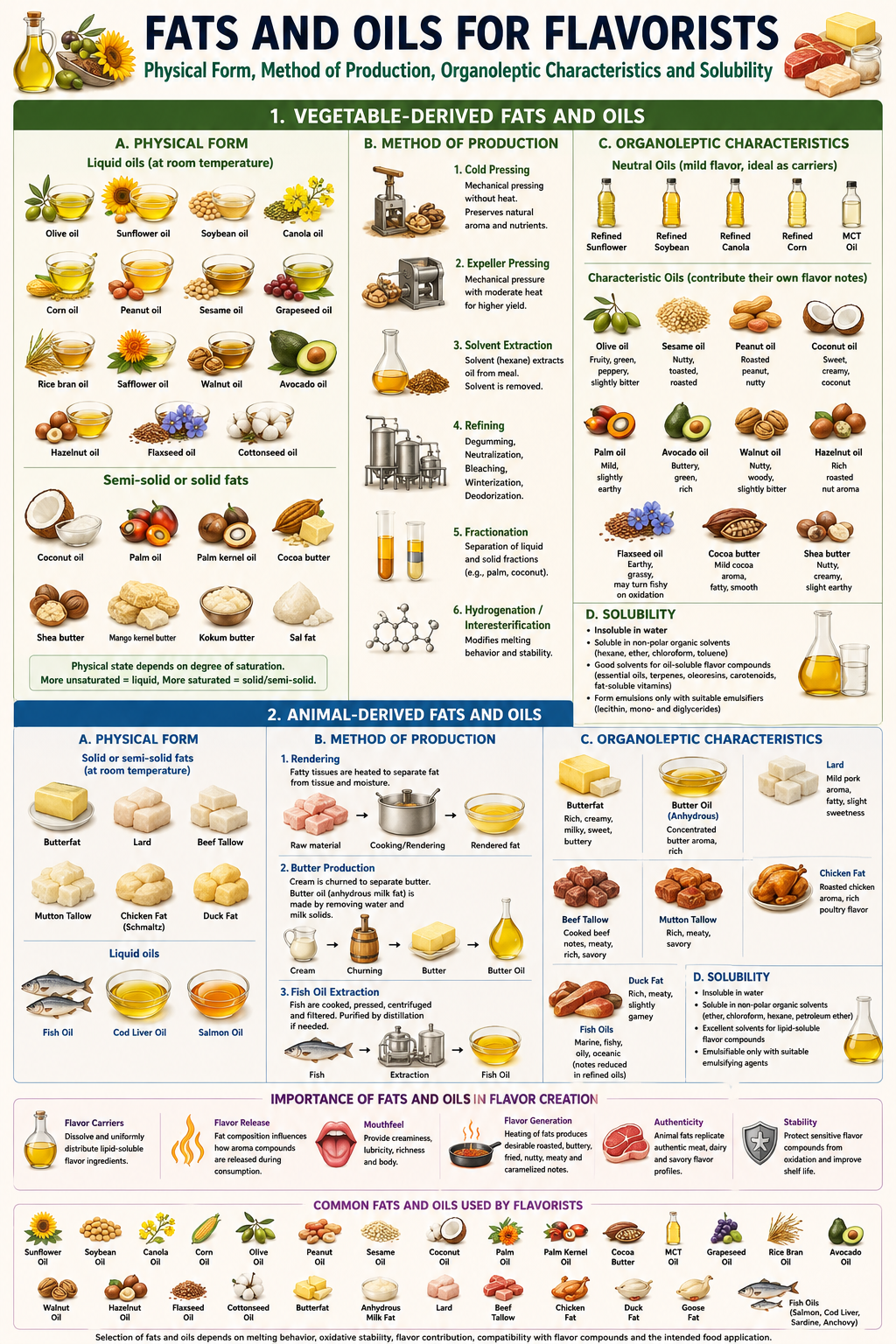
Vegetable- and animal derived fats and oils are one of several categories of flavoring substances that the Society of Flavor Chemists requires certified flavorists to understand thoroughly—particularly in terms of physical forms, production/manufacturing methods, organoleptic properties, and solubility. This topic is explicitly included on the Society’s qualification examination syllabus.
Fats and oils are essential raw materials in flavor creation because they act as carriers for flavor compounds, influence mouthfeel, contribute their own characteristic taste and aroma, and affect the stability and release of volatile compounds. They are broadly classified into vegetable-derived and animal-derived fats and oils.
1. Vegetable-Derived Fats and Oils
Physical Form
Vegetable fats and oils occur as clear liquids, semi-solid fats, or solid fats depending on their fatty acid composition.
- Liquid oils at room temperature (20–25°C):
- Olive oil
- Sunflower oil
- Soybean oil
- Canola (rapeseed) oil
- Corn oil
- Safflower oil
- Peanut oil
- Grapeseed oil
- Rice bran oil
- Sesame oil
- Walnut oil
- Avocado oil
- Hazelnut oil
- Flaxseed (linseed) oil
- Cottonseed oil
- Semi-solid or solid fats:
- Coconut oil
- Palm oil
- Palm kernel oil
- Cocoa butter
- Shea butter
- Mango kernel butter
- Kokum butter
- Sal fat
The physical state depends largely on the degree of saturation. Oils rich in unsaturated fatty acids remain liquid, while those containing higher levels of saturated fatty acids are solid or semi-solid.
Method of Production
Vegetable fats and oils are produced from seeds, nuts, fruits, or kernels using one or more of the following methods:
Cold Pressing
The raw material is mechanically pressed without excessive heat. This method preserves natural aroma compounds, antioxidants, pigments, and delicate flavor notes. Cold-pressed oils are preferred when their natural flavor contributes to the finished product.
Expeller Pressing
Mechanical pressure combined with moderate heat increases oil yield while retaining much of the natural flavor.
Solvent Extraction
Oil remaining after mechanical pressing is extracted using food-grade solvents such as hexane. The solvent is removed before refining. This method provides maximum yield and is widely used for commercial edible oils.
Refining
Most commercial oils undergo several refining steps:
- Degumming
- Neutralization
- Bleaching
- Winterization (for some oils)
- Deodorization
Refined oils have very little taste, odor, or color, making them excellent neutral carriers for flavor compounds.
Fractionation
Palm oil and coconut oil are commonly fractionated into liquid and solid portions with different melting characteristics. Fractionated palm oil liquid portion is commonly used as a solvent.
Hydrogenation and Interesterification
These processes modify melting behavior and oxidative stability. Modern food manufacturing increasingly favors interesterification over partial hydrogenation because it minimizes trans fat formation.
Organoleptic Characteristics
Flavorists must understand the sensory profile of each oil because it influences the final flavor perception.
Neutral Oils
These oils contribute little aroma or taste and are widely used as flavor carriers.
Examples include:
- Refined sunflower oil
- Refined soybean oil
- Refined canola oil
- Refined corn oil
- Refined grapeseed oil
- Medium-chain triglyceride (MCT) oil
Characteristics:
- Nearly colorless to pale yellow
- Mild aroma
- Minimal taste
- Clean oily mouthfeel
Characteristic Oils
These oils contribute their own flavor notes.
Olive oil
- Fruity
- Green
- Peppery
- Slight bitterness
Sesame oil
- Nutty
- Toasted
- Roasted
Peanut oil
- Roasted peanut
- Nutty
- Slight sweetness
Coconut oil
- Sweet
- Creamy
- Coconut aroma
Palm oil
- Mild
- Slightly earthy
- Fatty
Avocado oil
- Buttery
- Green
- Rich
Walnut oil
- Nutty
- Woody
- Slight bitterness
Hazelnut oil
- Rich roasted nut aroma
Flaxseed oil
- Earthy
- Grassy
- Slight fish-like note upon oxidation
Solubility
Vegetable oils are:
- Insoluble in water
- Soluble in non-polar organic solvents such as hexane, ether, chloroform, and toluene
- Good solvents for oil-soluble flavor compounds including essential oils, oleoresins, terpenes, carotenoids, fat-soluble vitamins, and lipid-soluble antioxidants
- Capable of forming emulsions only in the presence of suitable emulsifiers such as lecithin or mono- and diglycerides
2. Animal-Derived Fats and Oils
Physical Form
Most animal fats are solid or semi-solid at room temperature because of their relatively high saturated fat content.
Common examples include:
- Butterfat
- Butter oil (anhydrous milk fat)
- Lard
- Beef tallow
- Mutton tallow
- Chicken fat (schmaltz)
- Duck fat
- Goose fat
Liquid animal oils include:
- Fish oil
- Cod liver oil
- Sardine oil
- Anchovy oil
- Salmon oil
Method of Production
Rendering
Fatty tissues are heated to separate fat from connective tissue and moisture. Rendering may be:
- Dry rendering
- Wet rendering
The rendered fat is filtered, clarified, and sometimes refined.
Butter Production
Butter is produced by churning cream until the fat separates from buttermilk. Butter oil or anhydrous milk fat is obtained by removing water and milk solids from butter.
Fish Oil Extraction
Fish oils are extracted by cooking, pressing, centrifugation, filtration, and purification. Additional molecular distillation may be used to remove impurities and reduce fishy odors.
Organoleptic Characteristics
Animal fats provide unique richness and authentic cooked food notes. Animal fats are key species-defining components of meat flavors. For example, beef flavor profiles often incorporate tallow or beef fat, while chicken fat contributes a distinct, savory poultry note.
Butterfat
- Rich
- Creamy
- Milky
- Sweet
- Buttery
- Slight cooked dairy notes
Butterfat is one of the most important fats used in dairy, bakery, confectionery, and savory flavors.
Butter Oil (Anhydrous Milk Fat)
- Concentrated butter aroma
- Rich mouthfeel
- Excellent flavor release
Lard
- Mild pork aroma
- Fatty
- Slight sweetness
Beef Tallow
- Cooked beef notes
- Meaty
- Rich
- Savory
Frequently used in meat flavor development.
Chicken Fat
- Roasted chicken aroma
- Rich poultry flavor
- Fatty mouthfeel
Duck Fat
- Rich
- Meaty
- Slight gamey character
Fish Oils
- Marine
- Fishy
- Oily
- Oceanic
Highly refined fish oils possess much lower odor intensity and are mainly used for nutritional applications rather than flavor contribution.
Solubility
Animal fats exhibit the same general solubility properties as vegetable oils.
They are:
- Insoluble in water
- Soluble in non-polar organic solvents such as ether, chloroform, hexane, petroleum ether, and benzene
- Excellent solvents for lipid-soluble flavor compounds
- Emulsifiable only with suitable emulsifying agents
Importance of Fats and Oils in Flavor Creation
Flavorists use fats and oils for several important purposes:
- Flavor carriers: They dissolve and uniformly distribute lipid-soluble flavor ingredients.
- Flavor release: Fat composition influences how aroma compounds are released during consumption.
- Mouthfeel: They contribute creaminess, lubricity, richness, and body.
- Flavor generation: During heating, fats undergo oxidation and thermal degradation, producing desirable roasted, buttery, fried, nutty, meaty, and caramelized notes.
- Authenticity: Animal fats such as butterfat, chicken fat, beef tallow, and lard help recreate authentic meat, dairy, and savory flavor profiles.
- Stability: Appropriate oils protect sensitive flavor compounds from oxidation and improve shelf life.
Common Fats and Oils Used by Flavorists
The fats and oils most commonly encountered in flavor formulation include:
- Sunflower oil
- Soybean oil
- Canola (rapeseed) oil
- Corn oil
- Olive oil
- Peanut oil
- Sesame oil
- Coconut oil
- Palm oil
- Palm kernel oil
- Cocoa butter
- MCT oil
- Grapeseed oil
- Rice bran oil
- Avocado oil
- Walnut oil
- Hazelnut oil
- Flaxseed oil
- Cottonseed oil
- Butterfat
- Anhydrous milk fat (butter oil)
- Lard
- Beef tallow
- Chicken fat
- Duck fat
- Goose fat
- Fish oils (salmon, cod liver, sardine, anchovy)
These fats and oils are selected based on their melting behavior, oxidative stability, flavor contribution, compatibility with flavor compounds, and intended food application. Neutral refined oils are preferred when no background flavor is desired, while specialty oils and animal fats are chosen when authentic character and mouthfeel are essential to the final flavor profile.
###