Codex Alimentarius (CA) and the Flavor Industry, What Flavorists Need to Know, according to the Society of Flavor Chemists
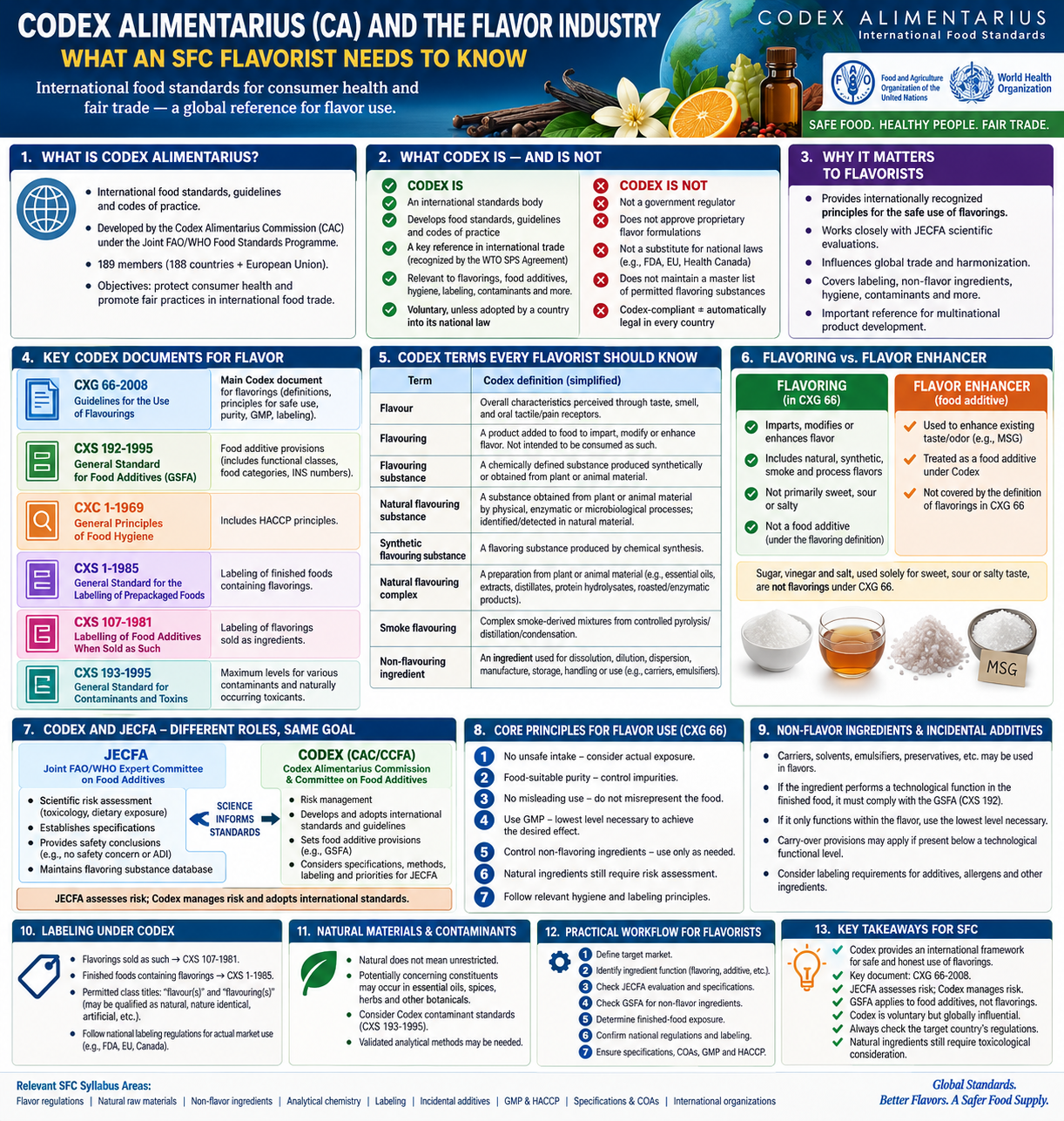
What an SFC flavorist needs to know
The Society of Flavor Chemists January 2026 syllabus places Codex Alimentarius (CA) under “International Organizations and Standards” and says candidates are expected to know its basic scope of work. But Codex also intersects with several other SFC syllabus subjects: international flavor regulations, natural and synthetic flavoring substances, smoke and process flavors, non-flavor ingredients, labeling, incidental additives, analytical methods, HACCP, GMP, specifications, and food-safety considerations.
The short version is:
Codex Alimentarius is the international FAO/WHO “food code.” It does not formulate flavors, approve proprietary flavors, or replace national law. For flavorists, its main importance is that it provides internationally recognized principles for the safe use, composition, hygiene, labeling, and risk management of flavorings and related food additives, working closely with JECFA scientific evaluations.
1. What exactly is Codex Alimentarius?
There are two related terms worth distinguishing.
Codex Alimentarius, literally “food code,” is the collection of internationally adopted food standards, guidelines, and codes of practice. The Codex Alimentarius Commission (CAC) is the intergovernmental body that develops and adopts those texts under the Joint FAO/WHO Food Standards Programme. It was established by FAO and WHO and currently has 189 members: 188 countries plus the European Union. Its objectives are protection of consumer health and fair practices in international food trade. (Codex)
Codex covers much more than flavors: food additives, hygiene, contaminants, pesticide and veterinary-drug residues, labeling, analysis and sampling, import/export certification, and commodity standards. (FAOHome)
Is Codex a law?
No. Codex texts are voluntary international standards. They become legally enforceable only when a country incorporates them into its legislation or regulations. Nevertheless, Codex carries substantial international weight because the WTO Sanitary and Phytosanitary Agreement recognizes Codex food-safety standards as an international benchmark. (FAOHome)
That distinction is extremely important for an SFC candidate:
Codex-compliant ≠ automatically legal in the United States, European Union, Canada, Japan, etc.
A flavorist always needs to check the actual target-market regulations.
2. The most important Codex document for a flavorist
The central document is:
CXG 66-2008 — Guidelines for the Use of Flavourings
Older documents and the original PDF may call it CAC/GL 66-2008; the current Codex naming convention uses CXG 66-2008. The current Codex CCFA listing still identifies it as the principal Codex guideline specifically covering flavorings. (FAOHome)
Its purpose is to provide principles for safe use of flavoring components evaluated by JECFA and considered to present no safety concern at estimated intake, or having established ADIs, together with appropriate identity and purity specifications. It also establishes principles intended to prevent misleading consumers. (FAOHome)
For an SFC exam, this is the Codex document you should associate immediately with flavorings.
3. Codex definitions every flavorist should understand
Codex terminology is useful because it creates an international conceptual framework, although national definitions may differ.
| Codex term | What the flavorist should understand |
|---|---|
| Flavour | The overall characteristics perceived principally through taste and smell, together with oral tactile/pain receptors. |
| Flavouring | A product added to food to impart, modify, or enhance flavor. It is not intended to be consumed as such. |
| Flavouring substance | A chemically defined substance produced synthetically or obtained from plant or animal material. |
| Natural flavouring substance | A flavoring substance obtained by physical, enzymatic, or microbiological processes from plant or animal material; the substance is identified/detected in natural material. |
| Synthetic flavouring substance | A flavoring substance produced by chemical synthesis. |
| Natural flavouring complex | A preparation from plant or animal material obtained by physical, enzymatic, or microbiological processes. Examples include essential oils, extracts, distillates, protein hydrolysates, and products of roasting, heating, or enzymolysis. |
| Smoke flavouring | Complex smoke-derived mixtures obtained through controlled pyrolysis/distillation/condensation processes. |
| Non-flavouring food ingredient | An ingredient used in the flavor for dissolution, dilution, dispersion, manufacture, storage, handling, or use—for example carriers or certain food additives. |
These definitions come directly from CXG 66-2008. The guideline also says that flavorings may include thermal process flavorings and mixtures of the various flavoring categories. (FAOHome)
This connects directly to the SFC syllabus requirement to understand essential oils, extracts, distillates, aroma molecules, smoke condensates, process flavors, spices, oleoresins, and other raw-material categories.
4. An important distinction: flavoring vs. flavor enhancer
This is a good SFC interview trap.
Under Codex, a flavoring and a flavor enhancer are not the same regulatory concept.
CXG 66 specifically excludes flavor enhancers from its definition of flavorings because flavor enhancers are treated as food additives under the Codex food-additive system. It also excludes substances whose purpose is exclusively sweet, sour, or salty, such as sugar, vinegar, and table salt. (FAOHome)
So:
| Material/function | Codex concept |
|---|---|
| Vanilla aroma added to impart vanilla character | Flavoring |
| Strawberry flavor mixture | Flavoring |
| Essential oil used for flavor | Natural flavoring complex |
| Smoke condensate used for flavor | Smoke flavoring |
| Substance used primarily to enhance existing taste/odor | Flavor enhancer → food additive |
| Sugar used strictly for sweetness | Not a flavoring under CXG 66 |
| Acid used solely for sourness | Not a flavoring under this definition |
Do not assume that because something influences sensory perception it automatically belongs to the Codex “flavoring” category.
5. The core rules Codex expects for flavor use
A flavorist should know the central principles of CXG 66-2008:
- Flavor use must not result in unsafe intake. Flavoring components have to be considered in terms of actual exposure, not merely whether they smell or taste acceptable.
- Flavorings must have food-suitable purity. Unavoidable impurities cannot occur at levels that create an unacceptable health risk.
- Flavor use must not mislead the consumer. A flavor can impart or modify flavor, but it should not be used in a way that misrepresents the nature or quality of the food.
- Use GMP and the minimum effective level. The amount of flavoring should be limited to the lowest quantity necessary to obtain the intended flavor effect.
- Non-flavoring ingredients must also be controlled. Carriers, solvents, emulsifiers, preservatives, and similar materials should be used only at levels necessary for manufacture, stability, handling, or use.
- Potentially concerning constituents of natural materials still require risk assessment. Natural origin does not eliminate toxicological considerations.
- Flavorings must also comply with appropriate hygiene and labeling principles.
The phrase worth remembering for the interview is:
“Lowest level necessary to accomplish the desired flavoring effect.”
That is the Codex/GMP concept.
6. Codex and non-flavor ingredients: very relevant to formulation
This subject connects directly to Section IV — Non-Flavor Ingredients in the SFC syllabus, which expects familiarity with solvents, preservatives, emulsifiers, weighting agents, carriers, gums, starches, maltodextrins, sugars, processing aids, acidulants, buffers, labeling, incidental additives, and application-dependent use.
CXG 66 permits non-flavoring food ingredients when necessary to manufacture, store, handle, dilute, dissolve, or disperse the flavor. But there is an important distinction:
If the ingredient functions only inside the flavor
It should generally be used at the lowest level necessary.
If the ingredient performs a technological function in the finished food
Then it must comply with the relevant provisions of the Codex General Standard for Food Additives — GSFA, CXS 192-1995.
For example, conceptually:
A flavor contains an emulsifier simply to keep the flavor concentrate stable. At the final flavor use level, very little emulsifier enters the beverage and it performs no technological function in the beverage.
That is different from intentionally designing the flavor system so that the same emulsifier also performs an emulsifying or cloud-stabilizing function in the finished beverage.
The latter situation can bring the GSFA food-category provisions into play.
7. What is the GSFA?
CXS 192-1995 — General Standard for Food Additives
The GSFA is Codex's international food-additive standard. Its searchable database contains adopted food-additive provisions and allows searching by:
- additive,
- food category,
- functional class,
- and INS number.
It is continually updated as the Codex Alimentarius Commission adopts provisions. (Codex)
A flavorist needs to understand that the GSFA is not a master list of permitted flavoring substances.
That is a common mistake.
The GSFA becomes particularly relevant to flavorists through things such as carriers, emulsifiers, preservatives, antioxidants, stabilizers, sweeteners, colors, acidity regulators and flavor enhancers that may occur in or alongside a flavor system.
8. INS numbers: don't confuse them with flavor approval numbers
Codex maintains the International Numbering System for Food Additives — INS, currently CXG 36-1989.
An INS number identifies a food additive in the Codex food-additive system. It is not the same thing as:
- a FEMA number,
- a JECFA flavoring number,
- a CAS number,
- or proof that a substance is universally legal as a flavor.
The JECFA flavoring database, for example, can be searched separately using flavor name, JECFA number, CAS number, FEMA number, or structural group. (FAOHome)
This is an excellent practical distinction for an SFC candidate to know.
9. Codex vs. JECFA — one of the most important distinctions
Codex and JECFA are closely connected, but they are not the same organization and do not perform the same job.
| Organization/body | Principal role |
|---|---|
| JECFA | Scientific risk assessment: toxicology, dietary exposure, safety evaluation, ADI or other safety conclusions, identity and purity specifications. |
| CCFA — Codex Committee on Food Additives | Primarily risk management for food additives; establishes/recommends provisions, develops priority lists for JECFA assessment, considers specifications, functional classes, methods, labeling, and related standards. |
| CAC — Codex Alimentarius Commission | Adopts Codex standards, guidelines, specifications, and related texts. |
| National authority | Decides what is legally permitted in the particular country or jurisdiction. |
JECFA is an independent scientific expert committee jointly administered by FAO and WHO. It performs risk assessments and provides scientific advice to FAO, WHO, member countries, and Codex. (FAOHome)
CCFA, by contrast, is responsible for matters such as additive maximum levels, priority-setting for JECFA evaluations, functional classification, specifications, analytical methods, and related standards. (FAOHome)
The SFC-level formulation to remember
JECFA assesses risk; Codex manages risk and adopts international standards.
That distinction will prevent several regulatory mistakes.
10. What JECFA has specifically to do with flavors
CXG 66 is explicitly built around JECFA flavor evaluations.
The FAO JECFA database maintains current specifications for evaluated flavoring substances, while the WHO database contains evaluation summaries including toxicological conclusions and evaluation histories. As of September 2026, the WHO database states that it includes updates through the 102nd JECFA meeting, June 2026. (FAOHome)
A flavorist can therefore use JECFA resources to check matters such as:
identity → CAS/JECFA/FEMA identifiers → specification → purity criteria → safety evaluation → evaluation history.
But an important Codex footnote says that failure of JECFA to have evaluated a flavoring component does not automatically mean that the material is unsafe or unacceptable for use in food. (FAOHome)
So this statement is incorrect:
“If JECFA has never evaluated it, Codex says it is unsafe.”
Codex does not say that.
11. Natural flavors are not automatically unrestricted
This is particularly important because the SFC syllabus devotes extensive attention to essential oils, herbs, spices, extracts, citrus oils and other natural materials.
CXG 66 recognizes that a substance of possible health concern may occur:
as a directly added flavoring substance, as a constituent of a natural flavoring complex, or naturally within a food ingredient such as an herb or spice.
When risk-management measures are developed, Codex identifies four important considerations: appropriate risk assessment, demonstration of a specific human-health risk, dietary exposure from all sources, and availability of a validated analytical method.
For a flavorist, this produces an important principle:
“Natural” is a statement about source/process, not a blanket toxicological exemption.
An essential oil may be perfectly normal as a flavor material while one of its naturally occurring constituents still requires exposure assessment or regulatory control.
That directly connects Codex to the SFC syllabus areas of natural materials, GC/MS and other analytical methods, specifications, and regulatory formulation.
12. Codex labeling and flavors
CXG 66 points to two additional labeling standards.
Flavorings sold as such
Codex directs flavoring labeling to CXS 107-1981 — General Standard for the Labelling of Food Additives When Sold as Such.
Finished foods containing flavorings
Finished-food labeling is addressed by CXS 1-1985 — General Standard for the Labelling of Prepackaged Foods.
The current Codex labeling text permits class titles such as “flavour(s)” and “flavouring(s)” and says the expression may be qualified by terms including natural, nature identical, artificial, or combinations as appropriate. (FAOHome)
However, that does not mean a U.S., EU, Canadian, or other national flavor declaration should simply copy Codex terminology. National regulations control the actual commercial label.
For example, the SFC syllabus separately expects knowledge of U.S. 21 CFR 101.22, EU Regulation 1334/2008, Canadian flavor labeling and other jurisdiction-specific requirements.
13. Carry-over and incidental additives
This is another strong connection to the SFC syllabus.
Codex labeling rules recognize carry-over of food additives. If an additive carried through from an ingredient exists in sufficient quantity to perform a technological function in the finished food, it generally requires the appropriate treatment under the labeling framework. If it is present below a technologically functional level, carry-over provisions may apply. (FAOHome)
That maps almost directly onto the SFC syllabus language:
“Flavor vs. finished product” and “Incidental additives.”
A flavorist therefore has to think beyond the composition of the flavor bottle itself:
What enters the finished food? At what concentration? Does it still have a technological function there?
14. Codex, GMP, hygiene and HACCP
CXG 66 says flavorings should be prepared and handled according to the relevant principles of Codex food hygiene.
The foundational document is:
CXC 1-1969 — General Principles of Food Hygiene
It incorporates the HACCP system and explains the science-based approach of identifying significant hazards and appropriate controls rather than depending solely on final-product testing. (FAOHome)
This directly explains why the SFC syllabus places Codex in the same broad section as:
HACCP, specifications, Certificates of Analysis, GMPs and food-safety considerations.
A professional flavorist is not necessarily the HACCP coordinator, but should understand why microbiological, chemical and physical hazards influence raw-material selection, formulation, processing and handling.
15. Contaminants and natural raw materials
Codex's relevance can extend beyond the flavor molecule itself.
CXS 193-1995 — General Standard for Contaminants and Toxins in Food and Feed establishes principles and maximum levels for various contaminants and naturally occurring toxicants in foods moving in international trade. The Codex contaminants program also uses JECFA scientific assessment. (FAOHome)
For a flavorist working with botanicals, spices, extracts, smoke-derived materials or agricultural raw materials, that reinforces the broader principle:
Regulatory evaluation includes both what you intentionally formulate and what may accompany the raw material.
16. The document codes worth recognizing
Older flavor-company files frequently contain legacy Codex names. Know both.
| Older citation you may encounter | Current Codex reference |
|---|---|
| CAC/GL 66-2008 | CXG 66-2008 — Guidelines for the Use of Flavourings |
| CODEX STAN 192-1995 | CXS 192-1995 — General Standard for Food Additives |
| CAC/RCP 1-1969 | CXC 1-1969 — General Principles of Food Hygiene |
| CODEX STAN 1-1985 | CXS 1-1985 — General Standard for the Labelling of Prepackaged Foods |
| CODEX STAN 107-1981 | CXS 107-1981 — Labelling of Food Additives When Sold as Such |
The current Codex CCFA listing uses the modern CXS/CXG designations, while the original 2008 flavoring guideline PDF still contains the historical CAC/GL and CODEX STAN references. (FAOHome)
17. What Codex does not do
| Incorrect statement | Correct SFC understanding |
|---|---|
| “Codex is an international FDA.” | No. It develops international standards and guidance; national governments enforce food law. |
| “Codex approves my flavor formula.” | No. Codex does not approve proprietary flavor formulations. |
| “JECFA and Codex are the same organization.” | No. JECFA performs scientific risk assessment; Codex performs standards/risk-management work. |
| “All flavor substances are listed in the GSFA.” | No. GSFA is principally the food-additive system; flavoring substances are handled differently. |
| “An INS number proves a flavor chemical is approved.” | No. INS identifies food additives in the Codex additive system. |
| “If something is JECFA evaluated, I can use it anywhere.” | No. Target-country law still determines legality and conditions of use. |
| “If JECFA hasn't evaluated a flavor substance, Codex calls it unsafe.” | False; CXG 66 explicitly says the guideline does not imply this. |
| “Natural ingredients don't require toxicological consideration.” | False. Natural flavoring complexes may contain components requiring risk management. |
| “Codex is mandatory law worldwide.” | False. Codex texts are voluntary unless incorporated into national rules. |
| “Flavor enhancer and flavoring mean the same thing.” | No. Codex treats flavor enhancers as food additives. |
18. A flavorist's practical Codex workflow
| Step | Question to ask |
|---|---|
| 1. Identify the intended market | U.S.? EU? Canada? Global? Codex alone is not the final legal determination. |
| 2. Identify the ingredient's function | Flavoring substance, natural complex, smoke flavoring, carrier, emulsifier, preservative, flavor enhancer, etc.? |
| 3. Check JECFA when relevant | Has the flavoring substance been evaluated? What specification and safety conclusion apply? |
| 4. Check the non-flavor ingredients | Does an additive/carrier perform a technological function only in the flavor or also in the finished food? |
| 5. Check GSFA when appropriate | Is the additive allowed for the relevant food category and function? |
| 6. Determine finished-food exposure | What concentration of the flavor and its constituents reaches the consumer? |
| 7. Consider natural-source constituents | Does an oil, extract, spice or botanical contribute a substance requiring risk management? |
| 8. Confirm national law | FDA/FEMA, EU, Canada, etc. still control actual marketability. |
| 9. Confirm labeling | Flavor declaration, carry-over, additive declarations, allergens and other national requirements. |
| 10. Confirm QA/food safety | Specifications, COAs, purity, GMP, HACCP and relevant analytical controls. |
19. How Codex connects to the SFC syllabus
Codex is not an isolated fact to memorize. It connects several SFC curriculum areas.
| SFC syllabus area | Codex connection |
|---|---|
| Categories of Flavoring Substances | Codex definitions of flavoring substances, natural flavoring complexes, smoke flavorings and synthetic/natural substances. |
| Flavor Regulations | Codex provides an international reference framework, while national regulations determine actual legality. |
| Natural Raw Materials | Potentially concerning constituents can arise naturally in oils, spices, herbs and extracts. |
| Analytical Chemistry | Codex risk-management principles contemplate validated methods of analysis. |
| Non-Flavor Ingredients | Carriers, solvents, emulsifiers and other additives may invoke the GSFA. |
| Labeling / Incidental Additives | CXS 1 and carry-over principles become relevant. |
| Flavor Forms / Applications | Finished-food use level and technological function matter. |
| JECFA | Scientific evaluation and specifications underpin much Codex flavor work. |
| HACCP / GMP | Codex hygiene principles are foundational international references. |
| Specifications / COAs | Identity, purity and control of contaminants connect directly to Codex/JECFA concepts. |
That is the level of integration expected from someone demonstrating the working knowledge of regulations, raw materials, production and flavor utilization described by the SFC syllabus.
20. What to memorize for an SFC interview
You should be able to say from memory:
Codex Alimentarius is the FAO/WHO international food-code system administered through the Codex Alimentarius Commission. It protects consumer health and promotes fair food trade. Codex standards are voluntary unless incorporated into national law, but they are important international references and are recognized under the WTO SPS framework. For flavorists, the key document is CXG 66-2008, Guidelines for the Use of Flavourings. It defines flavorings, flavoring substances, natural flavoring complexes and smoke flavorings; requires safe use, food-suitable purity, non-misleading use and GMP; and addresses non-flavoring ingredients, natural-source constituents, hygiene and labeling. JECFA performs the scientific safety evaluation and develops specifications, while Codex performs standards and risk-management functions. Food additives used in or through a flavor may also fall under the GSFA, CXS 192-1995. Codex never replaces the applicable national flavor regulations.
If you can comfortably explain that paragraph, you have the core SFC expectation covered.
Model SFC verbal-interview response
“Codex Alimentarius is the international food-standards system established by FAO and WHO. Its standards are not automatically law, but they provide an important international reference for food safety and trade. For flavorists, the main Codex document is CXG 66-2008, Guidelines for the Use of Flavourings. It covers definitions and principles for safe flavor use, including purity, GMP, non-misleading use, natural flavoring complexes, smoke flavors and non-flavor ingredients. JECFA performs the scientific safety assessments and establishes specifications, while Codex handles the international standards and risk-management framework. A flavorist also needs to know that carriers or additives in a flavor may fall under the GSFA if they perform a technological function in the finished food, and that national regulations always determine the final legality and labeling of a flavor.”
One final current point: the Codex site in 2026 lists CXG 66-2008 as the flavoring guideline, while the GSFA CXS 192-1995 and the food-additive INS text CXG 36-1989 show 2026 updates; separately, WHO's JECFA evaluation database is current through the 102nd JECFA meeting of June 2026. (FAOHome)
###