Deamination in Flavor Systems: Chemistry, Control, Applications, and Shelf-Life Impact
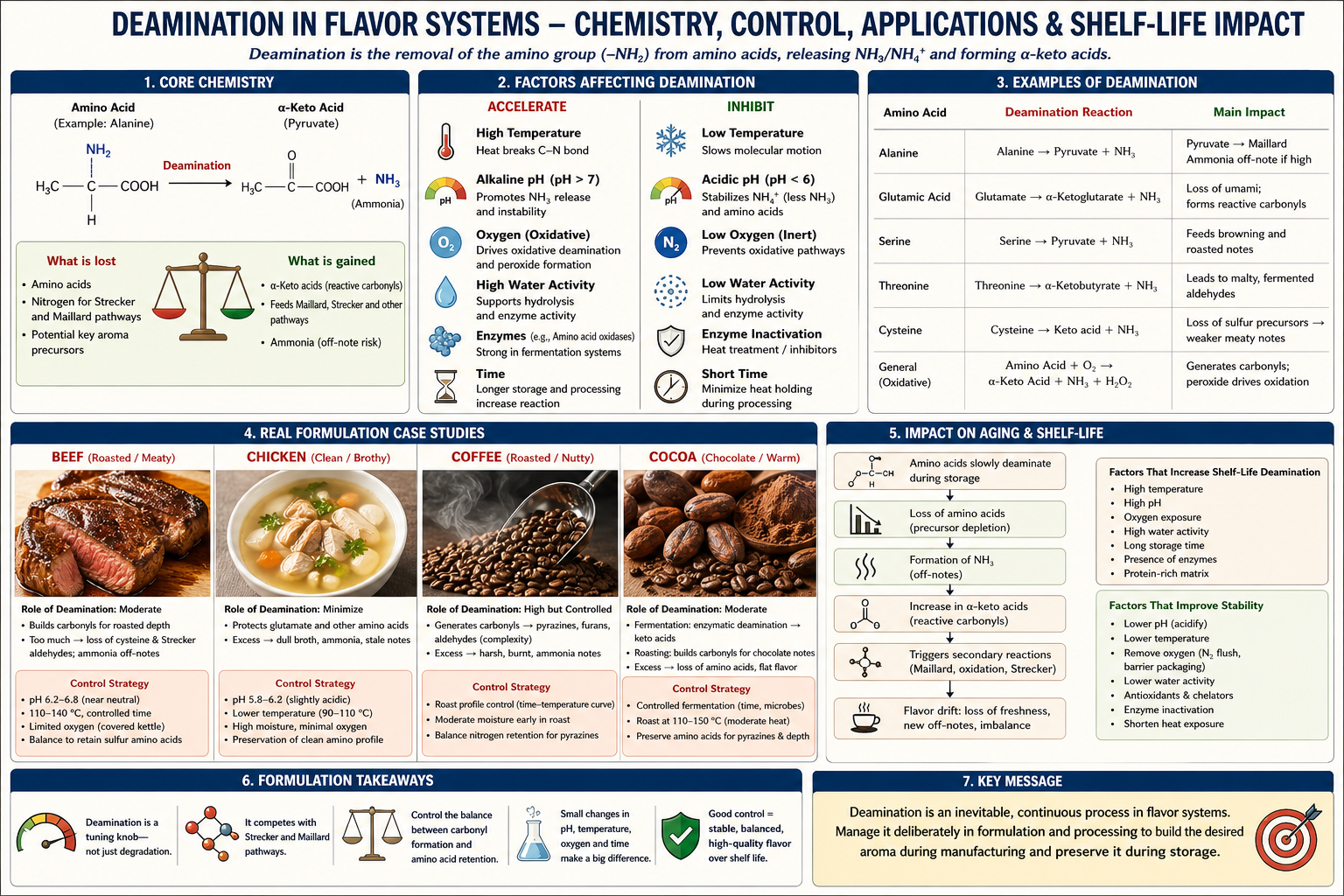
Deamination is among the dozens of chemical reactions and physical processes related to flavors that the Society of Flavor Chemists requires certified flavorists to understand and consider when formulating flavors.
Deamination is a key nitrogen-removal reaction in flavor chemistry, especially important in systems involving amino acids, proteins, and Maillard-derived intermediates. Understanding it helps you predict off-notes (ammoniacal, pungent) as well as precursor depletion for desirable aroma compounds.
COMPLETE GUIDE TO DEAMINATION FOR FLAVORIST TRAINEES
Table of Contents
- What Is Deamination?
- Chemical Groups Involved
- Reaction Conditions Needed
- Step-by-Step Reaction (Leucine Example)
- Factors That Accelerate Deamination
- Factors That Slow Down Deamination
- Examples in Food Flavors
- Effect on Aging & Shelf-Life
- Practical Flavorist Summary
1. What Is Deamination?
Deamination is the removal of an amino group (–NH₂) from a molecule.
In flavor chemistry, this reaction converts amino acids (often tasteless or bitter) into carbonyl compounds (aldehydes, ketones, acids) that are highly flavorful — contributing green, fruity, malty, cheesy, chocolatey, or roasted notes.
General equation:
Amino acid → α-Keto acid (or aldehyde) + NH₃ (ammonia)
2. Chemical Groups Involved
Key Functional Group
- Primary amino group (–NH₂) — typically on the α-carbon of an amino acid
Typical Starting Molecules
- α-Amino acids (e.g., alanine, valine, leucine, isoleucine, phenylalanine, asparagine, glutamine)
New Group Formed After Reaction
- Carbonyl group (=O) — aldehyde or ketone
Byproduct
- Ammonia (NH₃) — pungent, can be an off-note if excessive
3. Reaction Conditions Needed
Deamination occurs under three main types of conditions in food systems:
A. Enzymatic Deamination (Biochemical — natural flavor generation)
| Parameter | Range |
|---|---|
| Temperature | 20–50°C (optimal 30–40°C; enzymes denature above ~60°C) |
| pH | 5.0–7.0 (optimal 5.5–6.5) |
| Water activity | High (>0.9) — enzymes require aqueous environment |
| Oxygen | Required for oxidative deaminases |
| Cofactors | FAD, NAD⁺, or NADP⁺ |
| Enzymes | Deaminases, amino acid oxidases, dehydrogenases |
B. Thermal Deamination (Cooking, roasting, baking)
| Parameter | Range |
|---|---|
| Temperature | >100°C, typically 120–180°C |
| pH | Slightly acidic to neutral (5.0–7.0) |
| Water activity | Low to moderate (0.3–0.7) — too much water suppresses |
| Mechanism | Heat causes elimination of NH₃, forming keto acids or unsaturated compounds |
C. Chemical Deamination (Laboratory synthesis — rare in natural flavors)
| Parameter | Range |
|---|---|
| Reagents | Nitrous acid (HNO₂), hypochlorite, strong oxidizers |
| Temperature | 0–5°C (to control reaction) |
| pH | ~3–4 (for nitrous acid method) |
4. Step-by-Step Reaction (Leucine → 3-Methylbutanal)
This is the most important deamination for flavorists because it produces a powerful malty, chocolate, nutty note.
Starting Molecule: Leucine (at neutral pH)
      CH₃
       |
CH₃ — CH — CH₂ — CH — COO⁻
                 |
                NH₃⁺
Step 1 – Enzymatic oxidation
- Enzyme: Leucine dehydrogenase or amino acid oxidase
- Cofactor: FAD or NAD⁺ removes two hydrogens
Step 2 – Formation of imine intermediate
Water attacks, releasing NH₃
Intermediate (α-imino acid):
      CH₃
       |
CH₃ — CH — CH₂ — C — COO⁻
                 ||
                 NH
Step 3 – Hydrolysis to keto acid
Water replaces C=NH with C=O
Product: α-Ketoisocaproic acid
      CH₃
       |
CH₃ — CH — CH₂ — C — COO⁻
                 ||
                 O
Step 4 – Spontaneous decarboxylation (heat or enzyme)
Loss of CO₂ forms the aldehyde
Final product: 3-Methylbutanal (isovaleraldehyde)
      CH₃
       |
CH₃ — CH — CH₂ — CHO
Flavor description: Intensely malty, cocoa, nutty, slightly green at low dilution.
5. Factors That Accelerate Deamination
| Factor | Acceleration Range | Why It Works |
|---|---|---|
| Heat | 30–50°C (enzymatic), >120°C (thermal) | Provides activation energy; reaction rate doubles every 10°C |
| pH 5.0–7.0 | Optimal 5.5–6.5 | Amino group not fully protonated; enzymes active |
| Water (moderate) | Aw >0.9 (enzymatic), 0.4–0.7 (thermal) | Water acts as nucleophile for hydrolysis step |
| Oxygen | Present for oxidative deaminases | Electron acceptor, regenerates cofactors |
| High free amino acids | High concentration | More substrate available |
| Cofactors (FAD, NAD⁺) | Present | Essential for oxidative deamination |
| Metal ions (Mg²⁺, Mn²⁺, Zn²⁺) | Trace amounts | Enzyme cofactors for some deaminases |
6. Factors That Slow Down Deamination
| Factor | Inhibition Range | Why It Slows |
|---|---|---|
| Low temperature | <20°C (enzymatic), <80°C (thermal) | Reduces molecular motion and enzyme activity |
| Extreme pH | <4.0 or >8.5 | Amino group protonated (<4); enzymes denature (>8.5) |
| Very dry | Aw <0.3 | No water for hydrolysis; no molecular mobility |
| Anaerobic | No oxygen | Oxidative deaminases cannot function |
| Low amino acids | Low concentration | Limited substrate |
| High salt | >5% NaCl | Denatures enzymes, lowers water activity |
| Sulfites (SO₂) | Present | React with carbonyl products, shift equilibrium |
| Heavy metals (Cu²⁺, Hg²⁺) | Contamination | Bind to enzyme active sites |
7. Examples in Food Flavors
Cheese Ripening
| Cheese | Amino Acid | Aldehyde Produced | Flavor Note |
|---|---|---|---|
| Blue cheese | Leucine | 3-Methylbutanal | Malty, chocolate |
| Camembert/Brie | Phenylalanine | Phenylacetaldehyde | Honey, floral |
| Parmesan | Glutamic acid | α-Ketoglutaric acid | Umami modulation |
Conditions: 8–14°C, pH 5.5–6.0, aerobic, 2–12 months aging
Fermented Meats
| Product | Amino Acid | Aldehyde | Flavor Note |
|---|---|---|---|
| Dry salami | Valine | 2-Methylpropanal | Fruity, winey |
| Parma ham | Isoleucine | 2-Methylbutanal | Fruity, cocoa |
Conditions: 15–20°C, Aw 0.85–0.90, pH 5.0–5.5, 2–6 months
Cocoa & Coffee Roasting
| Product | Amino Acid | Aldehyde | Flavor Note |
|---|---|---|---|
| Roasted cocoa | Leucine | 3-Methylbutanal | Chocolate, malty |
| Light roast coffee | Phenylalanine | Phenylacetaldehyde | Floral, cherry |
Conditions: 120–160°C, low moisture (Aw 0.3–0.5), pH 5.0–5.5
Bread & Beer
| Product | Amino Acid | Aldehyde | Flavor Note |
|---|---|---|---|
| Bread crust | Leucine | 3-Methylbutanal | Malty crust |
| Ale beer | Leucine | 3-Methylbutanal | Malty ale character |
| Lager beer | Valine | 2-Methylpropanal | Fruity, winey |
Soy Sauce & Miso
| Amino Acid | Aldehyde | Flavor Note |
|---|---|---|
| Leucine | 3-Methylbutanal | Malty, chocolate |
| Phenylalanine | Phenylacetaldehyde | Honey, floral |
| Valine | 2-Methylpropanal | Fruity, winey |
| Isoleucine | 2-Methylbutanal | Fruity, cocoa |
Conditions: 25–35°C, pH 5.0–6.0, 10–15% NaCl, 3–12 months aging
Cooked Vegetables
| Vegetable | Amino Acid | Product | Flavor Note |
|---|---|---|---|
| Potatoes (fried) | Asparagine | Acrylamide + NH₃ | Fried (off-note if excessive) |
| Cabbage/mushrooms (boiled) | Glutamine | Glutamic acid + NH₃ | Umami enhancement then loss |
8. Effect on Aging & Shelf-Life
Deamination is a double-edged sword in flavor aging and shelf-life.
The Dual Role Over Time
| Phase | Effect | Sensory Result |
|---|---|---|
| Early aging (days to weeks) | Creates new aldehydes | Desirable aged character |
| Mid aging (weeks to months) | Aldehydes peak, ammonia appears | Complex, rich, savory |
| Late aging (months+) | Aldehydes degrade; ammonia dominates | Flavor loss, off-notes |
Positive Effects (Controlled Aging)
Aged Cheddar (3–12 months):
- Deamination of leucine → malty, nutty notes
- Peak at 6–9 months
- Decline after ~12 months (aldehyde oxidation)
Dry-Aged Beef (21–60 days):
- Deamination of valine → fruity, winey notes
- Optimal window: 21–45 days
- Beyond 60 days: ammonia build-up → cheesy off-note
Roasted Cocoa (post-roast):
- Fresh: high 3-methylbutanal (chocolate)
- 3–6 months: aldehyde loss of 30–50% → flat flavor
Negative Effects (Extended Shelf-Life)
| Problem | Cause | Result |
|---|---|---|
| Ammonia build-up | Continued deamination | Pungent, urine-like (detectable at 5–10 ppm) |
| Aldehyde oxidation | O₂ exposure | 3-Methylbutanal → 3-methylbutanoic acid (sweaty, rancid) |
| Aldol condensation | Aldehydes react with each other | Resinous, stale, loss of fresh notes |
| Imine formation | Aldehyde + NH₃ | Bitter, metallic, loss of floral notes |
| Volatile loss | Small aldehydes evaporate | Loss of top notes |
Shelf-Life Half-Life Examples
| Flavor Component | Storage Condition | Half-Life |
|---|---|---|
| 3-Methylbutanal in savory powder | 25°C, sealed, no O₂ | 6–9 months |
| 3-Methylbutanal in savory powder | 40°C, humid, air | 1–2 months |
| 3-Methylbutanal in savory powder | 4°C, vacuum packed | >18 months |
| 3-Methylbutanal in oil-based flavor | 25°C, air | ~3 months |
Monitoring Deamination During Shelf-Life
| Test | What It Measures | Acceptable Limit |
|---|---|---|
| Headspace GC-MS for aldehydes | Aldehyde remaining | >50% of initial |
| Ammonia test strip / ion chromatography | NH₃ concentration | <10 ppm in aqueous phase |
| pH drift | pH increase >0.5 units | Sign of excessive deamination |
| Sensory panel | Malty vs. ammonia perception | Malty dominant, ammonia absent/trace |
9. Practical Flavorist Summary
If You Want to Accelerate Deamination (for flavor development)
- Increase temperature to 30–50°C (enzymatic) or >120°C (thermal)
- Adjust pH to 5.5–6.5
- Ensure moderate water activity (0.4–0.7 for thermal; >0.9 for enzymatic)
- Provide oxygen for oxidative deaminases
- Add proteases first to release free amino acids
- Use cofactor-rich materials (e.g., yeast extract)
If You Want to Slow or Stop Deamination (for shelf-life extension)
- Keep cold (<10°C) or freeze
- Adjust pH below 4.0 or above 8.5 (if product allows)
- Reduce water activity below 0.65
- Remove oxygen (vacuum pack, N₂ flush)
- Add salt (>5%) or sulfites
- Heat to denature enzymes (85°C+ for 10 min, or HTST)
- Add antioxidants (BHA, BHT, tocopherols, rosemary extract)
If You Want Controlled Aging (cheese, cured meat, reaction flavors)
- Allow limited deamination at cool temperatures (4–15°C)
- Monitor ammonia and aldehyde levels regularly
- Ship or consume at peak (typically 2–6 months for most products)
- For reaction flavors: complete the reaction during production (heat inactivate enzymes); shelf-life then limited by aldehyde stability, not continued deamination
Key Thresholds to Remember
| Parameter | Value |
|---|---|
| Ammonia detection threshold | 5–10 ppm in water |
| 3-Methylbutanal flavor threshold | 1–2 ppm in water |
| Temperature for enzyme denaturation | >60°C (most deaminases) |
| Optimal pH for deamination | 5.5–6.5 |
| Water activity for thermal deamination | 0.4–0.7 |
| Water activity for enzymatic deamination | >0.9 |
Quick Reference Card
DEAMINATION: REMOVAL OF –NH₂ FROM AMINO ACIDS → ALDEHYDES + NH₃

ACCELERATES:                          SLOWS DOWN:
✓ 30–50°C (enzymatic)                 ✗ <20°C
✓ >120°C (thermal)                    ✗ <80°C (thermal)
✓ pH 5.0–7.0                          ✗ pH <4.0 or >8.5
✓ Aw 0.4–0.7 (thermal)                ✗ Aw <0.3
✓ Aw >0.9 (enzymatic)                 ✗ Anaerobic
✓ Oxygen present                      ✗ High salt (>5%)
✓ High free amino acids               ✗ Sulfites present

KEY FLAVOR PRODUCTS:
Leucine        → 3-Methylbutanal      (malty, chocolate)
Valine         → 2-Methylpropanal     (fruity, winey)
Isoleucine     → 2-Methylbutanal      (fruity, cocoa)
Phenylalanine  → Phenylacetaldehyde   (honey, floral)

SHELF-LIFE WARNING:
Deamination continues slowly in stored products → ammonia build-up + aldehyde loss
→ Store cool, low O₂, low Aw, or denature enzymes