Noteworthy: How to Make a Flavor Taste Riper
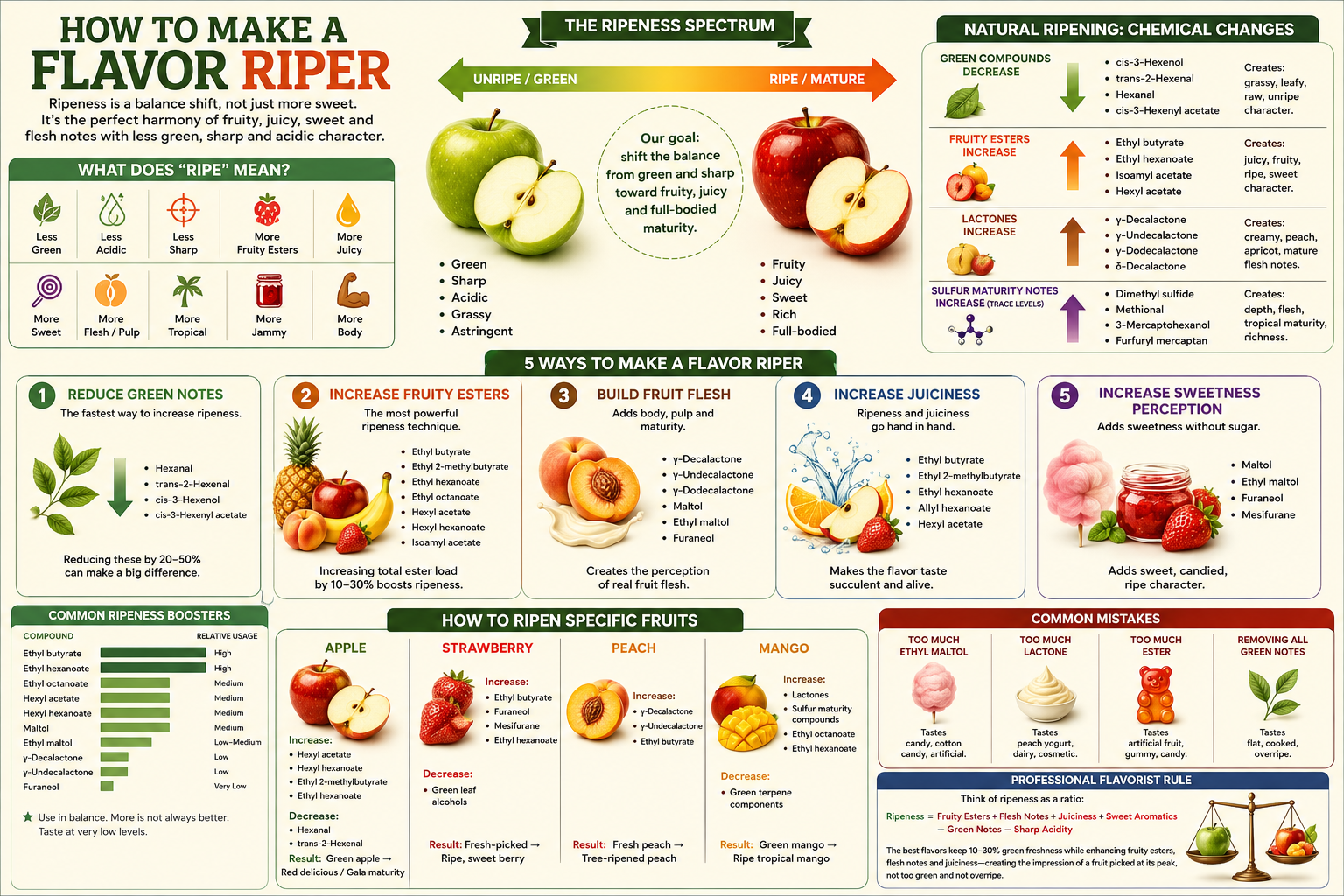
This is one of manipulations that the Society of Flavor Chemists requires certified flavorists to do when they formulate or modify a flavor. Here is the general guideline for flavorist trainees.
"Ripeness" is one of the most important concepts in flavor creation. A ripe flavor is not simply sweeter. It is the sensory impression that a fruit has reached peak maturity, where sugars, esters, lactones, sulfur compounds, terpenes, and texture signals are balanced.
A green apple and a ripe apple may contain many of the same molecules, but the ratios are very different.
What Does "Ripe" Mean to the Human Brain?
When consumers describe a flavor as ripe, they are usually perceiving:
- Less green
- Less acidic
- Less sharp
- More fruity esters
- More juicy character
- More sweetness
- More body
- More flesh/pulp character
- More tropical nuances
- More cooked or jammy nuances (at higher levels)
Ripeness is therefore a balance shift rather than a single flavor note.
Main Chemical Changes During Natural Fruit Ripening
As fruits ripen:
Green compounds decrease
Examples:
- cis-3-Hexenol
- trans-2-Hexenal
- Hexanal
- cis-3-Hexenyl acetate
These compounds create:
- grassy
- leafy
- raw
- unripe
character.
Fruity esters increase
Examples:
- Ethyl butyrate
- Ethyl 2-methylbutyrate
- Ethyl hexanoate
- Ethyl octanoate
- Hexyl acetate
- Hexyl butyrate
- Isoamyl acetate
These create:
- juicy
- fruity
- ripe
- sweet
character.
Lactones increase
Examples:
- γ-Decalactone
- γ-Undecalactone
- γ-Dodecalactone
- δ-Decalactone
These create:
- creamy
- peach
- apricot
- mature fruit flesh
notes.
Sulfur maturity notes increase
Especially in:
- mango
- passion fruit
- guava
- tropical fruits
Examples:
- Dimethyl sulfide
- Methional
- Furfuryl mercaptan (trace)
- 3-Mercaptohexanol
At trace levels they create:
- depth
- flesh
- maturity
Five Ways Flavorists Increase Ripeness
Method 1: Reduce Green Notes
This is often the fastest method.
Reduce:
| Compound | Effect |
|---|---|
| Hexanal | Green apple |
| trans-2-Hexenal | Leafy |
| cis-3-Hexenol | Fresh cut grass |
| cis-3-Hexenyl acetate | Green fruity |
Reducing these by 20-50% often makes a flavor seem significantly riper.
Method 2: Increase Fruity Esters
Most powerful ripeness technique.
Examples:
| Compound | Typical Effect |
|---|---|
| Ethyl butyrate | Ripe juicy fruit |
| Ethyl hexanoate | Sweet ripe flesh |
| Ethyl octanoate | Mature fruit |
| Hexyl acetate | Apple/pear maturity |
| Hexyl hexanoate | Full ripe apple |
| Ethyl 2-methylbutyrate | Juicy maturity |
For many fruit flavors:
Increasing total ester load by 10-30% produces a noticeable ripening effect.
Method 3: Build Fruit Flesh
Many flavors smell fruity but lack fruit flesh.
Fruit flesh compounds include:
| Compound | Character |
|---|---|
| γ-Decalactone | Peach flesh |
| γ-Undecalactone | Apricot flesh |
| γ-Dodecalactone | Tropical flesh |
| Maltol | Sweet flesh |
| Ethyl maltol | Candied ripe flesh |
| Furaneol | Strawberry flesh |
Adding flesh notes creates the perception of maturity.
Method 4: Increase Juiciness
Consumers often confuse:
- juicy
- ripe
because they occur together naturally.
Useful materials:
| Compound | Character |
|---|---|
| Ethyl butyrate | Juicy |
| Ethyl 2-methylbutyrate | Juicy apple |
| Ethyl hexanoate | Juicy tropical |
| Allyl hexanoate | Pineapple juice |
| Hexyl acetate | Juicy pear |
Method 5: Increase Sweetness Perception
Not actual sweetness.
Sweet aroma materials:
| Compound | Effect |
|---|---|
| Maltol | Sweet ripe fruit |
| Ethyl maltol | Candy-ripe |
| Furaneol | Jammy ripe |
| Mesifurane | Strawberry ripe |
These create maturity without adding sugar.
Compounds Commonly Used as Ripeness Boosters
Universal Ripeness Boosters
| Compound | Relative Usage |
|---|---|
| Ethyl butyrate | High |
| Ethyl hexanoate | High |
| Ethyl octanoate | Medium |
| Hexyl acetate | Medium |
| Hexyl hexanoate | Medium |
| Maltol | Medium |
| Ethyl maltol | Low-Medium |
| γ-Decalactone | Low |
| γ-Undecalactone | Low |
| Furaneol | Very Low |
How to Ripen Specific Fruits
Apple
Increase:
- Hexyl acetate
- Hexyl hexanoate
- Ethyl 2-methylbutyrate
- Ethyl hexanoate
Decrease:
- Hexanal
- trans-2-Hexenal
Result:
From green apple → red delicious / gala maturity.
Strawberry
Increase:
- Ethyl butyrate
- Furaneol
- Mesifurane
- Ethyl hexanoate
Reduce:
- Green leaf alcohols
Result:
From fresh-picked → ripe berry.
Peach
Increase:
- γ-Decalactone
- γ-Undecalactone
- Ethyl butyrate
Result:
From fresh peach → tree-ripened peach.
Mango
Increase:
- Lactones
- Sulfur maturity compounds
- Ethyl octanoate
- Ethyl hexanoate
Reduce:
- Green terpene components
Result:
From green mango → ripe tropical mango.
Common Mistakes
Too Much Ethyl Maltol
Produces:
- candy
- cotton candy
- artificial
instead of ripe.
Too Much Lactone
Produces:
- peach yogurt
- dairy
- cosmetic
notes.
Too Much Ester
Produces:
- artificial fruit
- gummy candy
- hard candy
character.
Removing All Green Notes
Real fruits always retain some green character.
A completely green-free flavor often tastes:
- flat
- cooked
- overripe
Professional Flavorist Rule
Think of ripeness as a ratio:
Ripeness = Fruity Esters + Flesh Notes + Juiciness + Sweet Aromatics − Green Notes − Sharp Acidity
The most successful commercial flavors are rarely "fully ripe." They usually retain 10–30% green freshness while enhancing fruit esters, flesh notes, and juiciness, creating the impression of a fruit picked at its peak rather than one that is overripe.
###