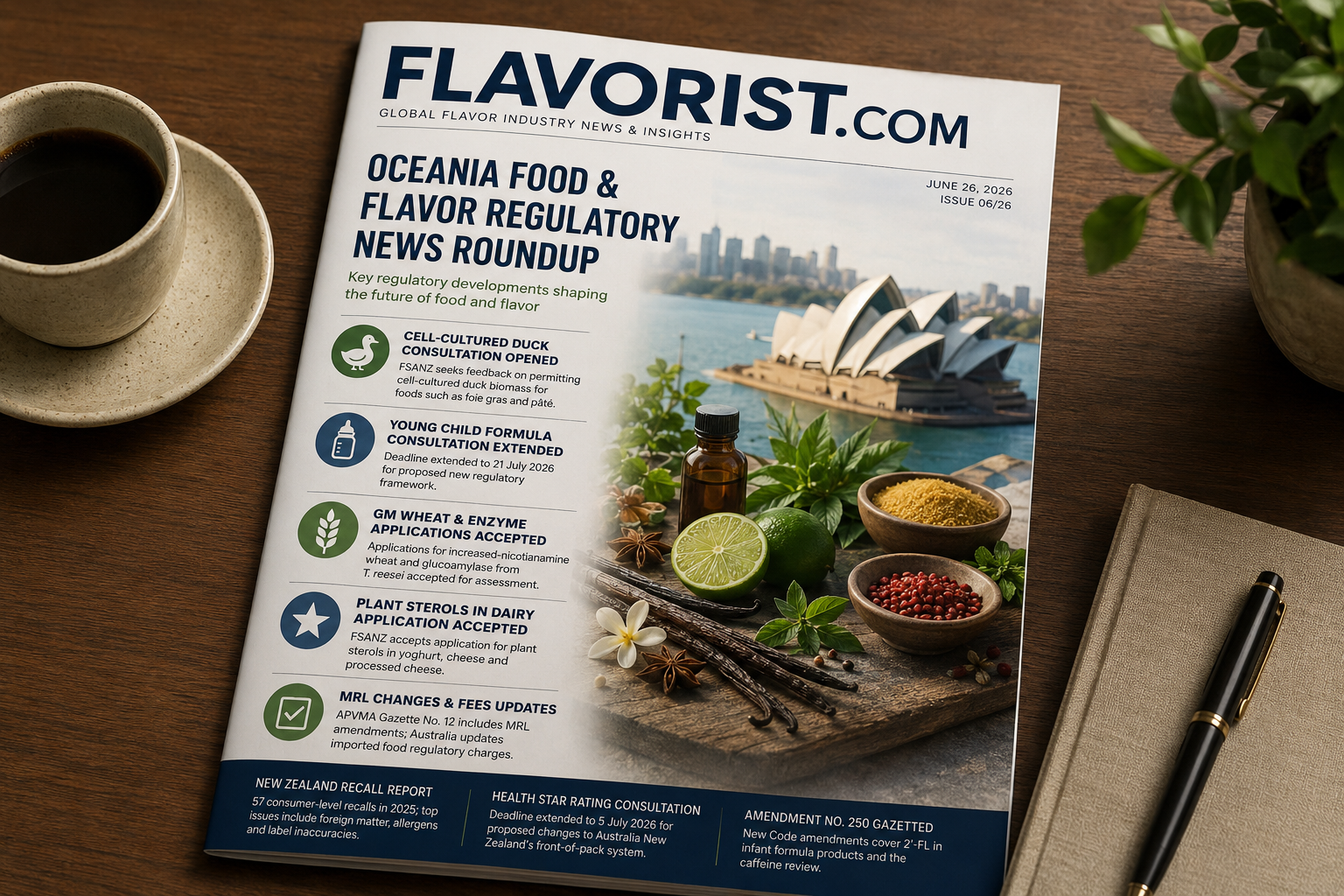
Oceania Food & Flavor Regulatory News Roundup: Major policy, food safety, novel food, and compliance developments shaping the industry (7–26 June 2026).
25 June 2026 — Australia/New Zealand — Cell-cultured duck biomass consultation
FSANZ opened public comment on Application A1341, which seeks to amend the Australia New Zealand Food Standards Code to permit cell-cultured duck biomass from Pekin duck embryonic stem cells. The proposed use is not a generic commodity approval; FSANZ described the biomass as an ingredient to be combined with other ingredients in foods such as foie gras and pâté. FSANZ stated that its safety assessment found no public health or safety concerns and noted that foods made with the ingredient would need to be labelled “cell-cultured” or “cell-cultivated.” For the food and flavour industry, this is one of the most important Oceania regulatory developments in the period because it affects novel proteins, premium savoury formats, animal-free positioning, meat flavour systems, and product-development pipelines for pâtés, spreads, terrines, and gourmet prepared foods. It also signals FSANZ’s continuing pathway for cultivated-food approvals after the earlier cell-cultured quail approval. Companies should monitor consumer-facing terminology, allergen and compositional data, and whether flavour or masking systems are needed to make cultivated duck products commercially viable. Submissions close 22 July 2026. (Food Standards Australia New Zealand)
24 June 2026 — Australia/New Zealand — Young child formula consultation deadline extended
FSANZ Circular 400-26 extended the submission deadline for Proposal P1066, the review of young child formula, to 21 July 2026. This matters because young child formula sits at the intersection of dairy, nutrition, flavours, sweeteners, claims, and labelling. Even though the circular itself is procedural, the affected proposal is commercially significant: it concerns the regulatory framework for products marketed for young children, a category where taste, sweetness, vanilla or dairy flavours, nutritional positioning, and parent-facing claims are all central. For flavour suppliers, the key watchpoints are whether the final framework changes permissions or expectations around flavouring use, sweet taste, voluntary nutrients, claims, or stage-based marketing. For manufacturers, a modernised framework could require reformulation, label redesign, claims review, and renewed substantiation for product benefits. The extension gives industry additional time to assess impacts and submit technical comments. Companies selling toddler milk, growing-up milk, dairy powders, paediatric nutrition products, or flavour systems used in these products should review the consultation documents and prepare evidence on consumer understanding, nutrition, and technological need. (Food Standards Australia New Zealand)
24 June 2026 — Australia/New Zealand — Glucoamylase processing-aid application accepted
FSANZ accepted Application A1358 for glucoamylase from Trichoderma reesei, with gene donor Aspergillus fumigatus, for use as a processing aid. The circular says FSANZ completed administrative assessment, assessment has begun, and public comment will be notified later. For the food and flavour industry, this is significant because glucoamylase converts starchy substrates into fermentable carbohydrates, which can influence production of syrups, brewing inputs, distilled products, fermented ingredients, bakery systems, flavour precursors, and biotechnology-derived ingredients. Processing-aid approvals can appear technical, but they often affect cost, yield, process efficiency, and supplier choices across multiple ingredient categories. The gene-donor and production-organism details also matter for regulatory, customer, halal/kosher, naturalness, and GM-source documentation. Ingredient suppliers should track whether the assessment results in new permissions, specifications, or labelling implications. Food manufacturers using enzyme-treated starches, sweeteners, fermentation substrates, malt-like ingredients, or enzyme-enabled flavour development should check whether supplier documentation will need updating. The application was accepted on 10 June and published in the 24 June circular. (Food Standards Australia New Zealand)
24 June 2026 — Australia/New Zealand — Increased-nicotianamine wheat application accepted
FSANZ accepted Application A1356 for food derived from increased-nicotianamine wheat lines containing event UM-12115T-1. While acceptance is only the start of assessment, the application is important for grain-based food manufacturers because wheat is foundational to bread, bakery, noodles, snacks, cereals, batters, coatings, and flavour-carrier systems. Nicotianamine relates to mineral-binding and plant metabolism, so the eventual assessment may focus on composition, nutritional relevance, food safety, and GM-event characterisation. For flavour companies, the direct impact may be limited at first, but wheat ingredients often act as carriers, bases, or matrices for seasoning systems, savoury snacks, bakery flavours, and prepared foods. Any future approval could create documentation needs around GM status, identity preservation, claims, export-market acceptance, and customer specifications. Manufacturers should not treat this as an immediate permission to use the wheat; the circular only confirms administrative acceptance and commencement of assessment. The commercial relevance is forward-looking: it indicates continued regulatory review of nutritionally modified staple crops in Australia and New Zealand. (Food Standards Australia New Zealand)
17 June 2026 — New Zealand — 2025 consumer-level food recalls annual report
New Zealand Food Safety released its 2025 consumer-level food recalls annual report, reporting that the agency coordinated 57 consumer-level recalls during 2025. Although the report covers the prior year, its release is regulatory news within the requested period and has practical implications for food and flavour companies. Recall statistics show where regulators are focusing attention and where industry controls are failing: allergens, foreign matter, microbiological risks, importer verification, and supplier management. For flavour houses, seasonings, sauces, inclusions, extracts, colours, and powdered ingredients are all vulnerable to cross-contact, undeclared allergens, or contamination introduced upstream. For manufacturers, the report reinforces that recall capability is not just a finished-product issue; it depends on traceability of minor ingredients, packaging, supplier certificates, batch coding, and rapid customer communication. The report is especially relevant to companies importing nuts, seeds, spices, peanut flour, powdered ingredients, and blended flavour systems, because such materials can enter many downstream products. Businesses should use the report as a prompt to review recall simulations, allergen matrices, foreign-material controls, supplier approval, and complaint escalation procedures. (MPI)
17 June 2026 — Australia — Conveyance Waste Recycling Policy for commercial and cruise vessels
Australia’s Department of Agriculture, Fisheries and Forestry listed Import Industry Advice Notice 96-2026 on 17 June 2026, announcing commencement of the Conveyance Waste Recycling Policy for commercial and cruise vessels. This is not a product-standard change, but it matters to food and beverage supply chains that rely on maritime logistics, cruise provisioning, vessel catering, and international movement of food waste. Biosecurity rules for conveyance waste affect how food scraps, packaging, galley waste, and potentially contaminated materials are segregated, treated, recycled, or disposed of. For the food and flavour industry, the impact is strongest for importers, ship suppliers, port service providers, cruise foodservice operators, and companies involved in chilled, frozen, packaged, or catered foods moving through ports. The policy may create operational opportunities for approved recycling but also requires compliance systems to avoid biosecurity breaches. Businesses should review vendor contracts, port procedures, waste documentation, and staff training, especially where food ingredients or packaged foods are unloaded, stored, repacked, or disposed of near regulated vessel-waste streams. (Agri-Fish Dept)
16 June 2026 — Australia — Imported food and biosecurity regulatory charges
Australia’s DAFF published Imported Food Notice 10-26 on changes to fees and charges for biosecurity and imported food regulatory activity. The imported-food notices page says these notices inform staff, clients, appointed laboratories, and FSANZ about operational requirements for monitoring food imported into Australia; it lists Notice 10-26 as dated 16 June 2026 and concerning changes to fees and charges. For food and flavour companies, this is a direct cost and planning issue. Importers of flavours, botanicals, spices, sauces, beverage bases, dairy ingredients, proteins, sweeteners, colours, extracts, and finished foods may face changed inspection, testing, or administrative costs from 1 July 2026. Even small fee increases can matter where shipments are frequent, low-margin, or sample-tested. Regulatory charge changes can also affect landed-cost calculations, distributor pricing, incoterm negotiations, and whether companies consolidate shipments. Compliance teams should update import budgets, broker instructions, and customer quotes. Procurement should confirm whether suppliers or import agents will pass through additional costs. Product developers should also factor charges into decisions to source novel or high-risk ingredients internationally. (Agri-Fish Dept)
16 June 2026 — Australia — APVMA Gazette No. 12: MRL amendments and Food Standards Code Schedule 20 proposal
APVMA Gazette No. 12 was published on 16 June 2026. Its contents include agricultural chemical products and labels, veterinary chemical products and labels, approved active constituents, revocation of suspension of registration, amendments to the APVMA MRL Standard, and a proposal to amend Schedule 20 of the Australia New Zealand Food Standards Code. For the food and flavour industry, the maximum residue limit items are the key issue. MRLs determine whether agricultural commodities and derived ingredients can legally be sold, imported, or used in food when pesticide residues are present. This matters for fruits, vegetables, herbs, spices, grains, oils, botanical extracts, citrus materials, natural flavour sources, and processed ingredients made from treated crops. A change in the APVMA MRL Standard or Schedule 20 can affect supplier specifications, residue-testing plans, certificates of analysis, export eligibility, and rejection risk at customer or border level. Flavour companies sourcing natural extracts should pay special attention because concentrated ingredients can also concentrate residue concerns. Manufacturers should have regulatory teams compare the gazette changes against current raw-material specifications. (APVMA)
12 June 2026 — Australia/New Zealand — Plant sterols in yoghurt, cheese and processed cheese application
FSANZ Circular 398-26 announced that FSANZ accepted Application A1353 for plant sterols as a novel food in yoghurt, cheese, and processed cheese. The circular states that assessment has commenced and a future opportunity to comment will be publicly notified. This is a significant development for dairy and functional-food innovation. Plant sterols are associated with cholesterol-lowering positioning in many markets, and expanding their use into yoghurt and cheese formats could create new opportunities for health-oriented dairy products, spreads, snacks, and processed-cheese applications. For flavour companies, plant sterols can present formulation challenges, including mouthfeel, dispersion, waxiness, bitterness, or flavour release in dairy matrices. If approved, manufacturers may need flavour masking, texture optimisation, and stability work to deliver acceptable products. Regulatory teams should also watch how FSANZ treats novel-food status, compositional permissions, claims, serving sizes, and consumer directions. The item is not yet an approval, but it signals a potential pathway for functional dairy innovation in Australia and New Zealand. (Food Standards Australia New Zealand)
12 June 2026 — Australia/New Zealand — Health Star Rating consultation extended
FSANZ Circular 398-26 extended the deadline for submissions on Proposal P1067, the Health Star Rating System, to 5 July 2026. This has broad implications for packaged foods and beverages because front-of-pack nutrition labelling can affect formulation strategy, brand positioning, and consumer comparison at shelf. For the flavour industry, the relevance is substantial: companies reformulating to improve nutrition profiles often rely on flavour technologies to reduce sugar, sodium, saturated fat, or energy while maintaining taste. If Health Star Rating requirements become more prominent or mandatory, demand may increase for salt-reduction flavours, sweetness modulators, bitterness blockers, mouthfeel systems, dairy-fat mimetics, and clean-label taste solutions. Manufacturers should model how current products score, identify vulnerable SKUs, and evaluate whether reformulation is commercially better than accepting a lower rating. The consultation extension also gives industry more time to submit technical evidence on category effects, label-space constraints, algorithm performance, and transitional timelines. This is one of the most cross-cutting regulatory items in the period because it can affect nearly every packaged food category. (Food Standards Australia New Zealand)
9 June 2026 — Australia/New Zealand — Amendment No. 250 to the Food Standards Code
FSANZ published Amendment No. 250 to the Australia New Zealand Food Standards Code on 9 June 2026. The amendment changed multiple standards and schedules and resulted from Application A1334, concerning 2′-FL from GM Corynebacterium glutamicum in infant formula products, and Proposal P1056, the Caffeine Review. This is highly relevant to two major commercial areas. First, infant formula manufacturers and ingredient suppliers gain or adjust permissions around 2′-fucosyllactose, a human milk oligosaccharide used in premium infant nutrition. This affects dairy formulation, GM-source documentation, specifications, and competitive claims. Second, caffeine regulation affects formulated caffeinated beverages, sports products, energy drinks, supplements positioned as foods, and products using bitter or stimulant ingredients. For flavour companies, caffeine is also a taste and masking issue because bitterness, sweetness balance, and warning statements can influence finished-product design. Companies should verify final Code text, update compliance checklists, and review labels, product specifications, and customer technical documents against the amended standards and schedules. (Food Standards Australia New Zealand)
###