Tea Tree as a Natural Flavoring: A Comprehensive Technical Guide
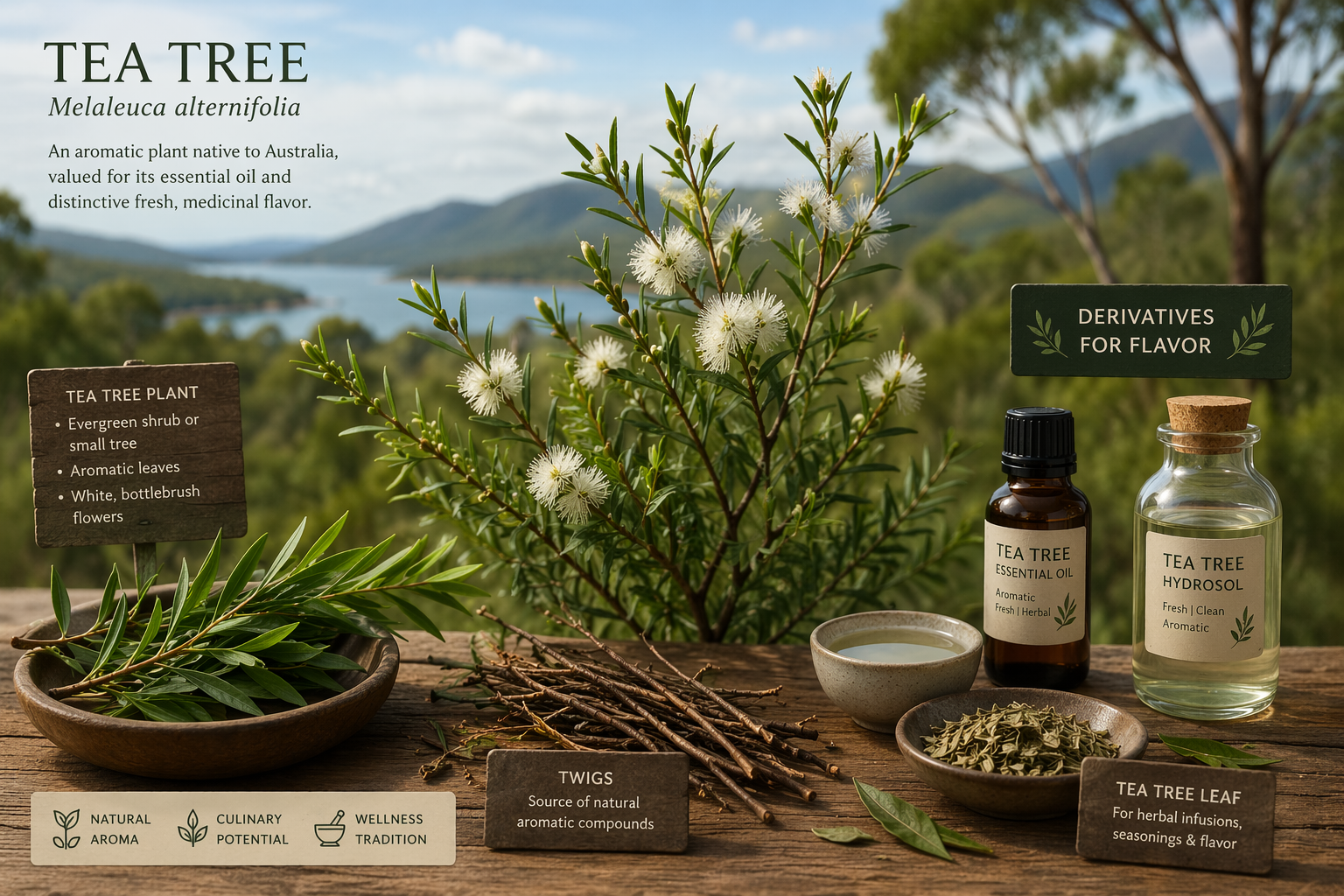
The Society of Flavor Chemists requires certified flavorists to be able to identify the plant part used, derivatives, organoleptic characteristics, and major chemical component(s) characterizing the aroma and flavor of the 80 natural flavorings listed on its syllabus for the qualification test and interview. Tea Tree is included among these essential items.
Introduction
Tea tree oil is derived from the leaves of Melaleuca alternifolia (Maiden & Betche) Cheel, a member of the Myrtaceae family native to Australia . Despite its name, tea tree is unrelated to the plant used to produce tea (Camellia sinensis). The name originated with Captain Cook's 18th-century expedition, where the crew used the leaves to brew a spicy, tea-like infusion .
For flavorists, tea tree oil offers a distinctive, powerful, and complex profile—fresh, spicy, camphoraceous, and warm—with distinct notes of nutmeg, eucalyptus, and pine. Its aroma is often described as a blend of medicinal, earthy, and herbaceous characters . The essential oil is dominated by terpinen-4-ol (the key active and character-impact component) and γ-terpinene, which together create its unique sensory and functional profile .
A critical and essential distinction for flavorists is that tea tree oil is NOT SAFE FOR INGESTION. While it is approved as a flavoring agent under FEMA GRAS (FEMA 3902) for use in foods at very low levels , numerous authoritative sources—including the National Center for Complementary and Integrative Health (NCCIH) and Poison Control—explicitly state that tea tree oil is toxic and should never be swallowed . This guide will detail the technical specifications for its use as a flavoring agent, but flavorists must understand that this is a high-potency, strictly regulated ingredient with significant safety constraints.
Plant Parts Used
The leaves and terminal branches are the plant parts used for flavoring purposes. The following characteristics are notable:
- Source Plant: Melaleuca alternifolia (Maiden & Betche) Cheel, a member of the Myrtaceae (myrtle) family, native to Australia .
- Plant Description: A small tree or shrub, growing 5–7 meters tall, with papery bark, narrow green leaves, and white flowers. It is commercially cultivated in Australia, particularly in New South Wales and Queensland.
- Leaf Description: Narrow, lanceolate leaves, 10–35 mm long, containing numerous oil glands that give the characteristic spicy, medicinal aroma.
- Harvesting: The leaves and terminal branches are harvested year-round, with the best yields typically from November to May (the Australian summer) . The material is steam-distilled soon after harvest to preserve oil quality.
- Essential Oil Content: Fresh leaves yield 1.0–2.5% essential oil.
The essential oil is obtained by steam distillation of the fresh or partially dried leaves and terminal branches. Solvent extraction yields a higher quantity but is typically used for research and varietal selection .
Chemical Composition & ISO Standards
Tea tree oil has a complex composition with over 100 identified compounds. Its quality and authenticity are defined by the ISO 4730 standard , which specifies the acceptable ranges for key components.
ISO 4730 Composition Specifications
| Component | Minimum (%) | Maximum (%) | Organoleptic Contribution |
|---|---|---|---|
| Terpinen-4-ol | 30 | — | Warm, spicy, earthy; characteristic active and flavor note |
| γ-Terpinene | 10 | 28 | Fresh, herbaceous, citrusy |
| α-Terpinene | 5 | 13 | Fresh, herbal, woody |
| 1,8-Cineole (Eucalyptol) | — | 15 | Fresh, camphoraceous, eucalyptus-like |
| α-Terpineol | 1.5 | 8 | Floral, lilac |
| α-Pinene | 1 | 6 | Fresh, pine, woody |
| p-Cymene | 0.5 | 12 | Woody, spicy, medicinal |
| Limonene | 0.5 | 4 | Fresh, citrus |
Critical Note: Terpinen-4-ol is the primary active and character-impact compound, required to be at least 30% of the oil. 1,8-Cineole (eucalyptol) is limited to 15% maximum, as higher levels can indicate adulteration or lower quality .
Derivatives
Tea tree is commercially available primarily as an essential oil. Various grades and certifications are available.
Tea Tree Essential Oil
Production Method: Steam distillation of fresh or partially dried leaves and terminal branches of Melaleuca alternifolia.
Description: Colorless to pale yellow mobile liquid with a characteristic powerful, fresh, spicy, warm, and slightly camphoraceous, nutmeg-like aroma .
Technical Notes: Yield is typically 1.0–2.5% from fresh leaves. The oil is composed primarily of terpinen-4-ol (30–45%), γ-terpinene (10–28%), and α-terpinene (5–13%) . Storage in a cool, dry place away from light is recommended; shelf life is typically 24 months in unopened containers .
Rectified Tea Tree Oil
Production Method: Fractional distillation to increase the concentration of terpinen-4-ol.
Description: Pale yellow liquid with a more focused, intense terpinen-4-ol character.
Tea Tree CO₂ Extract
Production Method: Supercritical carbon dioxide extraction of tea tree leaves.
Description: Yields a product with a different compositional profile, capturing heavier, less volatile components. Less common than the essential oil.
Synthetic Terpinen-4-ol
Production Method: Chemical synthesis; used in some commercial applications.
Description: Chemically identical to natural terpinen-4-ol but lacks the supporting complexity of the whole oil.
Organoleptic Characteristics
Aroma Profile
When evaluated, tea tree oil reveals a powerful, fresh, and complex aromatic profile:
- Primary Note: Powerful, fresh, spicy, warm, camphoraceous
- Terpinen-4-ol Character: Warm, spicy, earthy, nutmeg-like—the signature note
- γ-Terpinene Character: Fresh, herbaceous, citrusy
- α-Terpinene Character: Fresh, herbal, woody
- Camphoraceous: Fresh, medicinal, eucalyptus-like (from 1,8-cineole)
- Piney: Fresh, woody (from α-pinene)
- Medicinal: Slightly sharp, antiseptic quality
- Spicy: Warm, peppery, nutmeg-like
The overall aroma is often described as "fresh, spicy, and camphoraceous with a characteristic warm, nutmeg-like, medicinal character."
Taste Characteristics (Theoretical – For Flavor Use Only)
At typical flavor usage levels (parts per million range), tea tree oil would theoretically provide:
- Spicy: Warm, nutmeg-like character
- Fresh: Camphoraceous, eucalyptus-like notes
- Herbal: Slightly medicinal, green undertones
- Bitter: Slight, complex bitterness
- Cooling: Mild, camphoraceous sensation
The Key to Tea Tree's Unique Flavor
Tea tree's characteristic fresh, spicy, and camphoraceous flavor comes from the synergistic combination of its major components:
Primary Components:
- Terpinen-4-ol (30–45%): A monoterpene alcohol that provides warm, spicy, earthy, nutmeg-like notes—the signature character and key active component
- γ-Terpinene (10–28%): A monoterpene hydrocarbon that contributes fresh, herbaceous, citrusy notes
- α-Terpinene (5–13%): A monoterpene hydrocarbon that contributes fresh, herbal, woody notes
- 1,8-Cineole (Eucalyptol) (0–15%): A cyclic ether that contributes fresh, camphoraceous, eucalyptus-like notes
Supporting Components:
- α-Pinene (1–6%): Contributes fresh, pine, woody notes
- p-Cymene (0.5–12%): Contributes woody, spicy, slightly medicinal notes
- Limonene (0.5–4%): Contributes fresh, citrus notes
- α-Terpineol (1.5–8%): Contributes floral, lilac notes
- Aromadendrene (trace–7%): Contributes woody, spicy notes
The complex interplay of terpinen-4-ol (spicy, warm) with γ-terpinene (fresh, herbaceous) and 1,8-cineole (camphoraceous) creates the unique tea tree profile that is both fresh and spicy, medicinal and warm.
Applications in Flavoring
Regulatory Status – Critical Safety Note
Tea tree oil is approved as a natural flavoring substance for use in food products, but with the strictest safety considerations:
- United States: Tea tree oil is listed under 21 CFR §172.510 as a natural flavoring substance (FEMA No. 3902) . It is considered GRAS by the FEMA Expert Panel for use as a flavoring agent.
- European Union: Permitted for use in food flavorings under Regulation (EC) No 1334/2008.
- China: Approved food flavor under GB 2760 .
CRITICAL SAFETY NOTE: Despite its FEMA GRAS status, numerous authoritative sources—including the National Center for Complementary and Integrative Health (NCCIH), Poison Control, and the International Federation of Aromatherapists—explicitly warn that tea tree oil is toxic and should never be swallowed . This apparent contradiction is resolved by understanding that FEMA GRAS approval applies to its use as a flavoring agent in foods at very low, strictly controlled levels, not to its direct ingestion as a supplement or undiluted oil . Flavorists must exercise extreme caution and adhere strictly to recommended usage levels.
Typical Usage Levels (mg/kg)
The following usage levels are based on FEMA GRAS determinations and industry standards :
| Application | Typical Concentration Range (mg/kg) |
|---|---|
| Baked goods | 10 (average use level) |
| Beverages (non-alcoholic) | 10 (average use level) |
| Alcoholic beverages | 10 (average use level) |
| Frozen dairy | 10 (average use level) |
| Fruit products | 10 (average use level) |
| Meat products | 10 (average use level) |
| Soft candy | 10 (average use level) |
| Chewing gum | 10 (average use level) |
Note: The average use level across applications is approximately 10 mg/kg . Flavorists should not exceed this level without additional safety evaluation.
Usage & Dosage Best Practices
Flavorists must observe the following critical guidelines when working with tea tree oil:
CRITICAL SAFETY – NEVER FOR HUMAN INGESTION:
- Tea tree oil is toxic if swallowed and can cause severe reactions, including confusion, ataxia (loss of coordination), and coma .
- It is NOT SAFE for children in any ingested form.
- It should be avoided during pregnancy and breastfeeding.
- Use only at approved FEMA levels (average 10 mg/kg) and never exceed these levels .
- For flavor applications, it is used as a flavoring agent in processed foods at very low levels, not as a direct consumable.
Start Extremely Low: Tea tree oil is highly potent. Begin at the lower end of typical usage ranges (e.g., 5 mg/kg in beverages) and titrate upward if necessary. Never exceed FEMA maximum levels.
Pre-Dilution: Pre-dilute tea tree oil in ethanol or propylene glycol for easier handling and more even dispersion.
Flavor Synergies (For Flavor Applications): Tea tree oil is used as a flavoring agent to impart a fresh, spicy, camphoraceous character. It pairs well with:
- Citrus: Lemon, lime, orange (adds a unique twist)
- Herbs: Rosemary, thyme, basil
- Spices: Nutmeg, clove, cinnamon
- Mint: Peppermint, spearmint
- Eucalyptus: For fresh, medicinal blends
- Pine: For woody, forest-like notes
Flavor Applications: Tea tree oil serves as a flavor modifier in:
- Beverages: Very low levels in specialty beverages
- Confectionery: Hard candy, chewing gum
- Baked goods: Low-level background note
- Savory: Some spice blends
Fragrance and Topical Applications
Tea tree oil is far more commonly used in fragrance and topical applications than in flavors:
- Cosmetics: Acne treatments, cleansers, shampoos, soaps
- Oral care: Mouthwash, toothpaste (at very low levels)
- Household products: Cleaners, detergents, air fresheners
- Aromatherapy: Used for its purifying, antimicrobial properties
- Topical antiseptic: For cuts, scrapes, insect bites
- Pet care: Shampoos for fungal infections
Blends well with: Lavender, rosemary, lemon, eucalyptus, clove, cinnamon.
Shelf Stability & Storage
Understanding the stability of tea tree oil is critical for maintaining flavor quality.
Tea Tree Essential Oil
Storage Recommendation: Store in a full, airtight container in a cool, dry place away from light. Refrigeration (2–8°C) is recommended for long-term storage .
Stability Notes: Tea tree oil contains monoterpenes (γ-terpinene, α-terpinene) that are susceptible to oxidation. Oxidation can produce off-notes and reduce the concentration of active components. Shelf life is typically 24 months when stored properly in unopened containers .
Stability in Finished Products
- Heat stability: Moderate; monoterpenes are heat-sensitive and may degrade during high-temperature processing.
- pH stability: Stable across typical food pH range (3–8).
- Oxidation: Highly susceptible to oxidation; use antioxidants for long-shelf-life products.
- Light sensitivity: Protect from light.
Safety Considerations – CRITICAL
General Safety – DO NOT INGEST
Tea tree oil is approved as a flavoring agent at very low levels, but it is toxic if swallowed in significant quantities. The following safety information is for flavorists working with this ingredient in a professional capacity.
Critical Toxicity Information
- Oral Toxicity: Tea tree oil is toxic if swallowed. The oral LD50 in rats is 1.9–2.6 ml/kg . Ingestion can cause confusion, ataxia (loss of coordination), and coma in severe cases .
- Children: Tea tree oil is especially unsafe for children. Even small amounts can cause severe reactions.
- Pregnancy and Breastfeeding: Should be avoided during pregnancy and breastfeeding.
- Skin Irritation: Tea tree oil can cause skin irritation and sensitization in sensitive individuals. It should always be diluted for topical use .
- Allergies: May cause allergic contact dermatitis. Cross-reactivity with other fragrances is possible .
Contraindications
- Do not ingest undiluted or in large quantities.
- Do not use in products intended for children without extreme caution.
- Avoid during pregnancy and breastfeeding.
- Do not apply undiluted to skin.
Protective Measures
- Eye protection: Wear safety goggles when handling concentrated oil.
- Respiratory protection: Use in a well-ventilated area.
- Gloves: Wear chemical-resistant gloves (nitrile or neoprene).
- Protective clothing: Wear a lab coat or apron.
Maximum Usage Levels (FEMA)
The average use level for tea tree oil as a flavoring agent is approximately 10 mg/kg . This level should not be exceeded without additional safety evaluation.
Quality Control & Sourcing
Flavorists should implement the following quality checks when sourcing tea tree oil.
Essential Requirements for Certificates of Analysis (COA)
For Tea Tree Oil:
- Botanical identity: Melaleuca alternifolia (Maiden & Betche) Cheel
- Origin: Australia (preferred), with documented traceability
- Terpinen-4-ol content: 30–45% (GC analysis) – CRITICAL for quality
- 1,8-Cineole content: <15% – lower indicates higher quality
- γ-Terpinene content: 10–28%
- α-Terpinene content: 5–13%
- ISO 4730 compliance: Should be specified
- Physical properties: Specific gravity (0.882–0.903), refractive index (1.475–1.485), optical rotation (+7.0° to +12.0°)
Common Adulteration Risks
- Dilution with synthetic terpinen-4-ol or other terpenes
- Extension with less expensive oils (e.g., eucalyptus, pine)
- Addition of 1,8-cineole to mask adulteration
- Mislabeling of origin
Sourcing Considerations
| Origin | Characteristics |
|---|---|
| Australia (New South Wales, Queensland) | Traditional origin; highest quality; ISO 4730 compliant; documented supply chain |
| South Africa, Zimbabwe | Cultivated; good quality |
| China | Emerging producer; verify quality standards |
Certifications
Look for suppliers offering:
- ISO 4730 compliance (international standard for tea tree oil)
- ACO (Australian Certified Organic)
- USDA Organic
- Halal and Kosher certifications
- Non-GMO verified
Traditional and Historical Applications
Historical Uses
- Indigenous Australians: Used tea tree leaves for centuries as a traditional medicine. Crushed leaves were inhaled to treat coughs and colds, and applied to wounds for their antiseptic properties .
- Captain Cook's Expedition: The crew brewed the leaves to make a spicy tea (hence the name "tea tree") to prevent scurvy .
- Scientific Discovery (1920s): Arthur Penfold published the first papers on tea tree oil's antimicrobial properties, demonstrating it was 11–13 times stronger than the antiseptic phenol .
- World War II: Tea tree oil was included in first aid kits for Australian soldiers.
- European Pharmacopoeia (2002): Tea tree oil was added to the European Pharmacopoeia—the second Australian native oil (after eucalyptus) to receive this recognition .
Cultural Significance
Tea tree oil is one of Australia's most successful botanical exports. It is recognized globally for its antimicrobial, antiseptic, and antifungal properties. In Australia, it remains a staple in many households as a natural first-aid remedy.
Summary
Tea tree (Melaleuca alternifolia) is a unique and powerful natural flavoring material prized for its fresh, spicy, camphoraceous, and warm character. Its essential oil is dominated by terpinen-4-ol (30–45%) , γ-terpinene (10–28%) , and α-terpinene (5–13%) , as defined by the ISO 4730 standard. While approved as a flavoring agent at low levels (FEMA 3902), tea tree oil is toxic if swallowed and must be used with extreme caution.
Key characteristics:
- Primary components: Terpinen-4-ol (30–45%), γ-terpinene (10–28%), α-terpinene (5–13%)
- Aroma profile: Fresh, spicy, warm, camphoraceous, nutmeg-like
- Typical usage: Approximately 10 mg/kg (average use level)
- Primary applications: Flavoring agent at very low levels; more widely used in fragrance and topical applications
Critical considerations for flavorists:
- CRITICAL SAFETY: Tea tree oil is toxic if swallowed. Use only at approved FEMA levels (average 10 mg/kg) and never exceed these levels.
- ISO 4730 compliance: Ensure sourced oil meets international quality standards.
- Terpinen-4-ol content: Should be at least 30% for quality oil.
- 1,8-Cineole content: Should be below 15% for quality oil.
- Stability: Monoterpenes are susceptible to oxidation; store properly.
- Sourcing: Australian origin with ISO 4730 compliance is preferred.
- Flavor applications: Use as a flavoring agent in processed foods at very low levels; never recommend direct ingestion.
References and Further Reading
The information presented in this guide is synthesized from:
- Regulatory documents from FDA, FEMA (No. 3902), and international food safety authorities .
- ISO 4730 standard for tea tree oil .
- Published scientific literature on Melaleuca alternifolia .
- Industry technical data from major suppliers .
- Safety information from NCCIH, Poison Control, and medical authorities .
Key References:
- FEMA Flavor Ingredient Library: Tea Tree Oil (FEMA 3902)
- ISO 4730:2017 – Oil of Melaleuca alternifolia (tea tree oil)
- ChemicalBook: Tea Tree Oil Properties
- UL Prospector: Tea Tree Oil
- Tilley Distribution: Tea Tree Oil Australia
Disclaimer: This article is for educational purposes only. When using tea tree oil in commercial products, always verify current regulatory status in your jurisdiction, conduct appropriate safety assessments, and source ingredients from reputable suppliers who can provide documentation of botanical identity, origin, and ISO 4730 compliance. Tea tree oil is toxic if swallowed; use only at approved flavoring levels and never exceed FEMA maximum levels. The formulas and usage levels provided are illustrative examples and may require adjustment based on specific product requirements and regulatory compliance. Tea tree oil should be kept out of reach of children.
###