Flavor Emulsions: What Flavorists Need to Know About Formulation, Stability and Performance
Flavor Emulsion Technology, our 488-page reference book on flavor emulsions, was released on October 1, 2026. Order it here.
 Editor
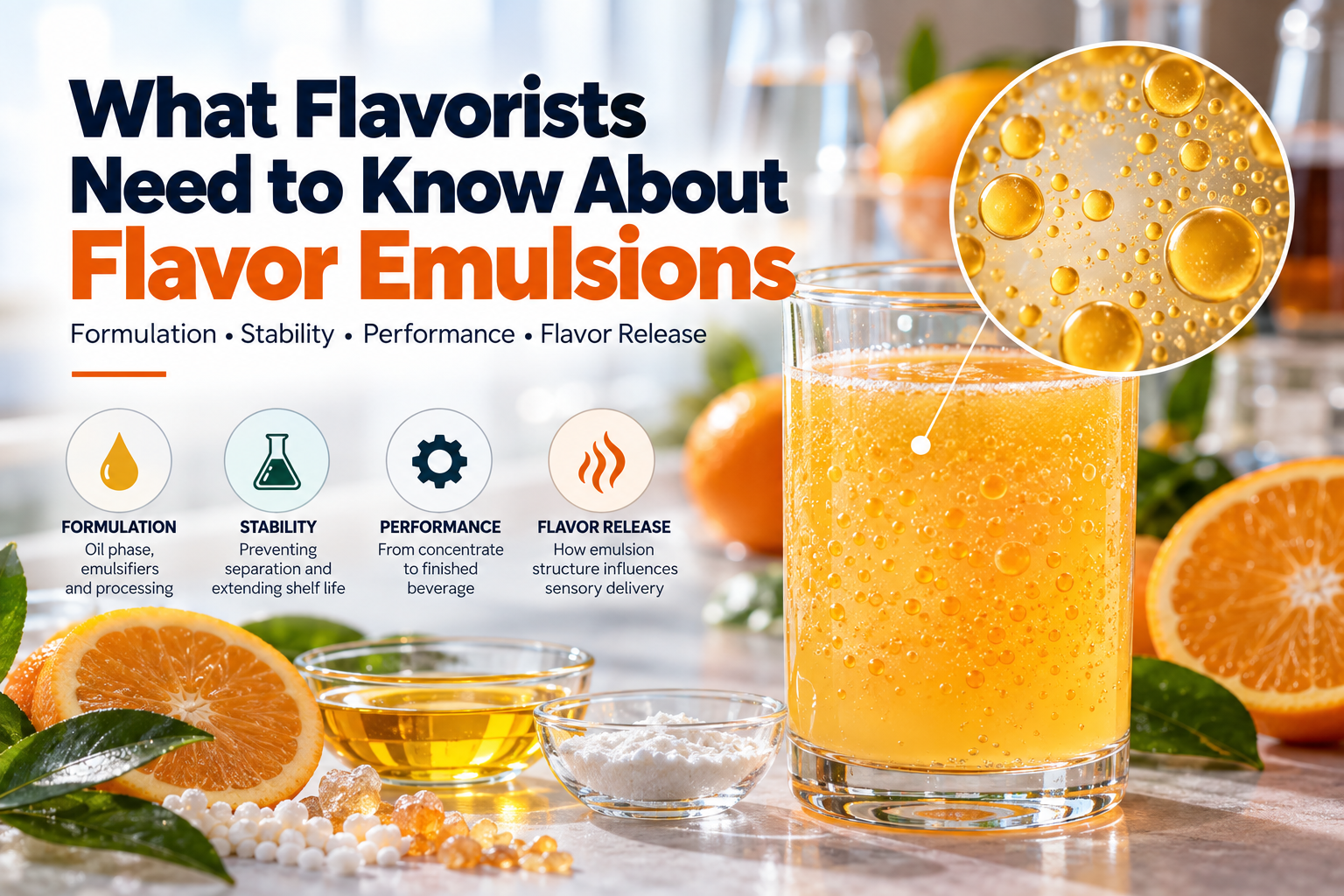
Getting the flavor profile right is only half a flavorist's job. The flavor also has to reach the consumer in the right physical form: it needs to survive processing and storage, disperse properly in the finished product, and release its aroma the way it was designed to. When the flavor is built on oils, that usually means an emulsion.
Emulsions let flavorists put citrus oils, essential oils and other oil-soluble materials into water-based foods and drinks. A good one is more than oil spread through water, though. Oil composition, emulsifier choice, droplet size, density, processing, beverage chemistry and flavor release all affect each other.
An emulsion can look fine in a lab bottle and still ring in the beverage a few weeks later. It can stay physically stable while its citrus top note drifts. A formula that works in one beverage base can fail when the acidity, soluble solids, minerals, carbonation or process changes. Working with emulsions means understanding how the formula and the physical structure shape the way the flavor performs.
What is a flavor emulsion?
An emulsion is one liquid dispersed in another that it doesn't normally mix with. In most beverage flavor emulsions, tiny droplets of flavor oil are spread through a water-based continuous phase: an oil-in-water (O/W) emulsion.
This is different from a solution. In a solution the flavor is dissolved molecule by molecule. In an emulsion the oil stays as separate droplets.
Those droplets want to separate. Conventional emulsions are thermodynamically unstable, so the formulator can't make them permanently stable. The goal is to slow breakdown enough that the emulsion holds up through manufacturing, distribution and shelf life.
Beverages make this harder. The concentrate has to survive storage and shipping, then keep working once it's diluted into a completely different chemical environment. That's why beverage emulsion research treats the oil phase, emulsifier, stabilizer and process as one design problem.
Why use an emulsion?
Many key flavor materials barely dissolve in water. Citrus oils are the obvious case, but the same goes for many essential oils, hydrophobic aroma chemicals, oleoresin fractions and oil-soluble functional ingredients. Added straight to a beverage, they float, distribute unevenly, form rings and taste inconsistent.
Breaking the oil into very fine droplets solves that. An emulsion can also provide cloud, carry oil-soluble colors or actives, and change how aroma compounds split between the oil, the water and the headspace.
That last effect matters a lot. The emulsion isn't a neutral container for the flavor. Aroma compounds partition differently among the oil, the water, the interface and the headspace, and oil composition, droplet structure, emulsifier and viscosity all affect how quickly they're released. Converting an oil-soluble flavor into an emulsion can change how it tastes.
Flavor emulsions and cloud emulsions
The two are closely related but do different jobs. A flavor emulsion is there mainly to deliver flavor, and may add some cloud along the way. A cloud emulsion is there mainly to provide turbidity and opacity, often with little flavor. Some do both.
It's worth deciding early which matters most, because the right oil phase, droplet size, density and stability approach depend on whether the priority is taste, appearance or both.
How an emulsion is built
It helps to think of three zones.
The oil phase holds the flavor materials, plus any carrier oils, ripening inhibitors, weighting agents, colors or other oil-soluble components.
The aqueous phase holds the water, emulsifier or hydrocolloid, acids, preservatives and other water-soluble ingredients.
The interface between them is where the emulsifier does its most important work. It helps form droplets during homogenization and then coats them so they're less likely to clump or merge.
Because of this, an emulsion can fail even when every ingredient is food-grade and appropriate. Ratios, order of addition, hydration, oil composition and processing history decide whether the whole system works.
Choosing an emulsifier
The two workhorses in beverage flavor emulsions are gum arabic (gum acacia) and suitable modified food starches.
Gum arabic has a long track record because it is surface-active while staying relatively low in viscosity at the levels needed for stabilization. Not every grade performs the same way, which is why emulsion-specific grades exist.
Modified starches can stabilize efficiently and are easy to process in many systems. Their behavior varies a great deal with the starch source and type of modification, so "modified starch" is not one interchangeable ingredient.
Both mainly stabilize droplets sterically. That helps explain why they cope well with the swings in acidity, ionic strength and processing that beverages go through.
So the question isn't simply which emulsifier is best. It's which emulsifier, at what ratio to the oil, under what process, gives the droplet structure you need and stays compatible with the finished product. Treating the emulsifier as a stand-alone choice is one of the more common development mistakes.
Hydration counts
An emulsifier that hasn't been prepared properly can't do its job. With hydrocolloids, incomplete hydration can cause uneven emulsification, undissolved particles, variable viscosity and poor coverage of the droplets during homogenization.
Develop the aqueous phase as carefully as the flavor oil. Supplier guidance on hydration time, temperature, agitation and solids level matters, and some gum arabic products are designed specifically to hydrate faster than standard grades.
The practical consequence is that a formula can't always be separated from its manufacturing instructions. Two batches with identical percentages can perform differently if they were hydrated differently.
The oil phase does more than carry flavor
Flavorists naturally focus on what the oil phase tastes like. In an emulsion it also sets key physical properties: density, viscosity, polarity and water solubility all affect how easily droplets form and how long they stay stable.
Citrus oils show both problems clearly. Many citrus components are lighter than the surrounding liquid, so droplets drift upward and eventually form a cream layer or ring. Some components are also soluble enough in water to make the system prone to Ostwald ripening, where material moves out of small droplets, through the water and into larger ones.
As a result, two emulsions with the same starting droplet size can age very differently depending on what is in the oil. Work on orange oil emulsions has shown that adding oils with very low water solubility can sharply reduce Ostwald ripening.
In short, the sensory formula and the stability formula are linked. Changing the citrus fraction, carrier or oil-soluble modifiers can change both the aroma and the way the emulsion behaves.
Weighting agents
Since most flavor oils are lighter than the beverage around them, a long-standing way to slow separation is to make the oil phase heavier. Narrowing the density gap slows gravitational separation, and that is what a weighting agent does. Studies have shown how the choice and level of weighting agent affect droplet density and emulsion behavior.
Which agent to use depends on the application and the market. Regulatory status, labeling and permitted levels have to be checked for each country and product category.
Weighting helps, but it doesn't replace good emulsification, droplet size control or proper shelf-life testing.
Droplet size
Looking at an emulsion tells you only so much. Droplet size and size distribution are among the most useful measurements, because most instability mechanisms depend heavily on them.
Smaller droplets usually cream more slowly, and a narrow distribution behaves more predictably than one with a tail of oversized droplets. But smaller isn't automatically better. The right target depends on the application, since droplet size affects appearance, opacity, interfacial area, processing demands and possibly flavor release. Very aggressive processing can also raise temperature or create other production problems.
A useful specification asks what size distribution gives the required stability and sensory performance in the finished product. That's far more useful than requiring the concentrate to "look homogeneous."
Homogenization
A pre-emulsion made with a high-shear mixer usually has droplets that are too large and too varied for long-term beverage stability. High-pressure homogenization breaks them down into a much finer distribution.
During homogenization, large droplets are stretched and torn apart, and the new surface has to be covered with emulsifier quickly. That's why homogenization and emulsifier level have to be optimized together. More intense homogenization creates more surface. If there isn't enough emulsifier, or it can't adsorb fast enough, the new droplets can merge again.
More emulsifier isn't automatically better either. Excess hydrocolloid that doesn't adsorb can cause problems such as depletion flocculation.
The aim is a balanced process that creates the intended droplet distribution and keeps it stable, not maximum emulsifier at maximum pressure. A published Ingredion beverage emulsion illustrates this: gum acacia, orange oil and ester gum, pre-emulsified under high shear, then put through two-stage homogenization, with ingredients and process designed as one.
How emulsions fail
When troubleshooting, pin down the mechanism before anything else. "Separation" covers several different problems.
| What you see | Likely mechanism | What to investigate |
|---|---|---|
| Cream layer | Gravitational separation | Are the droplets too large? Is the density gap too big? |
| Oil ring at the surface | Advanced creaming or coalescence, or poor dispersion stability | Has droplet size grown? Is the oil phase properly weighted? |
| Average droplet size grows in storage | Coalescence or Ostwald ripening | Are droplets merging, or is material migrating between them? |
| Droplets clump | Flocculation | Are emulsifier level, ionic conditions or free polymer contributing? |
| Fine as a concentrate, fails in the beverage | Incompatibility with the application | What changed on dilution: pH, Brix, minerals, preservatives, heat, carbonation? |
| Physically stable, but the flavor fades or shifts | Chemical breakdown or changed partitioning | Is oxidation happening? Are top notes being lost or redistributed? |
| Inconsistent from batch to batch | Raw material or process variation | Were hydration, temperature, shear, homogenization and ingredient lots the same? |
The mechanisms are distinct:
- Creaming is droplets moving upward, mainly because of the density difference.
- Flocculation is droplets clustering while staying separate.
- Coalescence is droplets merging into bigger ones.
- Ostwald ripening is molecules moving from small droplets to large ones through the water, which is particularly relevant to flavor and essential oils.
Each needs a different fix. Higher homogenization pressure might rescue an emulsion whose starting droplets are too big, but it won't solve an oil phase that is ripening.
Ostwald ripening and flavor oils
Ostwald ripening deserves particular attention because flavor oils behave differently from the long-chain triglyceride oils found in most foods.
Put simply, small droplets lose molecules into the surrounding water more readily than large ones. Those molecules move through the water and end up in larger droplets, so the small ones shrink and the large ones grow. Average droplet size rises even though the droplets never actually collide.
Triglyceride oils are so insoluble in water that this barely matters for them. Flavor and essential oils can be quite different, and research continues to find Ostwald ripening a major cause of instability when the oil has meaningful solubility in the continuous phase.
Knowing this can save a lot of troubleshooting time. If droplet growth comes from migration, switching emulsifiers probably won't fix it.
The concentrate is not the final test
Stability has to be shown in the finished product, not just in the concentrate.
Once the emulsion is diluted into a beverage, almost everything around the droplets changes. Stabilizer concentration falls. The pH may shift. Sugars or other sweeteners change the water phase, minerals change the ionic balance, and acids and preservatives come in. The drink may be carbonated, pasteurized, or hot- or cold-filled. The density and viscosity of the continuous phase can change too.
A concentrate that looks perfect for months can still fail in the finished drink. In practice, the beverage itself is part of the emulsion formula.
Flavor release
Physical stability tends to dominate emulsion work because separation is easy to see and easy to reject. Sensory effects are subtler.
Aroma compounds in an emulsion spread themselves across several environments. A very hydrophobic aroma chemical stays mostly in the oil, while a more water-compatible volatile moves more easily into the water and then the headspace. Changing the oil level, carrier oil, emulsifier, viscosity or droplet structure can shift both the timing and the intensity of release, and reviews of food emulsions identify droplet size, interfacial properties, viscosity and phase composition as factors that affect flavor partitioning.
For flavor creation, the practical upshot is to judge the profile once the delivery system is settled, ideally in the finished product. An oil blend that smelled right on its own may need rebalancing after emulsification.
Physical stability is not chemical stability
A bottle can show no separation at all while the flavor inside it deteriorates.
Citrus emulsions in particular contain oxidation-sensitive compounds, and the large oil-water interface makes oxidation control an important design issue. Raw material quality, dissolved and headspace oxygen, trace metals, light, antioxidants, packaging and storage temperature all affect chemical shelf life.
Development work should therefore track both physical measures and sensory or chemical ones. A steady droplet size distribution doesn't prove the flavor still tastes right.
A development sequence
Start with the application, not the emulsifier. Define the finished product, its shelf life, processing, storage temperature range, pH, soluble solids, mineral content, carbonation, target appearance and flavor profile.
Next, look at the oil phase and identify its likely trouble spots: density, water solubility, oxidation or viscosity.
Only then optimize the emulsifier system, stabilizer-to-oil ratio, weighting or anti-ripening strategy, and homogenization.
The most useful development data usually combine starting droplet size distribution, droplet growth over time, appearance, viscosity, accelerated and real-time stability, performance after dilution, and sensory evaluation.
The question to answer is not just whether the emulsion is stable. It's whether it is physically stable, chemically stable and tastes right under the conditions the customer will actually use it in.
Troubleshooting checklist
Persistent emulsion problems rarely come down to one mystery ingredient. Usually something in the interaction between formula and process has been missed. A practical sequence:
- Define the failure. Is it creaming, ringing, flocculation, coalescence, sedimentation, droplet growth, a viscosity change, loss of cloud, or a sensory problem?
- Measure. Compare droplet size distribution, viscosity, pH and other physical data at production and during storage instead of relying on appearance.
- Review the oil phase. Check density, water solubility, carrier composition and oxidation risk.
- Check the emulsifier. Confirm the grade, preparation, hydration and emulsifier-to-oil ratio.
- Audit the process. Look at pre-emulsion quality, shear, homogenization pressure, number of passes, temperature and air incorporation.
- Test in the real application. Repeat the evaluation after dilution into the target beverage and after the customer's actual heat treatment or filling process.
- Taste it. An emulsion that stays physically stable but no longer delivers the intended flavor has still failed.
What belongs in an emulsion specification
A specification limited to appearance, specific gravity and microbiological limits leaves important questions open. For critical applications, flavor houses and beverage developers may want to add droplet size parameters, a viscosity range, pH, storage conditions, dilution performance and application stability.
Where possible, separate the parameters measured on the concentrate from those measured after dilution into a defined reference beverage. That makes the specification a real predictor of how the emulsion will perform, not just a QC checklist.
Emulsions are part of the flavor design
The most useful shift for a flavorist is to stop treating emulsification as a manufacturing step that comes after the flavor is finished.
Oil composition affects stability. The emulsifier shapes the interface. Homogenization sets droplet structure, which affects physical behavior and can affect flavor release. The beverage changes the environment around the droplets, and storage changes both the physical system and the flavor chemistry. All of it shapes what the consumer tastes.
You don't need to be a colloid scientist to make good flavor emulsions. A working grasp of how flavor chemistry, interfacial behavior, processing, stability and sensory delivery fit together makes it much easier to design them well and to fix them when they go wrong. A successful emulsion doesn't just stay mixed. It delivers the intended flavor, appearance and performance from production through the end of its shelf life.
Frequently Asked Questions
What is a flavor emulsion?
Usually an oil-in-water system in which small droplets of oil-soluble flavor are dispersed through a water phase with the help of an emulsifier. It lets hydrophobic flavors such as citrus and essential oils be used in water-based products like beverages.
How is a flavor emulsion different from a flavor solution?
In a solution, the flavor is dissolved at the molecular level in a compatible solvent. In an emulsion, one phase stays dispersed as microscopic droplets in another it doesn't mix with, so droplet formation and physical stability have to be controlled.
Which emulsifiers are used in beverage flavor emulsions?
Gum arabic (gum acacia) and selected modified food starches are the most widely used. The right choice depends on the oil composition, emulsifier-to-oil ratio, process, target droplet size, labeling needs and the finished product.
Why do flavor emulsions separate?
Separation can come from creaming, flocculation, coalescence or Ostwald ripening. Each needs a different fix, so identifying the actual mechanism comes first.
Why do citrus emulsions form an oil ring?
Citrus oils are often lighter than the surrounding liquid, so droplets rise. Large droplets, weak interfacial stabilization, a big density gap and droplet growth during storage all raise the risk of a visible ring.
What causes Ostwald ripening?
Molecules move out of small droplets, through the continuous phase and into larger droplets. It matters for many flavor and essential oils because some of their components are noticeably soluble in water.
Are smaller droplets always more stable?
Smaller droplets reduce gravitational separation, but average size alone doesn't guarantee stability. Oil composition, size distribution, interfacial stabilization, density, the aqueous phase and storage conditions all play a part.
Can an emulsion be stable as a concentrate but fail in the beverage?
Yes. Dilution changes the environment completely. pH, soluble solids, minerals, carbonation, preservatives, heat treatment and dilution ratio can all affect behavior, which is why testing in the finished product is essential.
Can emulsification change how a flavor tastes?
Yes. Aroma compounds divide themselves among the oil, the water, the interface and the headspace, so changes in emulsion composition and structure can alter release and perception.
What should flavorists measure during development?
Droplet size distribution, viscosity, pH, density, appearance over time and stability in the application, along with sensory evaluation and, where needed, analytical checks for flavor deterioration.
###