
Burn Risk - Part 3: Preventing Burning of a Reaction Flavor in a Production Environment Preventing Burning of a Reaction Flavor in a Production Environment This production-focused guide is based on the roasted onion or savory sulfur reaction-flavor example, but the same logic also applies to meat, chicken, roasted vegetable, caramelized, and other thermal reaction flavors. The goal is not merely to keep
Burn Risk - Part 2: Roasted Onion Reaction Flavor Example and How to Determine Each Parameter in the Predictive Model Roasted Onion Reaction Flavor Example and How to Determine Each Parameter in the Predictive Model This document gives a detailed reaction flavor example built around a roasted onion or savory sulfur reaction flavor, with a step-by-step explanation of how to determine each parameter used in the burn-risk
Burn Risk - Part 1: Quantitative Heat and Mass Transfer Model for Predicting Burn Risk Quantitative Heat and Mass Transfer Model for Predicting Burn Risk This document presents a practical engineering model for predicting burn risk in a flavor reaction reactor, especially for Maillard, caramel, savory sulfur, extract concentration, and viscous thermal processes. It is not a full CFD (computational fluid dynamics) simulation. It is
Members only Chamomile as a Natural Flavoring: A Comprehensive Technical Guide Chamomile as a Natural Flavoring: A Comprehensive Technical Guide The Society of Flavor Chemists requires certified flavorists to be able to identify the plant part used, derivatives, organoleptic characteristics, and major chemical component(s) characterizing the aroma and flavor of the 80 natural flavorings listed on its syllabus for the
Celery Seed as a Natural Flavoring: A Comprehensive Technical Guid Celery Seed as a Natural Flavoring: A Comprehensive Technical Guide The Society of Flavor Chemists requires certified flavorists to be able to identify the plant part used, derivatives, organoleptic characteristics, and major chemical component(s) characterizing the aroma and flavor of the 80 natural flavorings listed on its syllabus for
Members only Cedarwood as a Natural Flavoring: A Comprehensive Technical Guide Cedarwood as a Natural Flavoring: A Comprehensive Technical Guide The Society of Flavor Chemists requires certified flavorists to be able to identify the plant part used, derivatives, organoleptic characteristics, and major chemical component(s) characterizing the aroma and flavor of the 80 natural flavorings listed on its syllabus for the
Condensation Reactions in Flavor Chemistry Condensation is one of a handful reactions the Society of Flavor Chemists requires flavorists to understand and consider when formulating flavors. Here is a detailed explanation of condensation reactions in the context of flavor chemistry. 1. Chemical Groups Involved and Conditions Required A condensation reaction is a class of organic
Members only Water Activity as a Master Control Parameter in Flavor Chemistry: Measurement, Mechanisms, and Reaction Kinetics The water activity meter is one of a dozen instruments that the Society of Flavor Chemists requires flavorists to know. Controlling water activity is important in flavor chemistry and physics. Scope of This Compilation This title captures the full body of content we developed, integrating: * The fundamental theory and measurement
Ripe Note Engineering: Sensory Definition, Molecular Mapping, and Precision Flavor Formulation The “ripe” note is one of the core flavor attributes that the Society of Flavor Chemists expects all certified flavorists to understand and control. Mastery of this note is essential for accurately formulating fruit flavors such as mango, apple, and strawberry, where the perception of ripeness plays a critical role
Members only Cassia as a Natural Flavoring: A Comprehensive Technical Guide Cassia as a Natural Flavoring: A Comprehensive Technical Guide The Society of Flavor Chemists requires certified flavorists to be able to identify the plant part used, derivatives, organoleptic characteristics, and major chemical component(s) characterizing the aroma and flavor of the 80 natural flavorings listed on its syllabus for the
The Complete Flavor Brief: What Buyers Must Provide for Successful Custom Flavor Development When a flavor buyer approaches a flavor house with the intention of purchasing a flavor, it is common that not all the necessary information is communicated. As a result, the flavor house may lack critical details required to develop a flavor that performs successfully in the buyer’s final product.
Members only Carrot Seed as a Natural Flavoring: A Comprehensive Technical Guide Carrot Seed as a Natural Flavoring: A Comprehensive Technical Guide The Society of Flavor Chemists requires certified flavorists to be able to identify the plant part used, derivatives, organoleptic characteristics, and major chemical component(s) characterizing the aroma and flavor of the 80 natural flavorings listed on its syllabus for
Jammy flavor, Jammy note, all things jammy flavorists need to know Manipulation of jammy note is a requirement by the Society of Flavor Chemists and questions regarding jamminess may be raised when candidates take the SFC qualification test/interview. This page shows you all things you possibly need to know when formulating a flavor with jammy note. By definition, the “jammy”
Members only Cardamom as a Natural Flavoring: A comprehensive Technical Guide Cardamom as a Natural Flavoring: A Comprehensive Technical Guide The Society of Flavor Chemists requires certified flavorists to be able to identify the plant part used, derivatives, organoleptic characteristics, and major chemical component(s) characterizing the aroma and flavor of the 80 natural flavorings listed on its syllabus for the
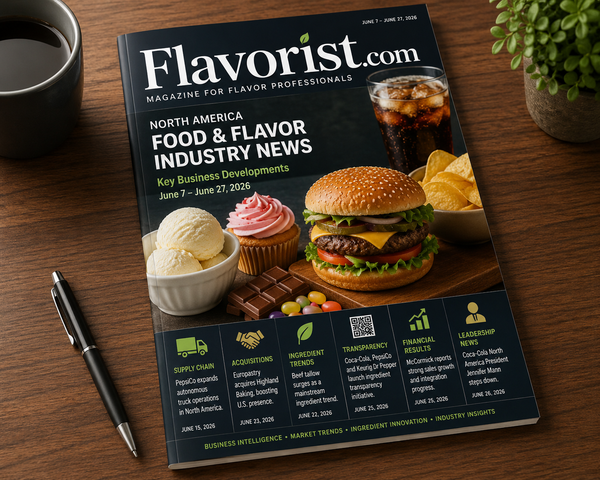
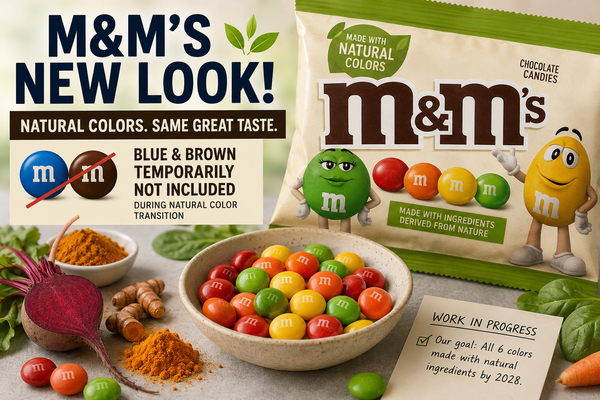
Global Food and Flavor Industry Product News Digest: March 14-27, 2026 North America Here is a summary of product news in the North American food and flavor industry from March 14 through March 27, 2026. Häagen-Dazs Shops (March 26, 2026), Häagen-Dazs Shops partnered with Miami-based Vicky Bakery to launch the limited-time Pastelito Dazzler dessert in South Florida,
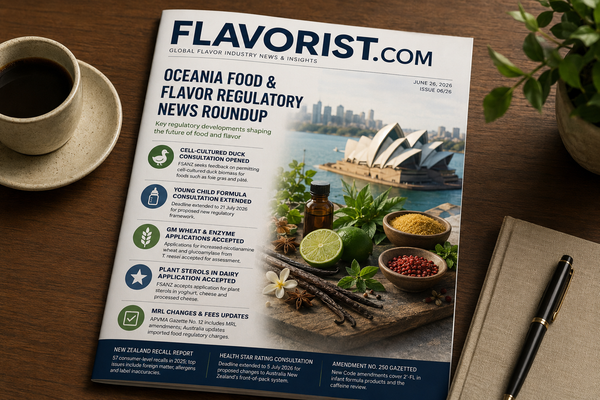
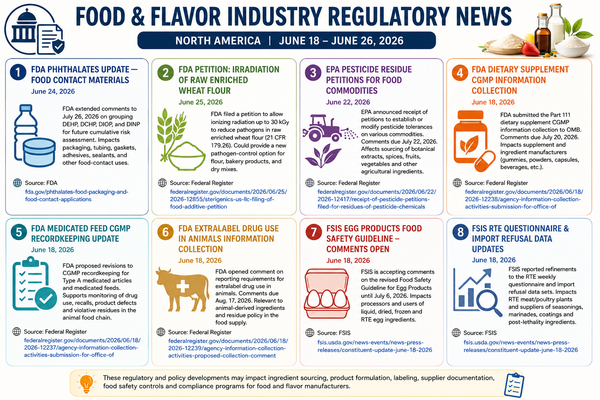
Global Food and Flavor Industry Law & Regulation Digest: March 14–27, 2026 Here is a summary of law and regulation news in the North American food and flavor industry from March 14 through March 27, 2026. USDA Product of USA Labeling Standard (March 25-26, 2026), the U.S. Department of Agriculture launched a national public awareness campaign to promote the new
Members only Full Patent Document: One Strawberry Flavor - CN 102321502 B Original patent document in Chinese strawberry patent in chinese 2013strawberry patent in chinese 2013.pdf465 KBdownload-circle This is a highly informative patent document detailing the creation of a strawberry flavor. It’s an excellent read that will benefit flavorists at all levels—from junior to senior. To access the
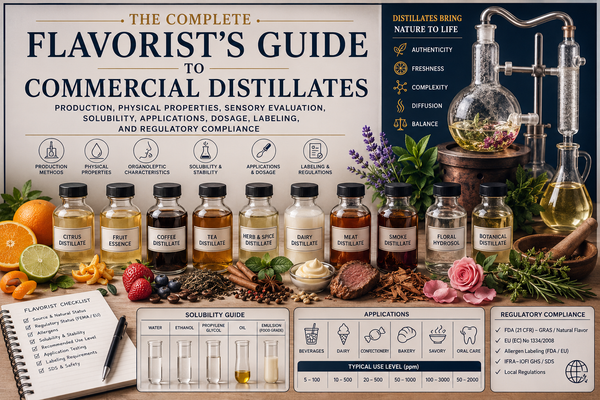
128 Important Synthetic Flavor Compounds Every Flavorist Needs to Know and Work with This is a quick-reference list of the flavor compounds John Wright recommends in Flavor Creation as essential for every flavorist to know and work with. Details for each compound are provided in multiple parts—Parts 1 through 13. Here are the complete series: Important Synthetic Flavor Compounds - Complete Series
Does Your Reaction Flavor have a cooling issue in a Large Reactor? Editor's note While every reactor has a finite cooling rate, that rate depends not only on the vessel’s size and configuration but also on the reaction composition itself. If a formulation becomes too viscous—due to gums or low water content—it may cool too slowly to
Caraway: What Flavorists Need to Know, According to the SFC Certified flavorists are required by the Society of Flavor Chemists to be able to identify the part(s) of the plant used, derivatives, organoleptic characteristics, and the major chemical component(s) which characterizes the aroma/flavor of the 80 natural flavorings listed on its Syllabus for the SFC qualification test/
Aldol Condensation in Flavor Chemistry: Mechanisms, Conditions, and Impact on Shelf Life Aldol condensation is one of a handful reactions the Society of Flavor Chemists requires flavorists to understand and consider when formulating flavors. 1) Chemical Groups Involved and Conditions Required Key Functional Groups Aldol condensation is a carbon–carbon bond-forming reaction between carbonyl compounds. The essential groups include: * Aldehydes (–CH=
Spectrophotometer vs. Colorimeter: A Complete Guide for the Flavor Industry Introduction In the flavor industry, visual perception shapes taste expectations. Before a consumer ever tastes a product, they evaluate its color. This makes precise color measurement essential for quality control, shelf-life testing, and formulation development. Two instruments dominate this field: the colorimeter and the spectrophotometer. While both measure light
Registration Opens for 2026 IFT Food Expo in Chicago CHICAGO – Organizers have announced that registration is now open for a leading annual gathering focused on food science, research, and technology, scheduled to take place July 12–15, 2026, at McCormick Place in Chicago. The event brings together professionals from industry, academia, and government to explore advancements in areas such
Character Impact Flavor Compounds for Common Flavors/Foods For many flavors—though not all—there is a compound that serves as the characteristic component. Menthol, for example, is the characterizing compound of mint flavor. Below is a list of flavors along with their corresponding characterizing compound(s), including descriptions of their odor or taste and their perception thresholds
Industry Meeting Announcement: Midwest Flavor Chemists Gathering Event Date: April 16, 2026 Location: Oasis Conference Center, 902 Loveland-Miamiville Road, Loveland, OH 45140 Event Hours: 11:00 AM – 6:00 PM EST This is a professional gathering for flavor industry specialists, featuring presentations, vendor showcases, and networking opportunities. Event Schedule Time Activity 8:00 – 10:00 AM